Teaching Assistant Resume Examples: the lines they read
Teaching Assistant Resume and Teacher Aide Sample Resume
By Mustafa Tarabya, founder of CVBooster · Published · Updated
A teacher aide sample resume and teaching assistant resume guide for school aides and graduate TAs, with summaries, small group bullets and clearances.
Sample resumes for a teaching assistant
The same teaching assistant content laid out in three CVBooster templates, so you can see what the finished document looks like before you write a word.
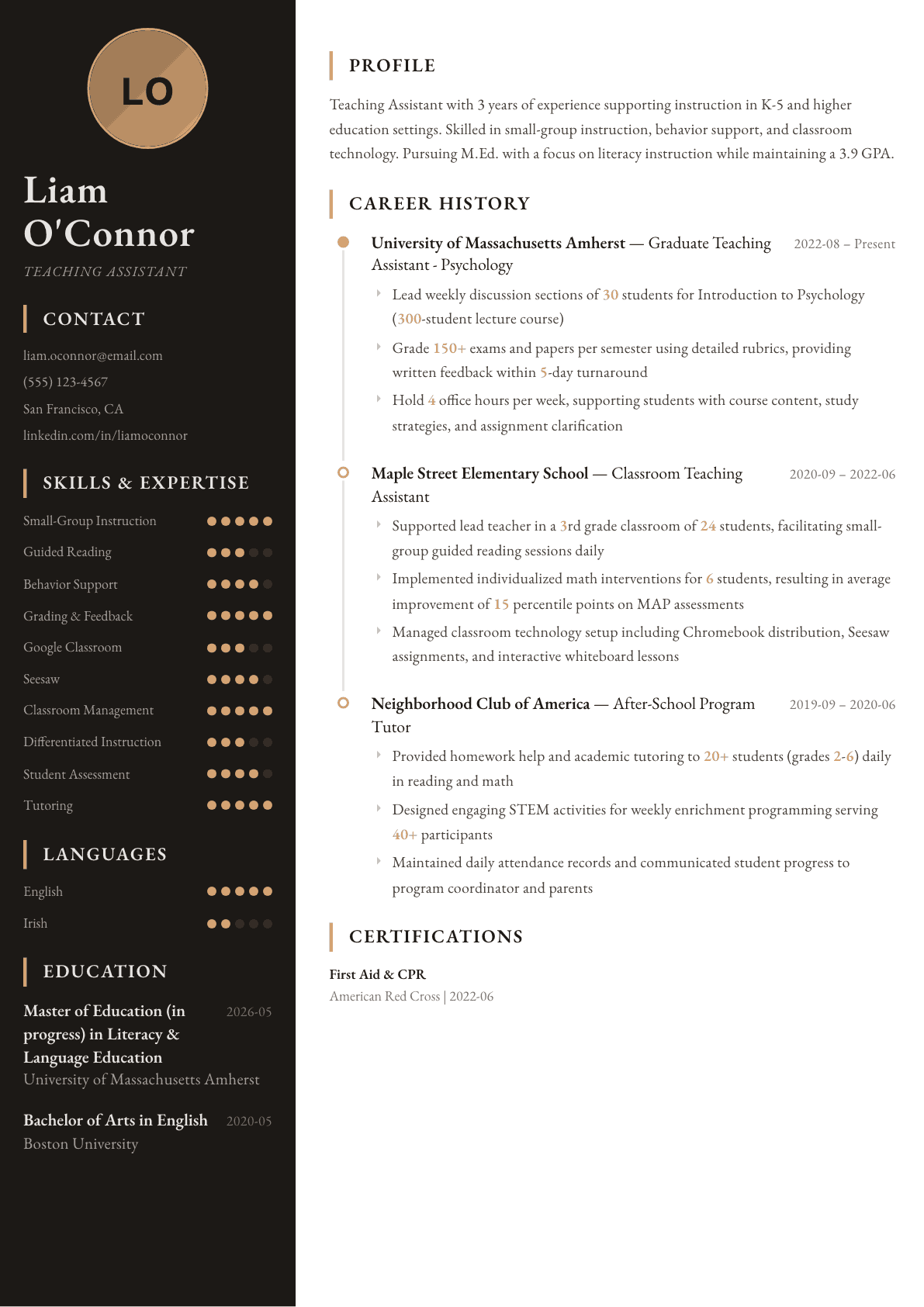
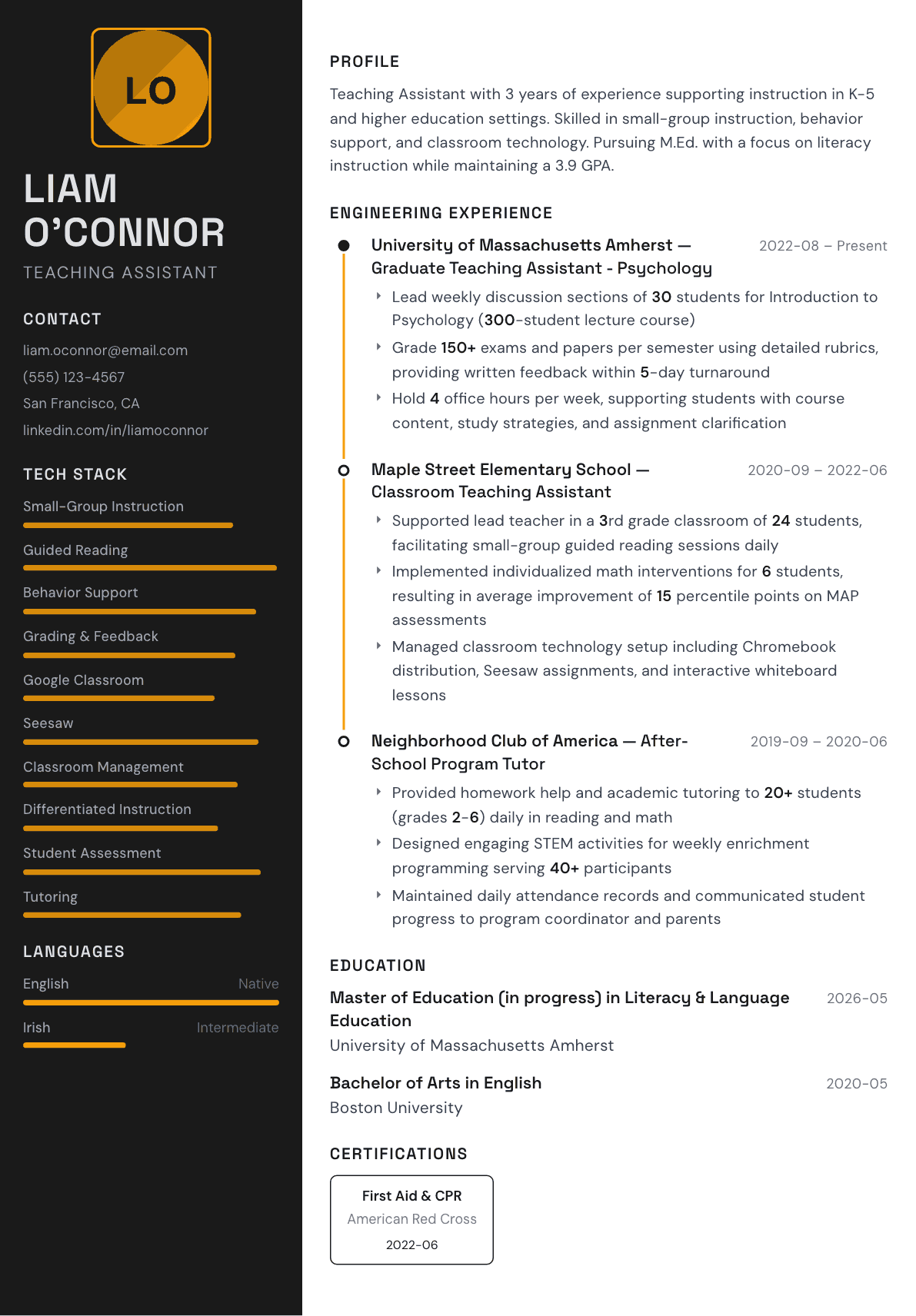
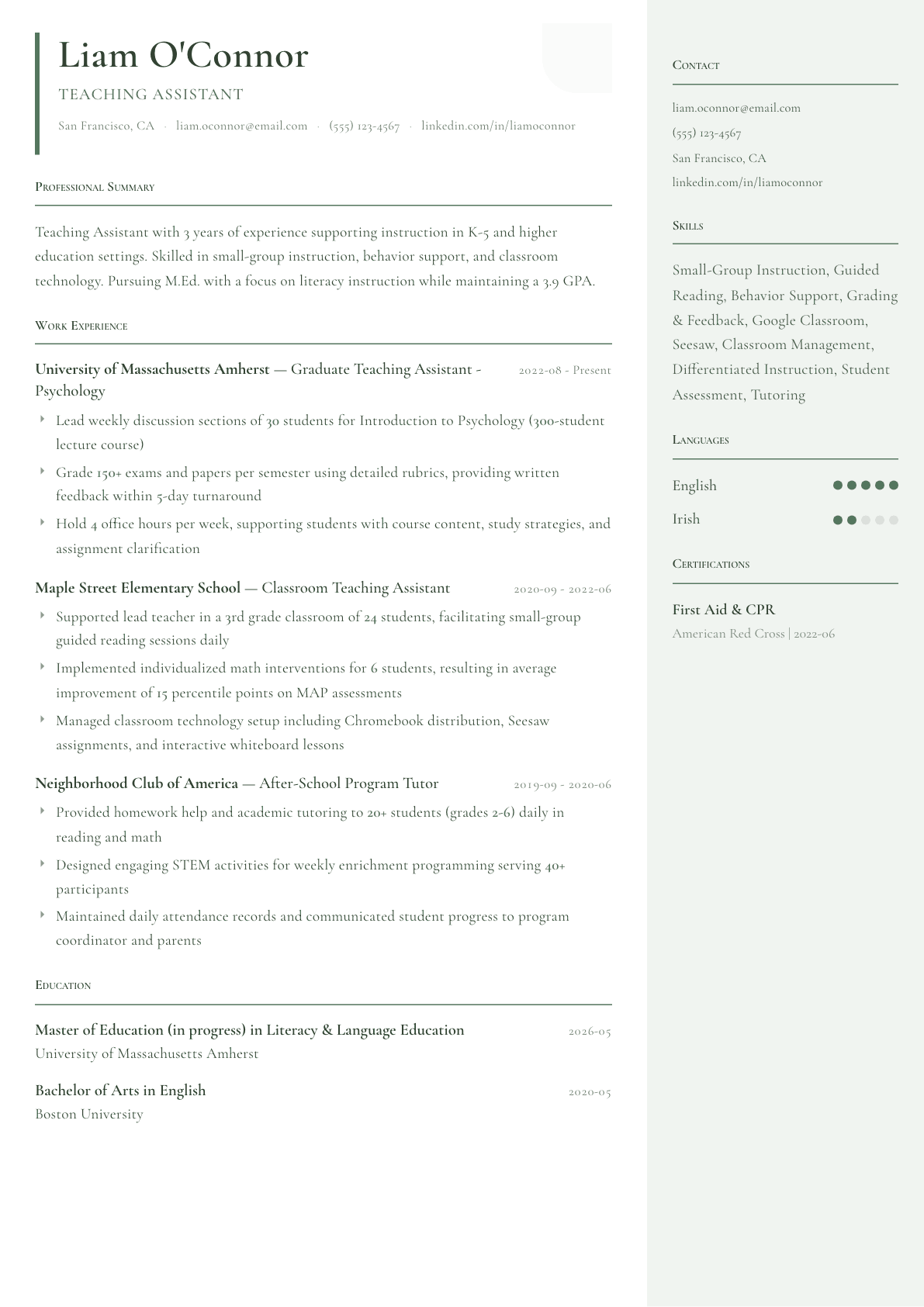
Example Teaching Assistant summary
Teaching Assistant with 3 years of experience across K-5 classrooms and a 300-student university lecture course. Leads weekly discussion sections, small-group guided reading, and grades 150+ exams a semester against detailed rubrics. Completing an M.Ed. in Literacy and Language Education.
Skills to list on a Teaching Assistant resume
- Small-Group Instruction
- Guided Reading
- One-on-One Tutoring
- Behavior Support
- Grading & Rubric-Based Feedback
- Google Classroom
- Seesaw / Canvas
- Classroom Management
- Differentiated Instruction
- Student Assessment
- STEM Activity Design
- Record Keeping
- Parent Communication
What actually gets this resume read
- Highlight specific instructional support: small groups, 1:1 tutoring, lab supervision, grading.
- Quantify student outcomes: assessment improvements, number of students supported, caseload size.
- Include classroom technology skills: Google Classroom, Seesaw, Canvas, Zoom, interactive whiteboards.
- Reference your education coursework or degree in progress to show career trajectory.
- Describe behavior management strategies and collaboration with lead teachers.
- Mention certifications: paraprofessional license, first aid/CPR, subject-specific endorsements.
How to write a teaching assistant resume
Teaching assistant covers two jobs that share a title and nothing else. One is a school paraprofessional or classroom aide, hired by a district office, often required to hold an associate degree or pass a state paraprofessional assessment, and evaluated on whether she can run a small group and support a student with an individualized plan without needing constant direction. The other is a graduate teaching assistant, appointed by an academic department, who leads discussion sections, grades for a large lecture and holds office hours.
The first thing your resume has to do is make clear which one you are applying for, because the two audiences want opposite evidence. A district reads for grade band, student support experience and clearance status. A department reads for the courses you can cover, the grading load you can carry and whether you have run a room of undergraduates alone.
This guide separates the two tracks where they differ and treats them together where the craft is the same, with summaries for a first-time aide, an experienced paraprofessional and a graduate assistant, plus the rewrites that turn support duties into evidence. In the UK the document is an assistant teacher CV or teaching assistant CV, usually two pages, with the DBS check, safeguarding training and any Level 2 or Level 3 teaching assistant qualification near the top.
Format: declare the track in the header
One page. This is a role where hiring is quick and volume is high, and nothing on a second page will be read. Put a target line under your name that matches the posting language exactly: paraprofessional, instructional aide, one-to-one aide, classroom assistant, or graduate teaching assistant with the department and course.
For school positions, add the qualifying credential right there. Many districts require either two years of college credit, an associate degree, or a passing score on a state paraprofessional assessment, and the HR office checks that line before anything else. Background clearance, fingerprinting and a current cardiopulmonary resuscitation card belong in the same block if you hold them.
Assistant teacher CV sample, the top third written out for a UK primary school: Amira Hussain, Teaching Assistant, Leicester. Profile: Level 3 Certificate in Supporting Teaching and Learning, enhanced DBS on the Update Service, two years in a Year 2 class running phonics groups and supporting two pupils with EHCPs. Key skills: Read Write Inc. phonics, small group intervention, SEND support, safeguarding training, first aid for children.
- Header: name, target title, credential or degree progress, city, phone, email.
- School track sections: summary, qualifications and clearances, classroom experience, education, skills.
- Graduate track sections: summary, teaching appointments, courses assisted, education, research, technical skills.
Summary: grade band or course level, and what you carry alone
Say the age group and the setting in the first line. A kindergarten aide, a middle school one-to-one aide for a student with autism and a high school resource room assistant do very different work, and a principal will not read further to find out which you are.
Then name the piece you handle independently. Leading a guided reading group, running a math intervention rotation, taking a section of thirty undergraduates every week, or grading a hundred and fifty exams with a rubric are all things the supervising teacher or professor does not have to do because you are there. That is the value you are selling.
Experience: what you did without the lead teacher standing there
The weakest teaching assistant resumes list what the classroom contained rather than what the writer did in it. Assisted the teacher, helped students and supported the classroom could describe someone who stapled papers for a year. Write instead about the instructional work you delivered: which subject, which group size, how often, and what you were tracking.
Behavior and access support is its own category and deserves its own bullets. Implementing a behavior plan written by someone else, collecting frequency data, redirecting without escalation, supporting toileting and feeding, pushing a communication device, or shadowing a student through a mainstream schedule are specific skills that districts are chronically short of.
For graduate appointments, give the course title, the enrollment, how many sections you led and the grading volume. Add anything you owned beyond delivery: writing quiz items, holding review sessions before a midterm, managing the course site, or training the next cohort of assistants. Those are the lines that turn into a lectureship later.
If you are working from a teacher aide job description for your resume, do not paste its duty list. Take each duty and add the group, the frequency and what you tracked. The lines below show the conversion for the duties that appear on almost every district posting.
- Job description: assists with small group instruction. Resume: Ran daily guided reading groups of five Grade 2 students and recorded running records every two weeks.
- Job description: supervises students during lunch, recess and transitions. Resume: Supervised lunch and recess for 120 students on a rotating duty schedule and walked a Grade 1 class between specials.
- Job description: supports students with IEPs. Resume: Implemented accommodations and a behavior plan for three students, logging frequency data the case manager used at annual reviews.
- Job description: prepares materials and maintains records. Resume: Prepared weekly differentiated packets for 24 students and kept attendance and homework logs in PowerSchool.
Skills: the practical ones a supervisor cannot train quickly
For school roles, list the instructional programs you have supported by name rather than in the abstract, along with the data you collected and the platforms the school used for attendance, communication and assignments. Familiarity with an accommodation page, a picture exchange system or a leveled reading program is worth more than a generic line about supporting diverse learners.
For graduate roles, list the software you can support students in, the grading and course platforms you have administered, and any language you can hold office hours in. A department scheduling an introductory statistics course cares whether you can debug a student script as much as whether you know the theory.
- Small-group and one-to-one instruction, with the subject and group size.
- Data collection: reading probes, behavior frequency counts, attendance and progress logs.
- Assistive and access support, including communication devices and mobility.
- Course platforms and grading systems you have administered.
Making a stepping-stone role look like a career step
Most people in this job want the next one, whether that is a classroom of their own, a licensure program or a faculty track. The resume should point that way without apologizing for the current title. Put any teaching coursework, licensure exams passed and hours logged toward certification in the education section, and let your bullets show independent instruction rather than assistance.
Reliability is also worth stating, quietly. Attendance, covering a class when the lead teacher was out, being trusted with a substitute plan, or taking on the summer program are the things a supervisor mentions first in a reference call, so make them visible on the page rather than hoping they come up later.
Assistant teacher resume template and teacher aide sample
Most resumes for teacher assistant and teacher aide jobs are written for the school version of the role, so the teacher aide sample resume below is a complete page for a paraprofessional in an elementary school. A graduate teaching assistant should keep the same order and swap the student support lines for courses, sections and grading load.
As an assistant teacher resume template, the order is: name and target title, a three line profile with grade band and credential, qualifications and clearances, classroom experience with group sizes, education, then skills. The finished sample below fills that template in, line by line.
Profile: Alicia Moreno, Teacher Assistant. Three years supporting kindergarten and first grade classrooms of up to 24 students, including two students with individualized education programs. Passed the state paraprofessional assessment, runs daily small reading groups on her own, and covers the room when the lead teacher is pulled into meetings.
- Current role, Teacher Assistant, Lincoln Elementary School, three years.
- Runs four guided reading groups a day using the school phonics program and records each student's progress on a weekly running record.
- Supports two students with individualized education programs during whole-class lessons, following the accommodations written by the special education teacher.
- Leads arrival, lunch and recess supervision for 48 students and logs behavior incidents in the school system the same day.
- Prepares the next week's materials every Friday, so the lead teacher spends planning time planning.
- Previous role, Summer Camp Counselor, City Parks and Recreation, two summers: led a group of 12 children aged six to eight.
- Education and clearances: Associate degree in Early Childhood Education, state background check and fingerprint clearance, CPR and first aid certified.
- Skills: small group reading instruction, behavior support plans, Google Classroom, Seesaw, English and Spanish.
Teaching Assistant resume summary examples
First classroom role
Education major with 60 college credits and a passing state paraprofessional assessment score, seeking an elementary instructional aide position. Two years of after-school tutoring with 20 students in grades 2 to 6 and a semester of practicum hours in a grade 3 classroom.
Experienced paraprofessional
Instructional paraprofessional with 5 years in K-5 classrooms, including 2 years as a one-to-one aide for a student with autism across a full mainstream schedule. Runs daily guided reading groups of 5 and collects behavior frequency data for 3 students on active intervention plans.
Graduate teaching assistant
Doctoral candidate in psychology with 4 semesters as a teaching assistant for a 300-student introductory lecture, leading 2 discussion sections of 30 each week. Grades roughly 150 exams and papers a term, holds 4 office hours weekly and trains incoming assistants on the rubric.
Work experience bullets: before and after
Before: Assisted the teacher with classroom activities.
After: Led 3 daily guided reading groups of 5 students each in a grade 2 classroom, running leveled texts and logging running records for the lead teacher every Friday.
Group counts, frequency and the record you handed over prove instruction rather than presence.
Before: Worked with a student with special needs.
After: Supported a grade 4 student with autism through a full mainstream schedule, implementing the behavior intervention plan and collecting frequency data on 3 target behaviors for the case manager.
The plan, the schedule and the data name skills districts struggle to hire for.
Before: Graded student work.
After: Graded roughly 150 exams and short papers per term against a shared rubric and returned written feedback within 5 days, keeping the section aligned with the other 6 assistants.
Volume, turnaround and calibration with other graders show the professor a real workload was handled.
Before: Helped students who were struggling.
After: Ran a daily 20-minute math intervention rotation for 6 students below grade level, using the school fluency program and reporting weekly progress to the intervention team.
Naming the routine, the group and the reporting loop shows a system rather than good intentions.
Before: Covered the class when the teacher was absent.
After: Covered the classroom on 12 occasions when the lead teacher was out, following the prepared plan and keeping the small-group schedule intact for the day.
Counting the coverage turns reliability from a claim into a record a reference can confirm.
Hard skills
- Small-group instruction
- Guided reading and running records
- Math fluency intervention
- Behavior plan implementation
- Behavior and progress data collection
- One-to-one student support
- Assistive and communication device support
- Rubric-based grading
- Discussion section facilitation
- Learning management system administration
- Classroom setup and materials preparation
- Attendance and record keeping
Soft skills
- Taking direction from a lead teacher
- Redirection without escalation
- Discretion with student information
- Reliability and attendance
- Approachability in office hours
- Team communication
Certifications worth listing
- ParaPro Assessment (Educational Testing Service)
- Registered Behavior Technician (RBT) (Behavior Analyst Certification Board)
- Nonviolent Crisis Intervention (Crisis Prevention Institute)
- CPR and First Aid Certification (American Red Cross)
Mistakes that cost teaching assistant candidates the interview
- Writing assisted the teacher as a bullet, which describes the title rather than any work you did.
- Leaving out the grade band or course level, so the reader cannot place you at all.
- Omitting the paraprofessional qualification route, which is the first thing a district HR office verifies.
- Hiding one-to-one and behavior support, the experience schools are most short of.
- Listing a graduate appointment with no enrollment, section count or grading volume attached.
- Treating the job as too junior to quantify, when group sizes, session counts and student numbers are all available to you.
Teaching Assistant resume questions
What qualifications do I need to be a teaching assistant in a school?
Most districts require a high school diploma plus one of three routes: two years of college credit, an associate degree, or a passing score on a state paraprofessional assessment. Background clearance is universal, and one-to-one roles often add crisis intervention training.
How do I list a graduate teaching assistantship on a resume?
Treat it as a job, not a line in your education block. Give the department, the course title and enrollment, how many sections you led, the grading volume and any material you authored. Departments hiring instructors read this as your teaching record.
What should an assistant teacher CV include in the UK?
A short profile naming the key stage and the support you give, your enhanced DBS status, safeguarding and first aid training, any Level 2 or Level 3 teaching assistant qualification, and experience entries showing group sizes, interventions and SEND support. Two pages is normal, and many schools ask for a supporting statement alongside the CV.
Is there an assistant teacher resume template I can follow?
Use the order in the sample on this page: name and target title, a short profile with grade band and credential, qualifications and clearances, classroom experience with group sizes and student numbers, education, then skills. Keep it to one page in a single column, and fill every line with counts from your own classroom rather than generic duties.
What should a resume for a teacher aide include, beyond the job description?
Start with the grade band and the students you supported, then the items a district checks before it calls: background check and fingerprint clearance, CPR and first aid, and the paraprofessional assessment or associate degree if your state asks for one. Add small group instruction, behavior support and any tutoring, camp or after-school work, which all show you can hold a group of children and follow a plan.