Permanent Makeup Artist Resume Examples: free ATS score
Write a Permanent Makeup Artist Resume With Healed Work
By Mustafa Tarabya, founder of CVBooster · Published · Updated
Permanent makeup artist resume example, keywords and a guide to writing healed results, pigment knowledge, safety and touch-up rates.
Sample resumes for a permanent makeup artist
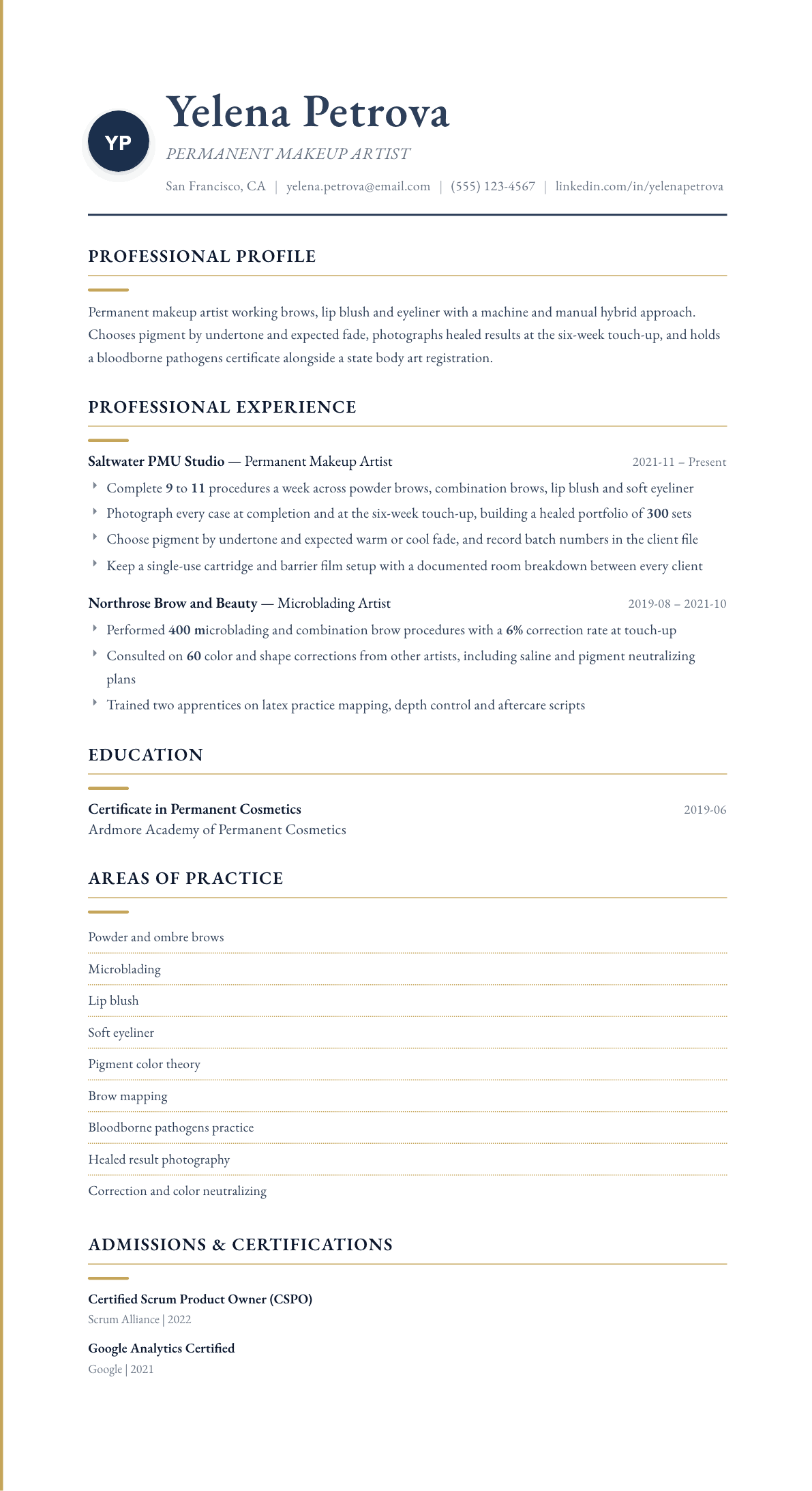
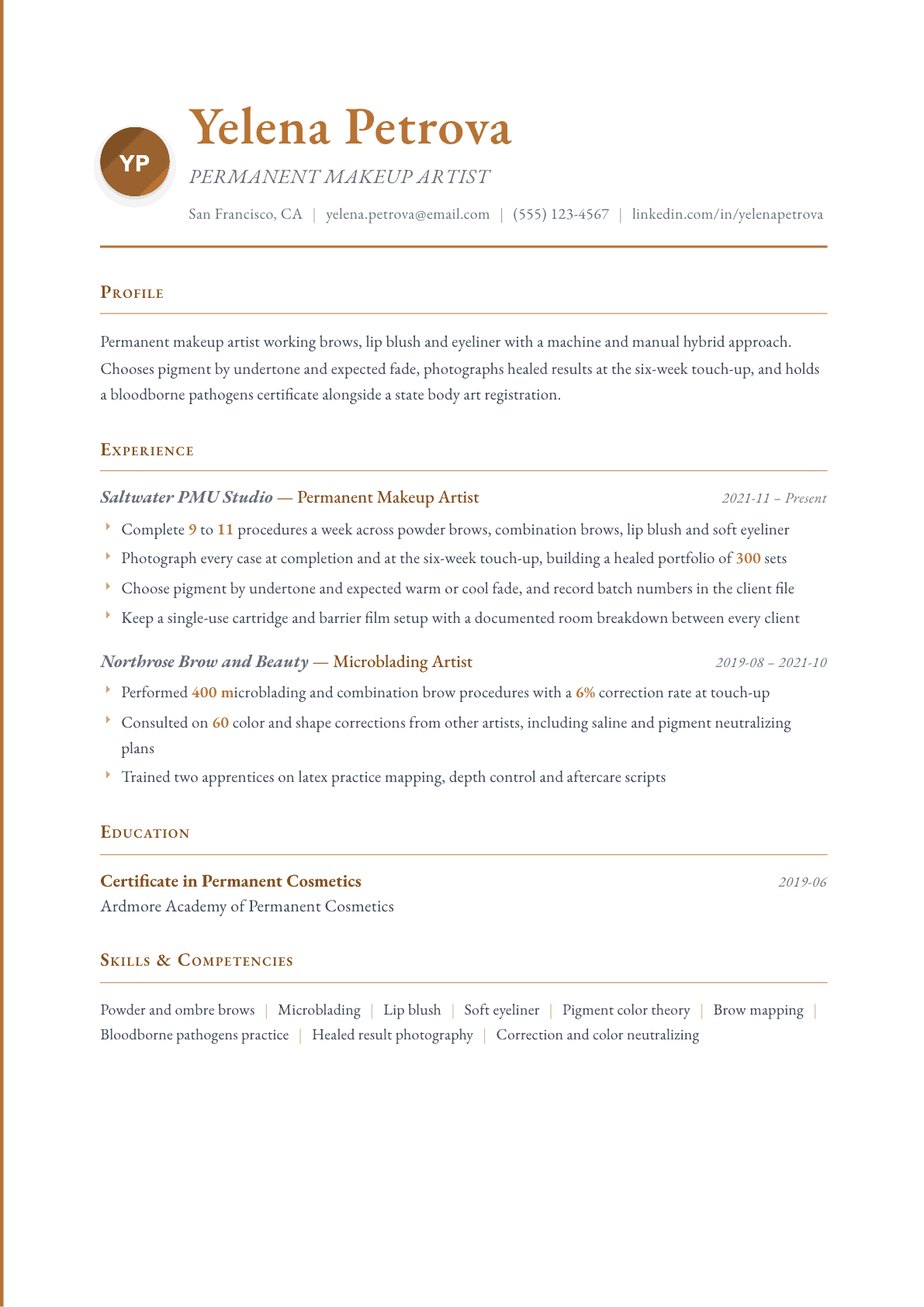
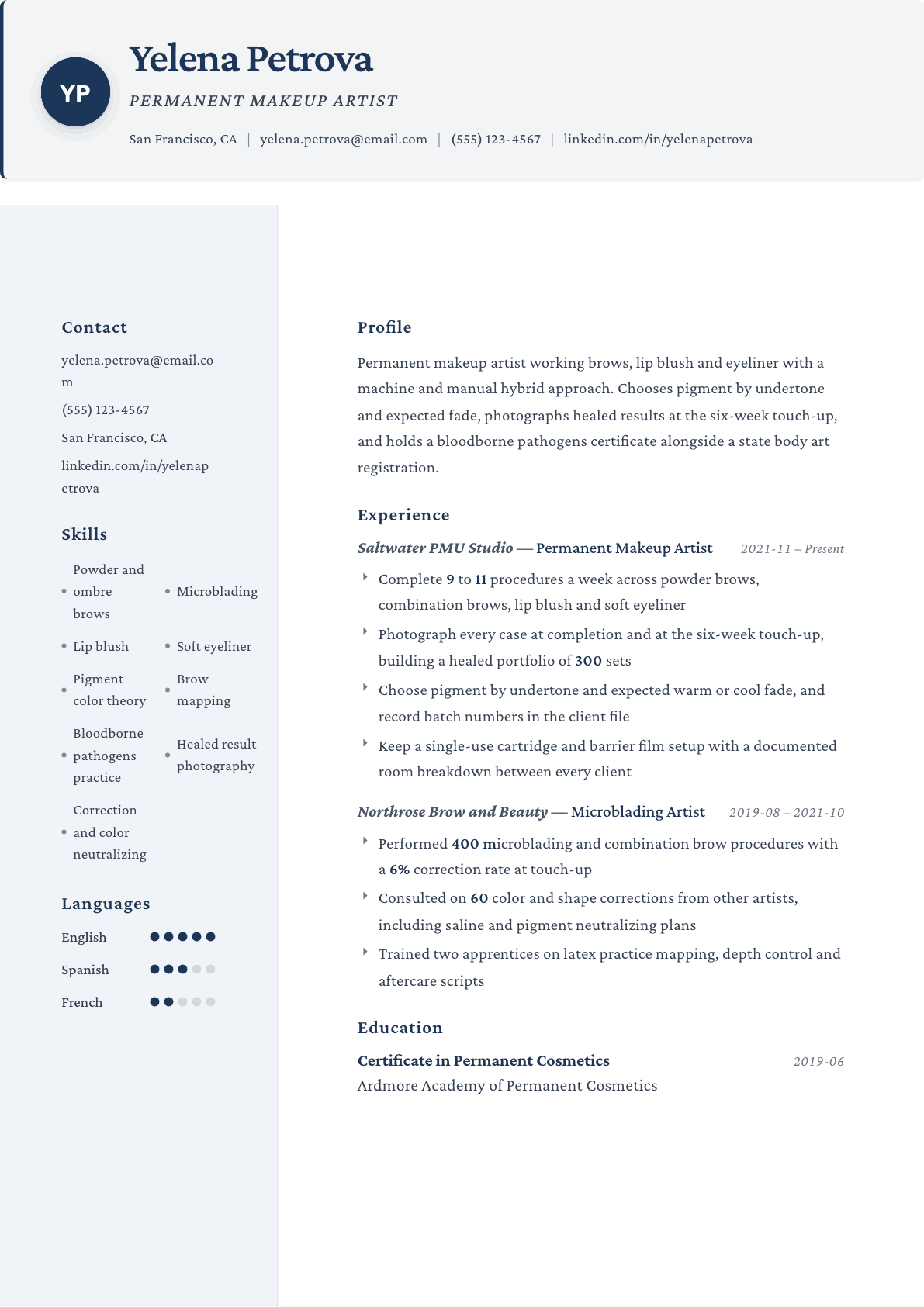
The same permanent makeup artist content laid out in three CVBooster templates, so you can see what the finished document looks like before you write a word.
Example Permanent Makeup Artist summary
Permanent makeup artist working brows, lip blush and eyeliner with a hybrid machine and manual approach. Builds shape from bone structure and expression, chooses pigment by undertone and expected fade, and photographs every case again at the six-week touch-up so the portfolio shows healed work rather than fresh work. Holds body art registration and current bloodborne pathogens training, and takes correction cases from other artists. Seeking a studio chair.
Skills to list on a Permanent Makeup Artist resume
- Microblading
- Powder and ombre brows
- Combination brows
- Lip blush
- Soft and lash line eyeliner
- Brow mapping and symmetry
- Pigment undertone theory
- Color correction and neutralizing
- Saline lightening
- Depth and needle configuration control
- Topical anesthetic protocol
- Bloodborne pathogens practice
- Consent and medical history intake
- Healed portfolio photography
- Aftercare instruction
What actually gets this resume read
- Show healed results, not fresh work, because a studio owner judges you on what the skin kept at six weeks.
- List the techniques separately: microblading, powder, combination, lip blush and eyeliner are different hands.
- Give your touch-up and correction rates, which tell an owner how much unpaid rework your book creates.
- State your body art registration, the county or state that issued it, and your bloodborne pathogens training.
- Name your pigment lines and explain how you choose by undertone and expected fade, not by a swatch card.
- Describe your setup and breakdown: single-use cartridges, barrier film, and how the room is turned over.
How to write a permanent makeup artist resume
Permanent makeup is judged on healed work, and every studio owner who hires knows it. Fresh photos taken in the chair flatter everyone. Six weeks later the pigment has settled, the warmth has come forward, the crisp strokes have softened, and whatever you actually did to the skin is finally visible. A resume that talks about fresh work tells an owner you have not yet learned that lesson.
The second thing an owner is reading for is risk. Pigment implantation breaks skin, so registration, bloodborne pathogens training and a documented single-use setup are hiring gates rather than bonus points. After that come the commercial facts: procedures per week, touch-up rate, correction rate, and whether clients come back for the color refresh that keeps a book alive.
This guide covers what a permanent makeup studio reads and in what order, with summaries for a newly certified artist, an artist with a settled book and a senior artist taking corrections, five rewritten bullets, and the questions that come up when a brow technician or tattoo artist moves into permanent cosmetics.
Format: one page, registration and technique list high, portfolio in the header
One page, reverse chronological, with a portfolio link in the header line beside your phone number. The technique list and your body art registration belong in the top third, because those two blocks decide whether an owner keeps reading.
Split the techniques rather than writing permanent makeup as one skill. Microblading, machine powder, combination brows, lip blush and eyeliner are different hands with different healing behavior, and studios usually hire against a specific gap on their menu.
- Technique block: microblading, powder and ombre brows, combination brows, lip blush, soft and lash line eyeliner, and corrections.
- Registration block: body art or permanent cosmetics registration with the issuing county or state, plus current bloodborne pathogens training.
- Numbers line: procedures per week, healed sets photographed, touch-up rate and correction rate.
- Setup line: single-use cartridges, barrier film, room breakdown between clients, and where consent and batch numbers are recorded.
Summary: techniques, healed portfolio, registration, book
Three lines. Name the techniques you run alone, say that your portfolio is healed work, give your registration and training status, and state how many procedures a week you carry. That is what an owner needs before she looks at a single photograph.
If you are crossing over from brow technician work or from body tattooing, say so and name the bridge. Brow technicians arrive with mapping, face reading and client consultation. Tattoo artists arrive with needle depth and machine control. Both still need pigment theory for skin and the healing behavior of small work on the face, so present that as training completed rather than as something implied.
Experience: mapping, pigment choice, depth, healing
Write the craft into the bullets. How you map a shape to bone structure and expression rather than to a trend, how you choose pigment by undertone and expected warm or cool fade, how you control depth across the tail where skin thins, and what you do differently on oily skin where strokes blur. Those sentences separate an artist from someone who bought a machine.
Then healing. State that you photograph at completion and again at the six-week touch-up, and give the size of your healed portfolio. Add your correction rate at touch-up, because it tells an owner how much unpaid rework your book will generate on her rota.
Include the setup and breakdown explicitly: single-use cartridges, barrier film on every surface a glove touches, the order you break the room down in, and where consent forms, medical history and pigment batch numbers are filed. An owner who has been inspected reads this closely.
Corrections and color theory
Correction work is the highest-skill part of the field and the fastest way to stand out on paper. Taking on someone else old work means reading a healed color you did not mix, deciding between saline lightening, laser referral and pigment neutralizing, and setting expectations for a client who is already unhappy. If you do it, describe the decision process, not just the volume.
Color theory deserves its own sentences. Say which pigment lines you work with and how you predict fade, because owners have seen too many brows go warm and too many lips heal ashy. An artist who can explain a choice in undertone terms is trusted with the difficult consultations.
Keywords a permanent cosmetics studio filters on
Studio and medspa postings reuse a set of terms: microblading, powder brows, ombre, combination brows, lip blush, permanent eyeliner, brow mapping, pigment undertone, color correction, saline lightening, needle configuration, topical anesthetic, aftercare, touch-up, healed results, body art registration, bloodborne pathogens. Mirror the true ones in your technique block and again in a bullet.
Mention teaching if you have done it. Studios that run apprenticeships value an artist who can teach latex practice mapping, depth control and aftercare scripting, and it often comes with a share of the training revenue.
Permanent Makeup Artist resume summary examples
Newly certified
Newly certified permanent cosmetics artist with 100 training hours, 30 latex practice sets and 25 supervised live models across microblading and combination brows. Body art registration current and bloodborne pathogens training complete. Building a healed portfolio and seeking an apprentice chair in a PMU studio.
Settled book
Permanent makeup artist completing 9 to 11 procedures a week across powder brows, combination brows, lip blush and soft eyeliner. Photographs every case again at the six-week touch-up, holds a healed portfolio of 300 sets, and records pigment batch numbers in every client file.
Senior artist and trainer
Senior PMU artist with eight years, taking color and shape corrections referred from other studios and running saline lightening and neutralizing plans. Trains apprentices on mapping, depth control and aftercare scripting, and maintains a correction rate at touch-up well below the studio average.
Work experience bullets: before and after
Before: Did microblading and permanent makeup on clients.
After: Completed 9 to 11 procedures a week across powder brows, combination brows, lip blush and soft eyeliner, mapping every shape to bone structure and natural expression before the first pass.
Weekly volume and separated techniques let an owner match you to a gap in her menu.
Before: Built a portfolio of my work.
After: Photographed every case at completion and again at the six-week touch-up, building a healed portfolio of 300 sets across a full range of skin types and brow densities.
Healed photography at a fixed interval is the only portfolio evidence a studio actually trusts.
Before: Chose the right pigment colors for clients.
After: Selected pigment by undertone and expected warm or cool fade, recorded batch numbers in the client file, and adjusted the mix at touch-up based on how the first pass healed.
Naming undertone, fade prediction and batch records shows a system rather than a lucky eye.
Before: Fixed other artists mistakes.
After: Consulted on 60 color and shape corrections referred from other studios, deciding between saline lightening, pigment neutralizing and referral for laser removal case by case.
The volume plus the three options shows correction judgment, the hardest skill in the field.
Before: Kept everything clean and sterile.
After: Ran a single-use cartridge and barrier film setup with a documented room breakdown between every client, and filed consent, medical history and batch numbers for each procedure.
A described setup with paperwork attached is what an inspector and an insurer actually check.
Hard skills
- Microblading
- Powder and ombre brows
- Combination brows
- Lip blush
- Soft and lash line eyeliner
- Brow mapping and symmetry
- Pigment undertone theory
- Color correction and neutralizing
- Saline lightening
- Needle configuration and depth control
- Topical anesthetic protocol
- Healed portfolio photography
- Consent and medical history intake
- Aftercare instruction
Soft skills
- Managing expectations before a permanent decision
- Steadiness across a long procedure
- Handling an unhappy correction client
- Teaching apprentices at the table
- Reading a face for shape and asymmetry
Certifications worth listing
- Certified Permanent Cosmetic Professional (CPCP) (Society of Permanent Cosmetic Professionals)
- Bloodborne Pathogens Training (American Red Cross)
Mistakes that cost permanent makeup artist candidates the interview
- Showing only fresh photographs, which every experienced owner discounts because pigment has not settled yet.
- Writing permanent makeup as a single skill instead of listing microblading, powder, combination, lip and eyeliner separately.
- Leaving off the body art registration and the issuing county, which are hiring gates in most places.
- Omitting touch-up and correction rates, so an owner cannot estimate the rework your book will add to her rota.
- Describing sterile practice in adjectives rather than naming single-use cartridges, barrier film and the breakdown order.
- Claiming correction work without explaining how you choose between lightening, neutralizing and referral.
Permanent Makeup Artist resume questions
Why do studios ask for healed photos rather than fresh work?
Because pigment settles, softens and shifts in undertone over several weeks, and only the healed result shows depth control and color choice. Fresh photos make every artist look competent, so a studio treats a portfolio without healed images as unproven.
What do I need before I can work as a permanent makeup artist?
Typically a permanent cosmetics or body art registration from the county or state, current bloodborne pathogens training, and a training certificate with documented hours and live models. Some jurisdictions also require an underlying esthetics or cosmetology license, so check locally.
I am a brow technician moving into permanent makeup. What transfers?
Mapping, face reading, consultation and aftercare coaching all transfer directly, and that is a real head start. What does not transfer is pigment behavior in healed skin, depth control and correction theory, so list your training hours and live model count separately.
Should I put my touch-up and correction rates on the resume?
Yes, if you track them honestly. A low correction rate at the six-week appointment is one of the few objective quality measures in this field, and an owner reads it as a direct estimate of the unpaid rework your book will generate.
How do I describe training I have not used on paying clients yet?
List it under training with the academy, the hours and the number of latex and live models completed, and keep it out of your main technique block until you have paid volume. Studios respect the distinction and distrust artists who blur it.
Related resume examples
- Makeup Artist Resume example
- Brow Technician Resume example
- Cosmetologist Resume example
- Esthetician Resume example
- Lash Technician Resume example
- Medical Esthetician Resume example