Lash Technician Resume Examples: the lines they read
A Lash Technician Resume That Proves Retention and Safety
By Mustafa Tarabya, founder of CVBooster · Published · Updated
Write a lash technician resume around set types, retention rates, adhesive control and sanitation, with sample bullets and keywords studios look for.
Sample resumes for a lash technician
The same lash technician content laid out in three CVBooster templates, so you can see what the finished document looks like before you write a word.
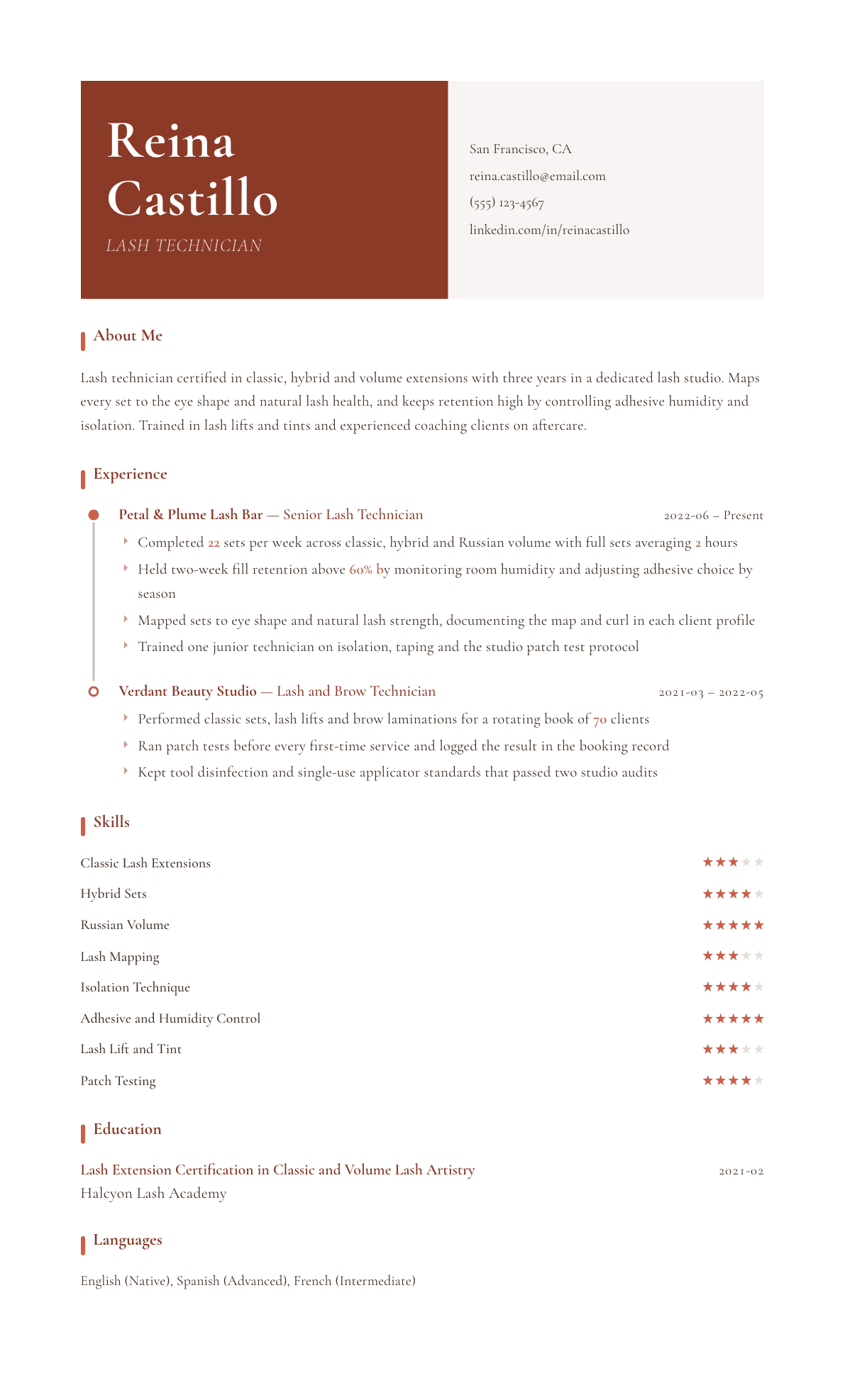
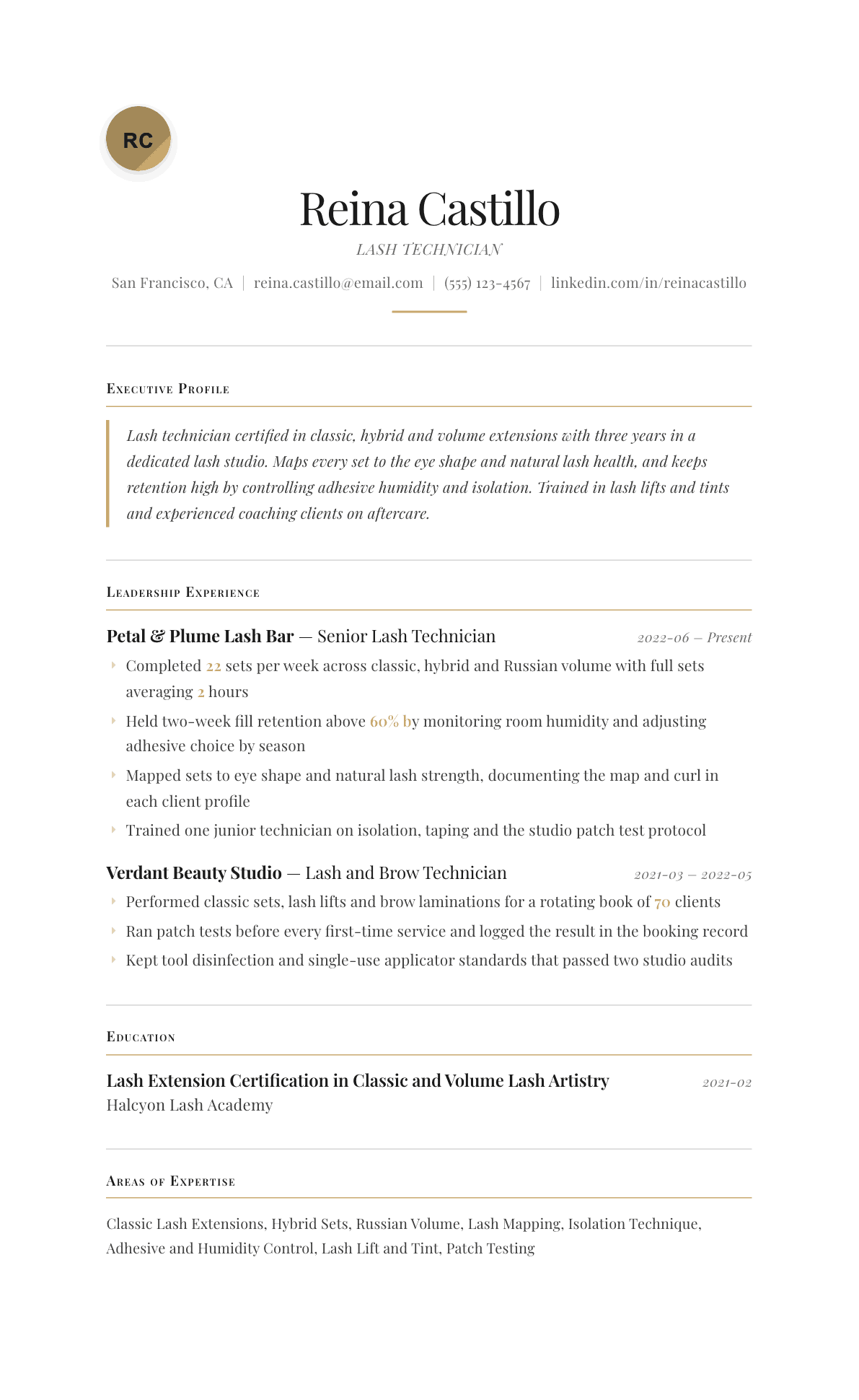
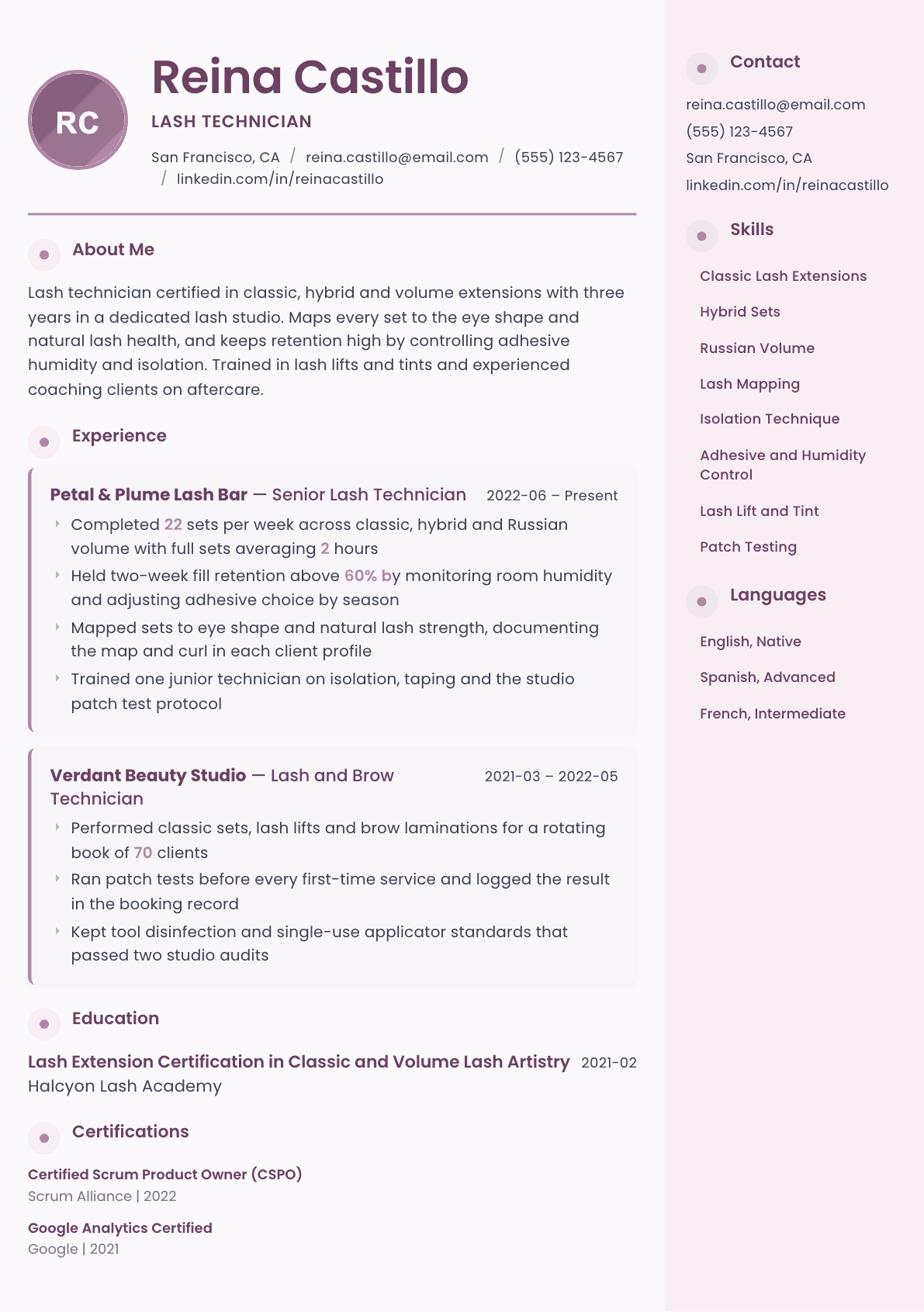
Example Lash Technician summary
Lash technician certified in classic, hybrid and volume sets with three years in a dedicated studio. Maps every set to eye shape and natural lash strength, then protects retention by matching adhesive to room humidity and holding clean isolation. Runs patch tests before first services and coaches clients through aftercare that keeps fills on schedule. Seeking a senior lash room with a volume-heavy clientele.
Skills to list on a Lash Technician resume
- Classic Lash Extensions
- Hybrid Lash Sets
- Russian Volume
- Mega Volume
- Lash Mapping
- Isolation Technique
- Adhesive Selection
- Humidity and Cure Control
- Lash Lift
- Lash and Brow Tinting
- Brow Lamination
- Patch Testing
- Aftercare Coaching
- Tool Disinfection
- Client Retention
What actually gets this resume read
- Name every set type you can perform, classic, hybrid, volume and mega volume, with the fill times you hold.
- Give a retention figure at the two or three week fill, because that is how studios grade a lash technician.
- Explain adhesive and humidity control, which tells an owner you understand why sets fail in different rooms.
- Show lash mapping and eye shape assessment rather than describing your work as natural and beautiful.
- Include patch testing and single-use applicator standards, since allergic reactions are the studio biggest risk.
- List lash lift, tint and brow services separately if you hold them, because they fill gaps between fill appointments.
How to write a lash technician resume
Lash work is graded on retention, and retention is the number a studio owner asks about first. If a set falls out in nine days, the guest blames the technician, books elsewhere, and the studio loses a client who would otherwise have returned every two or three weeks for years. So a lash technician resume that never mentions retention is answering every question except the one being asked.
The second thing an owner screens for is safety. Adhesives contain cyanoacrylate, eyes are involved, and an allergic reaction in a treatment room is a reputational and legal problem. Patch testing, single-use applicators, tool disinfection and honest aftercare instructions are not administrative details in this job, they are the professional standard that separates a trained lash technician from someone who bought a kit.
This guide covers how to present set types and fill times, how to write about adhesive and humidity control so an experienced owner recognizes you, what to do when you are newly certified, and how to handle the portable client book that most lash studios are really hiring.
Format: certification, set types, retention
One page, single column, reverse chronological. Under your name put your certifications with the academy or trainer who issued them, plus your state license where your state requires an esthetics or cosmetology license to perform lash extensions. Rules differ, so name the license you hold rather than assuming the reader knows the requirement.
Then a set type block: classic, hybrid, volume, mega volume, plus lash lift, tinting and any brow services you offer. Give the time you take for a full set and for a fill on each type. Studios build their price list around those times, and a technician who knows her own timings sounds like someone who has run a full column.
- Certification line naming each lash course completed and the academy or trainer behind it, newest first.
- License line for the state esthetics or cosmetology license where your state requires one to lash.
- Set type block with full set and fill times for classic, hybrid, volume and mega volume.
- Adjacent services listed separately: lash lift, lash tint, brow lamination and brow tint.
Retention: the number that gets you the interview
Give the share of extensions still attached at the two or three week fill, and say which mark you measured at. Studios track it, guests feel it, and a technician who quotes a real figure has clearly been paying attention to her own work over time rather than judging a set by how it looks the moment the guest sits up.
Then explain what drives it, because the explanation is the actual credential. Isolation quality, weight matched to the natural lash, correct base placement, adhesive chosen for the room conditions, and aftercare the guest will actually follow. An owner reading those words knows immediately whether you were taught properly.
Adhesive, humidity and the environment you work in
Adhesive cures according to temperature and humidity, which means the same product behaves differently in a summer room and a dry winter one. A lash technician who monitors the room with a hygrometer, adjusts adhesive choice by season and keeps her product stored and shaken correctly is protecting the studio's retention numbers, not fussing.
Write about it plainly: what you monitor, how you adjust, and how you store and rotate adhesive so nothing is used past its window. This is the single most reliable signal of an advanced lash technician, and almost nobody puts it on a resume, which is precisely why it works.
Mapping, eye assessment and the consultation
Describe how you decide what to apply. Eye shape, lash line density, natural lash strength and the guest's desired look together determine the map, the curl and the maximum safe length and weight. Say that you document the map, the curl and the diameter in the client profile so the set can be repeated or adjusted at the next fill.
Also say what you decline. Turning away a guest who wants a length her natural lashes cannot carry, or who arrives with damage from a previous set, protects the studio from a complaint and the guest from lash loss. Owners notice a technician who says no in the right places.
Safety, sanitation and aftercare
Patch testing before a first service, documented in the booking record, is the standard to state explicitly. Then single-use applicators and micro brushes, tweezer disinfection between guests, clean lash tiles, and a protocol for what happens if a guest reports irritation, including when you refer her to a physician.
Aftercare closes the loop. Say what you teach: no water for the cure window, cleanser used daily, oil-free products, brushing, and no lash curler on extensions. Then say how you deliver it, whether by card, message or a demonstration at the mirror, because instructions a guest ignores do not protect retention.
Lash Technician resume summary examples
Newly certified
Newly certified lash technician trained in classic and hybrid sets with a completed academy course and 40 supervised models. Confident in isolation, mapping to eye shape and patch testing, and building fill times toward studio standard. Licensed esthetician. Seeking a lash room with mentorship and a shared guest base.
Three years in a studio
Lash technician certified in classic, hybrid and volume sets with three years in a dedicated studio. Completes 22 sets a week, holds two-week fill retention above 60%, and adjusts adhesive by room humidity across the seasons. Trained one junior technician. Seeking a senior lash room with a volume-heavy clientele.
Lead lash artist and trainer
Lead lash artist running a fully booked column of mega volume and corrective sets while training the studio's new technicians. Wrote the patch test and aftercare protocol used across two rooms, manages adhesive rotation and storage, and handles referred removals and repairs. Seeking a lead artist or lash educator position.
Work experience bullets: before and after
Before: Applied lash extensions for clients at the studio.
After: Completed 22 sets a week across classic, hybrid and Russian volume, with full sets averaging two hours and fills averaging seventy-five minutes.
Set types with real timings tell a studio owner exactly how your column would slot into her price list and schedule.
Before: Clients were happy with how long their lashes lasted.
After: Held two-week fill retention above 60% by monitoring room humidity with a hygrometer and switching adhesive as the seasons changed.
Retention is the number studios grade on, and the humidity method proves the result was controlled rather than lucky.
Before: Chose a style that suited each client.
After: Mapped every set to eye shape, lash line density and natural lash strength, then documented map, curl and diameter in the client profile.
Naming the assessment inputs and the record shows a repeatable process instead of an eye for what looks nice.
Before: Followed hygiene rules in the treatment room.
After: Ran patch tests before every first-time service, logged results in the booking record, and used single-use applicators with tweezers disinfected between guests.
Allergic reaction is the studio's biggest risk, so a documented patch test protocol carries more weight than a hygiene claim.
Before: Told clients how to take care of their lashes.
After: Coached every guest through the cure window, daily cleanser use and oil-free products at the mirror before checkout, then sent the same instructions by message.
Aftercare only protects retention when it is delivered twice, so describing the method shows you understand why guests forget.
Hard skills
- Classic lash extension application
- Hybrid set design
- Russian volume fanning
- Mega volume technique
- Lash mapping and styling
- Isolation technique
- Adhesive selection and cure control
- Humidity and temperature monitoring
- Safe removal and repair
- Lash lift and tint
- Brow lamination and tint
- Patch testing protocol
- Tool disinfection and single-use practice
Soft skills
- Steady hands over long sets
- Saying no to unsafe requests
- Aftercare coaching
- Guest comfort during a two hour service
- Column time management
- Training junior technicians
Certifications worth listing
- Licensed Esthetician (state license) (State board of cosmetology)
- Licensed Cosmetologist (state license) (State board of cosmetology)
- Bloodborne Pathogens Certification (American Red Cross)
Mistakes that cost lash technician candidates the interview
- Never mentioning retention, which is the first thing a studio owner asks about and the whole basis of repeat bookings.
- Listing set types without fill and full set times, leaving an owner unable to price your column.
- Saying nothing about adhesive or humidity, which marks a technician as trained on technique but not on conditions.
- Omitting patch testing, the one protocol that protects the studio from the reaction that ends a reputation.
- Describing sets as natural or dramatic rather than naming curl, diameter, length and the mapping behind them.
- Claiming volume skill without saying whether the fans are handmade or premade, which an experienced owner will ask.
Lash Technician resume questions
Do I need a license to work as a lash technician?
It depends on the state. Many require an esthetics or cosmetology license before you may apply extensions, and a certificate from a lash academy alone is not enough. Name the license you hold and the state that issued it.
What retention figure should I put on my resume?
The one you actually observe at the two or three week fill, stated with the mark you measured. Do not round up. A studio owner will watch your first sets closely, and an inflated number is discovered within a month.
How do I write a lash technician resume when I am newly certified?
Use your training as the experience section. Give the academy, the course, the number of supervised models completed and your current full set time. Then add any beauty or guest-facing job that shows you can hold a booked column.
Should I include my own client following?
Yes, with honest numbers. Say how many regular guests you have and how often they return for fills. Lash guests rebook on a short cycle, so a portable book is worth a great deal to a studio filling an empty room.
How much detail about adhesive belongs on a resume?
One clear line is enough: that you select adhesive by room temperature and humidity, monitor conditions and rotate stock within its usable window. An experienced owner reads that as advanced training without needing the brand names.
Related resume examples
- Makeup Artist Resume example
- Esthetician Resume example
- Brow Technician Resume example
- Permanent Makeup Artist Resume example
- Aesthetician Resume example
- Laser Technician Resume example