Medical Esthetician Resume Examples: what gets the call
A Medical Esthetician Resume Built for Clinic Hiring
By Mustafa Tarabya, founder of CVBooster · Published · Updated
Write a medical esthetician resume that names devices, physician supervision and pre and post care, with examples, keywords and a full writing guide.
Sample resumes for a medical esthetician
The same medical esthetician content laid out in three CVBooster templates, so you can see what the finished document looks like before you write a word.
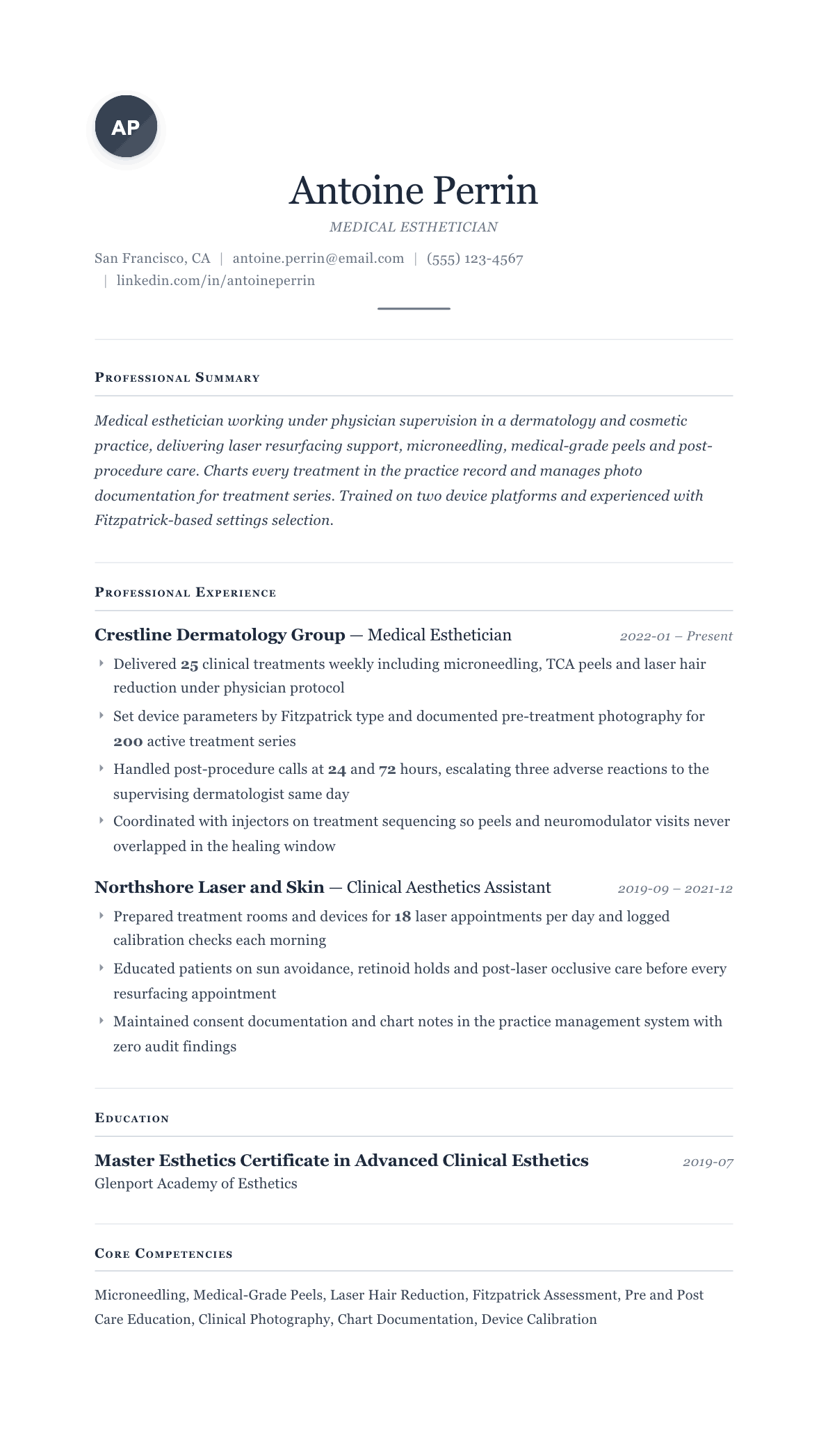
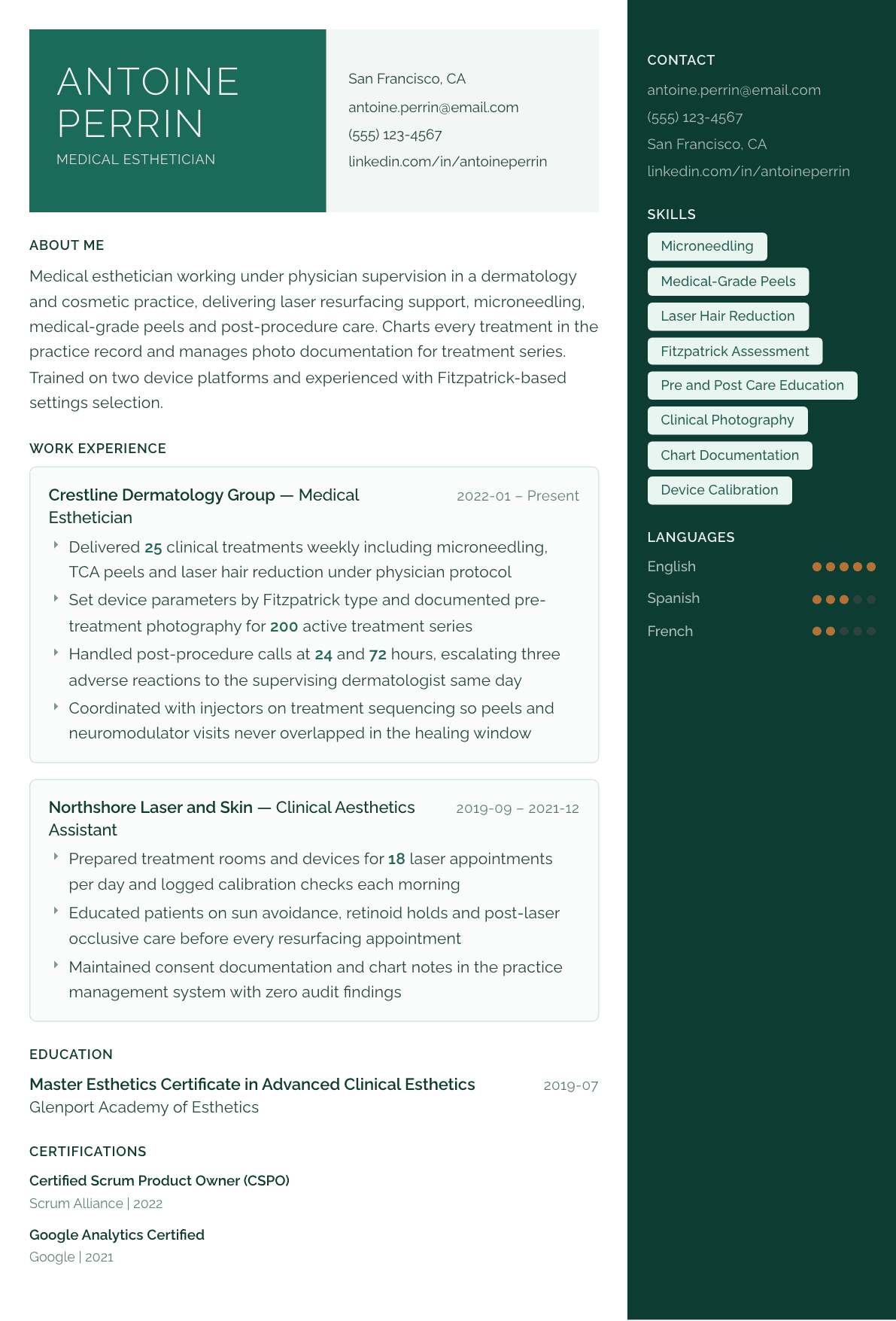
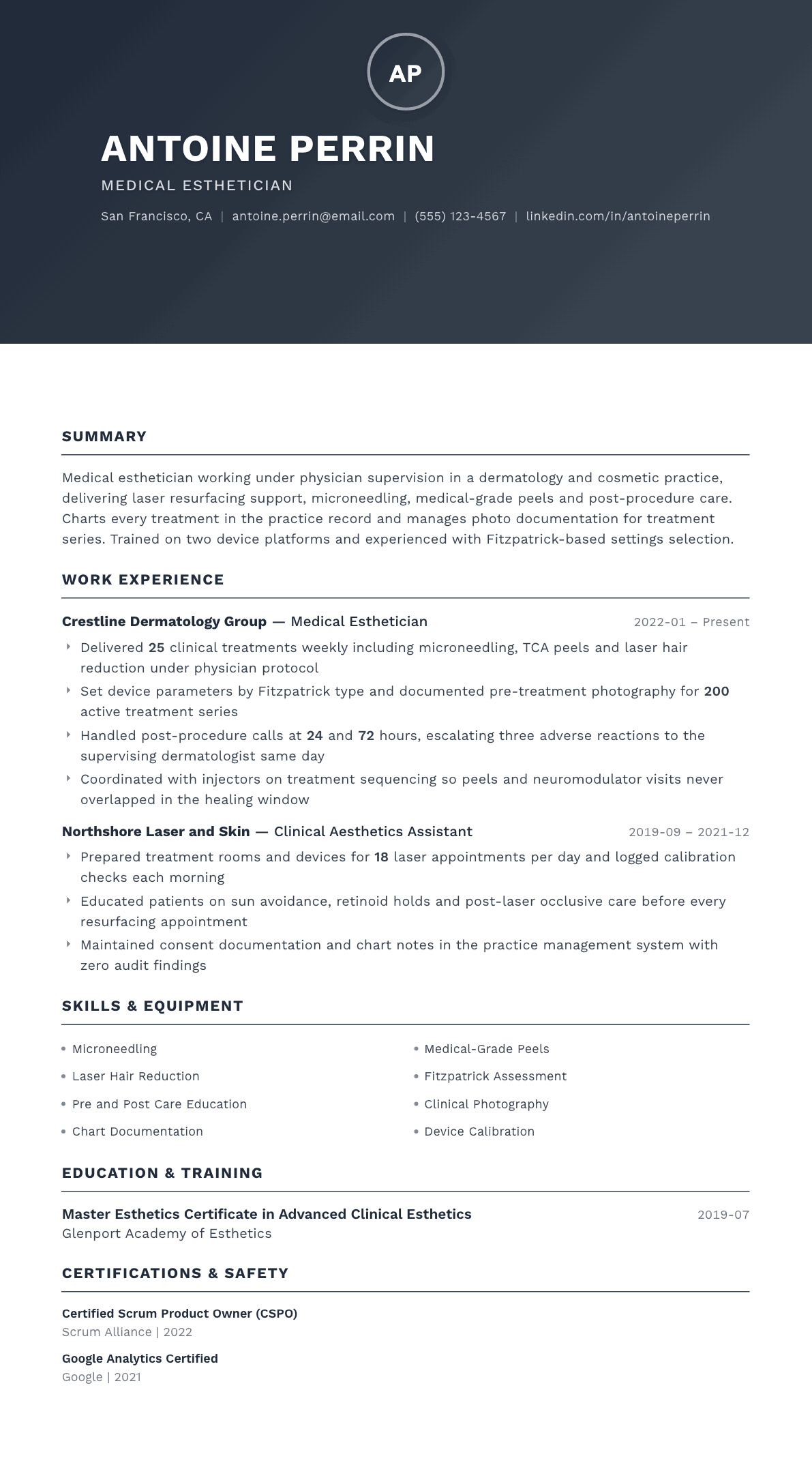
Example Medical Esthetician summary
Medical esthetician with clinical experience in a dermatology practice delivering microneedling, medical-grade peels and light-based treatments under physician protocol. Selects device settings by skin type, documents consents and standardized photography for every series, and runs structured post-procedure follow up. Comfortable escalating reactions quickly and coordinating treatment sequencing with injectors. Seeking a clinic role with an advanced device menu and a strong medical director.
Skills to list on a Medical Esthetician resume
- Microneedling
- Chemical Peels
- Laser Hair Reduction
- Intense Pulsed Light
- Radiofrequency Skin Tightening
- Fitzpatrick Assessment
- Contraindication Screening
- Pre and Post Procedure Care
- Clinical Photography
- Informed Consent Documentation
- Chart Notes
- Device Calibration
- Patient Education
- Infection Control
- Adverse Event Escalation
What actually gets this resume read
- State that you work under physician or medical director supervision, because clinics screen for candidates who know the boundary.
- Name every device platform you have been trained on, including the module and the treatment types you ran.
- Reference Fitzpatrick typing and settings selection so a medical director sees you understand risk before results.
- Show your documentation habits: consents, before and after photography, chart notes and adverse event escalation.
- Keep the spa language out. A medical esthetician resume reads clinical, not relaxing, from the first line.
- List the practice management or charting system you have used so the clinic can judge onboarding time.
How to write a medical esthetician resume
A medical esthetician resume is judged by a physician or a practice manager who carries the liability for whatever happens in your treatment room. That changes what the page has to prove. Not that you are good with guests, but that you understand scope, protocol and risk: what you may do under a medical director, what settings you choose for which skin type, and what you do at the first sign of a reaction you did not expect.
The other thing a clinic is buying is device coverage. Practices invest heavily in laser, light and energy platforms, and an idle device is expensive. So a hiring manager reads the resume looking for the platforms you have been trained on, the treatment types you ran on them, and whether anyone would need to pay for your training again.
This guide separates the medical esthetician resume from a spa one, shows how to write about supervision and protocol without sounding either timid or reckless, and gives bullets, summaries and answers to the questions people ask when they move from a day spa into a dermatology or plastic surgery practice.
Format: clinical from the first line
One page, single column, reverse chronological. The tone should read closer to a clinical support role than to a beauty resume. Under your name, put your esthetics license with the state and expiration, and any advanced or master esthetics designation your state issues. Then a device and modality block, then experience.
Drop the language of relaxation entirely. Words like pampering, indulgent and glow signal a spa background to a medical practice, and a hiring manager who is worried about scope reads them as a warning. Replace them with treatment, protocol, indication, downtime and follow up.
- License line: esthetics license, state, expiration, plus any state-specific advanced esthetics or laser designation.
- Device block naming platform families you have run: laser hair reduction, intense pulsed light, radiofrequency, microneedling.
- A protocol note stating that you work under physician or medical director standing orders.
- Charting systems used, listed by name, so onboarding time in the practice record can be estimated.
Scope and supervision: say the quiet part clearly
State that you operate under physician or medical director supervision and standing orders. This is not a limitation to hide, it is the frame the entire role sits inside, and a candidate who writes it plainly reads as someone who has worked inside a compliant practice. Mention who reviewed your protocols and how treatment plans were approved before you started a series.
Rules on who may operate energy devices differ by state and by device, so describe your training and your delegated tasks rather than making a blanket claim. Name the training provider or the manufacturer clinical educator who checked you off. That single detail resolves most of the questions a medical director would otherwise raise in an interview.
Devices and treatments: platform, parameter, patient type
For every modality, say what you ran, on whom, and how you decided the settings. Fitzpatrick typing is the vocabulary a practice expects. "Selected parameters by Fitzpatrick type and treatment history, with test spots before first laser hair reduction sessions" says more about your safety habits than a page of adjectives.
Give the treatment volume too. A practice running eighteen appointments a day needs to know whether you have worked at that pace. Then name the adjacent work that keeps a clinical schedule moving: room turnover, device calibration checks, consent collection, standardized photography and stocking.
Microneedling, medical-grade peels and post-procedure care deserve their own bullets because they are the treatments a medical esthetician owns most fully. Say the depth, the acid and the concentration family where you can do so accurately, and say who set the protocol.
Documentation, consent and adverse events
The section most candidates skip is the one a practice manager reads twice. Describe how you collected informed consent, where you charted, how you standardized before and after photography, and how you handled a reaction. An honest bullet about escalating a blistering response to the supervising physician the same day builds far more trust than a claim that you have never had a complication.
Follow up is part of the same story. Post-procedure calls at fixed intervals, written aftercare, sun avoidance instructions and retinoid holds all show that you think in treatment series rather than in single appointments, which is how a clinic thinks about revenue and outcomes.
Keywords a clinic posting will actually contain
Dermatology, plastic surgery and medical spa postings reuse a narrow vocabulary: medical esthetician, clinical skin care, microneedling, chemical peels, laser hair reduction, intense pulsed light, radiofrequency, Fitzpatrick, contraindications, pre and post care, informed consent, patient education, infection control. Use those words where they are true of you.
Mirror the treatment names the posting uses rather than the trade slang from your last practice. A clinic writing its posting around a device family wants the words back, and a resume that translates the same work into unfamiliar shorthand loses the keyword match and the reader at the same time.
Medical Esthetician resume summary examples
Moving from spa to clinic
Licensed esthetician with four years of advanced facial and peel work moving into clinical practice. Trained in microneedling and completed manufacturer certification on one laser hair reduction platform. Comfortable with Fitzpatrick typing, consent documentation and structured post-procedure follow up. Seeking a medical esthetician role under an active medical director.
Three years in a practice
Medical esthetician in a dermatology group delivering 25 treatments a week under physician standing orders, including microneedling, TCA peels and laser hair reduction. Sets parameters by skin type, documents standardized photography for 200 active series, and runs post-procedure calls at 24 and 72 hours. Seeking an advanced device practice.
Lead clinical aesthetics
Lead medical esthetician overseeing device scheduling and protocol training across a two-site cosmetic practice. Built the pre and post care standard now given to every resurfacing patient, trained three estheticians on Fitzpatrick-based settings, and coordinates treatment sequencing with injectors. Seeking a clinical aesthetics manager position.
Work experience bullets: before and after
Before: Performed laser treatments on patients.
After: Delivered laser hair reduction across Fitzpatrick types one through four under standing orders, running test spots before first sessions and logging parameters in the chart.
Skin typing, test spots and charted parameters show risk control, which is what a medical director is actually screening for.
Before: Did microneedling and peels at the clinic.
After: Performed 25 clinical treatments weekly including microneedling at protocol depth and medical-grade peels, sequenced around injector appointments to protect the healing window.
Volume, protocol language and treatment sequencing prove you have worked inside a real clinical schedule.
Before: Took before and after photos of patients.
After: Captured standardized before and after photography under fixed lighting and angle for 200 active treatment series, filed against consent in the practice record.
Standardization and the link to consent turn a routine task into documentation a practice can defend.
Before: Handled any problems that came up after treatment.
After: Ran post-procedure calls at 24 and 72 hours and escalated three adverse reactions to the supervising dermatologist the same day for physician review.
A named escalation path and a real number read as honesty, and honesty about complications is what earns clinical trust.
Before: Taught patients how to care for their skin.
After: Educated every resurfacing patient on sun avoidance, retinoid holds and occlusive aftercare before treatment, and confirmed understanding in writing at checkout.
Naming the specific instructions and the confirmation step shows compliance work rather than general friendliness.
Hard skills
- Microneedling
- Medical-grade chemical peels
- Laser hair reduction
- Intense pulsed light treatments
- Radiofrequency skin tightening
- Fitzpatrick skin typing
- Parameter selection and test spotting
- Informed consent documentation
- Standardized clinical photography
- Pre and post procedure protocols
- Device calibration checks
- Infection control and sterilization
- Practice record charting
Soft skills
- Protocol discipline
- Escalation judgment
- Patient education
- Collaboration with injectors and physicians
- Composure during reactions
- Attention to consent detail
Certifications worth listing
- Certified Laser Hair Removal Professional (Society for Clinical and Medical Hair Removal)
- Certified Medical Electrologist (CME) (American Electrology Association)
- Bloodborne Pathogens Certification (American Red Cross)
- Basic Life Support (BLS) (American Heart Association)
Mistakes that cost medical esthetician candidates the interview
- Writing spa marketing language on a clinical resume, which tells a physician you have not worked under standing orders.
- Claiming to operate a device family without naming the platform or the clinical educator who signed you off.
- Skipping consent, charting and photography, the three records a practice manager checks in every audit.
- Presenting a spotless record with no mention of how reactions are escalated, which reads as inexperience rather than skill.
- Ignoring Fitzpatrick typing, so nothing on the page suggests you adjust settings for darker skin.
- Listing treatments your state does not delegate to estheticians, which raises a scope question you cannot win.
Medical Esthetician resume questions
What is the difference between a medical esthetician and an esthetician resume?
The medical version leads with devices, protocols, supervision and documentation instead of the spa menu. Same license in most states, different evidence: parameters, consent, charting, escalation and patient education replace relaxation services and retail language.
Should I say I work under physician supervision?
Yes, plainly. Working under a medical director and standing orders is the structure of the job, and stating it shows you understand scope. A candidate who avoids the topic makes a practice manager wonder what was done unsupervised elsewhere.
How do I list device experience I got at one clinic only?
Name the platform family, the treatments you ran, the training provider who certified you, and roughly how many sessions you performed. Practices care more about depth on one device than a long list of platforms you touched twice.
Do I include a complication on my resume?
Not as a story, but do include the escalation habit: post-procedure follow up calls, physician review of unexpected responses, and same-day reporting. That signals a candidate who manages risk rather than one who has simply never been tested.
What certifications help a medical esthetician get hired?
A state esthetics license first, then bloodborne pathogens training, basic life support, and any manufacturer or clinical device certification. Laser credentials matter most in states that require a specific designation for energy device operation.
Related resume examples
- Esthetician Resume example
- Dermatologist Resume example
- Laser Technician Resume example
- Skincare Specialist Resume example
- Sports Massage Therapist Resume example
- Naturopath Resume example