Piano Teacher Resume Examples: free ATS score and gap list
Write a Piano Teacher Resume Studios and Schools Trust
By Mustafa Tarabya, founder of CVBooster · Published · Updated
Piano teacher resume examples with studio experience, repertoire and exam board keywords, plus a full guide to writing each section.
Sample resumes for a piano teacher
The same piano teacher content laid out in three CVBooster templates, so you can see what the finished document looks like before you write a word.
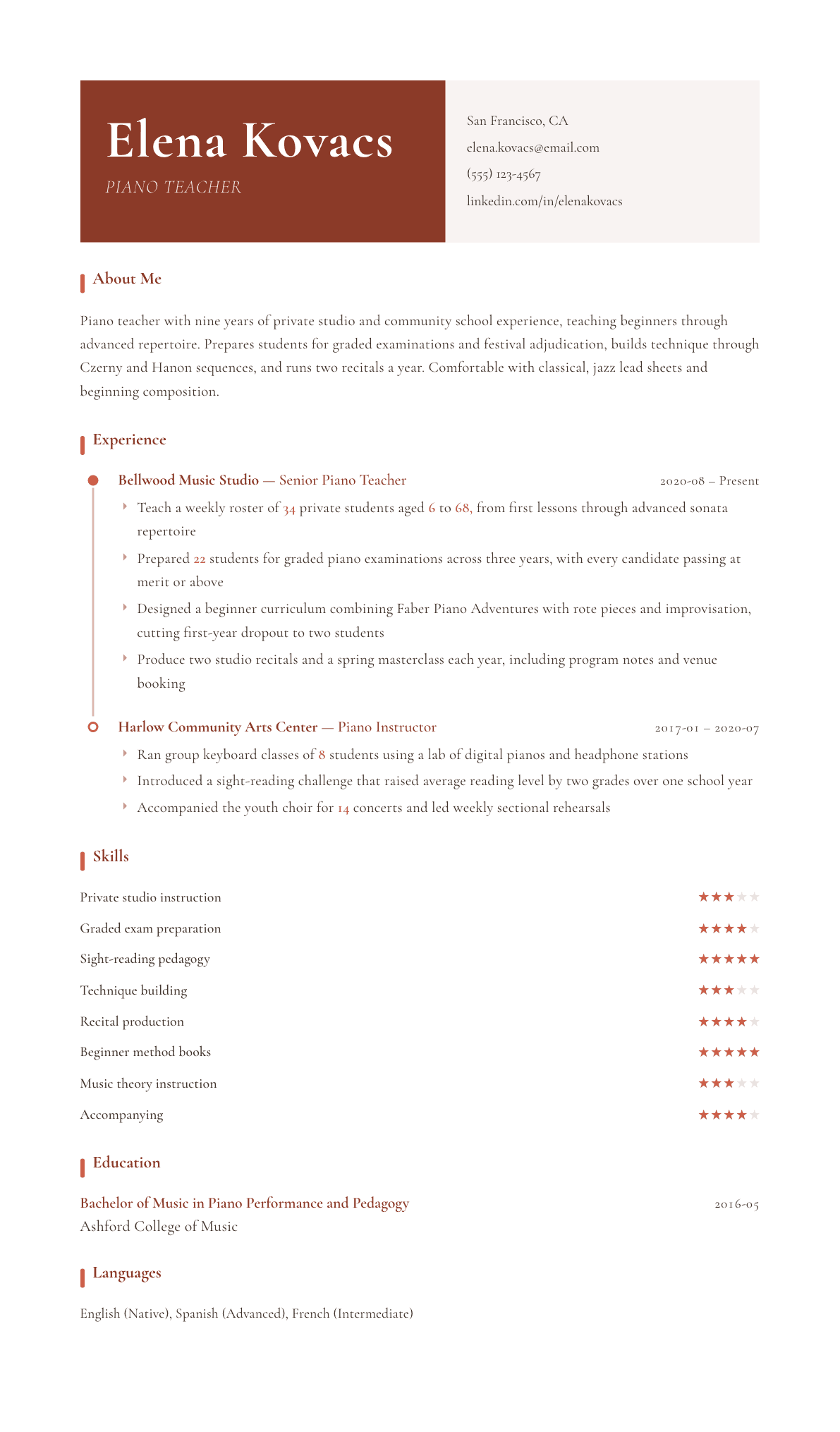
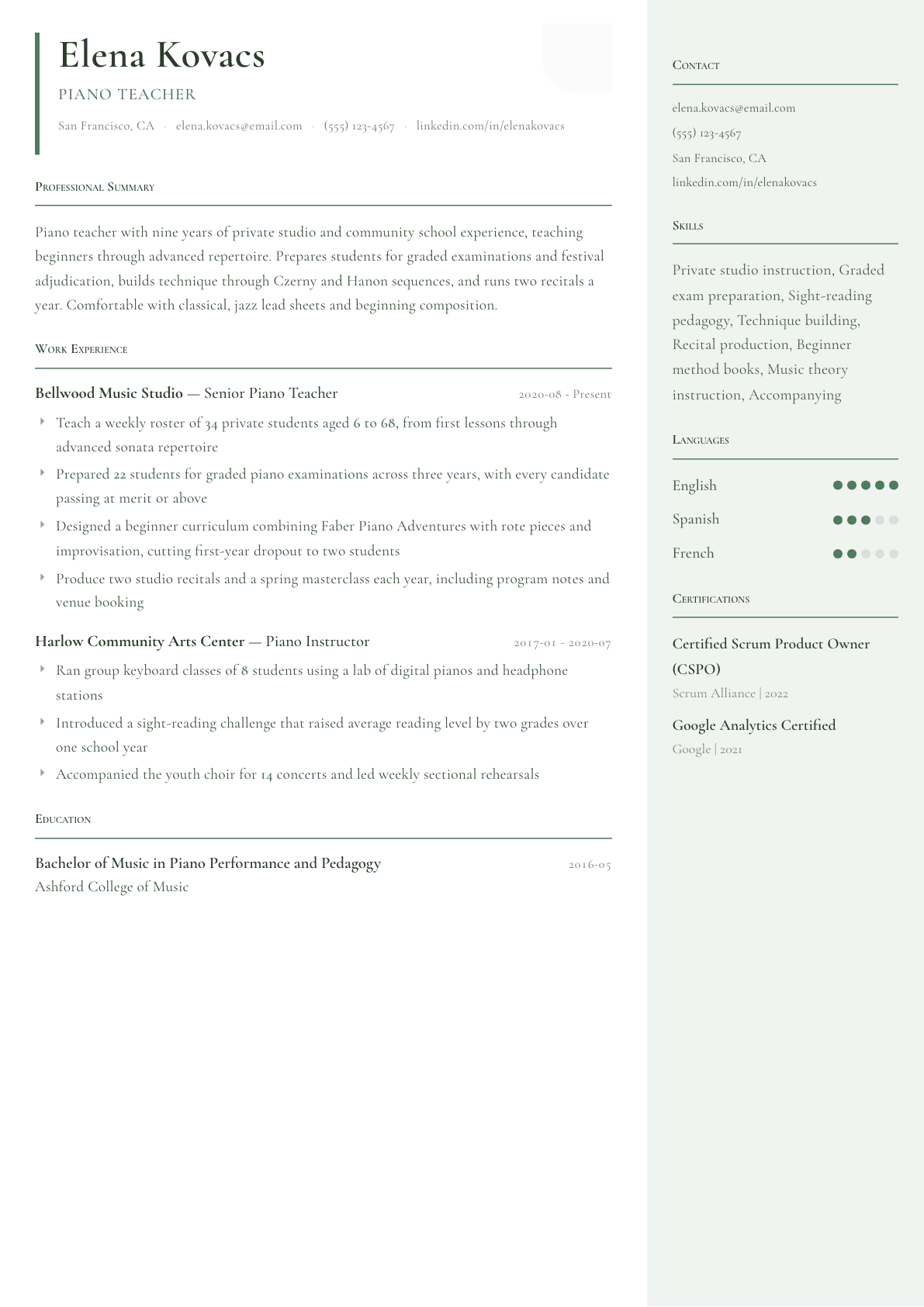
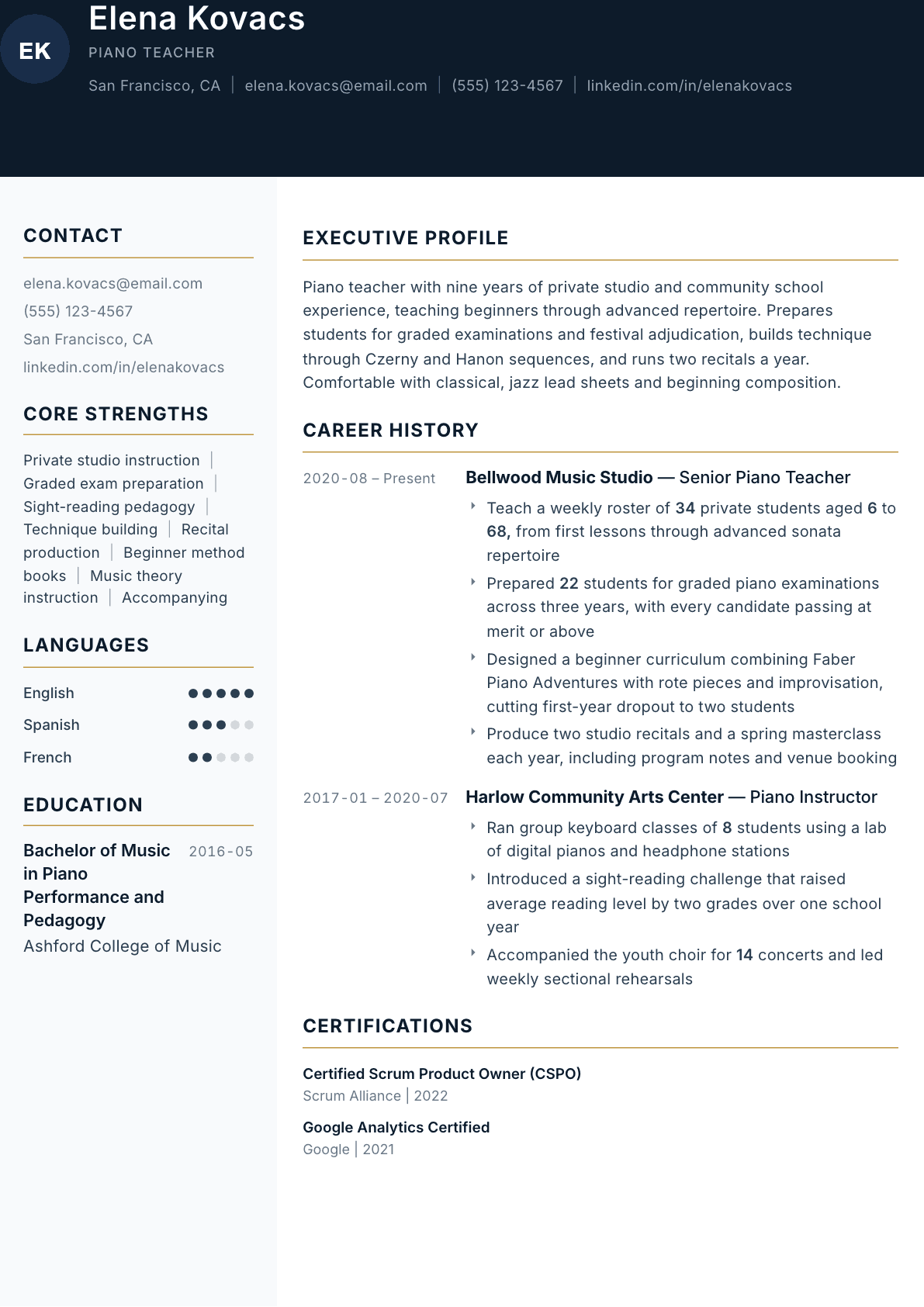
Example Piano Teacher summary
Piano teacher with nine years of private and community studio work, currently carrying a roster of 34 students from first lessons to advanced repertoire. Prepares candidates for graded examinations, coaches sight-reading and practice habits, and produces two recitals a year. Trained in performance and pedagogy, and comfortable teaching adults returning to the instrument after a long break.
Skills to list on a Piano Teacher resume
- Private piano instruction
- Group keyboard class teaching
- Graded examination preparation
- Music theory instruction
- Sight-reading development
- Technique and scale routines
- Repertoire selection
- Accompanying and collaborative piano
- Recital and festival preparation
- Beginner method curriculum
- Practice coaching for parents
- Ear training
- Improvisation and lead sheets
- Studio scheduling and billing
What actually gets this resume read
- Open with your teaching range: the youngest and oldest ages you take and the repertoire level you can carry.
- Name the method books and exam boards you work with, because studios and schools search on those exact terms.
- Give the size of your studio roster and the retention you hold, since both are the numbers an employer weighs.
- List recitals, festivals and competitions you have prepared students for, with the role you played in each.
- Add your own performance credits in a short section, but keep them below the teaching record on the page.
- Say which of your students passed examinations or won placements, because outcomes prove the pedagogy works.
- Mention background checks, studio insurance and any home-studio setup when you teach children privately.
How to write a piano teacher resume
A piano teacher resume is usually read by one of three people: a studio owner filling a roster, a community music school coordinator matching teachers to a schedule, or a parent who found you through a school directory and wants to know who will be alone in a room with their child. Each of them looks for something different, and a resume that only speaks to musicians misses two of the three.
The studio owner wants to know which levels you can carry, how many students you have held at once, and whether families stay with you. The school coordinator wants the day and time blocks you can fill, the group teaching you can do, and whether you can accompany. The parent wants credentials, background clearance, and evidence that beginners actually progress with you rather than quit in March.
This guide covers the section order that works for studio and school applications, three summaries at different career stages, before and after bullets drawn from the way piano teachers usually describe their work, and the questions that come up most when a performer sits down to write a teaching resume.
Format: teaching first, performing second, one page unless you are applying to a conservatory
Lead with the teaching record. Many pianists build the resume they used for auditions and then add lessons at the bottom, which tells a studio owner that teaching is your fallback. Reverse it. Performance credits belong in a compact section after your teaching history, listed by type rather than one line per concert.
Keep it to one page for a private studio or community school application. A university or conservatory pedagogy post is the exception: there you use a curriculum vitae with separate headings for teaching, performance, adjudication, presentations and student outcomes.
- Header: name, city, phone, email, and a link to a short teaching video or studio page if you have one.
- Order for studio work: summary, teaching experience, education, certifications and training, performance, skills.
- Order for a school position: summary, licenses and clearances, teaching experience, education, ensembles.
Summary: levels, ages, roster size, and the thing you fix
Three lines. Name the age range and the repertoire ceiling you can teach, the size of the studio you carry, and one specific strength. A pianist who can take a student from a first five finger position through a Chopin nocturne should say exactly that, because the ceiling is what separates candidates.
Pick a strength that is provable and useful to the person hiring. Beginner retention, exam preparation, adult returners, sight-reading, jazz lead sheets and accompanying are all things a studio is short of. Being passionate about music is not, because every applicant writes it.
Teaching experience: roster, level range, method, outcome
Each teaching entry needs four things: where you taught, how many students you carried at once, the age and level range, and what happened to those students. A line that reads twenty eight private students weekly, ages seven to adult, late elementary through early advanced, tells a studio owner more than a paragraph about your philosophy.
Then bullets on the work itself. Name the method books and the exam board, because studios teach from a shelf and want to know you can pick up theirs. Faber, Alfred, Bastien, Piano Safari and the Suzuki repertoire all signal a different beginner approach. Graded examination boards signal another kind of structure.
Finish each entry with an outcome bullet. Students who passed graded examinations, students who moved from one level to the next, retention across a school year, festival placements, or a recital you produced from booking through program notes. Outcomes are the part most piano teachers leave out, and they are the part that gets read.
Training, credentials and clearances
A degree in performance is not the same as training in pedagogy, and studios know it. If you hold a pedagogy degree, a certification from a national teaching body, or Suzuki teacher training at a stated volume level, put it in its own block. If your training came from workshops, conferences and years of studio observation, name those specifically rather than leaving the section empty.
Anyone teaching minors should list a current background check, and anyone teaching in a home studio should mention liability insurance. These two lines cost nothing to include and remove a question the parent or the school would otherwise have to ask.
- Teaching credential or pedagogy coursework, with the granting body.
- Suzuki teacher training with the volumes completed, when that is your approach.
- Background check status and studio liability insurance for private teaching.
- Accompanying and collaborative piano experience, since many schools hire for it.
Skills and keywords a studio search actually matches
Studio directories and school postings use a narrow vocabulary. The phrases that recur are private piano instruction, group keyboard, music theory, sight-reading, graded examination preparation, accompanying, beginner method, adult students and improvisation. Use the ones that are true of you in the summary once and in the skills section once, and then prove them inside a bullet.
Add the practical items families ask about before they ask about music: whether you teach in their home, in your studio or online, which platform you use for remote lessons, whether you have a second instrument, and which languages you teach in. These decide bookings more often than repertoire does.
Piano Teacher resume summary examples
Recent graduate
Piano performance graduate with two years of private teaching alongside degree study, carrying 9 students from first lessons through late elementary repertoire. Trained in Faber and Piano Safari beginner methods, comfortable with theory fundamentals and ear training, and seeking a studio roster with room to grow.
Established studio teacher
Piano teacher with 9 years of private and community school work, carrying 34 weekly students from beginners to advanced sonata repertoire. Prepared 22 candidates for graded examinations across 3 years with every candidate passing at merit or above, and produces 2 studio recitals a year.
Studio lead and adjudicator
Piano teacher and pedagogy specialist with 18 years of studio work, a roster of 40, and 4 teachers supervised at a community music school. Adjudicates at regional festivals, mentors early career teachers through observation cycles, and has prepared students for conservatory auditions.
Work experience bullets: before and after
Before: Taught piano lessons to students of all ages.
After: Taught 34 weekly private students aged 6 to 68, from first lessons through advanced sonata and nocturne repertoire.
The roster size, age band and repertoire ceiling tell a studio owner exactly which slots you can fill.
Before: Prepared students for exams.
After: Prepared 22 students for graded piano examinations over 3 years, covering scales, sight-reading and aural components, with every candidate passing at merit or above.
Naming the exam components and the results turns a claim into a track record a coordinator can rely on.
Before: Used beginner method books in lessons.
After: Built a first year curriculum combining Faber Piano Adventures with rote pieces and simple improvisation, which cut beginner dropout to 2 students that year.
The named method plus a retention outcome shows a deliberate approach rather than following whatever book was on the shelf.
Before: Organized recitals for my students.
After: Produced 2 studio recitals a year end to end: venue booking, program notes, running order by difficulty, and a pre-recital run-through for nervous first-time performers.
Listing the production steps shows you can take an event off the owner's desk, not just prepare pieces.
Before: Helped students improve their sight-reading.
After: Introduced a weekly sight-reading challenge with leveled cards and a practice log, raising the average reading level of the group class by 2 grades across a school year.
The method and the measured gain make a common teaching claim concrete and repeatable.
Hard skills
- Private piano instruction
- Group keyboard class teaching
- Graded examination preparation
- Beginner method curriculum
- Sight-reading pedagogy
- Technique and scale routines
- Music theory instruction
- Ear training and aural skills
- Accompanying and collaborative piano
- Repertoire selection by level
- Improvisation and lead sheets
- Recital and festival preparation
- Online lesson delivery
- Studio scheduling and billing
Soft skills
- Patience with slow progress
- Practice motivation
- Parent coaching
- Reading a student's frustration early
- Clear verbal correction
- Reliability across a weekly schedule
Certifications worth listing
- Nationally Certified Teacher of Music (Music Teachers National Association)
- Suzuki Teacher Training, Piano Units (Suzuki Association of the Americas)
Mistakes that cost piano teacher candidates the interview
- Building the resume around performance credits so that teaching looks like something you do between concerts.
- Writing that you teach all levels without naming the highest repertoire you have actually taken a student through.
- Leaving out the roster size, which is the single number a studio owner uses to judge whether you can carry a schedule.
- Skipping the method books and exam boards, so a coordinator cannot tell whether you fit the studio's existing shelf.
- Never mentioning retention, examination results or festival placements, which leaves the reader nothing to verify.
- Omitting background clearance and insurance when the role involves teaching children in a home or private studio.
- Listing every concert you have ever played instead of grouping performance work into two or three summary lines.
Piano Teacher resume questions
Do I need a music degree to work as a piano teacher?
Private studios and community schools usually hire on demonstrated teaching ability, references and a trial lesson rather than a degree. A degree helps at schools and universities, and pedagogy training of any kind strengthens an application that lacks one.
Should performance experience go on a piano teaching resume?
Yes, but compressed into a short section below your teaching record. Group it by type such as solo recitals, chamber work, accompanying and church positions, rather than listing individual concerts, and keep the total to a few lines.
How do I write a piano teacher resume with only a few students?
Show the students you have with their ages, levels and how long they have stayed, then add related work: accompanying, choir sectionals, church playing, assisting an established teacher, or a practicum from a pedagogy course. Depth beats headcount early on.
What should I say about online piano lessons?
Name the platform you teach on, the camera setup you use for the keyboard, and how you handle materials, whether that is scanned assignments, a shared practice log or a digital notebook. Studios that added remote students want a teacher who has already solved this.
How do I show that my students actually improve?
Use outcomes a stranger can check: examination results, festival or competition placements, students who moved up a level, retention across a school year, and students who went on to auditions. One outcome bullet per teaching entry is enough.