Yoga Instructor Resume Examples: the lines they read
Resume for Yoga Teacher and Yoga Instructor Jobs
By Mustafa Tarabya, founder of CVBooster · Published · Updated
A resume for yoga teacher and yoga instructor jobs: class formats, training hours, registration, settings from studio to school, keywords and a full guide.
Sample resumes for a yoga instructor
The same yoga instructor content laid out in three CVBooster templates, so you can see what the finished document looks like before you write a word.
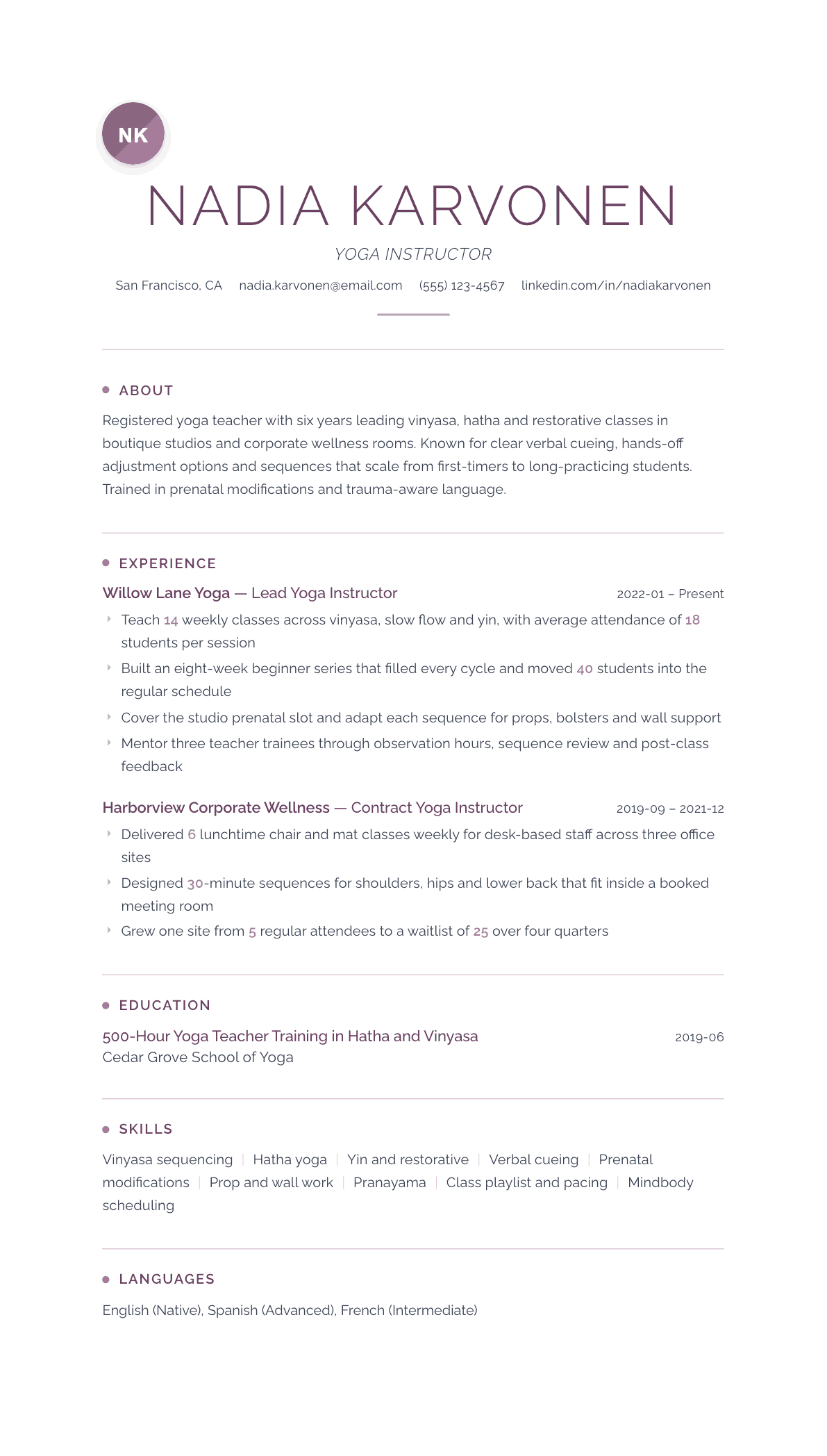
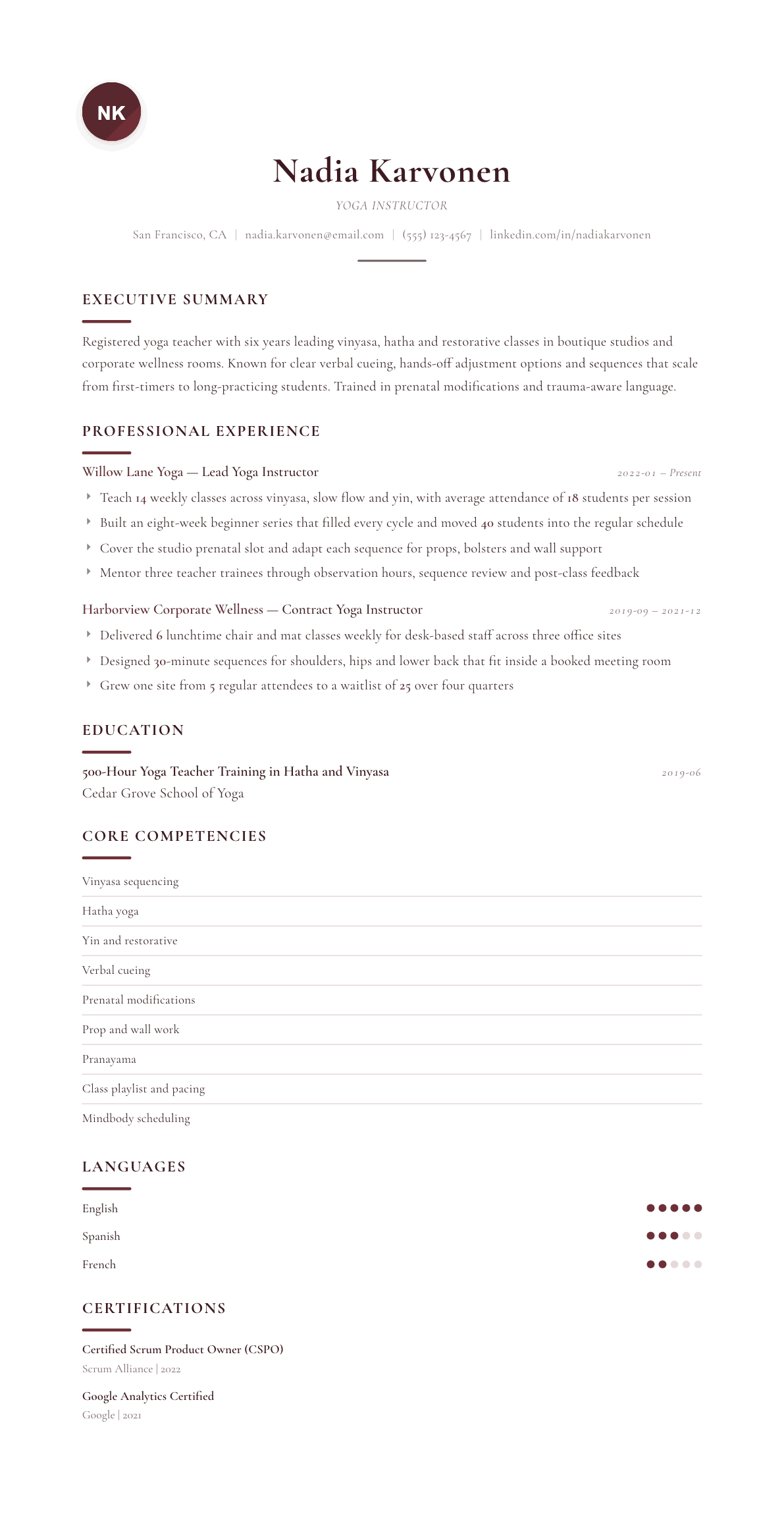
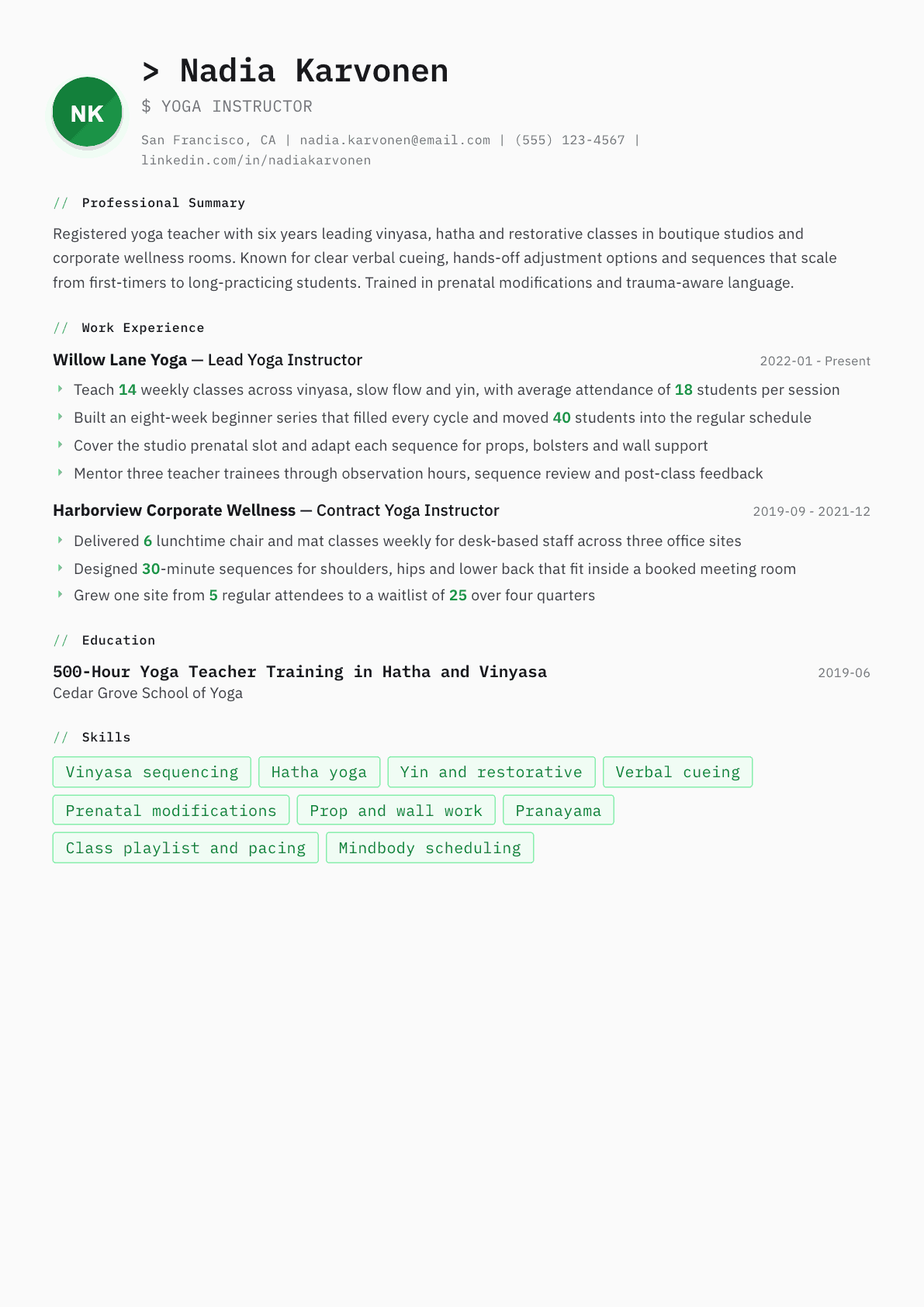
Example Yoga Instructor summary
Registered yoga teacher with six years of studio and corporate teaching across vinyasa, hatha and restorative formats. Teaches 14 classes a week to mixed-level rooms, built a beginner series that converts newcomers into members, and trains new teachers through observation and feedback. Certified in prenatal modifications and comfortable running workshops and private sessions.
Skills to list on a Yoga Instructor resume
- Vinyasa flow
- Hatha yoga
- Yin yoga
- Restorative yoga
- Prenatal yoga
- Chair yoga
- Sequence design
- Verbal cueing
- Hands-on assists
- Pranayama
- Anatomy for movement
- Injury modifications
- Workshop planning
- Private client coaching
- Studio scheduling software
- Community building
What actually gets this resume read
- Put your registration and training hours in the header so a studio manager sees them before reading anything else.
- Name every style you can teach on the schedule: vinyasa, hatha, yin, restorative, power, prenatal, chair.
- Give class counts and average attendance per week, because studios hire on the ability to fill a room.
- List continuing education by subject, not just hours, so the reader learns what you can actually cover.
- Say which booking system you have used, since studios run their schedule and payroll through it.
- Mention private clients, workshops and retreats separately from studio classes; they signal you can sell your own offering.
- Keep the personal philosophy paragraph to two lines and put the teaching evidence above it.
How to write a yoga instructor resume
Studio owners hire yoga instructors on two things a resume can prove: what you are cleared to teach, and whether students come back. Everything else is decoration. The owner is looking at a schedule grid with empty slots on it, and she wants to know which of those slots you can fill on a Tuesday morning without her rewriting the timetable.
That makes the yoga instructor resume unusual. The credential block matters, but so does a plain list of formats and time slots, and so does any number that shows retention: average heads in the room, a series that filled twice, a corporate contract renewed. Most applicants skip all three and write a paragraph about their personal practice instead.
This guide covers how to order the sections, what belongs in the training block, how to write class experience that reads like evidence, and the questions teachers ask when they move from teaching a friend group to applying at a studio. Gyms and wellness clubs often post the same job as yoga trainer, and a yoga trainer resume uses the identical structure, with group fitness formats and member retention given a little more room.
Format: one page, credentials and formats above the fold
One page is right for almost every teacher. A studio manager reviews applicants between classes, on a phone, and will not scroll past a second screen. Reverse chronological order, plain single column, no photo grid of poses.
The top third of the page has to answer three questions without the reader hunting: which training you completed and at what hour level, which styles you teach, and when you are available. Put availability in the header as a short line, because a teacher who can cover the six in the morning slot is worth more than one who can only teach weekends.
- Header: name, city, phone, email, training hours, registration status, and a one-line availability window.
- Sections in order: profile, teaching experience, training and certifications, styles and specialties, continuing education.
- A new teacher moves training above experience and adds practicum and community class hours.
Profile: styles, room types, and one thing you are known for
Two or three lines. Name the styles you teach, the settings you have taught in, and one specific strength. A studio that runs heated power classes and a rehabilitation clinic that runs gentle chair sessions are reading for opposite signals, so the profile is where you steer.
Skip the philosophy statement here. Almost every yoga instructor writes some version of meeting students where they are, which means the sentence carries no information. If your teaching has a real angle, alignment detail, breath-led pacing, athletic recovery, say the angle rather than the sentiment.
Teaching experience: classes per week, formats, and who was in the room
Each teaching role needs the studio or employer, the formats you covered, the number of classes a week, and the student population. A line that reads eleven weekly classes across vinyasa, slow flow and yin, mixed level drop-in room, tells an owner more than a paragraph about your approach.
Then two to four bullets. Use them for the things that separate a working teacher from an enthusiastic one: covering last-minute subs, building a series that filled, adapting for injuries in a full room, holding a corporate contract through renewal, mentoring trainees. Attendance figures belong here, because the studio is a business with a rent bill.
Substitute teaching counts and should be listed. A teacher who has covered forty subs across five studios has seen more room types than someone with one fixed slot, and owners read a strong sub list as reliability.
Training and certifications: hours, school, and lineage
List the school, the hour level and the tradition, in that order. Two hundred hours in hatha and vinyasa from a named school reads clearly. Add specialty trainings on their own lines: prenatal, yin, trauma-informed, children, chair and adaptive, yoga for athletes. Each one unlocks a different slot on a studio schedule, which is exactly how the owner will read it.
Keep current first aid and cardiopulmonary resuscitation certification listed with the issuing organization, because insurers and gym employers ask for it before your first shift. If you carry your own liability insurance, one line is enough.
Beyond the studio schedule: workshops, privates and retreats
Anything you have filled yourself belongs in its own short section. Workshops, six-week series, private clients, retreats and corporate contracts show that you can market a class, not only teach one. Studios increasingly want teachers who bring students with them, and this section is where that shows.
Name the booking or scheduling platform you have worked in, along with any front desk, membership sales or class check-in duties. Small studios hire one person to teach and to run the desk, and being able to do both moves you up the list.
Resume for a yoga teacher job: match the setting, not only the style
A resume for a yoga teacher job reads the same as a yoga instructor resume, and the two titles are used interchangeably in postings. Copy whichever word the advert uses into your title line. What changes between jobs is the setting, and each setting checks a different line first.
Write one master resume, then reorder the top third for each application so the line the employer checks first sits directly under your summary.
- Boutique studio: formats and time slots you can cover, average attendance, and any students who follow you to a new schedule.
- Gym or fitness chain: registration and hour level, first aid and CPR, group fitness experience, and comfort with a mixed ability room.
- School or after-school program: children's yoga training, background check status, classroom management, and sessions per week by age group.
- Corporate wellness: chair and desk formats, lunchtime sessions, contracts renewed, and how you handled a room of beginners.
- Clinic, rehab or senior living: adaptive and chair yoga training, work alongside physical therapists or care staff, and session notes.
Yoga Instructor resume summary examples
Newly trained teacher
Yoga teacher with 200-hour hatha and vinyasa training and 60 hours of practicum and community class teaching. Teaches beginner-friendly flow with clear breath cues and prop options. Current in first aid and cardiopulmonary resuscitation. Available for early morning, weekday evening and substitute slots.
Four years teaching
Yoga instructor with four years and 12 weekly classes across vinyasa, slow flow and yin in a mixed-level drop-in studio. Built a beginner series that filled three consecutive cycles and converted 30 newcomers into members. Trained in prenatal modifications and comfortable teaching rooms of 25 students.
Lead teacher and trainer
Lead yoga instructor with nine years of studio teaching and four years mentoring on a 200-hour teacher training faculty. Owns the weekly schedule for two studio rooms, runs quarterly workshops that sell out, and holds a corporate wellness contract renewed across three years.
Work experience bullets: before and after
Before: Taught yoga classes at a local studio.
After: Taught 12 weekly classes across vinyasa, slow flow and yin at a two-room studio, averaging 18 students per session.
Class count, formats and attendance let an owner picture you filling a specific slot on her grid.
Before: Created classes for beginners.
After: Designed and led an eight-week beginner series that filled every cycle and moved 40 first-time students onto the regular schedule.
The series length and the conversion into regular students turn a task into a business result.
Before: Worked with students who had injuries.
After: Adapted sequences on the spot for shoulder, knee and lower back limitations using blocks, straps and wall support, without pausing the class.
Naming the limitations and the props shows practical skill instead of a general claim of inclusivity.
Before: Helped new teachers.
After: Mentored three teacher trainees through observation hours, sequence review and written feedback after each class they led.
The specific mentoring steps prove you can be trusted with the studio's training pipeline.
Before: Taught corporate yoga.
After: Delivered six weekly chair and mat sessions across three office sites, building one location from five regulars to a waitlist.
The site count and the growth from five to a waitlist show you can hold and expand a contract.
Hard skills
- Vinyasa sequencing
- Hatha yoga
- Yin and restorative teaching
- Prenatal modifications
- Chair and adaptive yoga
- Verbal cueing
- Hands-on and hands-off assists
- Pranayama instruction
- Functional anatomy
- Injury modification and prop use
- Workshop and series design
- Studio booking software
Soft skills
- Room reading
- Pacing and timing
- Student retention
- Boundaries and consent
- Calm under a full room
- Reliability for subs
Certifications worth listing
- RYT 200 (Yoga Alliance)
- RYT 500 (Yoga Alliance)
- Registered Prenatal Yoga Teacher (RPYT) (Yoga Alliance)
- Registered Children's Yoga Teacher (RCYT) (Yoga Alliance)
- Adult First Aid and CPR/AED (American Red Cross)
- Group Fitness Instructor (American Council on Exercise)
Mistakes that cost yoga instructor candidates the interview
- Opening with a paragraph about your personal practice while the studio is trying to find out which classes you can cover.
- Leaving out class counts and average attendance, the two numbers a studio owner uses to decide whether you fill a room.
- Listing only the styles you love instead of every format you are trained and willing to teach.
- Hiding availability, so the manager has to email you before she can even check you against the empty slot.
- Skipping substitute teaching, which is often the longest and most varied part of a teacher's record.
- Letting first aid and cardiopulmonary resuscitation certification lapse and leaving it off, which stalls onboarding at gyms and clinics.
- Designing the page with pose photos and script fonts that fight with the applicant tracking system a gym chain runs.
Yoga Instructor resume questions
Do I need to be registered with Yoga Alliance to get hired?
Not everywhere. Independent studios often care more about the school you trained with and how you teach a trial class. Gym chains and insurers frequently do ask for registration, so list your hour level and school clearly either way.
How do I write a yoga resume with no paid teaching experience yet?
Put training first, then list every hour you have actually led: practicum classes, community and donation classes, friends and family sessions, event or festival slots. Give the format, the setting and the group size for each so the reader sees real mileage.
Is a yoga teacher or yoga trainer resume different from a yoga instructor resume?
No. Studios say teacher, gyms and clubs often say trainer, and the job is the same: certified training hours, the formats you can lead, classes per week and who keeps coming back. Use the title from the posting in your header. A gym reading a yoga trainer resume will also look for group fitness experience and current CPR.
How many styles should I claim I can teach?
Only the ones you could teach tomorrow morning without preparation panic. Claiming eight styles and freezing in a yin audition costs more than a shorter honest list. Put trained styles in one group and styles you assist with in another.
Does a yoga instructor resume need numbers?
Yes, more than most teachers expect. Classes per week, average attendance, series that filled, private clients retained, and contracts renewed are the figures a studio uses to judge whether hiring you adds revenue rather than cost.