Art Teacher Resume Examples: free ATS score and gap list
Art Teacher, Art Instructor and Art Education Resume Examples
By Mustafa Tarabya, founder of CVBooster · Published · Updated
Art teacher and art instructor resume examples, plus art education resume tips for graduates, studio and community educators: license, media, shows.
Sample resumes for a art teacher
The same art teacher content laid out in three CVBooster templates, so you can see what the finished document looks like before you write a word.
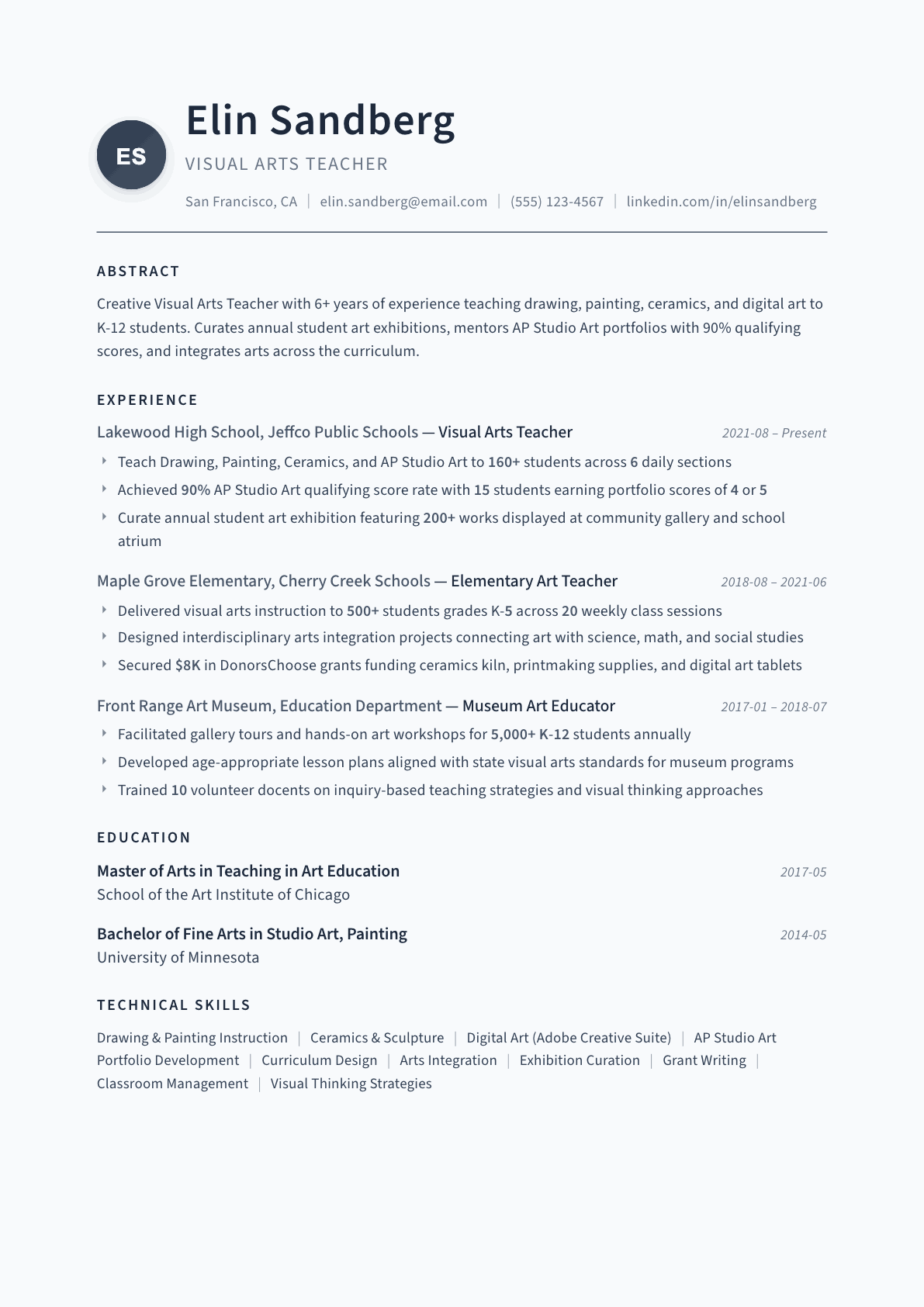
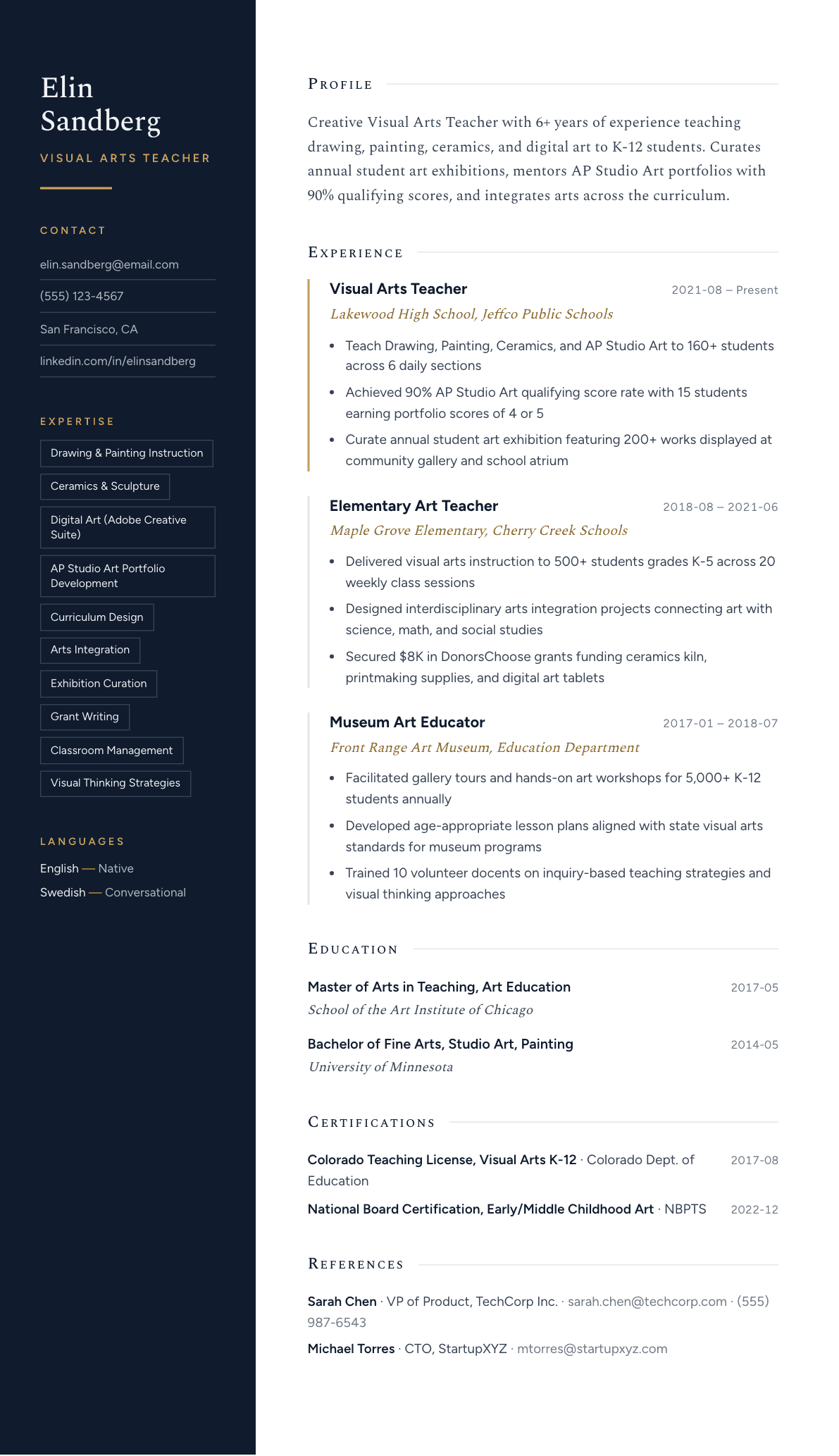
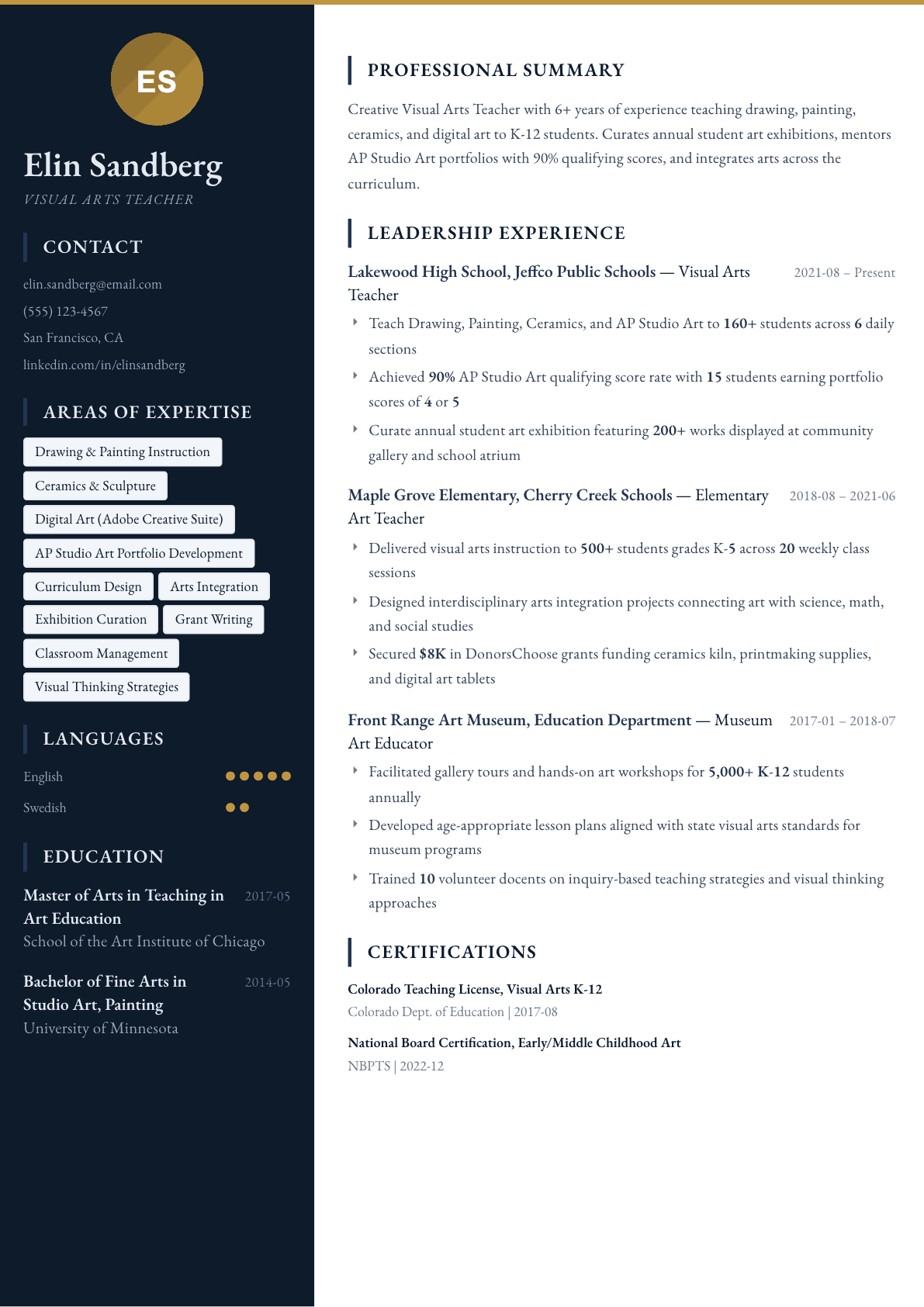
Example Art Teacher summary
Visual Arts Teacher with 6 years of K-12 experience teaching drawing, painting, ceramics, and AP Studio Art. Achieved 90% AP qualifying scores, curates annual 200+ piece student exhibitions, and secured $8K in art supply grants.
Skills to list on a Art Teacher resume
- Drawing & Painting
- Ceramics & Sculpture
- Printmaking
- Digital Art / Adobe Suite
- AP Studio Art
- Curriculum Design
- Arts Integration
- Exhibition Curation
- Grant Writing (DonorsChoose)
- Visual Thinking Strategies
- Classroom Management
- Art History
What actually gets this resume read
- Showcase the range of media and techniques you teach: drawing, painting, ceramics, printmaking, digital.
- Include AP Studio Art results and student exhibition highlights to demonstrate program quality.
- Highlight arts integration projects that connect visual arts with other subject areas.
- Mention grant writing accomplishments and creative fundraising for art supplies and equipment.
- Include your own artistic practice or exhibitions to show continued professional growth as an artist.
How to write a art teacher resume
An art teacher resume is read by a principal who is filling a single position that touches the whole building. Unlike a grade-level hire, the art teacher usually is the department, so the principal is asking whether one person can run a kiln safely, teach five preparations a day, hang a show that makes the school look good, and manage a cart or a room with two hundred students cycling through it a week.
Human resources looks at something narrower and more absolute: the state teaching license with a visual arts endorsement and the grade band it covers. Without that line near the top, a strong portfolio does not save the application, because the district cannot legally place you.
This guide covers the license block, how to write media range so a principal can see what you can actually teach, the studio management details that separate experienced art teachers from new ones, how an art education or art instructor resume works for graduates, studio instructors and museum or community educators, and the questions art teachers ask when they move between elementary, middle and high school programs. Districts that post an arts teacher job, covering visual art alongside crafts, design or media arts, read an arts teacher resume the same way, so list every arts discipline you are licensed and equipped to teach.
Format: license first, media range visible, portfolio linked
One page for the first few years, two once you have advanced placement results, exhibitions and grants to report. Put a licensure line directly under the header: the state, the endorsement area, the grade band, and any additional endorsement such as gifted education or English learners. Districts screen on that line before anything else.
Add a portfolio link that shows student work first and your own practice second. Principals want to see what students produced under your instruction, because that is the evidence of teaching. Your own exhibition record matters too, but it answers a different question.
- Header: name, city and state, phone, email, portfolio link, and the state license with endorsement and grade band.
- Section order: summary, licensure, teaching experience, media and curriculum, exhibitions and grants, education.
- Student teachers should list each placement with the grade band, the school type and the media taught.
Arts teacher resume summary: grade band, media and the program you built
Name the grade band, the years, the media you teach to a high standard, and the part of the program you own. An art teacher who runs advanced placement studio art and a ceramics sequence is a different hire from one who teaches a six-week elementary rotation to every student in the building, and both are valuable to the right principal.
Add one thing that made the program visible: an annual exhibition, a district art show, a mural, a scholastic art award record, or an advanced placement portfolio pass rate. Visibility is what a principal remembers about an art program.
Experience: preparations, media taught, and studio management
Open each role with the load. The grade band, the number of daily preparations, the class sizes, the number of students you see across a week, and whether you had a dedicated room or taught from a cart. A line reading five preparations, 28 students per section, 420 students weekly in a shared room describes a workload that any building administrator recognizes instantly.
List the media honestly and specifically: drawing, painting, printmaking, ceramics with hand building and wheel throwing, sculpture, fibers, photography with darkroom or digital, and digital design in Adobe Photoshop and Illustrator or Procreate. A principal is matching your list against the equipment already sitting in the room, so a general claim of mixed media tells them nothing about whether the kiln will be used.
Then write the studio management that experienced art teachers know is the real job: kiln operation and firing schedules, ventilation and material safety data sheet compliance, tool inventory and safety instruction, supply budget and ordering, and a cleanup routine that lets a class of twenty-eight leave a room usable in four minutes. New teachers skip this and it shows.
Curriculum, assessment and how you defend the grade
Show standards alignment to the National Core Arts Standards or your state arts standards, and name the four artistic processes of creating, presenting, responding and connecting if your curriculum documents use them. Then show assessment, which is where art teachers get challenged: rubrics for craftsmanship and concept, critique protocols, artist statements, sketchbook checks, and portfolio review.
Arts integration is worth its own bullet if you have done it well. A collaboration with a social studies teacher on a historical mural or with science on botanical illustration gives a principal a concrete reason to protect your position in a tight budget year.
Exhibitions, grants and your own practice
Give exhibitions a real section. Annual student shows with the number of pieces hung, district and regional art shows, scholastic art and writing award submissions and results, community gallery partnerships, and any public installation. Include the logistics you handled: matting and mounting, labels, hanging, opening night and family attendance.
List grants and fundraising with the funder and what the money bought. Art programs run on supplemental funding, and a teacher who has written successful grants for a kiln, tablets or printmaking equipment is solving a problem the principal already has. Close with your own exhibitions, residencies and gallery representation, kept to a few lines.
Art education and art instructor resumes: graduates, studios and community programs
An art education resume is the same document seen from the degree side. Graduates of art education programs, museum educators and community arts staff use the phrase, and the reader still wants the same three things: the credential, the media you can teach and proof that you can run a room. For a new graduate the degree and student teaching do most of the work, so put them directly under the license block and give student teaching the same detail as a paid job.
If you teach art outside a public school, say who the learners were and how often you saw them. A museum educator who led gallery tours for visiting classes, a community center instructor running a weekly ceramics course for adults, and a summer camp art lead all have real teaching evidence. Name the setting, the age range, the group size and the program you planned, and connect it to the grade band you are applying for.
An art instructor resume is the version for teaching outside a licensed classroom: community arts centers, private studios, recreation departments, summer programs and college continuing education. No state license is needed for most of these posts, so the top block becomes your degree, the media you teach and the courses you have run, with class size, age range and how many sessions each course lasted. Community college art instructor postings usually list a degree requirement, so copy their wording into your education line.
Keep it a resume, not an academic CV, unless you are applying for a college teaching post. A school principal wants two pages at most, while a university search committee expects the longer CV with exhibitions, publications and conference talks in full.
- Education block for a new graduate: Bachelor of Fine Arts in Art Education, K-12 visual arts licensure program, senior thesis exhibition in printmaking.
- Student teaching entry: Student teacher, middle school art, three preparations across sixth to eighth grade, planned and taught a clay unit and co-curated the spring student show.
- Museum educator entry: Gallery educator, city art museum, led inquiry-based tours for visiting elementary classes and wrote the pre-visit lesson packet sent to teachers.
- Art instructor entry: Art instructor, private studio and recreation department, designs and teaches eight week drawing and acrylic painting courses for teens and adults, twelve students a class, and hangs an end of term show.
- Community program entry: Ceramics instructor, community arts center, taught a weekly wheel-throwing course for adult beginners and managed kiln loading and firing schedules.
Art Teacher resume summary examples
First year out
Newly licensed K-12 visual arts teacher with two student teaching placements covering elementary rotation and high school drawing and ceramics. Comfortable with kiln operation, hand building and wheel throwing, and digital design. Portfolio includes student work from a 14-week ceramics unit and a school mural project.
Six years in
High school art teacher with six years teaching five preparations including drawing, painting, ceramics and advanced placement studio art to 420 students weekly. Grew the advanced placement section from 9 students to 31 and hung an annual exhibition of 200 works with a 92% qualifying score record.
Department lead
Visual arts department lead with twelve years across middle and high school, supervising three teachers and a full ceramics, photography and digital design sequence. Wrote grants funding a second kiln and a 20-station digital lab, and placed 47 student works in regional scholastic art awards over four years.
Work experience bullets: before and after
Before: Taught art to students in grades 9 through 12.
After: Taught five daily preparations across grades 9 to 12, including foundations drawing, painting, ceramics and advanced placement studio art, reaching 420 students a week in a shared studio.
Preparation count, course names and weekly student load describe a workload a principal can compare to the vacancy.
Before: Used the kiln and taught ceramics.
After: Ran the ceramics program end to end: wheel throwing and hand building instruction, glaze mixing, two weekly bisque and glaze firings, kiln maintenance logs, and ventilation and material safety compliance.
Firing schedules, maintenance and safety compliance are the parts a principal worries about, and naming them removes the worry.
Before: Organized the school art show every year.
After: Curated an annual spring exhibition of 200 student works, handling matting, labels, hanging and the opening reception, with attendance growing from 80 to 340 families over three years.
The scale, the production work and the attendance growth show a program that reached beyond the classroom.
Before: Wrote grants for art supplies.
After: Secured four classroom grants funding a second kiln, a set of drawing tablets and printmaking presses, then reported outcomes to each funder with student work samples.
Naming what the funding bought and the reporting follow-through shows a teacher who can be trusted with external money.
Before: Graded student artwork fairly.
After: Assessed studio work with a four-point rubric covering craftsmanship, concept and revision, paired with written artist statements and a mid-unit critique protocol that students led in small groups.
A described assessment system answers the parent challenge that every art teacher eventually faces.
Hard skills
- Drawing and painting instruction
- Ceramics: wheel throwing and hand building
- Kiln operation and firing schedules
- Printmaking
- Sculpture and fibers
- Digital art in Adobe Photoshop and Illustrator
- Photography, darkroom and digital
- National Core Arts Standards alignment
- Studio safety and material compliance
- Rubric design and portfolio assessment
- Advanced placement studio art portfolio preparation
- Exhibition curation and installation
- Grant writing for classroom funding
- Supply budget and inventory management
Soft skills
- Classroom management in an open studio
- Critique facilitation
- Differentiation across ability ranges
- Advocacy for the arts program
- Family and community engagement
- Collaboration with other subject teachers
Certifications worth listing
- State Teaching License, Visual Arts (State Department of Education)
- National Board Certification in Art (National Board for Professional Teaching Standards)
- Adobe Certified Professional in Visual Design (Adobe)
- Adult and Pediatric First Aid and CPR (American Red Cross)
Mistakes that cost art teacher candidates the interview
- Leaving the state license, endorsement and grade band off the top of the page, which stops the application before the portfolio is opened.
- Claiming mixed media instead of naming the specific media, so the principal cannot tell whether the equipment already in the room will be used.
- Filling the portfolio with your own work and almost none of your students', when student outcomes are what a school is hiring.
- Skipping kiln operation, ventilation and studio safety, which are the first questions asked in an art teacher interview.
- Describing the annual show as organized the art show with no scale, no production detail and no attendance.
- Ignoring assessment, leaving a principal to assume you grade art on effort and cannot defend a grade to a parent.
- Omitting the number of daily preparations and weekly student count, the two figures that describe an art teacher's real load.
Art Teacher resume questions
Should I include my own artwork in an art teacher portfolio?
Include a small section of your own practice, but lead with student work. A principal is hiring instruction, so the evidence they need is what beginners produced under your unit plans. Your own exhibitions belong on the resume as professional credibility and near the end of the portfolio.
How do I write an art teacher resume when I taught from a cart?
Say so plainly and make it a strength. Teaching from a cart means you planned for portable materials, fast setup and cleanup inside a shared classroom, and managed supplies without a sink. Principals in elementary buildings often hire for exactly that ability.
What is the difference between an art teacher, art instructor and art education resume?
Mostly the angle. An art education resume often comes from a recent graduate or a museum or community educator and leans on the degree, student teaching and program work, while an art teacher resume leads with classroom years and an art instructor resume leads with the courses you have run in studios, community programs or colleges. All three need the credential line, a license for schools, a degree for colleges and your training for studios, the media you teach and evidence that you can manage a studio full of students.
How do I show results when art has no standardized test?
Use the outcomes your program actually produces: advanced placement portfolio scores, scholastic art award submissions and recognitions, exhibition size and attendance, enrollment growth in elective sections, and student work accepted into district or community shows.
What changes when I apply to elementary rather than high school art?
Elementary hiring is about volume and rotation: hundreds of students a week, short sessions, fast transitions and age-appropriate materials. High school hiring is about depth and sequence: advanced courses, portfolio preparation and specialized equipment. Rewrite the summary and first bullets for whichever one you are applying to.