Music Teacher Resume Examples: free ATS score and gap list
Hit the Right Note with a Music Teacher Resume
By Mustafa Tarabya, founder of CVBooster · Published · Updated
Create a music teacher resume showcasing your instrument proficiency, ensemble direction, curriculum development, and ability to inspire students through music education.
Sample resumes for a music teacher
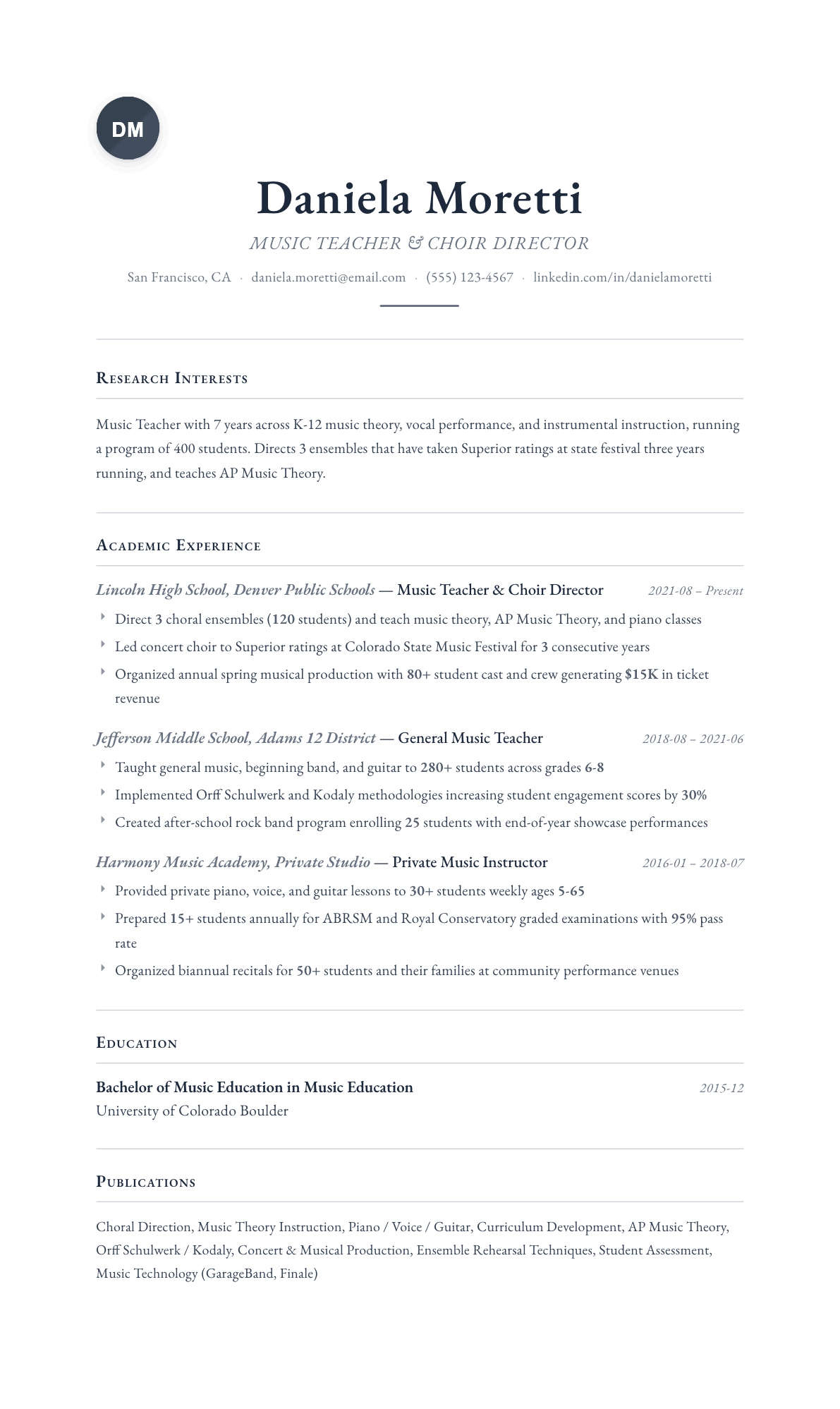
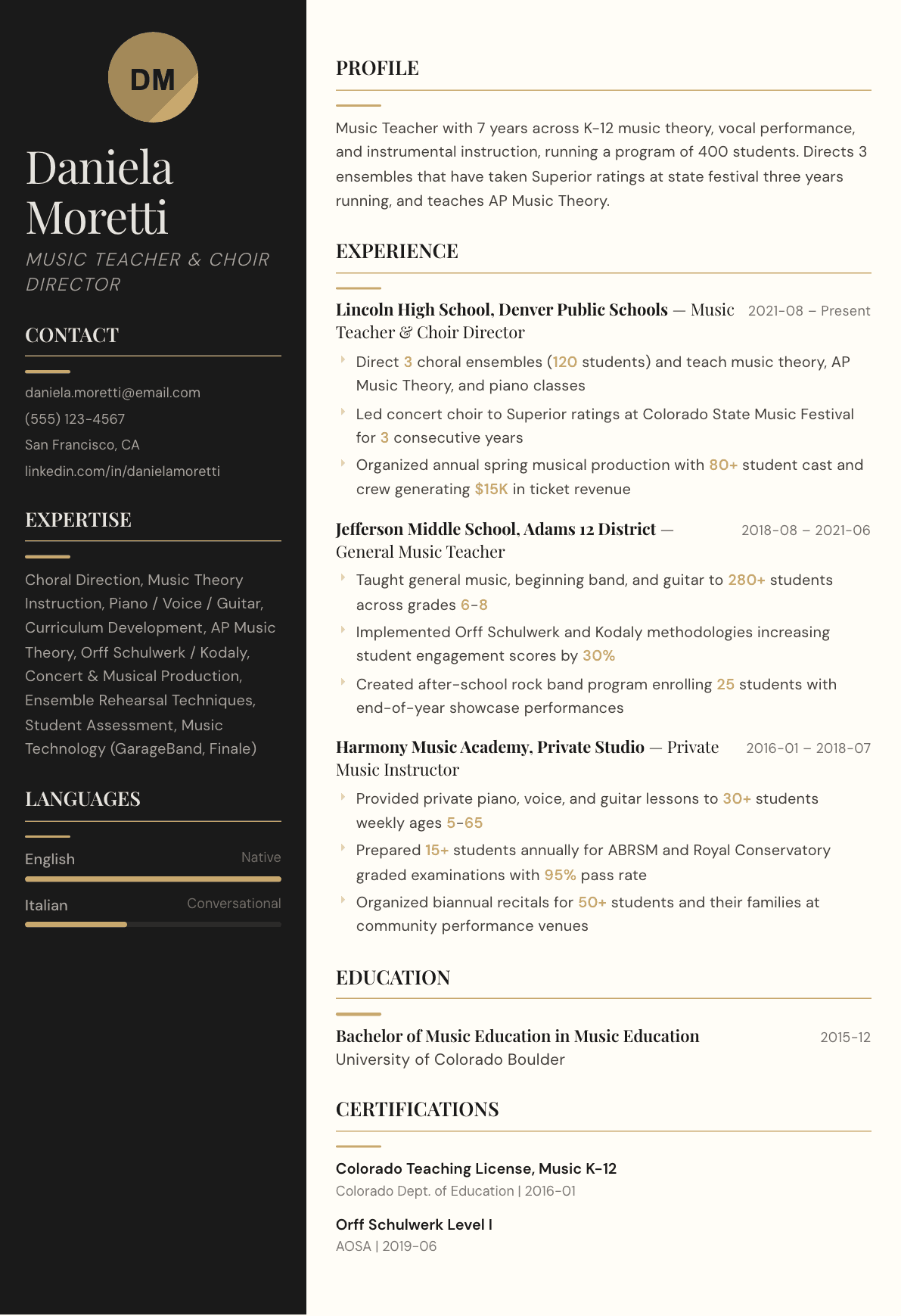
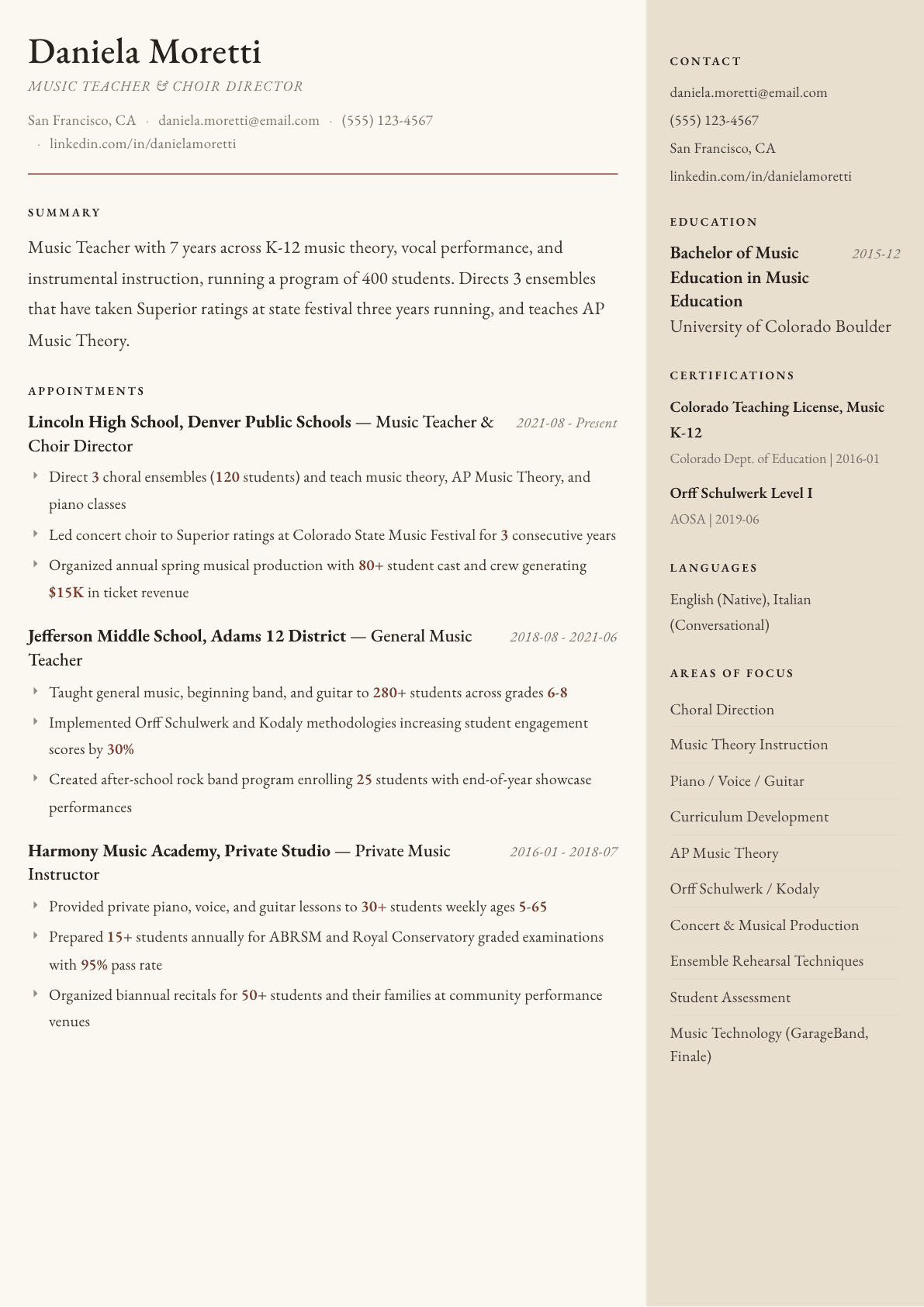
The same music teacher content laid out in three CVBooster templates, so you can see what the finished document looks like before you write a word.
Example Music Teacher summary
Music Teacher with 7 years of K-12 experience directing 3 ensembles to Superior state competition ratings. Teaches music theory, piano, and vocal performance to 400+ students with expertise in Orff and Kodaly methodologies.
Skills to list on a Music Teacher resume
- Choral / Ensemble Direction
- Music Theory & History
- Piano / Voice / Guitar
- Curriculum Design
- AP Music Theory
- Orff / Kodaly / Suzuki Methods
- Concert & Musical Production
- Rehearsal Techniques
- Student Assessment
- Music Technology
- Classroom Management
- Community Engagement
What actually gets this resume read
- Include your teaching license/certification with endorsement area and state.
- Highlight ensemble competition results. Superior and Excellent ratings carry significant weight.
- List all instruments and voice types you teach to show versatility.
- Mention music education methodologies: Orff, Kodaly, Suzuki, Dalcroze, or Gordon.
- Include musical productions, concerts, and community performances you have organized.
How to write a music teacher resume
Music teacher openings are unusually specific, and the specificity is the whole game. A school does not need a music teacher; it needs someone to take over the marching band, or to run elementary general music across four buildings, or to rebuild a choral program that lost half its singers. The principal and the arts coordinator read your resume against that one assignment, and the first thing they look for is whether you have run that kind of program before.
The second thing they read for is the ensemble record and the recruiting record. Directors are judged on what happens at festival and on how many students sign up next year, and both are visible from a resume if you write them down. Enrollment growth is often the more persuasive number, because a program that is growing is a program a principal does not have to worry about.
This guide covers the file a district arts office expects, how to write ensemble direction, general music instruction and private studio work, three music education resume examples written out for band, general music and choir, summaries at three stages, and the questions music teachers ask when they move between grade levels or between performance and teaching.
Format: two pages, with performance credits kept in proportion
Use a standard reverse-chronological teaching resume of two pages. Musicians often arrive from the performance world with a long list of credits and recitals, and that list, pasted in whole, buries the teaching evidence a principal needs. Keep a short performance section near the end unless you are applying to a conservatory or a studio faculty position.
Put the state license with the music endorsement and grade band directly under the header, and note additional endorsements such as general music, instrumental or vocal if your state issues them separately.
- Header: name, city and state, phone, email, license with music endorsement, and a link to a performance or program video if you have one.
- Order: summary, certification, teaching and directing experience, ensemble and festival record, education, private studio work, performance credits.
- A new graduate leads with student teaching, marching band staff work and any assistant directing.
Summary: what you direct, who you teach, and what the program does
Name the ensembles and the teaching load: concert band, marching band, jazz ensemble, orchestra, concert choir, show choir, general music, guitar, piano lab, music theory. Then the grade levels and the number of students in the program. A choral posting screens out band-heavy resumes in seconds, so lead with what matches.
Close the summary with the program's trajectory. Enrollment growth, festival ratings, a group you started, or a program you took over after a vacancy and stabilized are all outcomes an arts coordinator recognizes as hard to achieve.
Experience: rehearsal, repertoire, logistics and recruiting
Describe each position as a program, not as a set of classes. Give the ensembles, the number of students in each, the rehearsal schedule including before and after school commitments, and the performance calendar for a typical year. A principal who sees a realistic performance calendar knows you understand what the job costs.
Then the musicianship. Repertoire selection and the grade level of literature you program, sectional and full rehearsal technique, sight-reading instruction, music theory and history content, improvisation, and the methodologies you teach general music through, such as Orff, Kodaly, Dalcroze or Music Learning Theory. Elementary postings in particular are written around those methods.
Finish with the logistics nobody warns new directors about, because experience with them is a selling point: instrument inventory and repair, uniform and robe management, booster relations, fundraising, travel planning, festival registration, budget administration and scheduling around athletics. Programs fail on logistics more often than on musicianship.
The ensemble and festival record
Give this its own short section when you have a directing history. Festival and adjudication ratings, honor ensemble selections among your students, state auditions, solo and ensemble results, and invited performances all belong here, each with the year and the ensemble named. Keep it factual and let the record speak.
Recruiting and retention deserve the same treatment. The number of beginners recruited from feeder schools, the share of students who continued from one year to the next, and the growth or recovery of an ensemble are the numbers that predict whether the program survives a leadership change.
Skills: instruments, voice, and the technology in the room
State your primary instrument or voice type and your secondary proficiencies honestly, because a middle school general music position may require you to teach beginning band across all families, and an interview will include playing. Note conducting study, piano proficiency and accompanying ability, since being able to accompany your own choir changes a school's staffing math.
List the technology you teach with: notation software, a digital audio workstation, recording equipment, the piano or keyboard lab setup, and the software you use for practice submissions and assessment. Arranging and composing for your own ensembles is worth naming, since it saves a program money and adapts literature to the players you actually have.
Music education resume examples, written out
Three music education resume examples, one per common opening, written as plain text in the order a principal and a fine arts coordinator read them. The teachers and schools are invented; copy the order and the kind of detail, then swap in your own ensembles and enrollment.
High school band director. Header: Marcus Hale, Director of Bands, Knoxville, Tennessee, state teaching license in instrumental music, K-12. Summary: Band director in his eighth year leading a marching band, two concert bands and a jazz ensemble of about 110 students in total, with the program taking superior ratings at the state concert festival and a feeder plan built with the middle school director.
Elementary general music. Header: Ellen Park, General Music Teacher, Sacramento, California, single subject credential in music. Summary: Elementary general music teacher serving about 600 students a week in kindergarten to grade five across two buildings, trained in Orff Schulwerk levels I and II, running a fifth grade choir and a spring program for every grade.
Middle school choir, first year. Header: Jasmine Ortiz, Choral Music Teacher, Austin, Texas, music certification EC-12. Summary: Choral music teacher completing student teaching with two middle school choirs and a high school chamber choir, comfortable accompanying rehearsal on piano, and ready to prepare a choir for its first region concert and sight-reading evaluation.
- Band director: Grew the marching band from 64 to about 110 members over five seasons by running a summer beginner camp and visiting every fifth grade classroom each spring.
- Band director: Manage an inventory of school-owned instruments, the uniform stock and a booster budget with the parent board, and plan travel for two festival trips a year.
- General music: Teach a sequenced curriculum of singing, movement, recorder and Orff instruments across 24 classes a week in two buildings.
- Choir: Prepared a 40-voice middle school choir for concert and sight-reading evaluation during student teaching, leading sectionals and the warm-up sequence.
Music Teacher resume summary examples
First teaching position
Music teacher licensed K-12 with student teaching split between elementary general music for 380 students and a high school band program of 65. Trained in Orff Schulwerk Level I, plays trumpet and piano, and served three seasons on a marching band staff teaching brass technique.
Seven years directing
Choral director with seven years leading three ensembles totaling 120 singers at a comprehensive high school, plus AP Music Theory and piano class. Grew choir enrollment from 74 to 120 through a feeder school recruiting cycle and earned Superior ratings at state festival in four of the last five seasons.
Program director
Director of bands overseeing a 190-student program across concert, marching, jazz and percussion ensembles with two assistant directors. Manages the instrument inventory, the booster budget and a travel calendar, and rebuilt the middle school feeder sequence that now supplies about 50 beginners a year.
Work experience bullets: before and after
Before: Directed the school choir and taught music classes.
After: Directed three choral ensembles totaling 120 singers, taught AP Music Theory and two sections of piano class, and rehearsed before school four mornings a week through concert season.
Ensemble count, enrollment, the academic courses and the rehearsal schedule show the real size of the job.
Before: Improved the band program.
After: Grew band enrollment from 88 to 143 over four years by starting a fifth grade instrument petting zoo at both feeder schools and adding a beginning guitar class that fed into the program.
The growth number is credible because the recruiting mechanism behind it is named.
Before: Took students to music festivals.
After: Prepared and conducted the concert choir at state large group festival for five consecutive seasons, earning Superior ratings in four, and coached 22 students through solo and ensemble adjudication.
Adjudicated results with the ensemble and the count of soloists are the record a coordinator can verify.
Before: Managed the music budget and equipment.
After: Administered an annual program budget with booster fundraising, tracked an inventory of 210 school-owned instruments through a repair cycle, and cut outside arranging costs by scoring marching charts for the instrumentation on hand.
Inventory scale and a cost decision show the administrative half of directing that principals worry about.
Before: Taught general music to elementary students.
After: Taught general music to 420 students across grades K-5 on a rotating schedule, building an Orff-based sequence with barred instruments, recorder in fourth grade and a spring program for every grade level.
Enrollment, grade span, method and the yearly performance structure describe an actual elementary program.
Hard skills
- Choral and instrumental conducting
- Concert and marching band direction
- Repertoire selection and programming
- Sectional and full ensemble rehearsal technique
- Music theory and aural skills instruction
- Orff Schulwerk and Kodaly methods
- Sight-reading instruction
- Arranging and transcription
- Notation software and digital audio workstations
- Recording and sound reinforcement
- Instrument inventory and repair coordination
- Festival and adjudication preparation
- Booster and fundraising administration
Soft skills
- Rehearsal pacing and focus
- Recruiting and persuasion
- Working with parent volunteers
- Performance-day composure
- Individual encouragement
- Scheduling negotiation
Certifications worth listing
- Orff Schulwerk Teacher Certification Levels I to III (American Orff-Schulwerk Association)
- Kodaly Certification (Organization of American Kodaly Educators)
- Dalcroze Certificate (Dalcroze Society of America)
- National Board Certification, Music (National Board for Professional Teaching Standards)
Mistakes that cost music teacher candidates the interview
- Sending one resume to band, choir and general music openings when each screens for a different half of your experience.
- Listing recitals and performance credits at the top, which reads as a performer looking for a paycheck rather than a director.
- Giving ensemble names with no enrollment, so nobody can tell a chamber group of nine from a marching band of 150.
- Leaving out recruiting and retention, the numbers that show a program will still exist in three years.
- Ignoring the administrative work: inventory, budget, boosters, travel and uniforms are a large part of the position.
- Overstating instrument proficiency, which an interview that includes playing will uncover within minutes.
Music Teacher resume questions
How do I list my performing career on a teaching resume?
Keep a short section near the end with the most relevant credits: principal chairs, professional ensembles, recording work and recitals at recognized venues. Two or three lines establish your musicianship. A full performance list belongs in a separate curriculum vitae for conservatory or studio faculty applications.
Should I include a link to a recording of my ensembles?
Yes, when the recording is decent. A single link in the header to a short program video or a festival performance lets a hiring committee hear the ensemble sound you produce, which is the thing they most want to know and cannot learn from any resume.
How do I apply for an elementary general music job with only secondary experience?
Lead with method training such as Orff, Kodaly or Dalcroze levels, since elementary postings are written around them. Then surface any work with younger students: feeder school recruiting visits, summer camps, a private studio with beginners, or a children's choir you have directed in a community setting.
Do festival ratings really belong on a resume?
Yes, when you name the festival, the ensemble and the years. Ratings are the closest thing music education has to an external audit, and an arts coordinator reads them the way a principal reads test scores. Report them plainly and avoid claiming credit for a season you did not direct.
What if I am asked to cover multiple buildings?
Say directly that you have done it and how. Name the number of buildings, the travel schedule, the cart-based teaching if you had no room, and the total student count. Multi-building assignments are common and difficult, and prior experience with them removes a serious risk from the hiring decision.