Product Manager Resume Examples: the lines they read
Product Manager Resume Examples and a Product Management Template
By Mustafa Tarabya, founder of CVBooster · Published · Updated
Product manager resume examples and a product management resume template with the section order, metrics, discovery work and ATS keywords product leaders check.
Sample resumes for a product manager
The same product manager content laid out in three CVBooster templates, so you can see what the finished document looks like before you write a word.
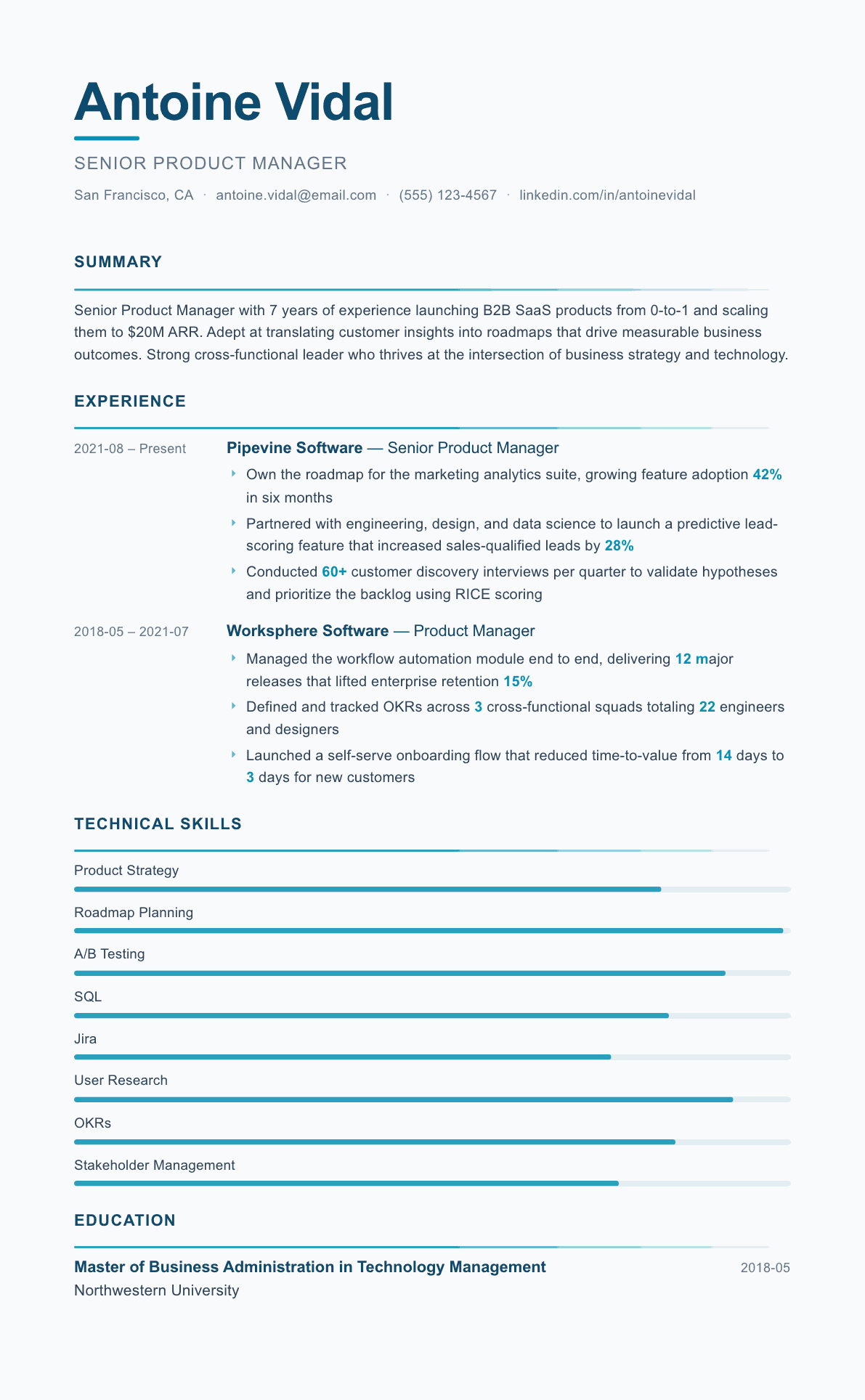
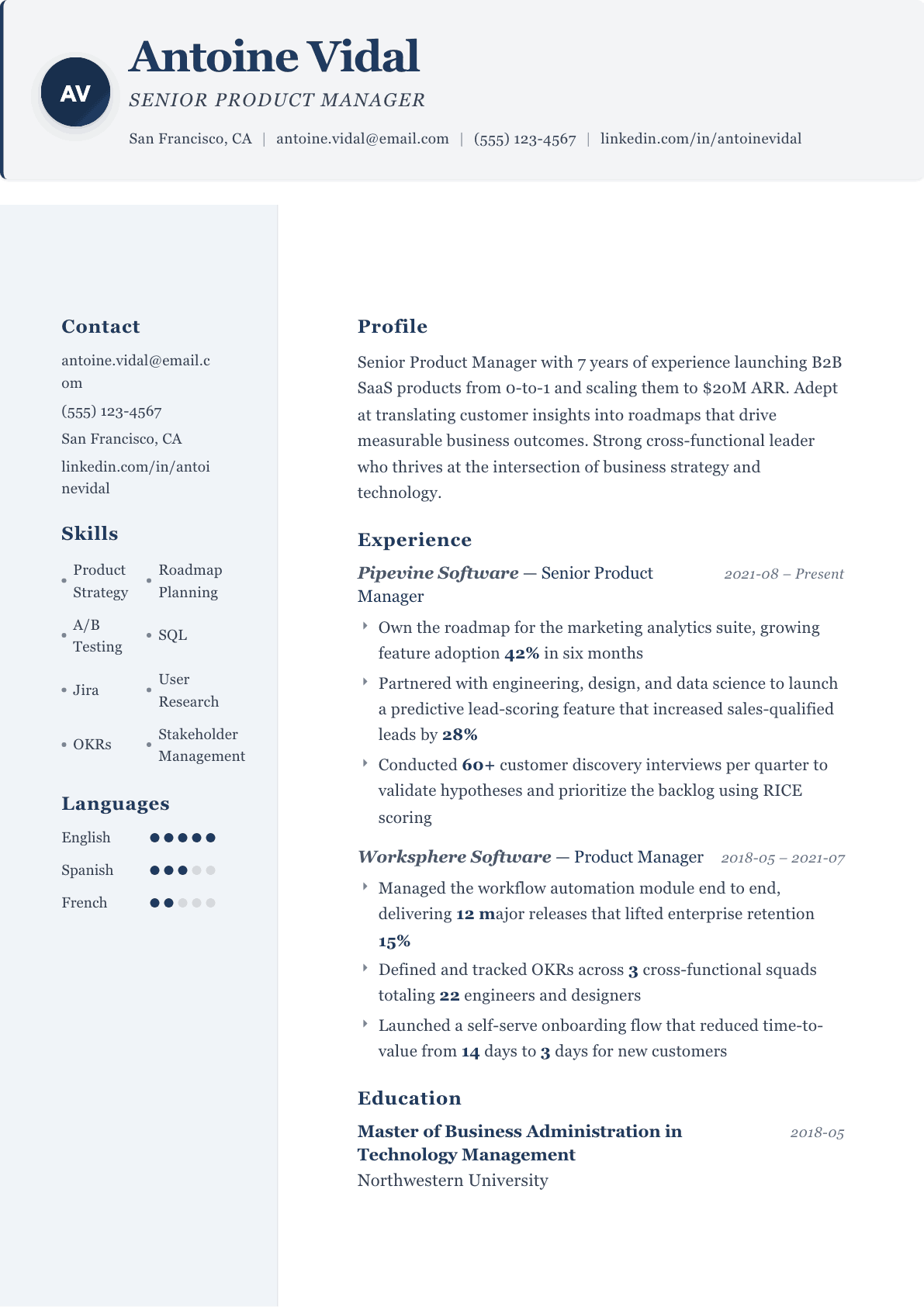
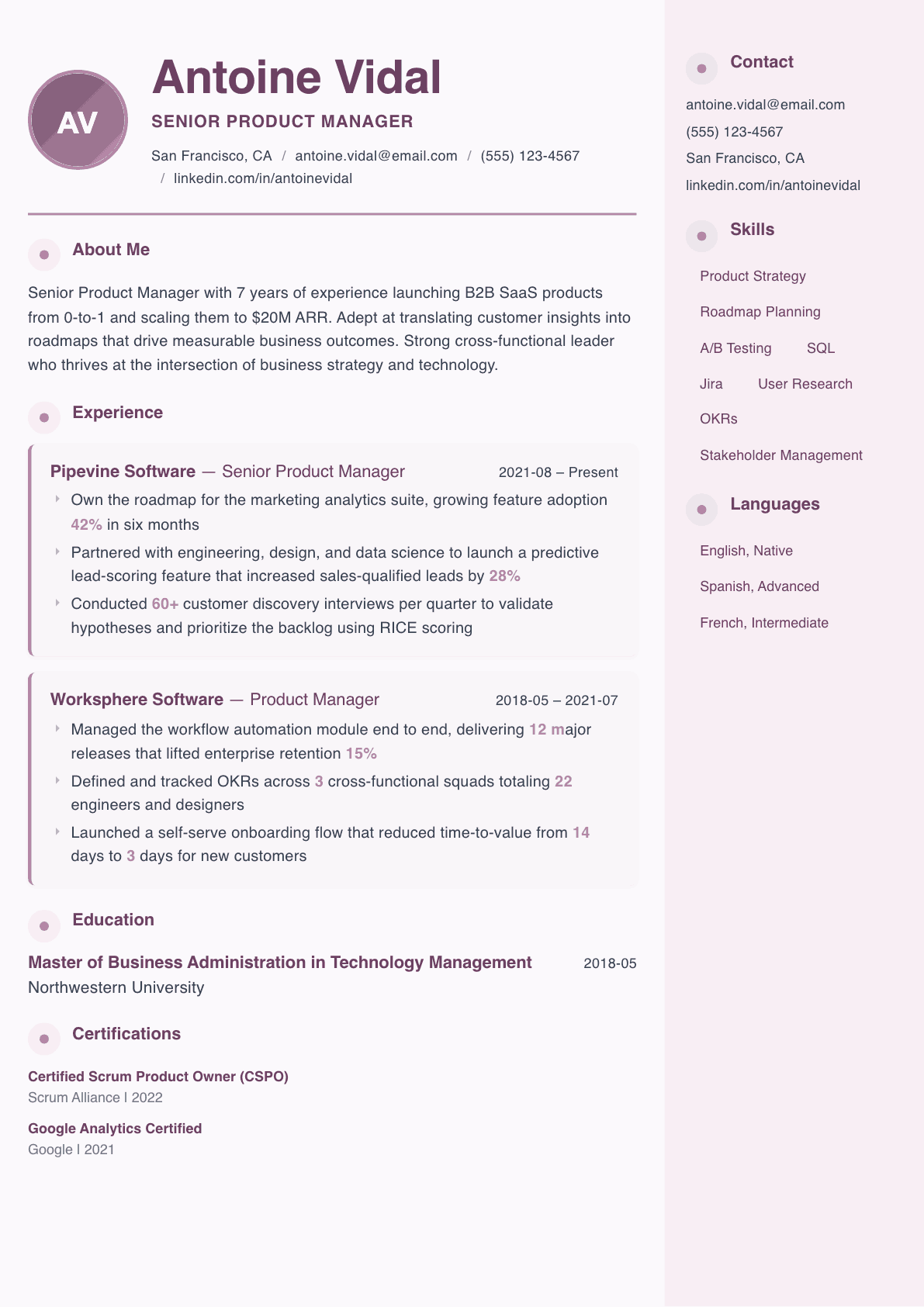
Example Product Manager summary
B2B SaaS product manager, 7 years, two products taken from zero to one and scaled past $20M in annual recurring revenue. Runs discovery at 60 customer interviews a quarter, prioritizes with RICE, and works with squads of 22 engineers and designers. Recent wins include predictive lead scoring worth a 28% lift in sales-qualified leads and an onboarding rebuild that cut time to value from 14 days to 3.
Skills to list on a Product Manager resume
- Product Strategy
- Roadmap Planning
- User Research
- A/B Testing
- SQL
- Data Analysis
- Jira
- Agile / Scrum
- OKRs
- Stakeholder Management
- Competitive Analysis
- Go-to-Market Strategy
- Wireframing
- Customer Discovery
- PRD Writing
What actually gets this resume read
- Frame every bullet point around outcomes: revenue growth, retention lift, adoption rate, or cost savings.
- Show your ability to prioritize by referencing frameworks like RICE, MoSCoW, or ICE explicitly.
- Highlight cross-functional leadership by naming the teams and disciplines you partnered with.
- Include metrics for both discovery (interviews conducted, experiments run) and delivery (features shipped, launches).
- Demonstrate data fluency by mentioning tools like SQL, Amplitude, Mixpanel, or Looker.
- Tailor your resume to the company stage: emphasize 0-to-1 for startups, scale and optimization for enterprise.
How to write a product manager resume
Product manager openings attract the widest range of backgrounds of any role in a technology company, so the screen is brutal and it is mostly about evidence. A head of product reading your file is trying to separate people who decided what to build from people who wrote tickets for decisions someone else made. Titles do not answer that question, and neither do adjectives, so the resume has to.
The strongest signal is a decision with a number on both sides of it. You saw something in the data or in customer conversations, you chose to build one thing and not another, and a metric moved that the business already tracked. A file made of feature launches with no metric attached reads as delivery management, which is a different job and usually a lower band.
This guide covers the shape of a product resume that survives a five second scan, how to write about discovery and experiments honestly, how to handle a launch that failed, summaries for an associate product manager, a mid level product manager and a group or principal, and the questions people ask when moving into product from engineering, design, support or consulting.
Format: product context before responsibilities
One page until you have roughly ten years of experience. Under each role, before any bullets, write the product context: what the product was, who used it, the business model, the scale, and the team around you. Something like a self serve billing product for small business customers, on a squad of six engineers and one designer, reporting to the head of platform. A reader can then interpret every bullet correctly instead of guessing whether you owned a public product or an internal tool.
Scale matters more than the company name. Monthly active users, accounts, transaction volume, requests per second on the surface you owned, or annual recurring revenue for the product line, stated as a magnitude, all tell the reader the weight of the decisions you made. A product manager on a small internal tool at a famous company is not senior to one who owned a revenue surface at a company nobody has heard of.
- Context line: product, users, business model, scale, team composition.
- Bullets: two on decisions and outcomes, one on discovery, one on cross functional or technical depth.
- A short skills block with the analytics, experimentation and tracking tools you personally used.
- For candidates moving into product, a section for products or side work you actually built and released.
Write decisions, not deliveries
The verb at the front of a product bullet tells the reader what kind of product manager you are. Coordinated, supported, gathered requirements and managed the backlog point at execution support. Chose, cut, prioritized, killed, repositioned, rebuilt and reordered point at ownership. Use the second set, and back each with the reasoning: what you learned, what you traded away, and what happened.
The trade off is the part candidates leave out and interviewers ask about. A bullet that says you cut two of five planned features from a release after usability testing showed users never reached them, and released three weeks earlier as a result, demonstrates judgment far better than a bullet listing all five.
Metrics: the ones a product leader trusts
Not every number is a product metric. Activation rate, week four retention, conversion through a defined funnel step, task success rate, time to first value, support contact rate, expansion revenue, churn and net revenue retention are metrics a product leader recognizes and can interrogate. Story points, tickets closed, releases per quarter and features delivered are throughput measures and they weaken the page.
Always give the baseline and the window. Lifting activation from a stated starting point over a named period is a claim someone can test in an interview, which is exactly why it is believable. Where the result is confidential, use a relative movement and describe the cohort instead of the absolute figure.
If a bet did not work, one honest bullet about it is a strength. Say what you predicted, what the experiment showed, what you did next, and what the team stopped doing. Product leaders have all killed things and they hire people who can.
Discovery and research: quantity plus method
Show that you talk to users on a routine rather than during a project. Give the cadence and the method: weekly customer calls, a continuous interview habit, usability sessions before a redesign, sales call listening, support ticket analysis, or a diary study for a workflow change. Then show one place where research overturned an internal assumption, because that is the proof that discovery was real and not a formality before a decision already made.
Quantitative discovery counts too. Say what you queried yourself. A product manager who writes their own structured query language against the event tables, builds funnels in the product analytics tool, and reads the experiment results without waiting for an analyst is materially faster than one who cannot.
Keywords, and tailoring to company stage
Postings repeat a known vocabulary: product strategy, roadmap, discovery, prioritization, experimentation, go to market, product requirements, stakeholder alignment, product led growth, and objectives and key results. Include the ones you have practiced, once each, attached to work rather than clustered in a list.
Then tailor to stage. An early stage company wants to see zero to one work: finding the first customers, releasing something rough, changing direction on evidence. A large company wants to see work inside constraints: legacy systems, compliance review, partner teams, migration of an existing user base without breaking it. The same career can be presented either way, and the wrong emphasis loses a screen you would have passed.
Product management resume template: the section order to copy
A product management resume template is a fixed order of blocks that lets a head of product find the same facts in the same place on every file. Use the order below for associate, mid level and senior product roles, keep it to one column so it parses cleanly in an applicant tracking system, and change the content per posting rather than the layout.
Candidates moving into product from engineering, design, support or consulting keep the same template and add one block for products or side projects they actually built and released, placed above education.
- Header: name, city, email, phone and a portfolio or LinkedIn link.
- Summary: three lines with product area, scale, stage of company and one decision with its metric.
- Experience: a context line per role (product, users, business model, scale, team), then three to four bullets on decisions, discovery and outcomes.
- Skills: analytics, experimentation and tracking tools you used yourself, plus methods such as discovery interviews and pricing tests.
- Products built and education: side projects or launches, then degree and any product owner or scrum credential.
Product Manager resume summary examples
Associate product manager
Associate product manager on a mobile onboarding surface used by roughly four hundred thousand monthly users. Ran nine usability sessions that led to cutting two steps from account setup, lifting completion from 62% to 74%, and writes the squad analytics queries directly in the warehouse.
Product manager, five years in
Product manager owning billing and subscription management for a business to business platform, working with a squad of seven engineers and a designer. Rebuilt the plan upgrade flow after interviews showed customers could not find it, raising self serve expansion by 31% and removing a recurring category of support tickets.
Group product manager
Group product manager leading three squads across the growth and monetization area, with two product managers reporting in. Set the quarterly strategy against retention and expansion goals, killed a payments partnership after a four week pilot, and grew net revenue retention across two annual cycles.
Work experience bullets: before and after
Before: Managed the product roadmap and backlog for the team.
After: Owned the quarterly roadmap for the billing area, cutting eleven requested items to four after scoring each against expansion revenue and support load, and published the reasoning to sales and support before the quarter started.
The reader sees the prioritization criteria and that you defended the decision to the teams it affected.
Before: Launched a new feature that users liked.
After: Released a saved filters feature after ten customer interviews identified repeated manual setup, reaching 38% weekly adoption in the target segment within two months and cutting a recurring support request category.
The evidence that prompted the build and a measured adoption figure replace an unverifiable claim about sentiment.
Before: Ran A/B tests to improve conversion.
After: Ran six experiments on the checkout funnel over a quarter, of which two shipped positive, and documented the four losing variants so the team stopped repeating a pricing display idea that had already failed twice.
Reporting the losses and what the team learned reads as scientific rather than as a highlight reel.
Before: Worked closely with engineering and design.
After: Paired with the tech lead to break a nine month platform migration into four releasable stages, letting the team deliver the first customer facing benefit in six weeks instead of at the end.
A concrete collaboration outcome shows technical partnership, where the generic version shows only proximity.
Before: Gathered customer feedback and requirements.
After: Set a weekly customer call habit across two quarters, turning 40 conversations into a themed opportunity backlog that replaced the previous request list sorted by whoever asked loudest.
The cadence and the change to how the team decided make discovery a practice rather than an activity.
Hard skills
- Product discovery and customer interviews
- Roadmap and prioritization frameworks
- Experiment design and analysis
- Product requirement documents
- SQL and warehouse querying
- Amplitude and Mixpanel
- Event tracking and instrumentation design
- Funnel and cohort analysis
- Pricing and packaging
- Go to market planning
- Jira and Linear
- Figma and design review
- Objectives and key results
Soft skills
- Saying no with a reason
- Written communication
- Influencing without authority
- Facilitating disagreement between functions
- Comfort with ambiguity
Certifications worth listing
- Professional Scrum Product Owner (PSPO I) (Scrum.org)
- Certified Scrum Product Owner (CSPO) (Scrum Alliance)
- SAFe Product Owner / Product Manager (POPM) (Scaled Agile)
- Pragmatic Institute Product Certification (Pragmatic Institute)
Mistakes that cost product manager candidates the interview
- Listing features released with no metric, which reads as delivery work rather than product ownership.
- Using throughput measures such as tickets closed or velocity as if they were product outcomes.
- Leaving out the product context, so a reader cannot tell an internal admin tool from a revenue surface.
- Claiming credit in the plural for a whole team result without saying which part you decided.
- Hiding every failed bet, which makes the file read as either lucky or edited.
- Naming analytics tools you have only seen dashboards from rather than queried yourself.
- Writing the same resume for an early stage company and a large enterprise, when they screen for opposite evidence.
Product Manager resume questions
How do I move into product management from engineering or design?
Lead with the decisions you already made: the scope you cut, the customer problem you reframed, the feature you argued against. Add anything you released end to end, including side projects with real users, and use the product context line to show you understand users and business model, not only the build.
What if my company will not let me publish product metrics?
Use relative movement and describe the cohort. Raising activation by a stated percentage among new self serve accounts over one quarter reveals nothing confidential and is fully interrogable in an interview. Avoid vague substitutes such as significantly improved, which read as if there was no number at all.
What is the best product management resume template?
A plain one column template with a header, a three line summary, experience with a product context line per role, a skills block and education. Keep it to one page up to about ten years of experience. Product leaders reward editorial judgment, so a clean template with strong bullets beats a designed layout with graphics.
Do product management certifications help?
They help least of any signal in this field and they never substitute for outcomes. A scrum or product owner credential is worth a line if you have it, particularly in enterprises that run formal agile frameworks, but it belongs at the bottom of the page, not in the summary.
How do I write about a product that was canceled or a company that shut down?
State it plainly and keep the evidence. Describe what you learned, the decision you made with it, and why the bet was closed, whether that was funding, a market signal, or a strategy change. Hiring managers care that you can read a weak signal early far more than that every product survived.
Related resume examples
- Business Analyst Resume example
- UX Designer Resume example
- Marketing Manager Resume example
- Head of Product Resume example
- Product Marketing Manager Resume example
- General Manager Resume example