Program Manager Resume Examples: the lines they read
Craft a Program Manager Resume That Shows Scope Beyond One Project
By Mustafa Tarabya, founder of CVBooster · Published · Updated
Program manager resume example with a sample work history, governance keywords, a skills list and a guide to writing every section.
Sample resumes for a program manager
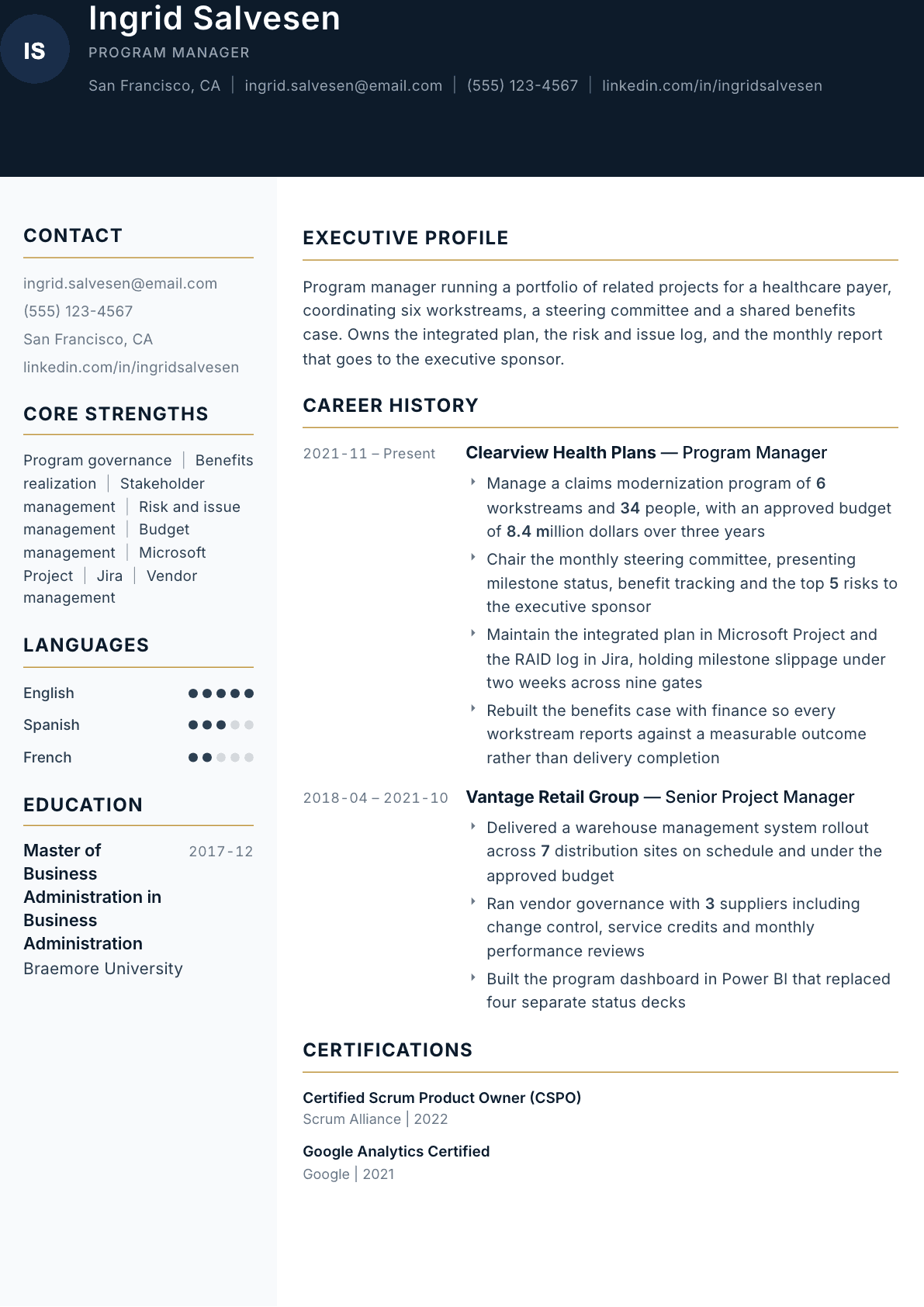
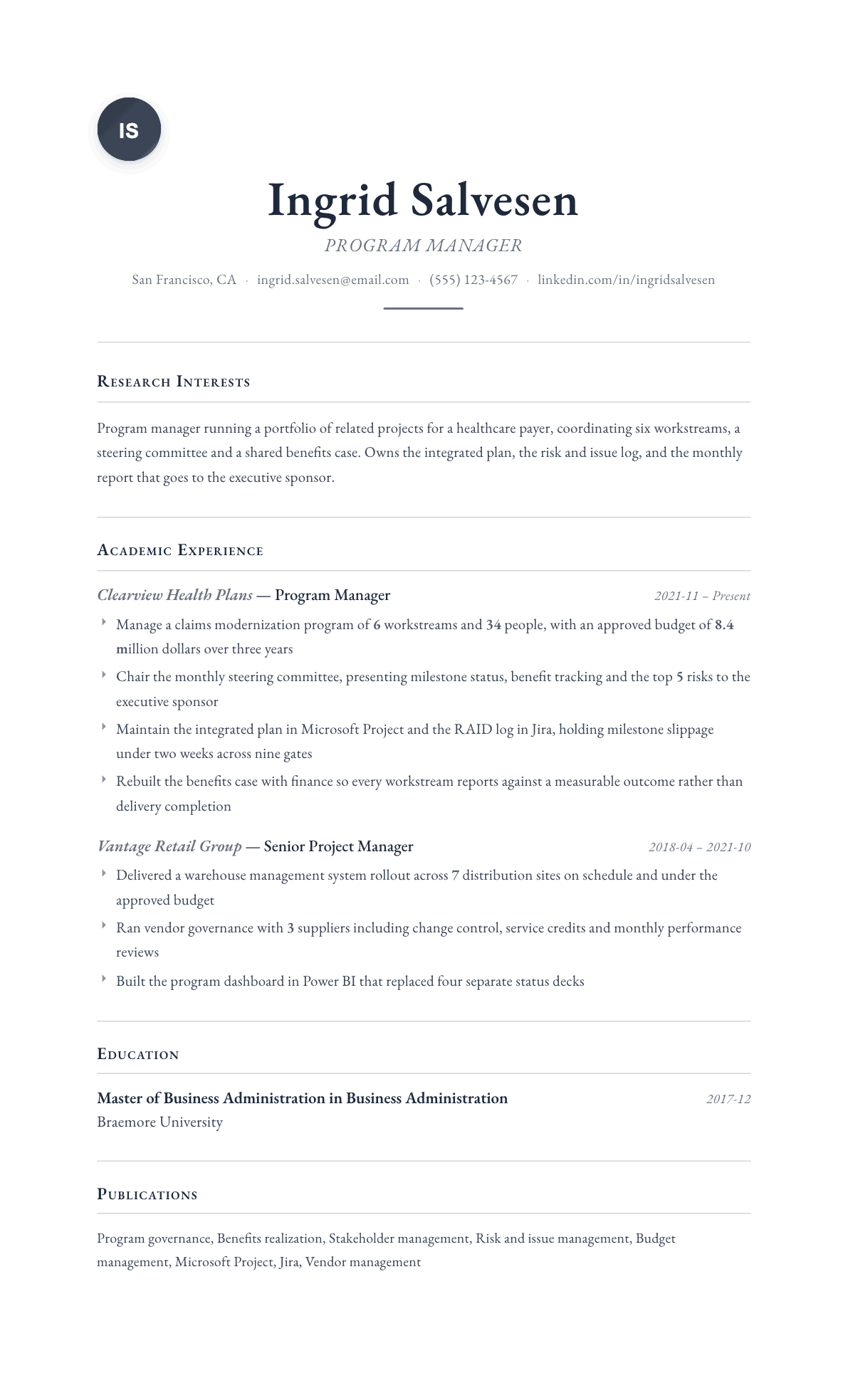
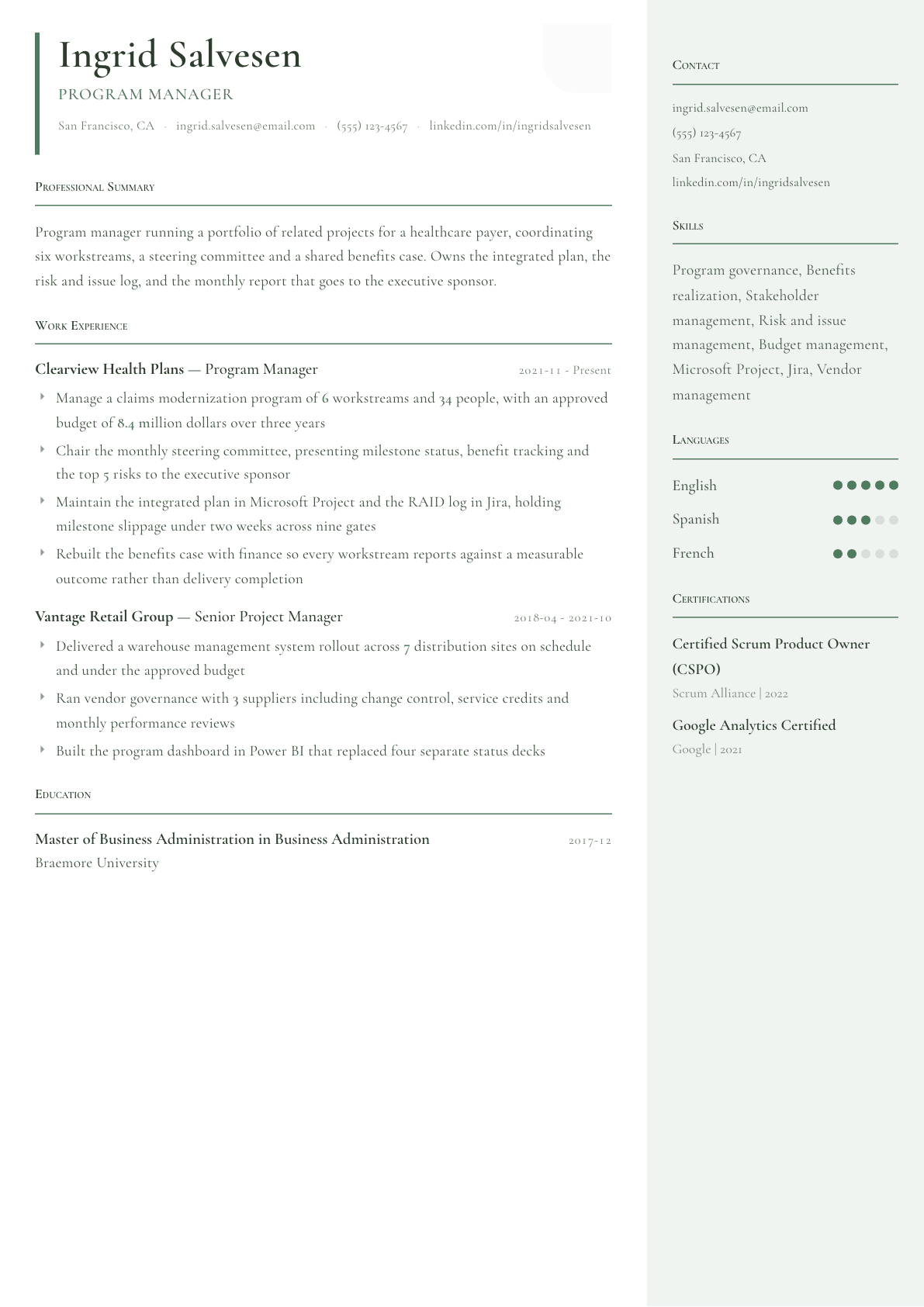
The same program manager content laid out in three CVBooster templates, so you can see what the finished document looks like before you write a word.
Example Program Manager summary
Program manager with eight years running multi-project programs in healthcare and retail, most recently a claims modernization program of six workstreams and thirty-four people against an eight million dollar budget. Chairs the steering committee, owns the integrated plan and the benefits case, and keeps milestone slippage inside two weeks across nine stage gates. PMP certified and comfortable holding vendors to contract.
Skills to list on a Program Manager resume
- Program governance
- Portfolio planning
- Benefits realization
- Stakeholder management
- Steering committee reporting
- Risk and issue management
- Budget and forecast management
- Vendor and contract management
- Change control
- Resource planning
- Microsoft Project
- Jira
- Power BI
- Business case development
- Dependency management
What actually gets this resume read
- Make the program scope obvious: number of projects, workstreams, people, sites and the total approved budget.
- Show governance you personally ran, such as chairing a steering committee or owning stage gate approvals.
- Report benefits, not just delivery, because a program is judged on outcomes rather than a set of finished projects.
- Name the methodology and where it bent, for example a stage gate program with agile delivery teams underneath it.
- Keep the risk story visible: how many risks you carried, what you escalated, and what you resolved without escalating.
- List certifications such as PMP or PgMP with the issuing body, since program postings frequently filter on them.
How to write a program manager resume
The first thing a hiring director checks on a program manager resume is whether you have actually run a program or a large project with a program title attached. A program is several related projects sharing dependencies, a sponsor and a single benefits case. If your file describes one workstream, one team and one deliverable, the reader will reclassify you as a project manager and screen you against that shorter list.
The second check is governance. Program managers are hired to hold a structure together: a steering committee, stage gates, a risk and issue log, a change control route and a monthly report that an executive sponsor uses to make decisions. Resumes that describe delivery activity without governance read as senior project management, which is a different and usually lower band.
This guide covers how to state program scope so it is unmistakable, how to write governance and benefits bullets, how to handle a program that was stopped or rescoped, which certifications matter, and the questions program managers ask when moving between sectors.
Format: two pages, one program per block
Two pages is standard. A program manager with real scope cannot compress several programs, each with its own budget, sponsor and workstream count, into a single page without stripping the detail that earns the interview.
Give each program its own block with a scope line before the bullets: number of projects or workstreams, people, sites or business units, budget, and duration. Then the bullets. This structure lets a reader compare your programs against the one they are hiring for in a few seconds.
- Header: name, title, city and state, phone, email, and certification acronyms after your name if you hold them.
- Sections in this order: summary, core competencies, experience, certifications, education.
- Scope line per program: workstreams, headcount, budget, duration, sponsor level.
Summary: scope, governance, and benefits ownership
Three lines. What kind of programs you run and in what sector, the largest scope you have carried, and the governance you personally chaired. Naming the sponsor level matters because reporting to an executive sponsor is a different job from reporting to a delivery lead.
Include benefits ownership if you have it. Program managers who track benefit realization rather than only milestone completion are a smaller group, and saying so in the summary separates you from the majority of applicants immediately.
Experience: governance, dependencies, benefits, vendors
Governance bullets should name what you ran, not what existed. Chairing the monthly steering committee, presenting milestone status and risk to the executive sponsor, holding stage gate approvals, and running change control with a named threshold are all acts. Operated within a governance framework is a description of the building you worked in.
Dependency management is the discipline that only programs have, so evidence it. Cross-workstream dependencies tracked, sequencing decisions you made, and the slippage you prevented or absorbed. A milestone slippage figure held across a number of gates is one of the most credible numbers on a program resume.
Benefits deserve a bullet in every program block. What the business case promised, how you tracked it, and what was measured after delivery. Rebuilding a benefits case with finance so each workstream reports an outcome rather than a completion percentage is a strong, specific claim.
Vendor governance is often half the job. Number of suppliers, contract management, change orders, service credits and monthly performance reviews. Say what leverage you actually applied, because programs with several suppliers are hired for differently.
- Name the governance forum you chaired and who sat on it.
- Give a dependency or slippage number across a stated number of stage gates.
- Report a benefit measured after go-live, not only delivery completion.
Programs that were stopped, rescoped or absorbed
A stopped program is not a failure to hide. Programs get halted when the business case stops holding, and a manager who recommended stopping one, or who ran an orderly close down, has demonstrated exactly the judgment sponsors want. Write it plainly: the trigger, the recommendation, the close down, and what was preserved.
Rescoping is even more common and equally worth describing. Reducing a program from six workstreams to four after a funding decision, and replanning the remaining dependencies without losing the critical milestone, is real program work. Leaving it out to keep the story clean removes your best evidence of judgment under pressure.
Certifications, methods and keywords
Program postings frequently filter on certification, so list what you hold with the issuing body and keep the acronym next to your name in the header. Name the method the program ran under and be honest about the mix, since most large programs are stage gated at the top with agile delivery teams underneath.
Recurring keywords include program governance, benefits realization, stakeholder management, dependency management, risk and issue management, change control, resource planning, vendor management and business case. Match the posting's wording once in the competencies block and once inside a bullet where it is evidenced.
Program Manager resume summary examples
Moving up from project manager
Senior project manager stepping into program management, having delivered a warehouse system rollout across seven distribution sites on schedule and under budget. Ran vendor governance with three suppliers including change control and service credits, and built the dashboard that replaced four separate status decks.
Established program manager
Program manager running a claims modernization program of six workstreams and thirty-four people against an approved budget of 8.4 million dollars over three years. Chairs the monthly steering committee, owns the integrated plan and the RAID log, and holds milestone slippage under two weeks across nine gates.
Portfolio level
Program director managing two concurrent transformation programs with a combined budget above twenty million dollars and four vendor partners. Reports to the executive committee, rebuilt the benefits case with finance so every workstream reports a measured outcome, and led the orderly close down of a third program after a funding review.
Work experience bullets: before and after
Before: Managed a large program for the business.
After: Managed a claims modernization program of six workstreams and thirty-four people with an approved budget of 8.4 million dollars across three years.
Workstreams, headcount, budget and duration are the four numbers a reader uses to judge program scope.
Before: Reported program status to senior stakeholders.
After: Chaired the monthly steering committee, presenting milestone status, benefit tracking and the top five risks to the executive sponsor with a decision log kept between meetings.
Chairing and a decision log show ownership of governance rather than attendance at someone else's meeting.
Before: Kept the program on schedule.
After: Maintained the integrated plan and RAID log across six workstreams, holding milestone slippage under two weeks through nine stage gates by resequencing two dependent deliveries.
A slippage figure across a stated number of gates plus the action taken is verifiable delivery control.
Before: Tracked benefits for the program.
After: Rebuilt the benefits case with finance so each workstream reported against a measurable business outcome rather than delivery completion, with results reviewed at each gate.
Shifting from completion to outcome measurement is the specific work that separates a program manager from a project lead.
Before: Worked with vendors on the program.
After: Ran vendor governance with three suppliers covering change control, monthly performance reviews and service credits, recovering two missed milestones without a contract dispute.
Naming the contractual levers and the outcome shows commercial management rather than supplier coordination.
Hard skills
- Program governance and stage gates
- Integrated planning
- Dependency management
- Benefits realization tracking
- Risk and issue management
- Change control
- Budget and forecast management
- Vendor and contract management
- Resource planning
- Business case development
- Microsoft Project
- Jira and Confluence
- Power BI reporting
Soft skills
- Executive communication
- Negotiating between workstream leads
- Escalation judgment
- Holding a plan under pressure
- Facilitating decisions
- Coaching project managers
Certifications worth listing
- Project Management Professional (PMP) (Project Management Institute)
- Program Management Professional (PgMP) (Project Management Institute)
- PRINCE2 Practitioner (PeopleCert)
- Managing Successful Programmes (MSP) Practitioner (PeopleCert)
- Certified ScrumMaster (CSM) (Scrum Alliance)
- SAFe Program Consultant (SPC) (Scaled Agile)
Mistakes that cost program manager candidates the interview
- Describing a single project under a program title, which gets the file rebanded as project management during the screen.
- Listing governance forums that existed without saying which ones you chaired or what decisions came out of them.
- Reporting delivery completion instead of measured benefit, which is the question the sponsor will ask first.
- Omitting budget, workstream count and headcount, leaving the reader unable to compare your scope to theirs.
- Hiding a stopped or rescoped program, which removes the strongest available evidence of judgment.
- Claiming a methodology purely, when most large programs run a gated structure over agile delivery teams.
Program Manager resume questions
What is the difference between a program manager and a project manager?
A project manager delivers one defined output. A program manager coordinates several related projects toward a shared benefits case, owns cross-project dependencies, and runs governance with an executive sponsor. Make that difference visible in your scope lines.
Do I need a PMP or PgMP to get a program manager role?
Not always, but many postings filter on one and a certification often decides who is read first. If you hold one, place the acronym after your name in the header and list the issuing body in the certifications section.
How do I write about a program that was stopped?
State the trigger, your recommendation, and how you closed it down: assets preserved, contracts exited, team redeployed. Sponsors value a manager who can stop a program cleanly at least as much as one who finishes everything they start.
How much detail about budget should I include?
Give the approved budget you were accountable for and how you tracked forecast against it. Avoid group or portfolio figures you had no control over, since interviewers routinely test whether the number was really yours.
How do I move into program management from a delivery role?
Take on the coordination nobody owns: cross-project dependencies, a combined status report, or the benefits tracker. Those bullets let you describe program work honestly before you have carried the title on an employment contract.
Related resume examples
- Project Manager Resume example
- Program Director Resume example
- PMO Manager Resume example
- Technical Program Manager Resume example
- Project Analyst Resume example
- Executive Director Resume example