Regional Property Manager Resume Examples: free score
Write a Regional Property Manager Resume That Shows Portfolio Scale
By Mustafa Tarabya, founder of CVBooster · Published · Updated
Regional property manager resume example, keyword list and writing guide covering portfolio size, NOI growth, occupancy, budgets and site team oversight.
Sample resumes for a regional property manager
The same regional property manager content laid out in three CVBooster templates, so you can see what the finished document looks like before you write a word.
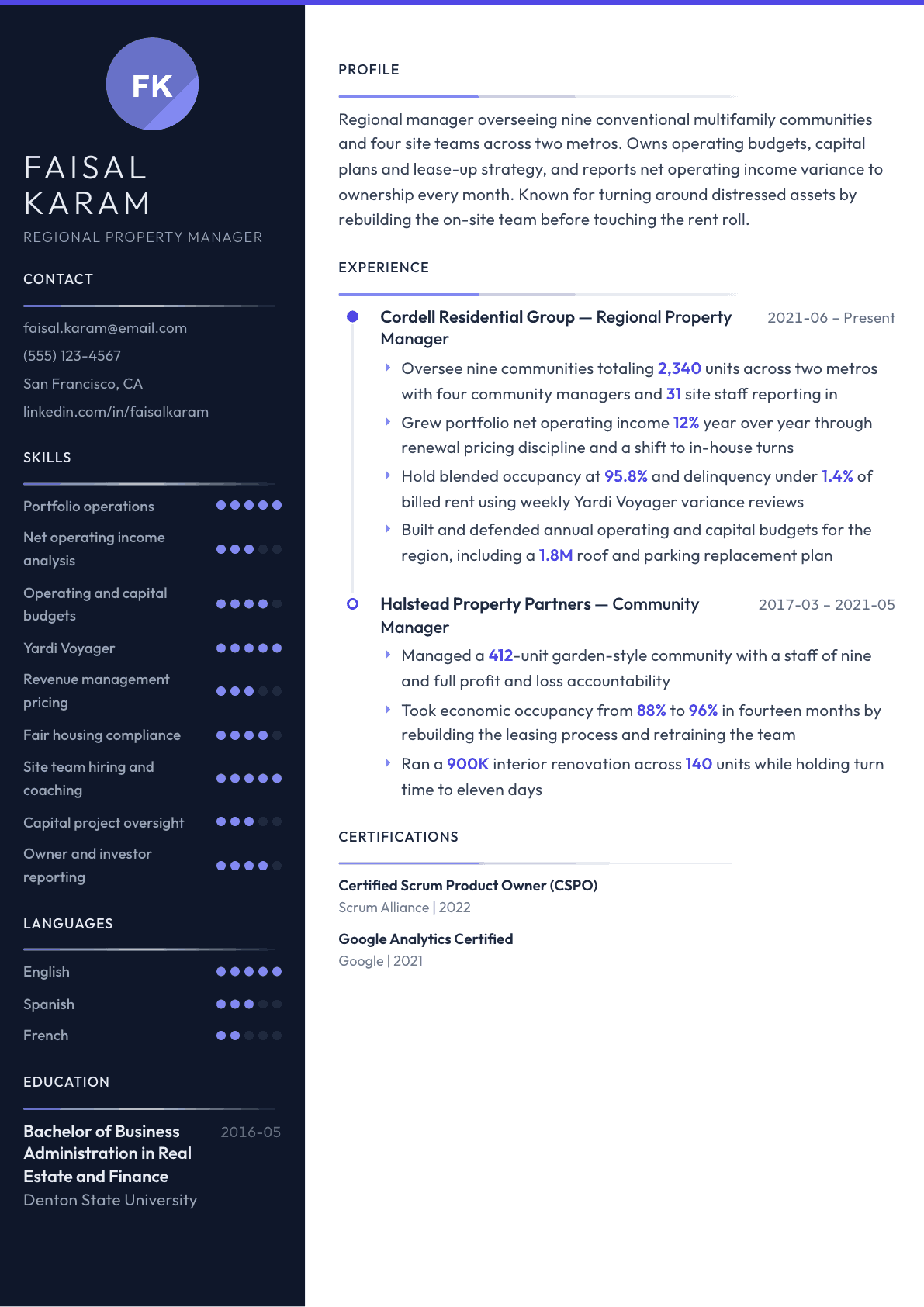
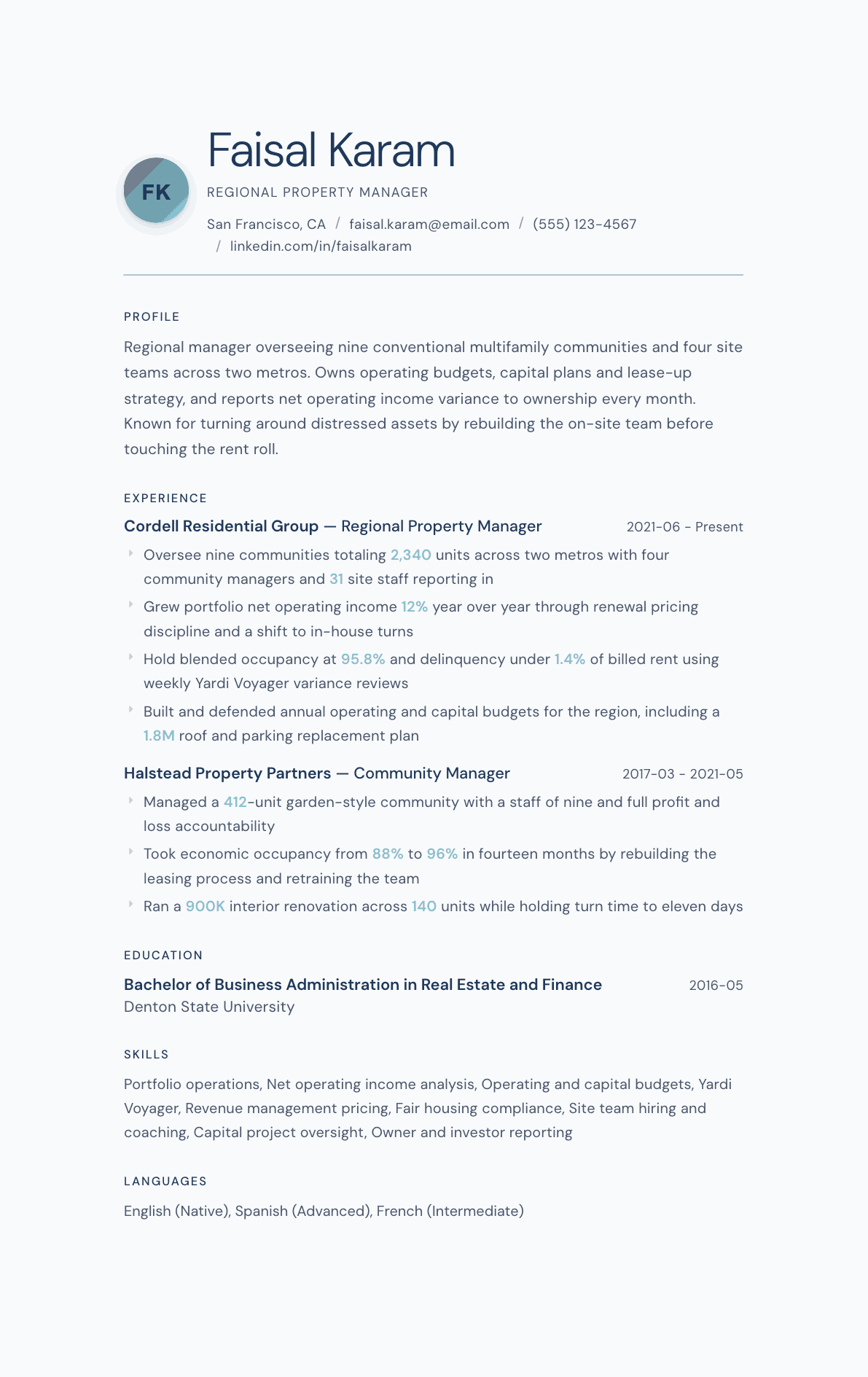
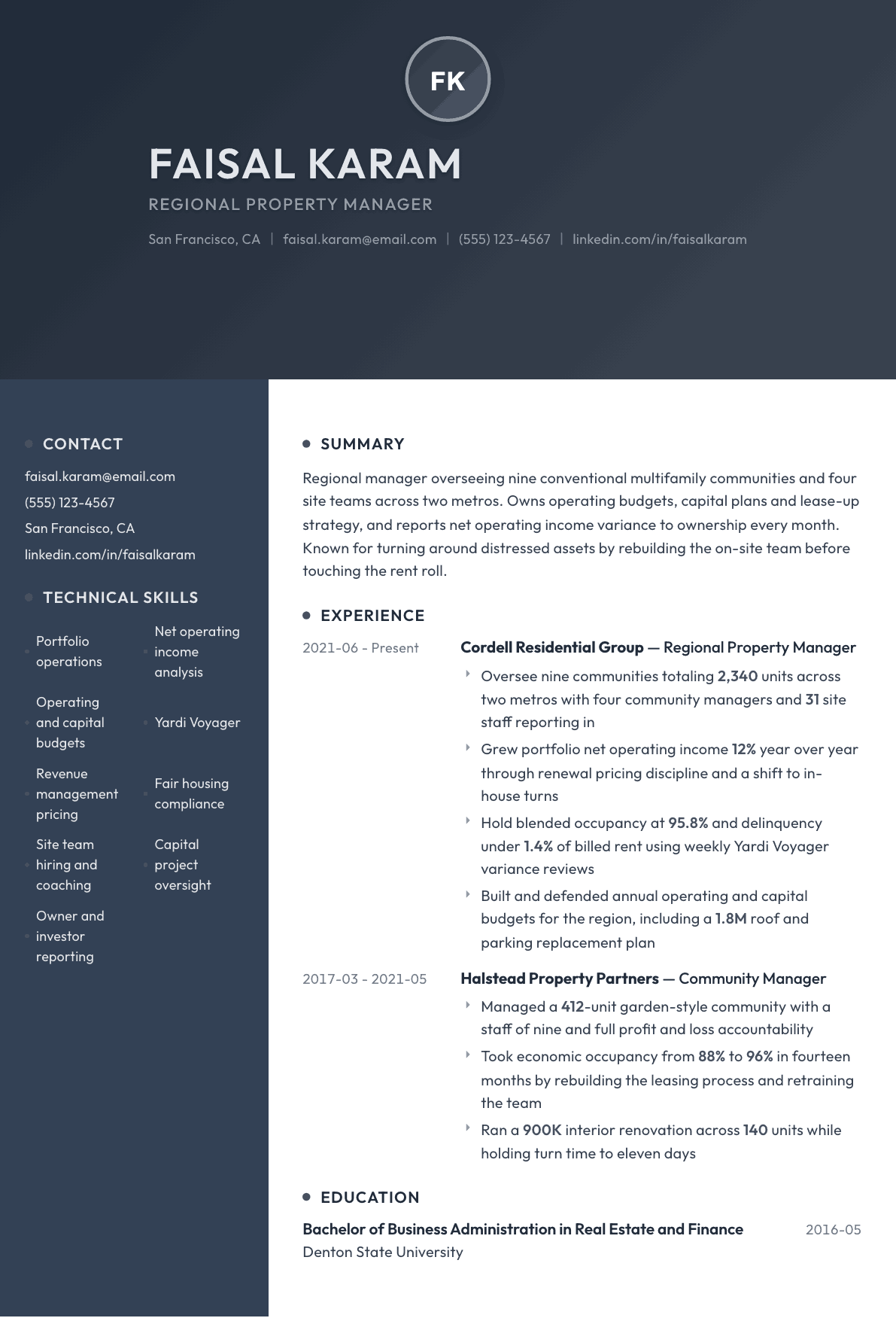
Example Regional Property Manager summary
Regional property manager with eight years in conventional multifamily, currently responsible for nine communities and more than two thousand units across two metros. Builds and defends operating and capital budgets, holds blended occupancy near ninety-six and delinquency under two, and coaches four community managers. Repositioned two distressed assets by rebuilding site teams first and pricing second. Seeking a larger mixed asset class region.
Skills to list on a Regional Property Manager resume
- Multifamily portfolio management
- Net operating income growth
- Operating budget preparation
- Capital expenditure planning
- Occupancy and delinquency control
- Revenue management systems
- Yardi Voyager and RealPage
- Lease-up and asset repositioning
- Fair housing compliance
- Vendor contract negotiation
- Site team recruiting and training
- Owner and investor reporting
- Property inspections and audits
- Resident retention strategy
- Due diligence on acquisitions
What actually gets this resume read
- Open with portfolio scale: how many properties, how many units, how many states and how many direct reports.
- Give net operating income movement and occupancy for the portfolio, not for one flagship property you like talking about.
- Name the property management platform and the revenue management tool, because a regional owns the reporting from both.
- Separate conventional, affordable, student and lease-up assets, since owners hire for the asset class they actually hold.
- Show budget authority in plain terms: what you built, what you defended and what you were allowed to approve.
- Put fair housing and state landlord-tenant compliance on the page, because a regional carries that exposure for every site.
- Describe one turnaround in detail: the condition you inherited, what you changed first, and where the asset landed.
How to write a regional property manager resume
A regional property manager resume is judged on scale and on money. The vice president of operations who screens it wants to know how many assets you have carried at once, how many units that came to, how many site teams reported to you, and what happened to net operating income while you had the region. Everything else is supporting evidence.
Most candidates for this job write like community managers who got a bigger title. They describe daily property tasks, resident events and vendor calls, and never say what the portfolio looked like. The screener cannot tell whether you ran three assets or fifteen, so the resume reads as a lateral move rather than a step up.
This guide sets out how to write the portfolio line, how to report operating results honestly, how to describe budget authority so an owner knows what you were trusted to approve, and how to handle the turnaround story that almost every regional interview eventually asks about.
Format: two pages, portfolio table first
Reverse chronological, two pages, and no design that pushes the numbers below the fold. A regional resume that fits on one page usually did so by cutting the portfolio detail, which is the only part the reader needed.
Directly under the summary, give a compact portfolio block: asset count, unit count, markets, asset class and direct reports for the current role. A hiring vice president reads that block, decides whether you are at the right level, and only then reads the jobs.
- Header line: name, city and state, phone, email, and any IREM or apartment association designation letters after your name.
- Order the page as summary, portfolio snapshot, professional experience, education, designations, then systems.
- Give each role its own portfolio line before the bullets: assets, units, markets, class and reporting structure.
- Keep bullets to four or five per role and let older community manager jobs shrink to two.
The portfolio line: assets, units, markets, teams
Write the portfolio line the way an asset manager would describe the region in a board deck. Nine communities, two thousand three hundred units, two metros, conventional garden and mid-rise, four community managers and thirty-one site staff. That single line answers the four questions a screener would otherwise have to guess at.
Be precise about asset class, because hiring is class specific. Conventional, affordable with tax credit compliance, student housing with a bed lease cycle, senior living, build to rent and mixed use are different operating jobs. An owner with a tax credit portfolio wants to see compliance experience named, not implied.
If your region changed during your tenure, say so. Growing from five assets to nine through acquisitions, or absorbing a second market after a merger, is a stronger fact than a static count and it shows you have onboarded new properties.
Results: net operating income, occupancy, delinquency, turn
Owners grade a regional on four numbers, so put all four on the page: net operating income movement, economic occupancy, delinquency as a share of billed rent, and expense variance to budget. Give the portfolio figure rather than the best property in it, because a screener who has done this job will assume you cherry picked otherwise.
Attach a mechanism to each result. Occupancy that rose because you rebuilt a leasing team reads differently from occupancy that rose because the submarket tightened. Naming what you did protects the number from the obvious objection.
Include renewal and turnover figures if you have them. Retention costs less than acquisition on every asset, and a regional who can quote portfolio renewal conversion is showing that they read the weekly report rather than waiting for the monthly.
Budget and capital authority: say what you could approve
Write budget responsibility in three parts: what you built, what you defended, and what you could sign. A regional who prepares the operating budget, presents it to ownership, and approves spend to a stated limit is doing a different job from one who executes a budget handed down. Both are legitimate, but the reader needs to know which.
Capital work deserves its own bullet. Name the project type, the scope and the outcome: roof replacements across three assets, a parking lot reconstruction, a unit interior renovation with a rent premium target. Say whether you scoped it, bid it, selected the contractor and managed draws.
Vendor contracts are part of the same story. National versus local contracting, bid cycles, insurance certificate compliance and scope enforcement are all things a regional owns and a community manager rarely does.
Systems, compliance and the people layer
Name the property management platform and the revenue management tool separately, because a regional reads reports out of both. Yardi Voyager, RealPage OneSite, Entrata and AppFolio all produce different variance reporting, and an operator switching platforms wants someone who has already lived in theirs.
Compliance belongs on a regional resume because the exposure sits with you. Fair housing training and audit, state landlord and tenant procedure, tax credit file compliance where applicable, and safety or risk programs are all worth a line. Say what you audited and how often, not that you value compliance.
Then the people layer, which is what most regionals are actually hired to fix. Hiring, onboarding, performance management, succession bench and turnover among site staff. A region with stable managers outperforms a region that reopens the same position twice a year, and any experienced reader knows it.
Regional Property Manager resume summary examples
Moving up from community manager
Community manager for a 412-unit garden asset with full profit and loss accountability, moving into a regional seat. Took economic occupancy from 88% to 96% in fourteen months, ran a 900K interior renovation, and covered two sister properties during manager vacancies. Yardi Voyager and fair housing trained.
First regional portfolio
Regional manager for six conventional communities totaling 1,480 units in one metro, with three community managers reporting in. Grew portfolio net operating income 9% over two years, held delinquency at 1.6% of billed rent, and stabilized two assets after ownership change. Builds and presents the operating budget.
Multi-market regional
Regional director covering fourteen assets and 3,900 units across three markets, mixed conventional and tax credit, with five managers and a floating support team. Owns operating and capital budgets, presents monthly variance to ownership, and led due diligence and onboarding for two portfolio acquisitions in the last cycle.
Work experience bullets: before and after
Before: Responsible for managing multiple apartment communities in the region.
After: Oversaw nine conventional communities totaling 2,340 units across two metros, with four community managers and 31 site staff reporting in.
Asset count, unit count, markets and reporting structure let the reader place you at a level; "multiple" leaves them guessing.
Before: Improved occupancy and reduced delinquency across the portfolio.
After: Held blended economic occupancy at 95.8% and delinquency under 1.4% of billed rent by moving the portfolio to weekly variance reviews and a 100-day renewal touch.
The two numbers are the ones ownership tracks, and naming the mechanism keeps the reader from crediting the market instead of you.
Before: Handled budgets for all properties in my region.
After: Built and defended annual operating and capital budgets for nine assets, presenting variance to ownership monthly and approving spend within a defined authority limit.
Building, defending and approving are three different levels of trust, and the strong version states which ones you held.
Before: Turned around an underperforming property.
After: Repositioned a 268-unit asset inherited at 79% occupancy by replacing the site team, resetting renewal pricing and completing deferred exterior work, reaching 94% within nine months.
The inherited condition, the sequence of actions and the result make the turnaround verifiable instead of a claim.
Before: Worked with vendors and managed capital projects.
After: Scoped, bid and managed a roof and parking replacement program across three assets, holding contractors to insurance compliance and draw schedules through completion.
Naming the scope and the controls shows capital project ownership rather than vendor coordination.
Hard skills
- Multifamily portfolio operations
- Net operating income analysis
- Operating budget preparation and defense
- Capital expenditure planning
- Variance reporting to ownership
- Revenue management and pricing oversight
- Yardi Voyager and RealPage OneSite
- Entrata and AppFolio reporting
- Occupancy and delinquency management
- Lease-up and asset stabilization
- Acquisition due diligence and onboarding
- Vendor contracting and bid management
- Fair housing auditing
- Tax credit and affordable compliance
Soft skills
- Coaching site managers
- Difficult conversations with owners
- Prioritizing across competing assets
- Written variance narrative
- Conflict resolution with residents and staff
- Hiring judgment
Certifications worth listing
- Certified Property Manager (CPM) (Institute of Real Estate Management)
- Accredited Residential Manager (ARM) (Institute of Real Estate Management)
- Certified Apartment Portfolio Supervisor (CAPS) (National Apartment Association)
- Certified Apartment Manager (CAM) (National Apartment Association)
Mistakes that cost regional property manager candidates the interview
- Leaving the portfolio size out entirely, so the reader cannot tell a three-asset region from a fifteen-asset one.
- Quoting the results of your best property and calling them portfolio results, which an experienced screener will test in the interview.
- Listing resident event planning and daily site tasks that belong on a community manager resume and crowd out regional work.
- Describing budget involvement without saying whether you built it, defended it or simply spent within it.
- Omitting the asset class, which matters because tax credit, student and conventional hiring pools barely overlap.
- Naming a property software without saying what you produced from it, so the reader assumes light usage.
- Writing a turnaround as an adjective rather than a sequence, with no inherited condition and no end state.
Regional Property Manager resume questions
How many properties should I list if my region changed size over the years?
Give the current or ending portfolio in the role header line, then add a bullet describing the growth: started with five assets and ended with nine after two acquisitions. That shows both scale and the ability to onboard new properties, which is a separate skill an owner pays for.
Should I put net operating income figures on a resume if ownership treats them as confidential?
Use movement rather than absolute dollars. Saying that portfolio net operating income grew by a stated share year over year reveals nothing proprietary, while a rent roll or an asset valuation would. Most owners consider directional operating results fair to discuss.
Do I need a CPM or CAPS designation to be hired as a regional property manager?
Not usually, but they shorten the screen. Many postings list a designation as preferred rather than required, and a candidate holding one moves past the first filter faster. If you are mid-course, write the designation with a candidate status rather than claiming it outright.
How do I show regional experience when my title was still community manager?
Describe the scope rather than the title. Covering two sister properties during vacancies, training managers at other assets, or leading a portfolio project all count. Put those facts in bullets under the community manager job and state in the summary that you are seeking a regional seat.
What do owners actually check in a regional property manager interview?
They test the numbers on the resume. Expect to be asked how you calculated occupancy, what drove a specific variance, how you would handle an asset missing budget by a wide margin, and how many site managers you have hired and lost. Write only figures you can reconstruct.
Related resume examples
- Property Management Resume example
- Commercial Property Manager Resume example
- Residential Property Manager Resume example
- Asset Manager Real Estate Resume example
- Leasing Manager Resume example
- Real Estate Developer Resume example