Residential Property Manager Resume Examples: free score
Write a Residential Property Manager Resume Around Occupancy and Delinquency
By Mustafa Tarabya, founder of CVBooster · Published · Updated
Residential property manager resume example and guide covering occupancy, renewals, delinquency, turn times, maintenance and fair housing.
Sample resumes for a residential property manager
The same residential property manager content laid out in three CVBooster templates, so you can see what the finished document looks like before you write a word.
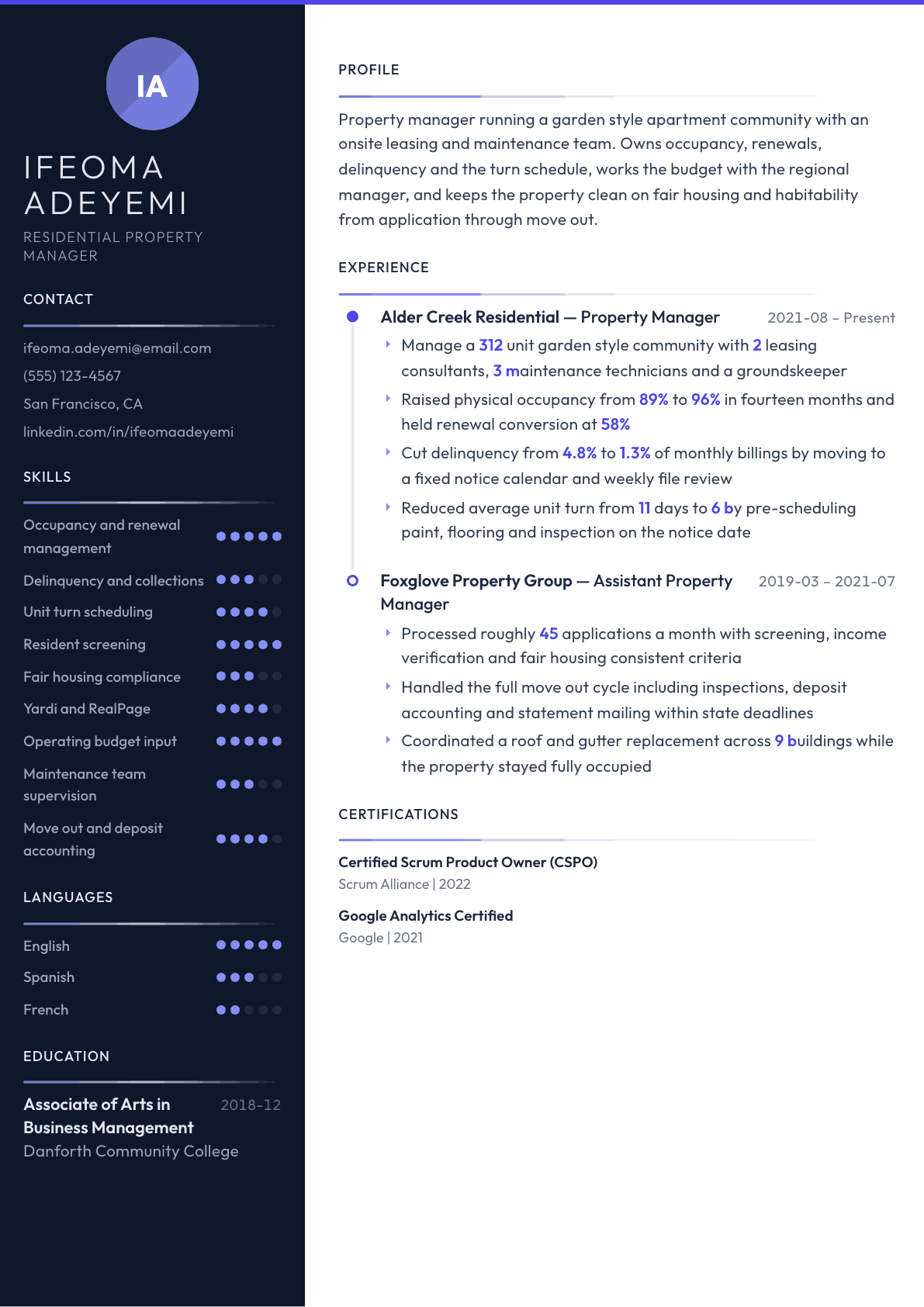
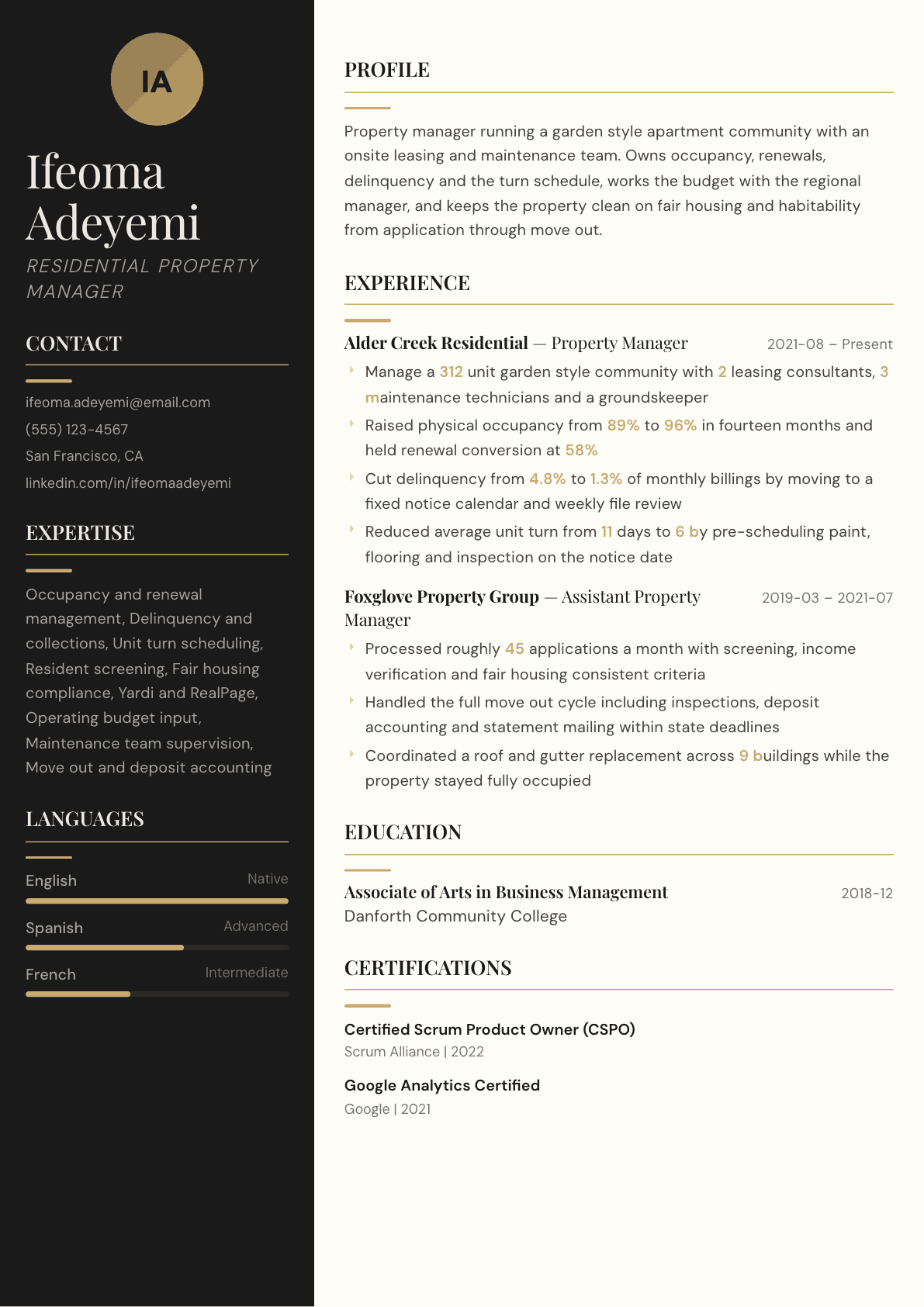
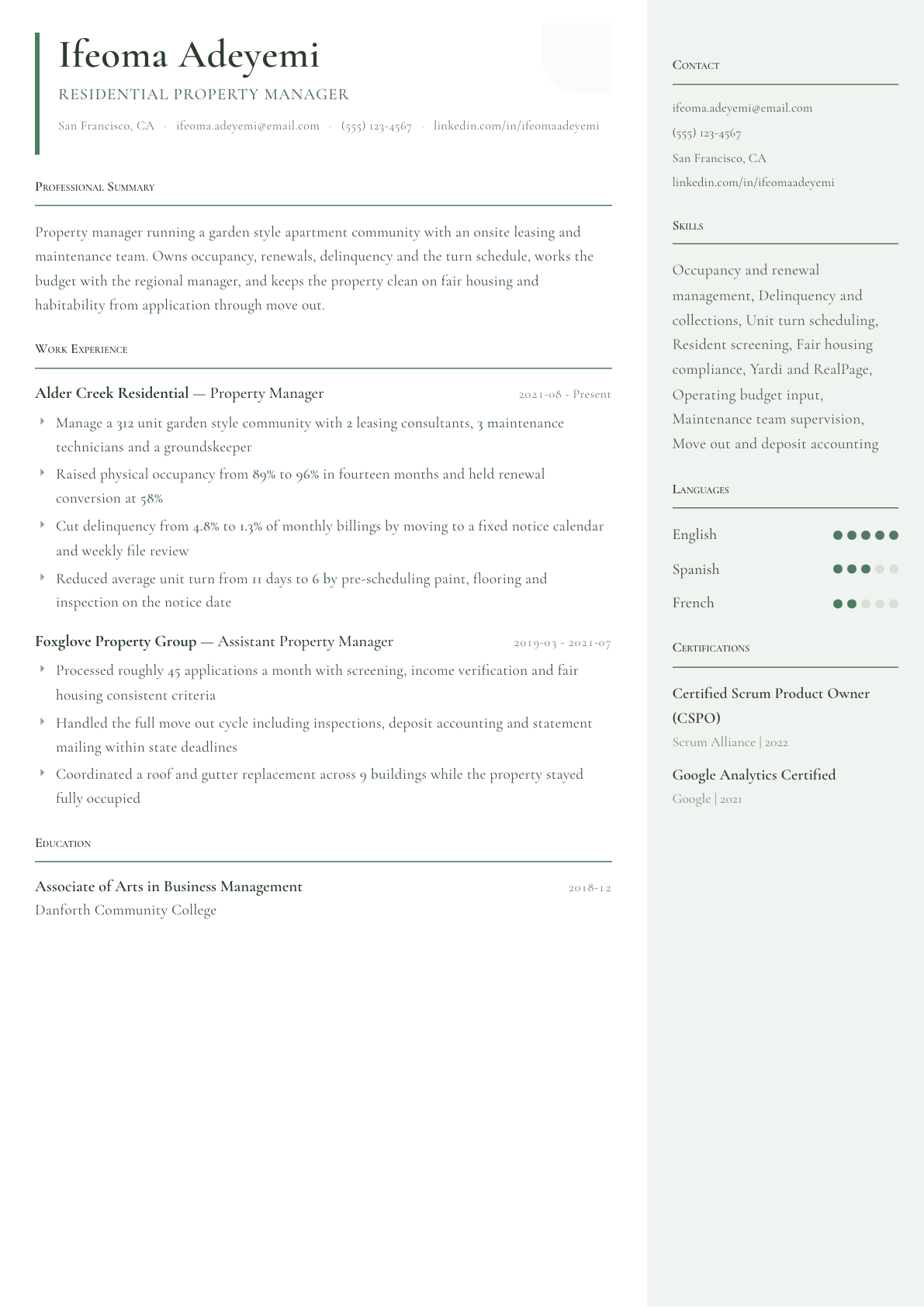
Example Residential Property Manager summary
Residential property manager running a three hundred twelve unit garden style community with an onsite leasing and maintenance team. Raised physical occupancy by seven points in just over a year while holding renewal conversion near sixty percent, cut delinquency to a small share of monthly billings through a fixed notice calendar, and shortened average unit turn from eleven days to six by scheduling trades on the notice date.
Skills to list on a Residential Property Manager resume
- Occupancy and traffic management
- Renewal negotiation and conversion
- Delinquency and collections process
- Eviction filing coordination
- Resident screening criteria
- Fair housing and reasonable accommodation
- Unit turn scheduling
- Make ready and vendor coordination
- Preventive maintenance planning
- Operating budget and variance
- Yardi and RealPage property software
- Move out inspection and deposit accounting
- Resident retention programs
- Onsite team supervision and training
What actually gets this resume read
- Start with unit count and property type, because a lease up, a garden community and scattered site rentals differ.
- Give occupancy, renewal conversion and delinquency together, since a manager who fixes one can hurt another.
- Put average turn days on the page, as it is the number that connects maintenance to leasing revenue.
- Name your team by role and headcount, because supervising technicians is a different job from leasing alone.
- Show your fair housing practice as consistent screening criteria and documentation, not as a training you attended.
- State the software you run, since the reports a regional manager wants come out of that system.
How to write a residential property manager resume
A regional manager hiring a residential property manager is looking at four numbers and one instinct. The numbers are occupancy, renewal conversion, delinquency and turn time. The instinct is whether you can hold all four at once, because the easiest way to fix any one of them is to wreck another. Rent anything to anyone and occupancy climbs while delinquency follows it up.
That is why a page listing responsibilities does not compete. Overseeing daily operations of the community describes the title, not the operator. The residential managers who get interviewed write the four numbers with the direction they moved, the period, and the specific practice that moved them.
This guide covers the property block that sets your scale, presenting occupancy and delinquency honestly together, writing the turn process as a schedule, and treating fair housing as documented practice rather than a training certificate. Three summaries, before and after bullets, and the questions site managers ask when they aim at a regional seat.
Format: property block, team, software, then the numbers
One page for a site manager, two if you have run several communities or a small portfolio. Start with a property block: unit count, property type and vintage, and whether the asset was stabilized, in lease up, in renovation or distressed when you arrived. That last detail is the context every number on your page depends on, and most candidates leave it out.
Then the team and the software. Leasing consultants, maintenance technicians, groundskeepers and any contracted staff you direct, followed by the property management system. A regional manager pulls the same reports out of that system every Monday, so knowing your platform is a practical hiring factor rather than a formality.
- Property block for a residential manager: unit count, property type, vintage and the condition of the asset when you took it.
- Team line: leasing consultants, maintenance technicians and contracted vendors directed on site.
- Performance block: occupancy, renewal conversion, delinquency and average turn days, each with the direction it moved.
- Compliance line covering fair housing practice, affordable program experience and local habitability requirements.
Summary: the asset, the team, and the four numbers moving together
Three lines. Name the community and its size, the team you run, and at least two of the four core numbers with movement. A residential manager who raised occupancy while holding renewals and cutting delinquency has proved the balancing act, which is the entire craft of the job.
If you have taken over a troubled property, put that in the first line. Turnarounds are the most valuable thing on a residential resume, and stating that occupancy sat in the eighties when you arrived converts an ordinary number into a result. Without the starting point, a reader assumes you inherited the good number.
Occupancy, renewals and delinquency written as one story
Give the three together and describe the practice behind each. Occupancy comes from traffic, tour conversion and pricing discipline. Renewals come from outreach timing, the offer structure and how maintenance requests were handled during the year. Delinquency comes from screening standards, a fixed notice calendar and consistent follow through, not from being tough.
Say what you changed rather than what you achieved alone. Moving to a weekly delinquency file review, sending renewal offers ninety days out in three waves, retraining leasing on follow up within an hour of a tour: these are the practices a regional manager can transplant to another property, and transplantable practice is what they are buying.
Be careful about economic occupancy. Physical occupancy with heavy concessions can look excellent while collections tell a different story, and experienced regional managers ask about the gap. A manager who volunteers both numbers is treated as credible before the question is even raised.
Turns, maintenance and the schedule that ties them to revenue
Average turn days is the number that connects maintenance to leasing revenue, and it is the easiest place to show operational thinking. Describe the schedule: an inspection on the notice date, paint and flooring booked before the resident moves out, the punch walk, and the ready date confirmed to leasing so a unit can be pre-leased. Give the before and after days.
Then the maintenance operation. Work order volume, average close time, the emergency response standard, the preventive maintenance calendar and how you handle after hours calls. If you supervise technicians, say how you assign work and what you do about repeat calls on the same unit, because repeat work orders are where resident satisfaction quietly dies.
Fair housing, compliance and the vocabulary of the postings
Fair housing on a resume should read as practice. Written screening criteria applied identically, documented reasonable accommodation decisions, consistent advertising language, and records kept for the required retention period. A course attended is a line in the education section; a documented process is a line in the experience section, and only one of them reassures an owner.
Postings reuse a compact vocabulary worth matching: physical and economic occupancy, renewal conversion, traffic and tour conversion, delinquency, make ready, unit turn, notice to vacate, security deposit disposition, preventive maintenance and resident retention. If you have run affordable or subsidized units, name the program type and the recertification work, because that experience is scarce and specifically searched for.
Residential Property Manager resume summary examples
Assistant to first manager seat
Assistant manager on a 190 unit community, processing about 45 applications a month with consistent screening criteria and running the full move out cycle within state deadlines. Coordinated a roof replacement across 9 buildings while the property stayed occupied. Seeking a first residential property manager seat.
Site manager, garden community
Property manager of a 312 unit garden style community with 2 leasing consultants and 3 maintenance technicians. Raised physical occupancy from 89% to 96% in fourteen months while holding renewal conversion at 58%, cut delinquency from 4.8% to 1.3% of billings, and reduced average turn from 11 days to 6.
Senior manager, multiple sites
Senior residential manager over two communities totaling 540 units with 9 onsite staff, including a lease up delivered to 94% occupancy in seven months. Owns budgets, capital scopes and vendor contracts for both assets, and trains new managers on the delinquency and renewal calendars used across the region.
Work experience bullets: before and after
Before: Managed the day to day operations of an apartment community.
After: Managed a 312 unit garden style community with 2 leasing consultants, 3 maintenance technicians and a groundskeeper, owning occupancy, renewals, delinquency and the turn schedule.
Unit count, team composition and named responsibilities describe the seat instead of restating the title.
Before: Improved occupancy at the property.
After: Raised physical occupancy from 89% to 96% in fourteen months by retraining leasing on same day tour follow up and repricing eight floor plans against a weekly competitor survey.
A starting point, an ending point, a period and two specific practices make the improvement transferable.
Before: Reduced delinquency and improved collections.
After: Cut delinquency from 4.8% to 1.3% of monthly billings by moving to a fixed notice calendar, reviewing every open balance weekly and documenting payment plans in writing before the notice date.
The mechanism explains the drop, and a regional manager can install the same calendar at another property.
Before: Turned units quickly between residents.
After: Reduced average unit turn from 11 days to 6 by inspecting on the notice date, pre-scheduling paint and flooring for the move out week, and confirming the ready date to leasing for pre-leasing.
A turn is a schedule, and describing the schedule shows how the days were removed rather than claiming speed.
Before: Followed fair housing rules in leasing.
After: Applied written screening criteria identically to about 45 applications a month, documented every reasonable accommodation decision, and kept advertising copy and tour scripts consistent across all leasing staff.
Fair housing becomes credible when it is a documented process rather than a rule the manager says they follow.
Hard skills
- Occupancy and traffic management
- Renewal offer strategy and conversion
- Delinquency cycles and collections
- Eviction filing coordination
- Written screening criteria and application processing
- Fair housing and reasonable accommodation documentation
- Unit turn scheduling and make ready control
- Work order and preventive maintenance oversight
- Operating budget input and variance explanation
- Yardi and RealPage property software
- Move out inspection and deposit disposition
- Vendor scheduling and capital project support
Soft skills
- Holding a screening standard when the property is under occupancy pressure
- Defusing a resident dispute in a leasing office with other people waiting
- Coaching a leasing consultant whose tours are not converting
- Carrying an emergency call at two in the morning and still opening the office
- Delivering an eviction decision without making it personal
Certifications worth listing
- Certified Apartment Manager (CAM) (National Apartment Association)
- Accredited Residential Manager (ARM) (Institute of Real Estate Management)
- Certified Occupancy Specialist (COS) (National Center for Housing Management)
- Certified Property Manager (CPM) (Institute of Real Estate Management)
Mistakes that cost residential property manager candidates the interview
- Giving occupancy with no starting point, so a reader cannot tell whether you built the number or inherited it.
- Reporting physical occupancy alone when concessions and unpaid rent make the economic number the honest one.
- Describing collections as firm follow up rather than as a fixed notice calendar with a weekly file review.
- Leaving average turn days off the page, when it is the clearest evidence that maintenance and leasing are working together.
- Treating fair housing as a training certificate instead of a documented screening and accommodation practice.
- Omitting the condition of the asset when you took it, which is the context that makes every other number readable.
Residential Property Manager resume questions
What if occupancy fell while I was the manager?
Explain the cause and show what you controlled: renewal conversion held, delinquency reduced, turn days cut, expenses managed. A new supply wave or a major employer leaving affects every property nearby, and regional managers know the difference between a market and a manager.
How do I show value on a lease up rather than a stabilized property?
Lease ups are judged on pace, so give units leased per month against the underwritten absorption, the concession package used and the occupancy reached by a given month. Add the punch and delivery coordination, because lease up managers work alongside construction.
Should I list the property management software I use?
Yes, by name and by the parts you work in: leasing and applications, accounting and receivables, work orders, renewals and reporting. A regional manager runs the same reports every week and hires partly for how quickly you will produce them.
How do I get to a regional property manager role?
Show that your practices travel. Systems you wrote that another site adopted, managers or assistants you trained, coverage you provided at other properties, and budget ownership. Regionals hire people whose results came from process rather than from personal effort at one site.
Does affordable housing experience belong on the page?
Absolutely, and name the program type and the compliance work: income certification, annual recertification, file audits and inspection preparation. That skill set is scarce, specifically searched for, and hard to teach a manager who has only run conventional units.
Related resume examples
- Property Management Resume example
- Leasing Consultant Resume example
- Assistant Property Manager Resume example
- Regional Property Manager Resume example
- Vacation Rental Manager Resume example
- HOA Manager Resume example