Commercial Property Manager Resume Examples: free score
A Commercial Property Manager Resume Built on NOI and Tenant Retention
By Mustafa Tarabya, founder of CVBooster · Published · Updated
Commercial property manager resume example and guide covering CAM reconciliations, operating budgets, tenant retention and vendor contracts.
Sample resumes for a commercial property manager
The same commercial property manager content laid out in three CVBooster templates, so you can see what the finished document looks like before you write a word.
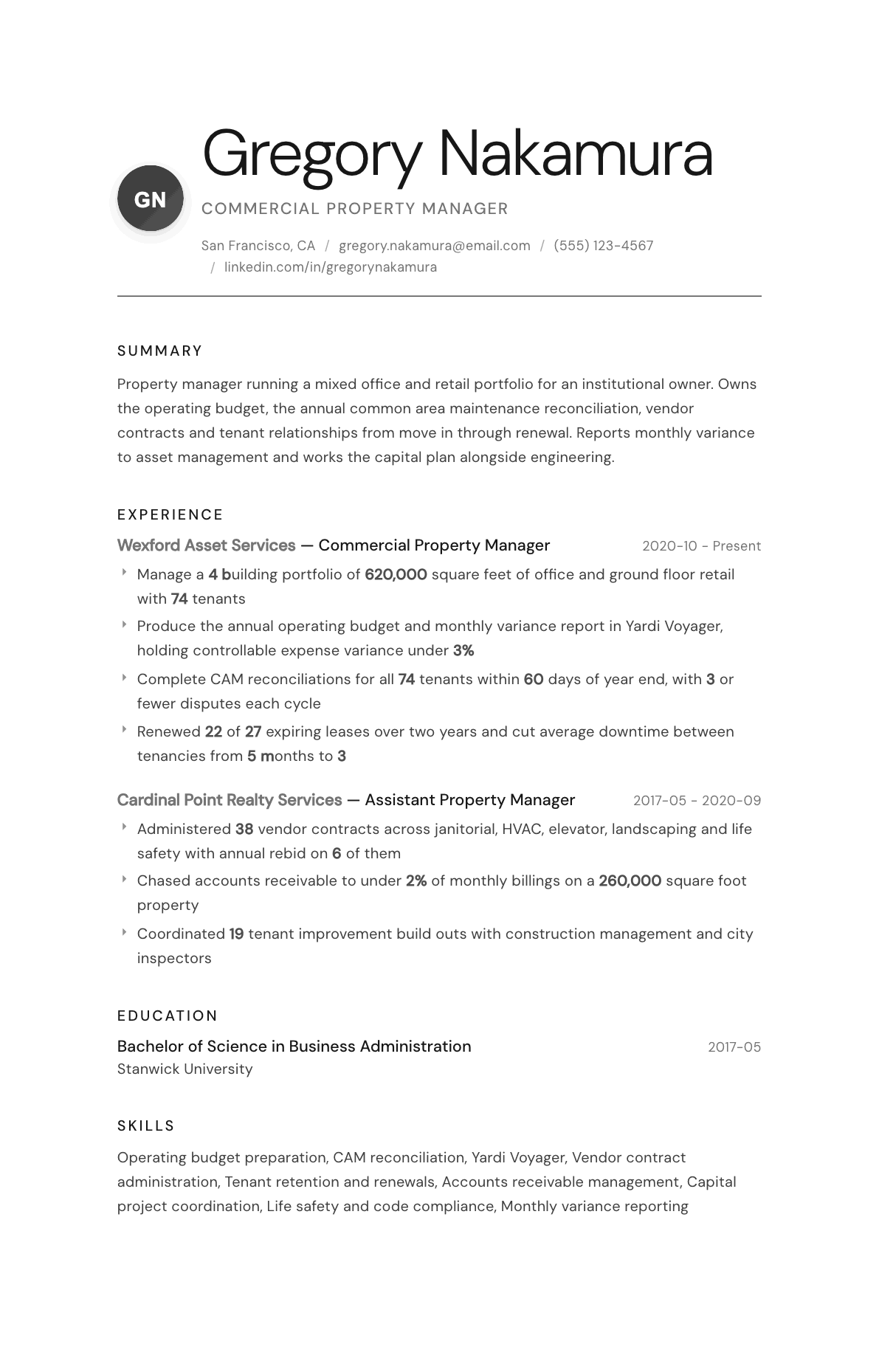
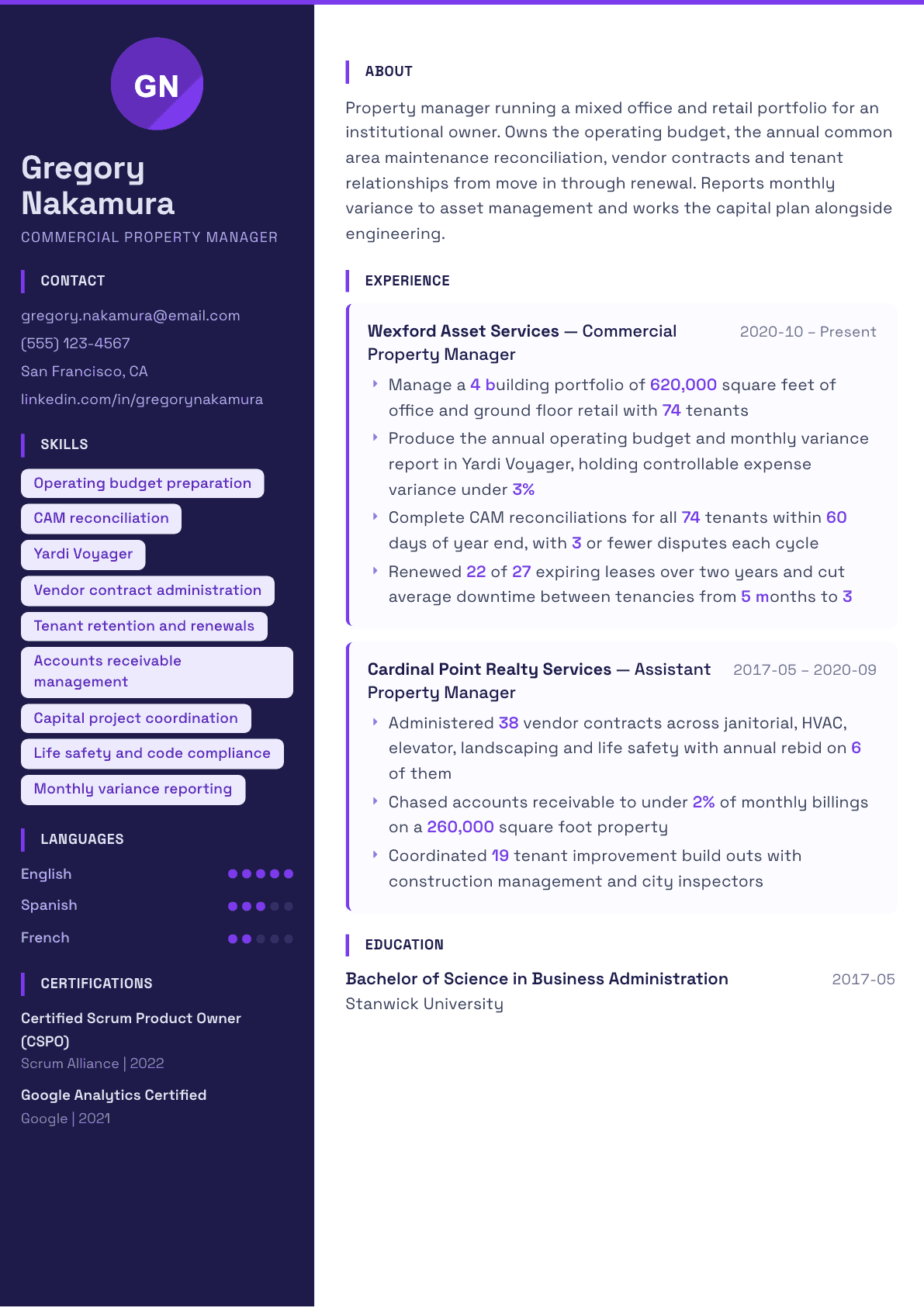
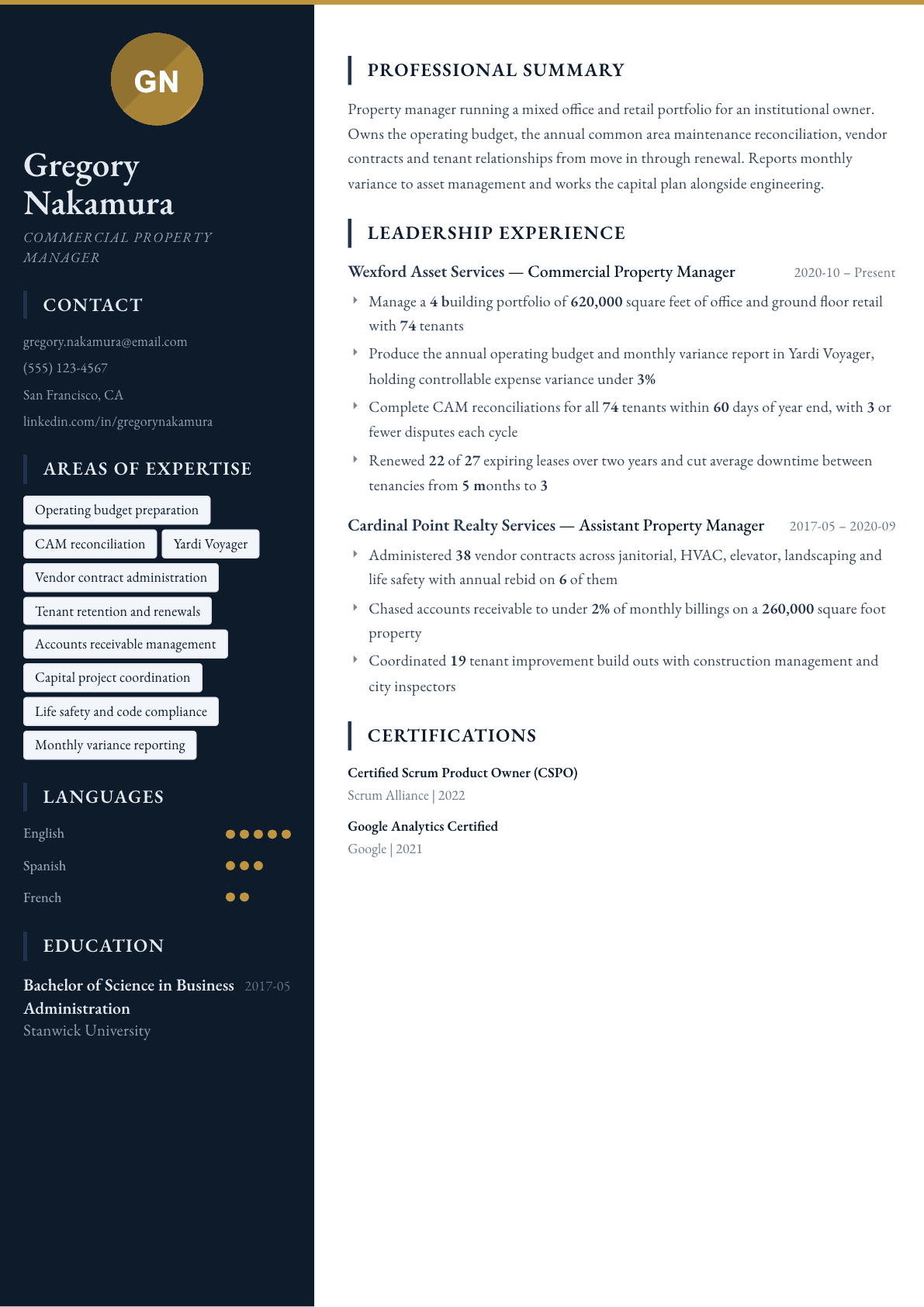
Example Commercial Property Manager summary
Commercial property manager running four office and retail buildings totaling six hundred twenty thousand square feet with seventy-four tenants for an institutional owner. Owns the operating budget and monthly variance reporting in Yardi Voyager, closes common area maintenance reconciliations within sixty days of year end with few disputes, renews the large majority of expiring leases, and has cut downtime between tenancies by two months while coordinating tenant build outs.
Skills to list on a Commercial Property Manager resume
- Operating and capital budget preparation
- Monthly variance reporting
- Common area maintenance reconciliation
- Lease administration and abstracts
- Yardi Voyager and MRI
- Vendor contract negotiation and rebid
- Accounts receivable collection
- Tenant retention and renewal negotiation
- Tenant improvement coordination
- Building systems and preventive maintenance
- Life safety and emergency planning
- Code and certificate of occupancy compliance
- Insurance certificate tracking
- Asset management reporting
What actually gets this resume read
- Open with portfolio size in buildings, square footage and tenant count, because those three numbers set your scale.
- Name the accounting platform you work in, since Yardi, MRI and RealPage each carry different reporting habits.
- Give your CAM reconciliation cycle time and the dispute count, as that is the work owners hear complaints about.
- Show retention as leases renewed against leases expiring, plus the downtime between tenancies.
- List the vendor categories you contract and rebid, not a general statement about managing vendor relationships.
- Include the capital projects you coordinated and the trades involved, since ownership funds those decisions.
How to write a commercial property manager resume
A commercial property manager is hired to protect net operating income on somebody else's asset. The asset manager reading your resume is checking three things: whether you can hold a budget, whether your tenants renew, and whether the annual reconciliation goes out on time without generating a queue of disputes. A page about delivering exceptional service to tenants answers none of them.
Scale sets the frame. Buildings, square footage and tenant count define the job more precisely than a title does, because a single tenant industrial park and a multi tenant office building with seventy-four suites are different professions wearing the same name. Put those numbers where a reader finds them without searching.
This guide covers presenting portfolio scale, writing the reconciliation and budget work properly, showing retention as renewals against expirations, and describing vendor and capital coordination in a way an owner recognizes. Three summaries, before and after bullets, and the questions managers ask when moving between office, retail, industrial and institutional ownership.
Format: portfolio scale, accounting platform, then owner type
One page for a single property manager, two once you carry a portfolio across several assets. Lead with scale under the summary: buildings, total square footage, tenant count and product type. Add the ownership type, because reporting for an institutional owner, a private family owner and a real estate investment trust have different rhythms and different tolerance for surprises.
Put the accounting platform high on the page. Yardi, MRI and RealPage each carry their own reporting conventions, and an employer whose whole general ledger lives in one of them will short list the manager who already knows it. Name the modules you actually work in rather than the brand alone.
- Scale block for a commercial manager: buildings, square footage, tenant count, product mix and ownership type.
- Systems line naming the accounting platform, the work order system and the lease administration module you use.
- Financial responsibilities stated plainly: operating budget, capital budget, variance reporting and reconciliation cycle.
- Team line: assistant managers, engineers, day porters and contracted staff you direct.
Summary: what you run, what you own financially, who you report to
Three lines. Portfolio scale, the financial deliverables that are yours rather than the accountant's, and the audience for your reporting. A manager who owns the operating budget, the monthly variance narrative and the annual reconciliation for a defined portfolio has described a real seat, and an asset manager can immediately picture handing over the assets.
If you are moving up from an assistant role, say so and evidence it with the pieces you already carried alone: receivables, vendor contracts, tenant build out coordination, insurance certificate tracking. Owners promote assistants regularly, but they want to see which parts of the manager job you were already doing without supervision.
Budgets, reconciliations and the variance narrative
The annual budget is the centerpiece. Say that you build it, what you build it from, and how close the year lands. Controllable expense variance is the fair measure, since taxes, insurance and utilities move for reasons no manager controls. A manager who separates controllable from uncontrollable variance in their own writing signals that they think the way an owner does.
Then the reconciliation. Common area maintenance and operating expense reconciliations are the most visible thing you do all year, because every tenant reads theirs. Give the cycle time from year end, the tenant count covered, and how many disputes came back. Add the mechanics: gross up methodology, pro rata share calculation, exclusions honored from negotiated leases, and caps or base year stops. Naming those details tells an owner you have read the leases rather than run a default report.
Tenants, retention and receivables
Retention is the number that moves value. Give renewals against expirations over a period, and pair it with downtime between tenancies, because a renewal record achieved by giving away every economic term is not a win. If you handled the renewal negotiation yourself rather than passing it to leasing, say so, since ownership groups split that responsibility differently.
Receivables belong here too. Give aged balances as a share of monthly billings, the collection cadence you run, and how you escalate: statement, notice, default letter, then legal. Tenant relationships are what make collections possible without litigation, so describe one difficult account you resolved and kept in the building.
Vendors, building systems, capital work and the keywords
List the vendor categories you contract and rebid: janitorial, HVAC service, elevator, life safety, landscaping, security, parking and waste. Say how often you take a category back to bid and what a rebid produced in service level or cost. Owners have been burned by managers who renew every contract without testing the market.
Capital coordination deserves specifics: roof replacement, chiller work, parking structure repair, restroom modernization, tenant build outs and the inspections that go with them. Then match the vocabulary in the postings, which is consistent across the field: common area maintenance reconciliation, net operating income, variance report, lease abstract, estoppel certificate, certificate of insurance, preventive maintenance and certificate of occupancy.
Commercial Property Manager resume summary examples
Assistant moving up
Assistant property manager on a 260K square foot office property, already owning receivables, 38 vendor contracts and tenant build out coordination. Chased aged balances to under 2% of monthly billings and coordinated 19 tenant improvement projects with construction management. Seeking a first commercial property manager seat.
Portfolio manager
Commercial property manager running 4 buildings totaling 620K square feet of office and ground floor retail with 74 tenants for an institutional owner. Builds the operating budget and monthly variance report in Yardi Voyager, holds controllable expense variance under 3%, and closes reconciliations within 60 days of year end.
Senior manager with staff
Senior property manager over a mixed office and retail portfolio with two assistant managers and three building engineers reporting in. Renewed 22 of 27 expiring leases across two years, cut downtime between tenancies from 5 months to 3, and delivered a roof and chiller capital program on budget.
Work experience bullets: before and after
Before: Managed a portfolio of commercial properties.
After: Managed 4 buildings totaling 620K square feet of office and ground floor retail with 74 tenants for an institutional owner, directing two assistants and three building engineers.
Buildings, square footage, tenant count and staff define the job in a way that a portfolio claim never does.
Before: Prepared annual budgets and monthly reports.
After: Built the annual operating and capital budgets in Yardi Voyager and wrote the monthly variance narrative, landing controllable expense variance under 3% for three consecutive years.
Separating controllable variance and holding it across years is the measure an asset manager actually tracks.
Before: Completed CAM reconciliations each year.
After: Completed common area maintenance reconciliations for all 74 tenants within 60 days of year end, honoring negotiated exclusions and base year stops, with 3 or fewer disputes each cycle.
Cycle time, lease level detail and the dispute count show reconciliation competence rather than reconciliation attendance.
Before: Maintained good tenant relationships and high retention.
After: Renewed 22 of 27 expiring leases over two years and cut average downtime between tenancies from 5 months to 3 by starting renewal conversations twelve months before expiration.
Renewals against expirations plus downtime and the method behind it turn retention into an operating result.
Before: Oversaw building vendors and maintenance contracts.
After: Administered 38 vendor contracts across janitorial, HVAC, elevator, landscaping and life safety, rebidding 6 categories annually and rewriting the janitorial scope after two consecutive inspection failures.
Contract count, categories, a rebid cadence and one corrective action show vendor management as a discipline.
Hard skills
- Operating and capital budget preparation
- Monthly variance reporting and narratives
- Common area maintenance reconciliation
- Lease abstraction and administration
- Yardi Voyager and MRI
- Accounts receivable and collection escalation
- Vendor contract negotiation and rebid
- Tenant improvement project coordination
- Preventive maintenance program management
- Life safety and emergency response planning
- Estoppel and insurance certificate administration
- Capital project planning and reporting
Soft skills
- Delivering a reconciliation invoice a tenant was not expecting
- Holding an engineer accountable without losing the building
- Explaining a variance to an owner before it becomes a question
- Keeping calm through an after hours water or power event
- Negotiating a renewal where the tenant knows the market softened
Certifications worth listing
- Certified Property Manager (CPM) (Institute of Real Estate Management)
- Real Property Administrator (RPA) (BOMI International)
- Facilities Management Administrator (FMA) (BOMI International)
- LEED Accredited Professional (Green Business Certification Inc.)
Mistakes that cost commercial property manager candidates the interview
- Omitting square footage and tenant count, which are the two numbers that establish whether you have done this job at scale.
- Writing about budgets without giving variance, so an owner cannot tell whether your numbers ever held.
- Treating reconciliation as a routine task instead of naming cycle time, gross up methodology and the dispute count.
- Reporting retention as a feeling rather than as renewals against expirations with downtime beside it.
- Listing vendor management generically without the categories contracted or how often a category goes back to bid.
- Leaving the accounting platform off the page, when the employer's entire general ledger habit is built around one system.
Commercial Property Manager resume questions
How do I move from residential to commercial property management?
Point at the transferable operations work, then close the real gap on the page: reconciliations, lease administration, recovery structures and tenant improvement coordination. Owners assume a residential manager can run a building and doubt they can read a commercial lease, so answer that doubt directly.
What if I manage buildings but do not own the budget?
Say exactly what you contribute: expense forecasting, capital recommendations, variance explanations or vendor pricing. Being honest about the split is better than implying full ownership, because the first interview question about the budget process will settle it either way.
How much detail should I give about CAM reconciliations?
Enough to prove you work from the leases rather than from a default report. Name gross up methodology, pro rata share, negotiated exclusions and caps or base year stops, then give the cycle time and the dispute count for the tenant population you served.
Do I need a designation to advance in commercial property management?
It is not required, but the recognized designations open institutional doors and often appear as a preference in postings. Candidates in progress should list the courses completed and the expected completion, since employers credit visible momentum toward a credential.
Should I include engineering and building systems knowledge?
Yes, at the level you genuinely hold it. Knowing how a chiller sequence, a fire alarm test cycle and an elevator maintenance contract work makes you a better negotiator with vendors, and owners notice managers who can question an invoice rather than approve it.
Related resume examples
- Property Management Resume example
- Leasing Consultant Resume example
- Regional Property Manager Resume example
- Commercial Real Estate Agent Resume example
- Vacation Rental Manager Resume example
- HOA Manager Resume example