Renewable Energy Analyst Resume Examples: free ATS score
Build a Renewable Energy Analyst Resume That Powers Opportunities
By Mustafa Tarabya, founder of CVBooster · Published · Updated
Create a renewable energy analyst resume showcasing energy market analysis, financial modeling, and project evaluation expertise with ATS-optimized templates for clean energy firms and utilities.
Sample resumes for a renewable energy analyst
The same renewable energy analyst content laid out in three CVBooster templates, so you can see what the finished document looks like before you write a word.
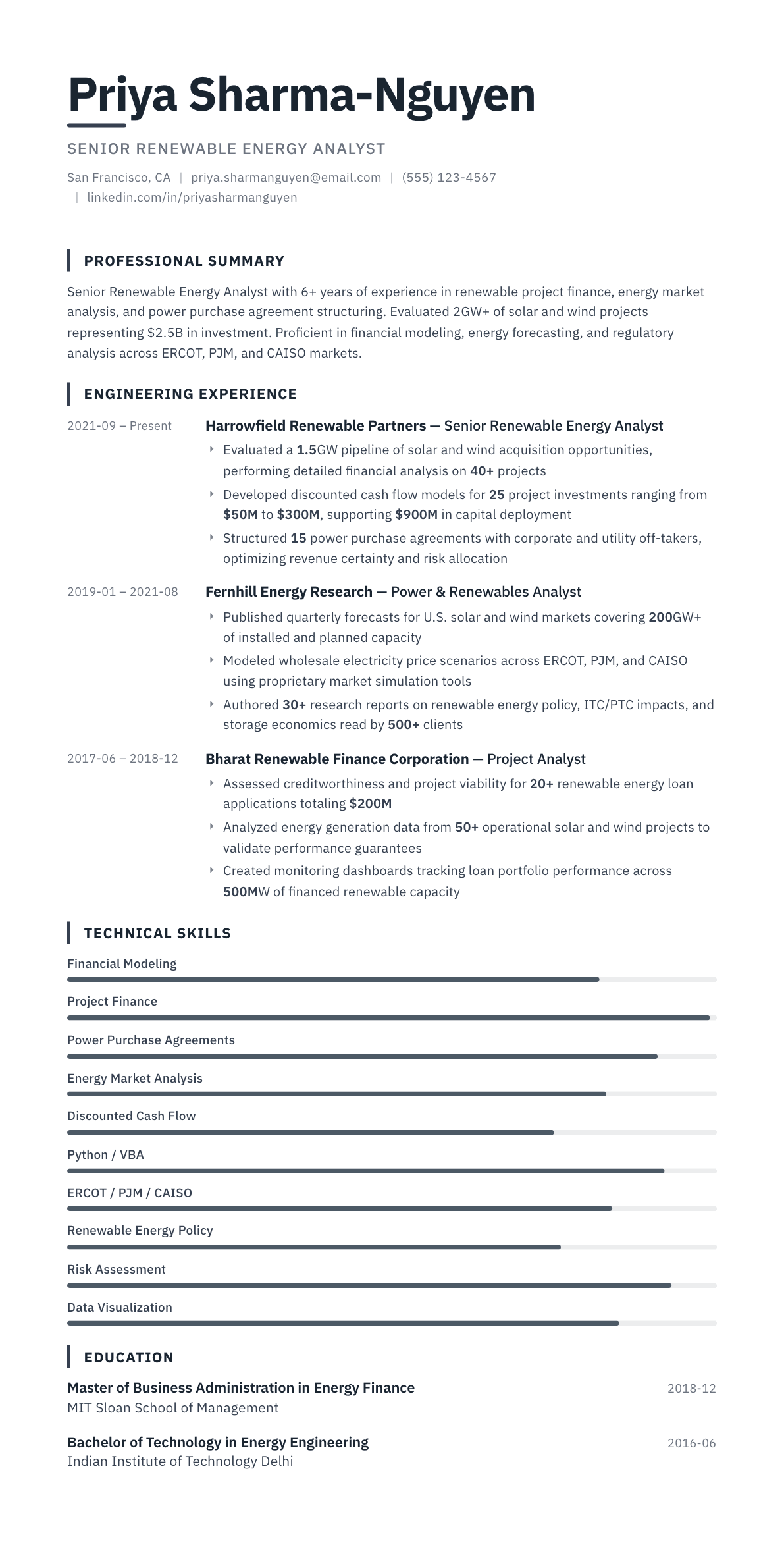
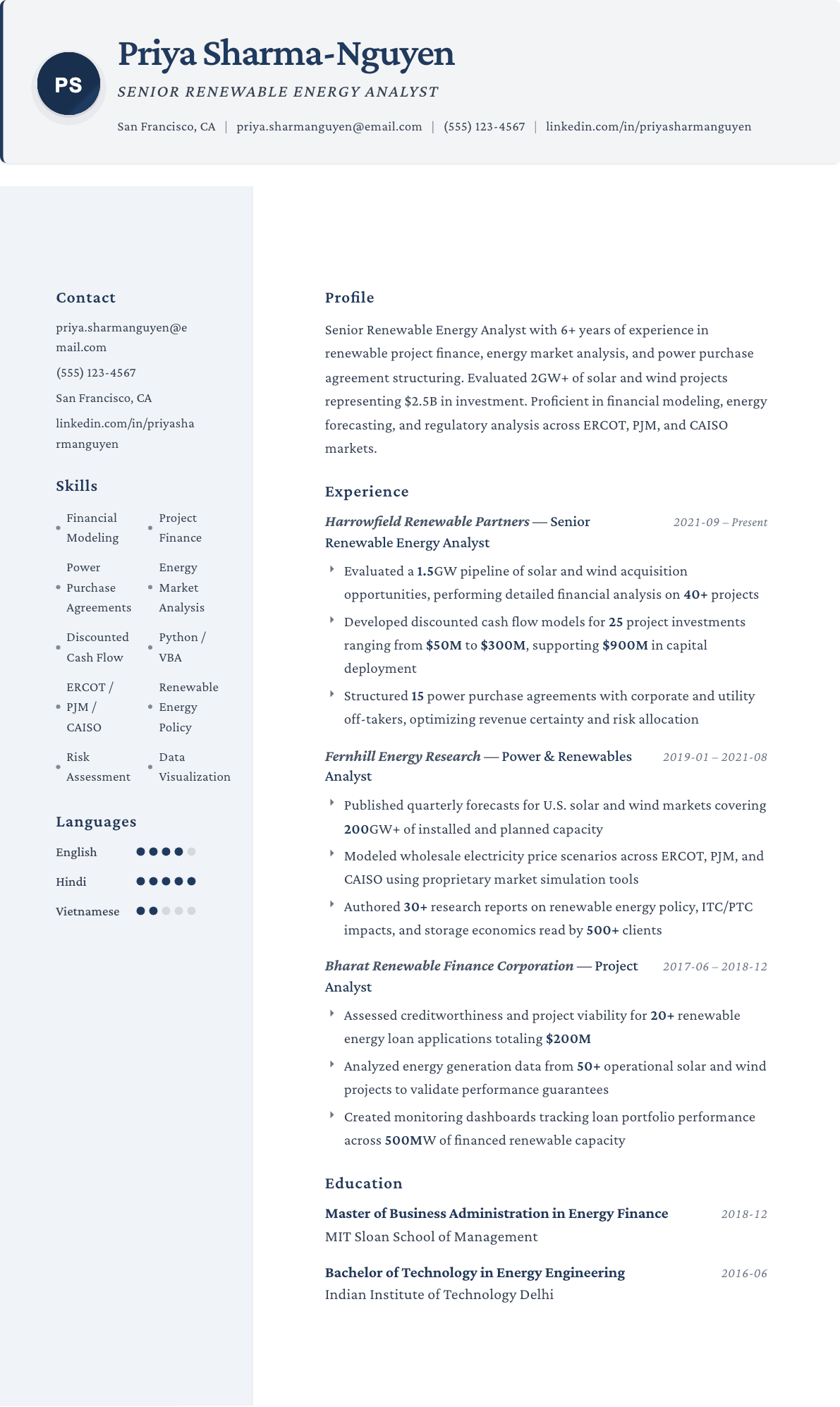
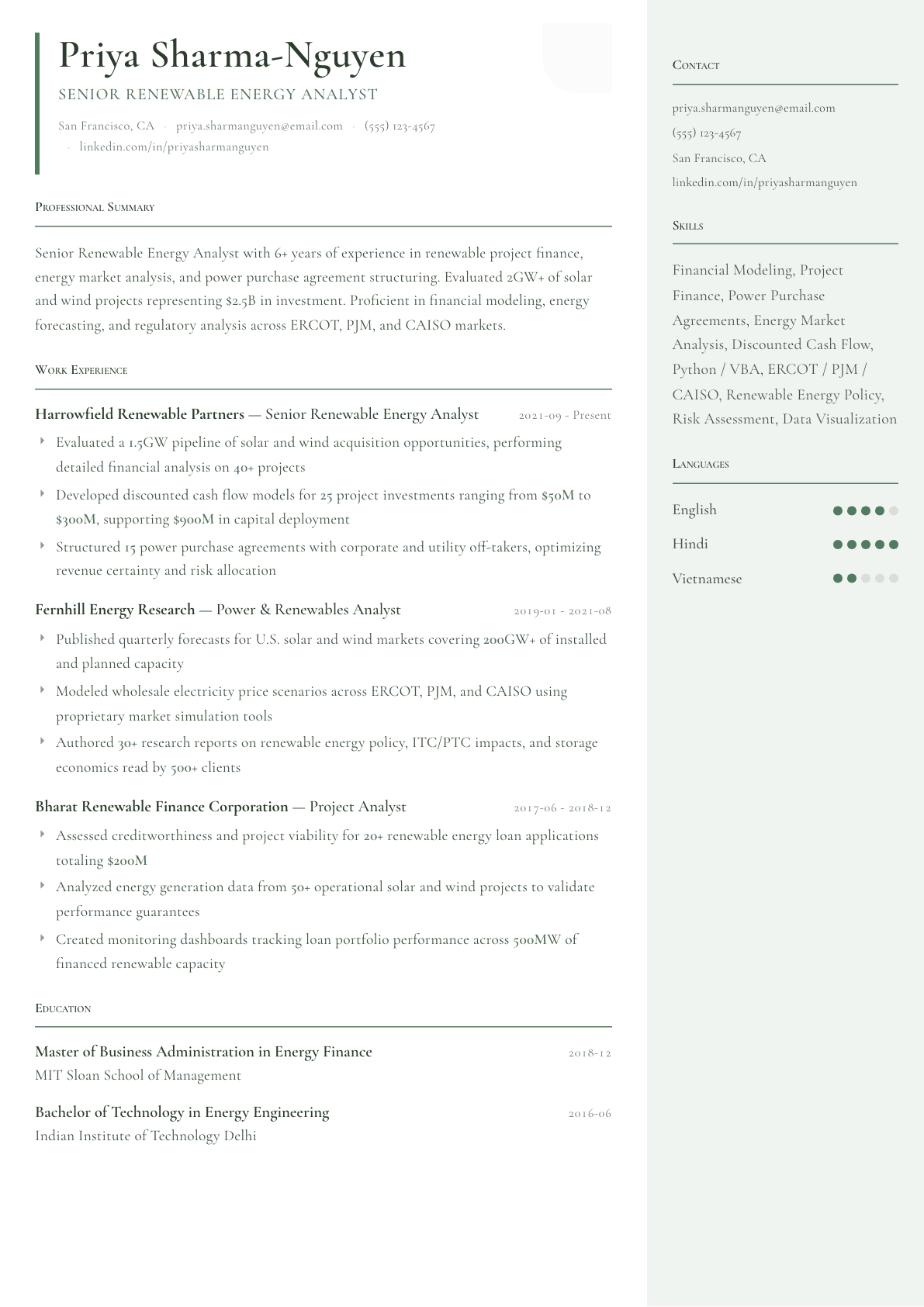
Example Renewable Energy Analyst summary
CFA candidate and Senior Renewable Energy Analyst with 6+ years in project finance and energy market analysis. Evaluated 2GW+ of solar and wind projects representing $2.5B in investment. Structured 15 PPAs and built DCF models supporting $900M in capital deployment. Deep expertise in ERCOT, PJM, and CAISO markets.
Skills to list on a Renewable Energy Analyst resume
- Financial Modeling
- Project Finance
- Power Purchase Agreements
- Energy Market Analysis
- LCOE / IRR Analysis
- Python / VBA
- Bloomberg Terminal
- Renewable Energy Policy
- Due Diligence
- Risk Assessment
- Data Visualization
- Wholesale Market Modeling
What actually gets this resume read
- Quantify deal flow: GW evaluated, dollar value of investments, and number of PPAs structured.
- Highlight financial modeling skills: DCF, LCOE, IRR, and sensitivity analysis with specific tools used.
- Include energy market expertise: ISO/RTO markets, wholesale pricing, and capacity mechanisms.
- Mention policy analysis experience: ITC, PTC, RPS, carbon pricing, or international feed-in tariffs.
- List analytical tools: Excel/VBA, Python, Bloomberg Terminal, or proprietary energy modeling platforms.
How to write a renewable energy analyst resume
Renewable energy analyst covers work that sits between finance, engineering and policy, and the hiring manager is usually one of the three. A developer wants someone who can size a project and defend its assumptions to an investment committee. A utility or independent system operator wants someone who can model dispatch and prices. A research or advisory firm wants someone who can publish a defensible market view. The resume has to declare which of those you are.
The second filter is the market. Experience in one wholesale power market does not automatically transfer, because the interconnection process, the capacity construct and the settlement rules differ. Naming the markets you have modeled is as important on this resume as naming the software.
This guide covers the sector and market lines that get an analyst read, how to describe financial and production models without inflating them, summaries at three career stages, and the technical vocabulary that separates an analyst who has closed deals from one who has only read about them.
Say which side of the industry you work on
Open with the technology, the stage and the market. Utility-scale solar development is a different job from operating asset performance analysis, and storage revenue modeling is different again. Name the technologies you have worked with, whether the projects were greenfield, under construction or operating, and the markets involved.
Then give scale in the terms the industry uses: megawatts evaluated, gigawatt-hours produced, number of projects, size of the pipeline. Capacity is the currency of this sector, and an analyst who omits it forces the reader to assume the projects were small.
- Header: name, city and state, phone, email, and market or region focus.
- Order: summary, technical and modeling skills, experience, education, certifications.
- Technologies to name explicitly: solar photovoltaic, onshore and offshore wind, battery storage, hybrid and co-located projects.
Financial modeling: what the model did, not that you built one
Everyone claims financial modeling. Say what the model produced and what decision it fed. A project model that produces levelized cost of energy, unlevered and levered returns, debt sizing against a coverage ratio, and a tax equity structure is a different artifact from a screening spreadsheet, and hiring managers can tell the difference in about a minute.
Name the assumptions you owned: capital cost curves, operating expense build-up, degradation, availability, curtailment, basis risk, merchant tail pricing, and the incentive structures that apply in your jurisdiction. Say whether your model was reviewed by lenders, by an independent engineer or by an investment committee, because external review is the strongest quality signal available.
Production, resource and market modeling
Energy yield work has its own vocabulary and its own software. Name the tools you have run and the outputs: production estimates with probability of exceedance levels, loss diagrams, shading and wake analysis, and post-construction performance comparison against the original estimate. An analyst who has reconciled operating output against a pre-construction forecast has seen where assumptions break.
For market analysis, name the simulation or forecasting platform, the region, and the question the run answered: curtailment exposure, capture price for a given technology, ancillary service revenue for a storage asset, or the effect of a transmission upgrade. Keep the emphasis on the decision the analysis supported.
- Interconnection: queue position analysis, network upgrade cost exposure, study phases.
- Offtake: power purchase agreements, hedges, tolling and merchant exposure.
- Operating assets: availability, performance ratio, and variance against budget.
Data skills are now part of the job
Analysts who only work in spreadsheets are losing ground to those who can pull settlement and generation data directly. Name the languages and tools: Python with pandas, SQL against a market or asset database, and a visualization layer for the dashboards the commercial team reads every morning.
Mention the datasets by category rather than by vendor where possible: nodal price histories, interconnection queue filings, generator interconnection agreements, meteorological reanalysis data, and asset-level generation reporting. Knowing where the numbers come from is a hiring signal in itself.
Education, credentials and a career change into clean energy
Engineering, economics, finance and environmental science degrees all appear in this field, and none is disqualifying. Put the degree with the field and add coursework or a thesis only when it is directly relevant, such as power systems, energy economics or corporate finance.
If you are moving in from general finance, consulting or another energy segment, state the move in the summary and translate deliberately. Deal modeling becomes project modeling, commodity analysis becomes power price analysis, and asset management becomes operating portfolio performance. Then close the credibility gap with a named self-study project you can discuss in detail.
Renewable Energy Analyst resume summary examples
First analyst role
Energy analyst with an engineering degree and a year supporting solar development, building project cost models, running production estimates and tracking interconnection queue positions across two markets. Comfortable in Excel and Python, and completed a self-directed study of storage revenue stacking.
Four years in
Renewable energy analyst with 4 years in project finance for solar and storage, owning the project model for assets from early screening to financial close. Modeled 30 projects totaling 2 GW, supported diligence on 6 acquisitions, and works daily across two wholesale markets.
Senior analyst
Senior analyst with 9 years across development, advisory and operating asset performance, leading revenue and curtailment modeling for a 4 GW wind, solar and storage portfolio. Presents price and capture assumptions to the investment committee and manages two junior analysts.
Work experience bullets: before and after
Before: Built financial models for renewable energy projects.
After: Built and maintained the project finance model for 18 solar and storage assets, sizing debt to a 1.30 coverage ratio and producing the levered return case reviewed by lenders at financial close.
The number of assets, the coverage constraint and external lender review show the model carried real weight.
Before: Analyzed energy market data.
After: Analyzed 5 years of nodal settlement prices in SQL and Python to estimate capture price and basis risk for a 200 MW wind asset, feeding the hedge structure the commercial team executed.
The data, the tools and the decision it fed turn generic analysis into a traceable contribution.
Before: Worked on power purchase agreements.
After: Modeled pricing and shape risk for 9 power purchase agreement negotiations, quantifying the cost of a fixed shape against hourly delivery and recommending the settlement basis adopted in 6 of them.
Naming the specific risk quantified and the adoption rate shows influence rather than participation.
Before: Prepared reports on renewable energy trends.
After: Authored a quarterly outlook on interconnection queue attrition across two markets, tracking 400 queued projects and revising the pipeline conversion assumption used in the corporate development plan.
A named recurring deliverable with a dataset behind it and an assumption it changed is far stronger than reporting.
Before: Helped with due diligence on acquisitions.
After: Ran commercial diligence on 6 operating solar acquisitions, reconciling metered generation against the pre-construction estimate and flagging a persistent availability shortfall that reduced the bid.
A specific diligence finding with a commercial consequence is what an investment team hires for.
Hard skills
- Project finance modeling
- Levelized cost of energy analysis
- Power purchase agreement structuring
- Wholesale market analysis
- Energy yield and production modeling
- Battery storage revenue modeling
- Interconnection queue analysis
- Curtailment and basis risk assessment
- Debt sizing and coverage ratio analysis
- Python and pandas
- SQL
- Scenario and sensitivity analysis
- Operating asset performance reporting
Soft skills
- Defending assumptions to an investment committee
- Written analysis for non-technical readers
- Working across development and finance teams
- Handling incomplete project data
- Prioritizing across a pipeline
Certifications worth listing
- Chartered Financial Analyst (CFA) (CFA Institute)
- Certified Energy Manager (CEM) (Association of Energy Engineers)
- Renewable Energy Professional (REP) (Association of Energy Engineers)
- Financial Risk Manager (FRM) (Global Association of Risk Professionals)
Mistakes that cost renewable energy analyst candidates the interview
- Writing about clean energy in general terms while never naming the technology, the market or the capacity you worked with.
- Claiming financial modeling without saying what the model output was or who reviewed it.
- Ignoring the market rules, when interconnection and settlement differences are the reason regional experience is valued.
- Reporting portfolio size as if you owned it, instead of naming the projects you personally modeled.
- Leaving out data skills, which now separate analysts who can build their own dataset from those who wait for one.
- Listing policy interest without any analysis showing how an incentive or a rule change altered a project case.
Renewable Energy Analyst resume questions
Do I need an engineering degree to be a renewable energy analyst?
No. Economics, finance and environmental science backgrounds are common, and the deciding factor is whether you can build and defend a project model. If your degree is not technical, show energy-specific work such as a production estimate or a market study you completed.
How do I show market experience if I have only worked in one region?
Name the market clearly and describe the rules you have worked with, such as the interconnection study process, the capacity construct and the settlement interval. Then state which other markets you have studied, so the reader sees awareness rather than a single-market blind spot.
Should I list the software I use for energy yield modeling?
Yes, alongside the outputs you produced, such as probability of exceedance cases and loss diagrams. Naming the tool without the output suggests you have opened it, while naming the output shows you have defended an estimate to someone who paid for it.
How do I move into renewable energy from a general finance role?
Translate the transferable core in the summary: modeling, diligence and credit analysis all apply directly. Then add one concrete energy artifact, such as a project model you built for a public asset, and name the technologies and markets you are targeting.
How much detail should I give about deals I supported?
Enough to show your role and the outcome without breaking confidentiality. Capacity, technology, market and the analysis you owned are usually safe. Keep counterparty names and pricing out unless the transaction was publicly announced.
Related resume examples
- Energy Consultant Resume example
- Solar Energy Engineer Resume example
- Sustainability Manager Resume example
- Engineering Intern Resume example
- Wind Energy Technician Resume example
- Facilities Engineer Resume example