Facilities Engineer Resume Examples: what gets the call
Build a Facilities Engineer Resume Around Buildings and Uptime
By Mustafa Tarabya, founder of CVBooster · Published · Updated
Facilities engineer resume example with building systems bullets, CMMS and energy keywords, plus a guide to writing every section.
Sample resumes for a facilities engineer
The same facilities engineer content laid out in three CVBooster templates, so you can see what the finished document looks like before you write a word.
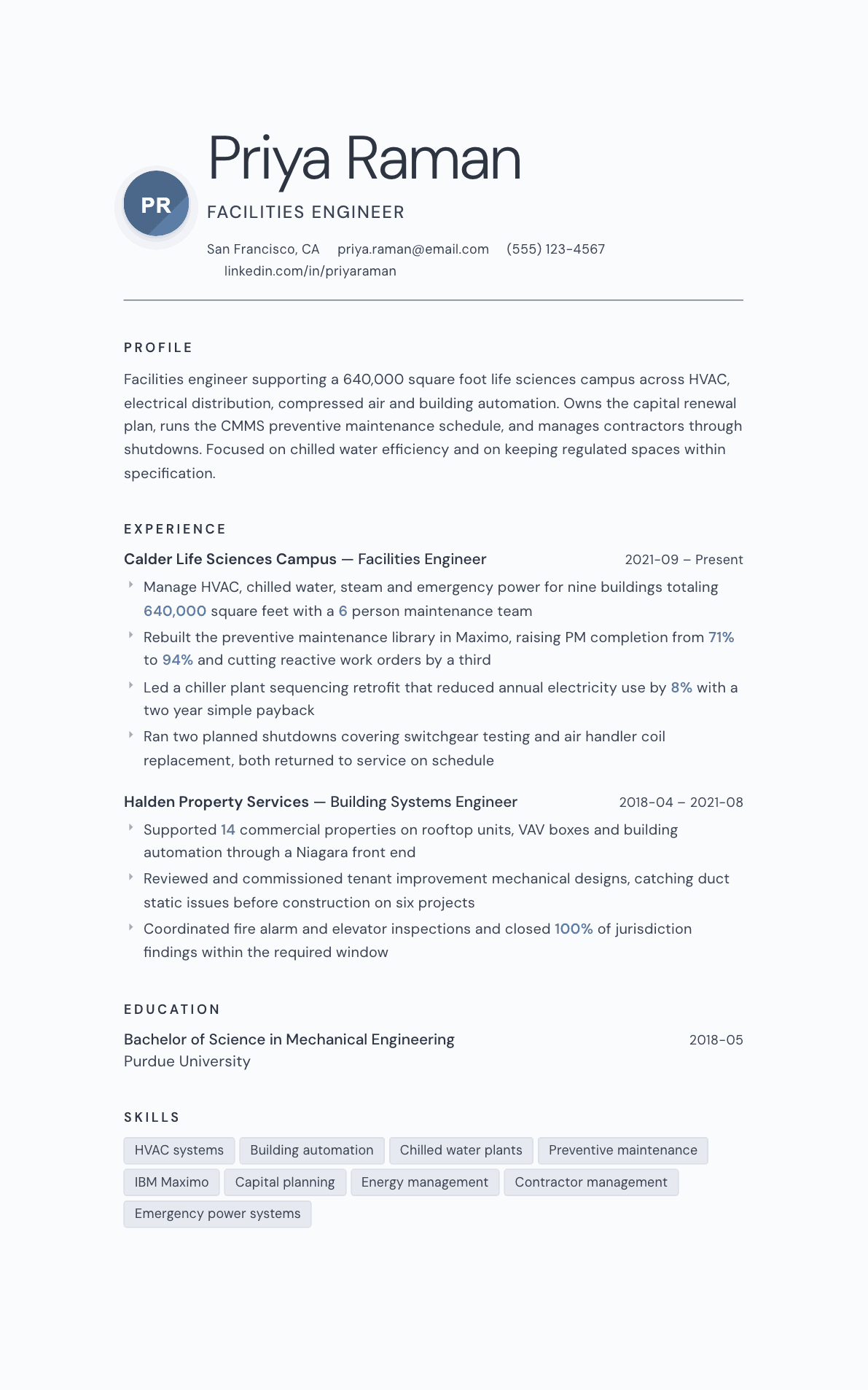
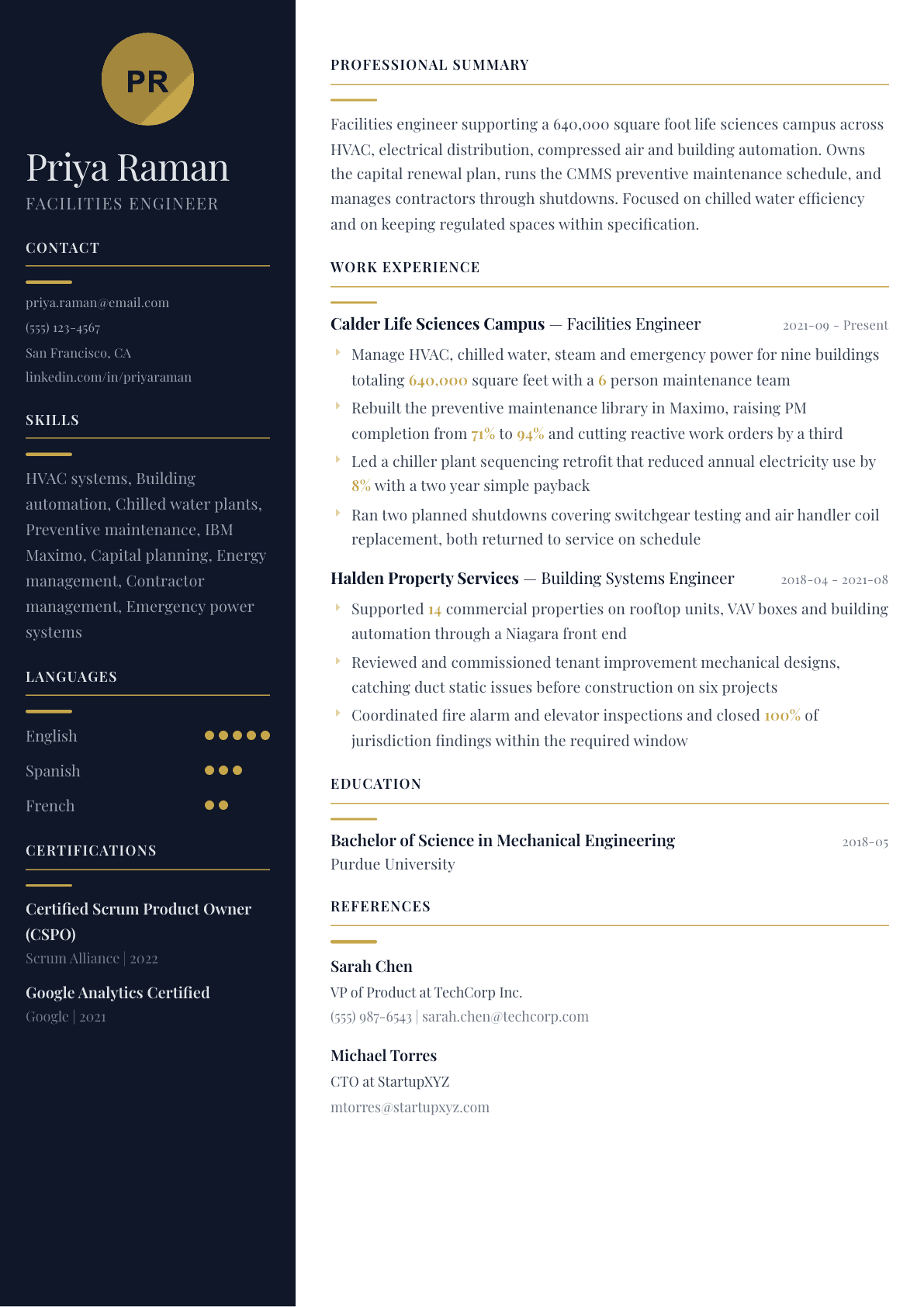
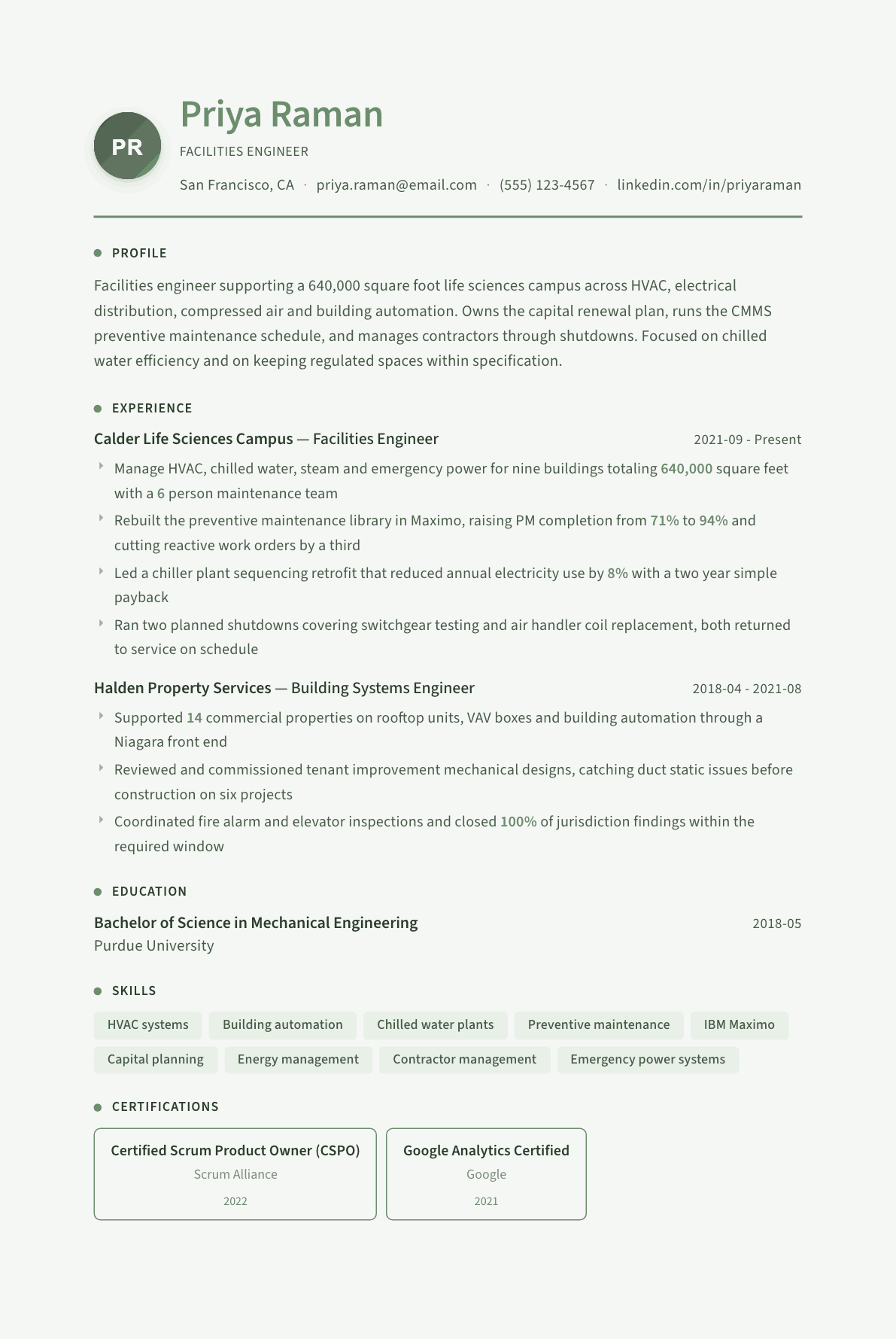
Example Facilities Engineer summary
Facilities engineer with six years supporting research and commercial buildings across HVAC, chilled water, electrical distribution and emergency power. Owns preventive maintenance in Maximo, plans capital renewal, and directs contractors through planned shutdowns. Raised PM completion from 71% to 94% on a nine building campus and delivered a chiller sequencing retrofit with a two year payback. Seeking a lead facilities engineering role.
Skills to list on a Facilities Engineer resume
- HVAC systems
- Chilled water plants
- Building automation systems
- Electrical distribution
- Emergency power
- Preventive maintenance planning
- CMMS administration
- Energy management
- Capital project planning
- Vendor and contractor management
- Commissioning support
- Compressed air systems
- Life safety inspections
- Root cause analysis
- Budget management
What actually gets this resume read
- Open each job with the square footage, building count and type, because scope is the first thing a director checks.
- Name the building automation front end and the CMMS you used, such as Niagara, Metasys, Maximo or Fiix.
- Report PM completion, uptime or work order backlog rather than saying you maintained building systems.
- Show at least one energy or capital project with the measure, the saving and the payback period.
- Say how many technicians and contractors you directed, since facilities roles blend engineering with supervision.
- Mention regulated environments such as clean rooms or data centers explicitly, as they change the hiring bar.
How to write a facilities engineer resume
A facilities engineer keeps buildings running and keeps them worth owning. The job sits between hands on maintenance and capital planning, which is why the resumes that succeed read as both technical and managerial. A director of facilities scanning applications wants to know the portfolio you carried, the systems you personally understand, the team and contractors you directed, and whether the building got quieter after you arrived.
Portfolio scale is the first filter. Nine research buildings on a campus, one distribution center, a hospital wing, a data hall or forty retail sites are all facilities engineering and none of them prepare you for the others. Say the square footage, the building count and the use type in the first line of every job and half the screening is done.
This guide walks through format, summary, experience, skills and certifications for a facilities engineer, with three example summaries, before and after bullets from building systems work, and the questions that come up when engineers move between property management, manufacturing sites and regulated environments.
Format: a scope line, then results, one column throughout
Reverse chronological with a short scope line under each employer. Facilities hiring managers read a stack of resumes that all say responsible for building operations, so a scope line stating buildings, area, systems and headcount immediately separates yours.
Keep it to one page under five years and two pages after. Add a certifications block near the top if you hold a stationary engineer license, a refrigeration operator certificate or an energy management credential, because those are legal requirements in some jurisdictions and gate the role.
- Header: name, city, phone, email, and any operator license you hold.
- Order: summary, certifications, experience, technical systems, education.
- Add a capital projects block once you have delivered three or more worth listing.
Summary: portfolio, systems, and the operating measure you moved
Name the portfolio and its use: laboratory campus, manufacturing site, class A office, healthcare, distribution or mixed use. Then name the systems you own, which usually means HVAC and chilled water, electrical distribution and emergency power, plumbing, compressed air, and the building automation front end.
Finish with one operating number. Preventive maintenance completion, reactive work order share, unplanned downtime, energy use intensity or capital plan delivery all work. That number is what tells a director you manage the building rather than react to it.
Experience: run the building, plan the renewal, direct the trades
Split each job into three kinds of bullet. Operations first: the systems, the maintenance program, the response to failures, the compliance inspections. Then projects: capital renewal, retrofits, tenant improvements, shutdowns. Then people: technicians supervised, contractors managed, budget owned.
Operations bullets need measures a facilities director recognizes. Preventive maintenance completion rate, work order backlog in weeks, mean time to respond on critical calls, chilled water plant efficiency, and inspection findings closed within the window. Saying you maintained equipment reliably is not a measure.
Project bullets need the scope, the cost control result and the disruption you avoided. A chiller sequencing retrofit with a stated saving and payback, an air handler coil replacement completed inside a weekend shutdown, a switchgear test that found a failing breaker before it dropped a floor. Occupants notice disruption more than they notice savings, so mention both.
Systems and software: the technical block that gets parsed
List building systems and platforms separately. Systems: air handling and VAV, chilled water and cooling towers, boilers and steam, electrical distribution and switchgear, generators and uninterruptible power, fire protection, elevators, compressed air, water treatment.
Platforms: the building automation front end by name such as Niagara, Metasys, Desigo or a competing system, and the maintenance management system such as Maximo, Fiix, eMaint or a corporate equivalent. Add energy analytics tools and any space or asset database you administered. Recruiters search on those product names directly.
Compliance, regulated space and keywords
If you have supported clean rooms, vivariums, laboratories, data halls or pharmaceutical space, give it its own bullet with the environmental parameters you held: temperature and humidity bands, pressure cascades, air change rates, monitoring and alarm response. Those environments raise the hiring bar and the pay band.
Common posting keywords include preventive maintenance, work order management, building automation, capital planning, life safety inspections, energy management, vendor management, shutdown planning, deferred maintenance and root cause analysis. Place each in a bullet where it is genuinely true.
Facilities Engineer resume summary examples
First facilities role
Mechanical engineering graduate with a year supporting building operations across four commercial properties, covering rooftop units, VAV troubleshooting and preventive maintenance scheduling. Trained on a Niagara front end and on work order management. Looking for a facilities engineer position on a laboratory or manufacturing site.
Six years in
Facilities engineer responsible for HVAC, chilled water, steam and emergency power across nine buildings totaling six hundred thousand square feet. Rebuilt the preventive maintenance library in Maximo, raised completion above 90%, and delivered two planned shutdowns on schedule with a six person maintenance team.
Lead facilities engineer
Lead facilities engineer with twelve years across research campuses and data halls. Owns a multi year capital renewal plan, directs eleven technicians and a contractor base, and holds clean room and vivarium spaces inside specification. Delivered a central plant upgrade with a measured reduction in annual electricity use.
Work experience bullets: before and after
Before: Responsible for maintaining building HVAC and electrical systems.
After: Managed HVAC, chilled water, steam and emergency power across nine buildings totaling six hundred and forty thousand square feet with a six person maintenance team.
Portfolio size, systems and team headcount give a director the scope comparison they need in one sentence.
Before: Improved the preventive maintenance program.
After: Rebuilt the preventive maintenance library in Maximo against manufacturer intervals, raising PM completion from 71% to 94% and cutting reactive work orders by roughly a third.
It names the system, the basis for the change and two before and after measures a facilities team tracks weekly.
Before: Worked on energy efficiency projects.
After: Led a chiller plant sequencing retrofit with metered verification, reducing annual electricity use by 8% for a two year simple payback.
Verification and payback are what a capital committee asks for, so including them makes the saving believable.
Before: Coordinated shutdowns with contractors.
After: Planned and ran two shutdowns covering switchgear testing and air handler coil replacement, sequencing eight contractors and returning both buildings to service inside the scheduled window.
Contractor count and on time return to service prove coordination rather than attendance at a shutdown.
Before: Handled inspections and compliance for the site.
After: Coordinated fire alarm, sprinkler and elevator inspections across fourteen properties and closed every jurisdiction finding inside the required correction window.
Compliance only counts when findings are closed, and stating the closure record removes any doubt.
Hard skills
- HVAC and air handling systems
- Chilled water plants and cooling towers
- Boilers and steam distribution
- Electrical distribution and switchgear
- Generators and uninterruptible power
- Building automation systems
- Preventive maintenance planning
- CMMS administration
- Energy management and metering
- Capital renewal planning
- Shutdown and outage planning
- Compressed air and water treatment
- Life safety inspection coordination
- Contractor and vendor management
Soft skills
- Occupant communication
- Contractor negotiation
- Emergency response coordination
- Budget discipline
- Technician supervision
- Prioritizing competing requests
Certifications worth listing
- Certified Facility Manager (CFM) (International Facility Management Association)
- Facility Management Professional (FMP) (International Facility Management Association)
- Certified Energy Manager (CEM) (Association of Energy Engineers)
- LEED AP Operations and Maintenance (US Green Building Council)
- Certified Plant Maintenance Manager (CPMM) (Association for Facilities Engineering)
Mistakes that cost facilities engineer candidates the interview
- Opening a job with duties instead of the portfolio, so nobody knows whether you ran one building or forty.
- Listing building systems without saying which ones you troubleshoot yourself versus which ones you contract out.
- Talking about energy savings without a verification method, which reads as a vendor claim rather than a result.
- Leaving the maintenance management system unnamed when recruiters search on Maximo, Fiix and similar products.
- Ignoring the supervisory half of the job, since facilities engineers are judged on how the trades perform.
- Burying regulated space experience such as clean rooms or data halls that would have raised the offer level.
Facilities Engineer resume questions
What is the difference between a facilities engineer and a facilities manager?
The engineer owns the technical systems, the maintenance strategy and the capital projects. The manager owns budgets, services, space and vendors more broadly. Many postings blend them, so mirror the language of the specific posting in your summary.
Which certifications actually help a facilities engineer?
A certified energy manager credential helps for utility heavy portfolios, and facility management credentials help when the role includes budget and vendor ownership. In jurisdictions requiring a stationary engineer or refrigeration license, that license outranks everything else.
How do I show energy work convincingly on a resume?
Give the measure, the verification and the payback. Say what you changed, how the saving was confirmed, whether by metering or utility bill comparison, and how long the investment took to return. Unverified claims invite skepticism in interviews.
Do I need building automation experience for a facilities engineer role?
Increasingly yes for anything larger than a single small building. Name the front end you used, say whether you adjusted schedules and setpoints or only monitored alarms, and be honest about the level, because it is tested quickly.
How do I move from property management into an industrial facilities role?
Emphasize the systems that transfer, which are chillers, boilers, air handling, electrical distribution and emergency power. Then name the industrial exposure you have to compressed air, process cooling or production support, and be specific about what you have not yet done.
Related resume examples
- Mechanical Engineer Resume example
- Industrial Engineer Resume example
- Building Engineer Resume example
- Maintenance Manager Resume example
- Chief Engineer Resume example
- Plant Engineer Resume example