Wind Energy Technician Resume Examples: read this first
Build a Wind Energy Technician Resume That Generates Interest
By Mustafa Tarabya, founder of CVBooster · Published · Updated
Create a wind energy technician resume highlighting turbine maintenance, safety compliance, and troubleshooting expertise with templates designed for wind farm and OEM hiring.
Sample resumes for a wind energy technician
The same wind energy technician content laid out in three CVBooster templates, so you can see what the finished document looks like before you write a word.
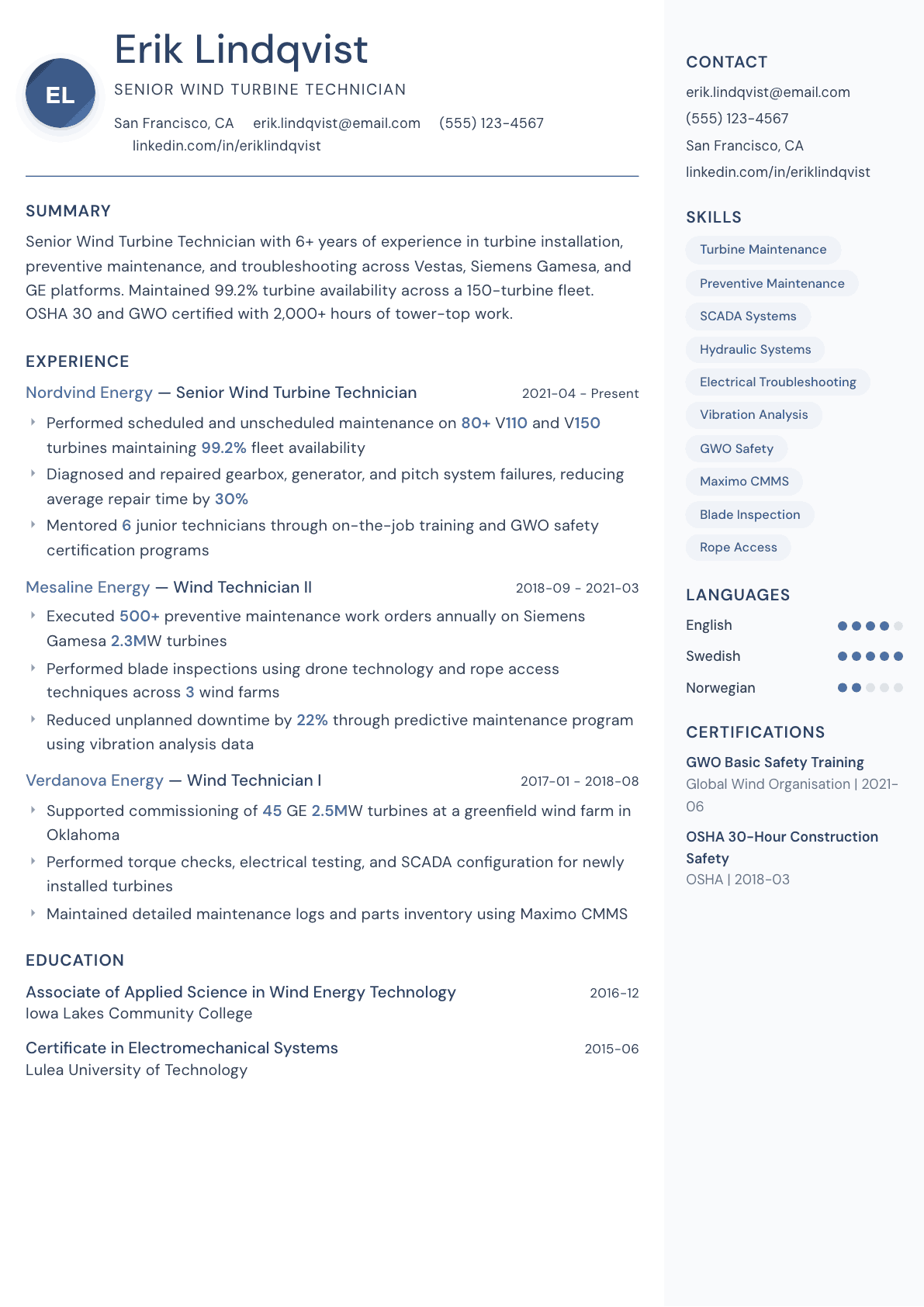
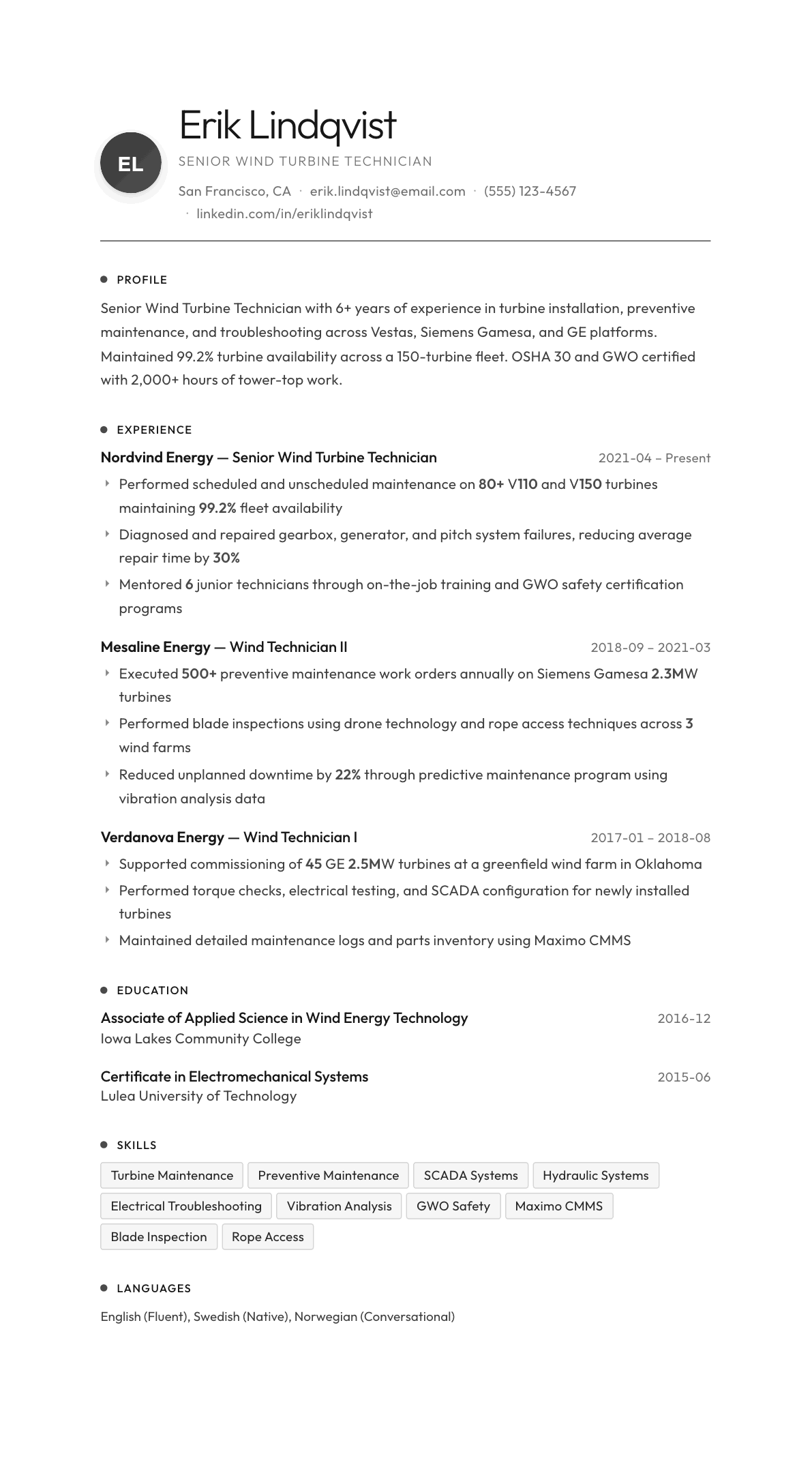
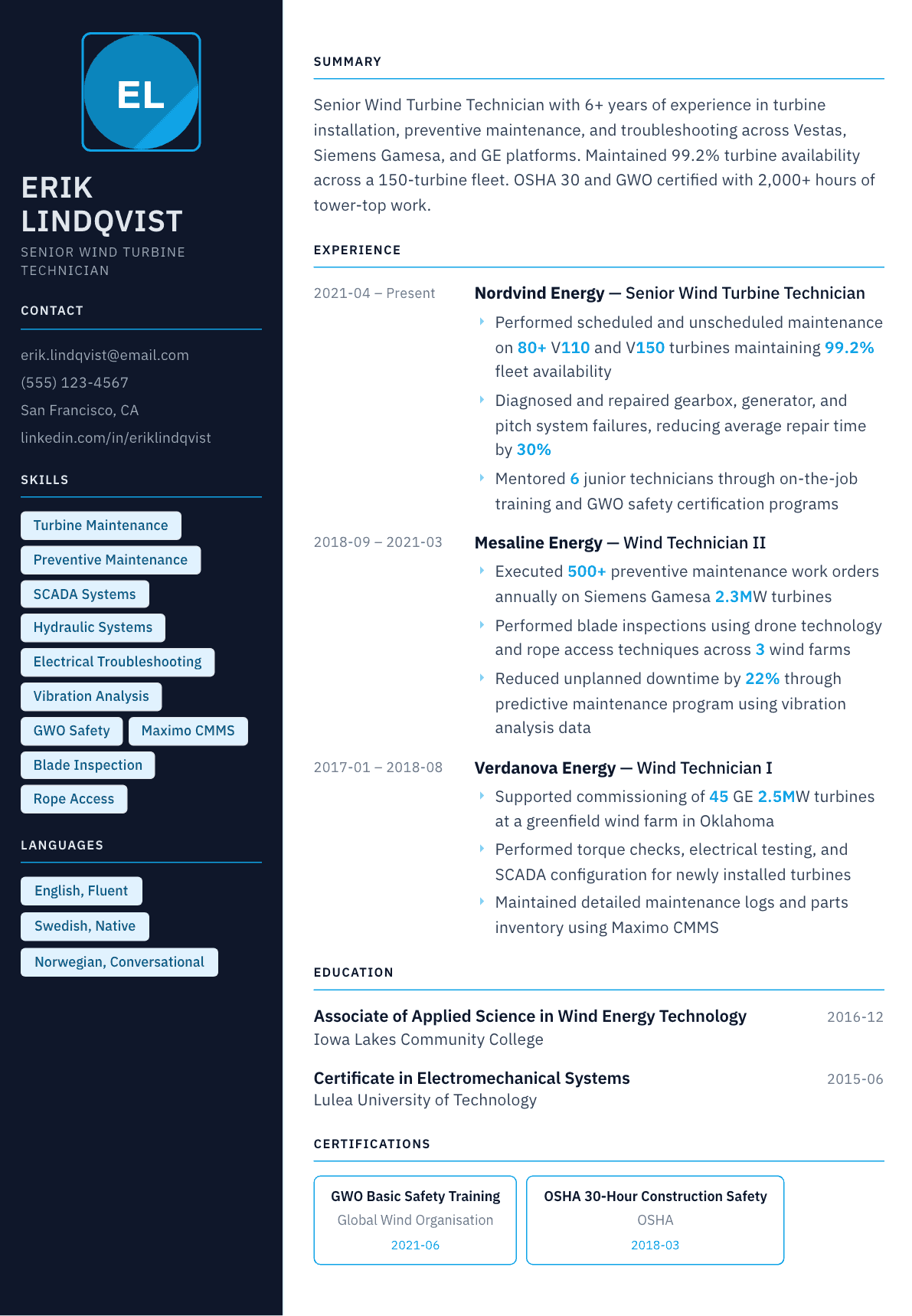
Example Wind Energy Technician summary
GWO and OSHA 30 certified Wind Turbine Technician with 6+ years maintaining Vestas, Siemens Gamesa, and GE platforms. Achieved 99.2% fleet availability across 150 turbines. Skilled in predictive maintenance, vibration analysis, and SCADA diagnostics with 2,000+ hours of tower-top experience.
Skills to list on a Wind Energy Technician resume
- Turbine Maintenance
- Preventive Maintenance
- Electrical Troubleshooting
- Hydraulic Systems
- SCADA Systems
- Vibration Analysis
- GWO Safety
- OSHA Compliance
- Maximo CMMS
- Blade Inspection
- Gearbox Repair
- Rope Access / Climbing
What actually gets this resume read
- List turbine platforms you have worked on: Vestas, Siemens Gamesa, GE, Nordex, Enercon.
- Quantify fleet performance: availability percentage, turbines maintained, and downtime reductions.
- Highlight safety certifications prominently: GWO, OSHA 30, rope access, crane operation.
- Include CMMS experience: Maximo, SAP PM, Fiix, or custom work order systems.
- Mention specialized skills: blade repair, gearbox overhaul, high-voltage switching, or SCADA troubleshooting.
How to write a wind energy technician resume
A wind energy technician resume is read fast and filtered hard. The site manager or regional maintenance lead looking at it wants three answers in the first ten seconds: which turbine platforms you have worked on, whether your GWO modules are current, and whether you can climb and be rescued at height without restriction.
Everything else is secondary to those three. A technician who has spent four years on Vestas V110 units and one who has spent four years on GE 1.5 machines are not interchangeable on day one, and a lapsed working at height module means you cannot go up the tower on Monday regardless of how good the rest of the resume reads.
This guide covers how to lay out platform experience so it survives a fast scan, how to write maintenance work so it shows diagnostic ability rather than a task list, how to handle travel and per diem realities, and the questions technicians ask when moving from a construction traveler role to a site based one.
Format: one page, certifications and platforms near the top
One page until you have around ten years in the field. Wind maintenance hiring runs on volume during commissioning and outage season, and a two page resume for a technician role gets skimmed rather than read. Keep it plain text friendly: no columns, no icons, no photo.
Put a safety and certifications block directly under the summary, above experience. List each GWO module you hold with its refresh status, your rescue and first aid training, OSHA training, and any rope access or crane and rigging qualification. This is the block a site manager checks first because it decides whether you can be scheduled.
- Header: name, base city and state, phone, email, and your travel availability.
- Order: summary, safety and certifications, turbine platforms, field experience, technical skills, education and training.
- Add a short platforms line naming manufacturers and models, for example Vestas V90 and V110, GE 1.5 and 2.x, Siemens Gamesa SWT.
Summary: platforms, years aloft, and the work you are known for
Two or three lines. Name the platforms, the number of turbines in the fleets you have maintained, whether the work was onshore or offshore, and the specialty you bring. Blade repair, gearbox and main bearing work, high voltage switching, pitch and yaw systems, converter troubleshooting and up tower major component exchange are all different specialties and site leads staff for them individually.
If you are coming in from an adjacent trade, say so and connect the parts that transfer. Industrial electricians, marine and diesel mechanics, elevator technicians and military aviation maintainers all cross into wind regularly, and hydraulics, torque and tension procedures, electrical troubleshooting and confined space work carry over cleanly.
Experience: fleet size, availability, and how you found the fault
Start each role with the site context: the number of turbines, the platform, the developer or owner operator, and whether you were in operations and maintenance, commissioning, construction or a traveling troubleshooting crew. Then say what you were responsible for, such as a route of turbines under scheduled maintenance or a call out rotation.
The bullets that separate a strong technician from an average one describe diagnosis, not replacement. Anyone can write that they changed a component. Write how you narrowed it down: reading fault codes in the SCADA history, comparing vibration spectra, checking pitch accumulator pressures, isolating a converter cabinet, running a hipot test on a generator winding, trending oil analysis before a gearbox call.
Availability is the plant metric that pays the bills, so tie your work to it where you honestly can. Downtime reduced on a repeat fault, a stuck turbine returned to service, a scheduled maintenance route closed inside the window during the low wind season.
Safety and physical requirements: state them, do not imply them
Wind employers screen on physical and safety eligibility because the insurance and the rescue plan depend on it. Say plainly that you can climb the tower, that you meet the weight limit for the fall arrest and rescue equipment, and that you hold current working at height and manual handling training. If you have offshore sea survival modules, list them separately because they are not interchangeable with onshore ones.
Add your incident and near miss discipline. Site leads value technicians who report near misses, write clean lockout and tagout permits and refuse a job when the wind speed or lightning distance is outside limits. A line about safety observations submitted or a stop work authority used carries weight.
Systems, tools and keywords a wind recruiter filters on
Name the work order system by product, since fleet operators run different ones and onboarding time matters. Name the SCADA and condition monitoring platforms you have used, the torque and tensioning equipment, the crane and lift types, and the specific test gear such as insulation resistance testers, thermal cameras and vibration analyzers.
Repeated posting vocabulary includes preventive maintenance, corrective maintenance, troubleshooting, up tower repair, major component exchange, blade inspection and composite repair, high voltage switching, hydraulic systems, torque and tension, and root cause analysis. Mirror the posting once in the skills block and once inside a bullet.
Wind Energy Technician resume summary examples
New technician
Wind energy technician with a two year renewable energy technology degree and a full set of current GWO modules including working at height, first aid, manual handling and fire awareness. Completed a 12 week site internship on GE 1.5 machines covering scheduled maintenance routes and torque verification.
Four years in the field
Wind technician with four years across Vestas V90 and V110 fleets totaling 78 turbines, plus two commissioning campaigns. Strong on pitch and hydraulic troubleshooting and up tower converter work. Current GWO and rope access Level I. Held fleet availability above 97% during a full outage season.
Lead technician
Lead wind technician with nine years across onshore Siemens Gamesa and GE fleets and two offshore campaigns. Runs a crew of six, plans major component exchanges with crane contractors, and owns high voltage switching authority. Cut repeat pitch faults on one site by 40% through a bearing lubrication program.
Work experience bullets: before and after
Before: Performed scheduled maintenance on wind turbines.
After: Completed six month and annual scheduled maintenance on a route of 22 Vestas V110 turbines, including torque verification, filter and oil changes, and yaw and pitch system inspection.
Platform, route size and the actual service tasks let a site manager judge how fast you would be productive.
Before: Troubleshot turbine faults.
After: Diagnosed a recurring pitch fault by trending SCADA fault history against accumulator pressures, traced it to a failing proportional valve, and returned the unit to service after two days of intermittent stops.
The diagnostic path shows reasoning, which is what distinguishes a technician from a parts changer.
Before: Helped with blade repairs.
After: Carried out rope access leading edge composite repairs on 14 blades, including grinding, laminate layup and coating, with drone inspection sign off before returning each unit to service.
The repair method, the volume and the verification step turn assistance into a documented skill.
Before: Followed all safety procedures on site.
After: Held lockout and tagout authority for up tower work, wrote confined space and high voltage switching permits, and submitted 30 safety observations that led to a revised rescue plan for the nacelle hatch.
Permits held and a change that resulted from an observation prove safety ownership rather than compliance.
Before: Used the work order system to log jobs.
After: Closed work orders in the site maintenance management system with fault codes, parts consumed and root cause notes, giving the reliability engineer usable data on repeat gearbox alarms.
It connects paperwork to a downstream reliability outcome instead of describing data entry.
Hard skills
- Scheduled and preventive turbine maintenance
- Pitch and yaw system troubleshooting
- Hydraulic system service
- Gearbox and main bearing inspection
- Blade inspection and composite repair
- High voltage switching
- Converter and generator troubleshooting
- Torque and tensioning procedures
- SCADA fault code analysis
- Vibration analysis and condition monitoring
- Insulation resistance and thermal imaging testing
- Up tower major component exchange
- Lockout and tagout permitting
- Work order and maintenance management systems
Soft skills
- Crew communication at height
- Stop work judgment in marginal weather
- Fault reporting discipline
- Working alone in remote sites
- Mentoring new climbers
Certifications worth listing
- GWO Basic Safety Training (Global Wind Organisation)
- GWO Basic Technical Training (Global Wind Organisation)
- GWO Advanced Rescue Training (Global Wind Organisation)
- OSHA 30-Hour Construction (OSHA Outreach Training Program, U.S. Department of Labor)
- Rope Access Technician Level I (Society of Professional Rope Access Technicians)
- Rope Access Level 1 (IRATA International)
- First Aid and CPR (American Red Cross)
Mistakes that cost wind energy technician candidates the interview
- Leaving the turbine platforms off the resume, which forces a recruiter to guess whether you can work the fleet she is staffing.
- Listing GWO without saying whether the modules are current, since an expired refresh means you cannot be scheduled.
- Writing replacement bullets with no diagnosis, so every job reads as swapping a part someone else identified.
- Hiding travel availability, when traveling crews and site based roles are staffed from completely different pools.
- Padding the resume to two pages with generic mechanical duties instead of tightening one page around platforms and faults.
- Using a designed template with graphics; wind operators run keyword filters and a parsed mess loses the certification block.
Wind Energy Technician resume questions
Do I need GWO certification before applying as a wind technician?
Many operators will train a promising candidate, especially out of a technical program, but holding current basic safety training makes you schedulable immediately and moves you ahead of untrained applicants. If you hold it, put it above your experience section rather than at the bottom.
How do I list turbine platforms I have only touched briefly?
Separate them honestly. Keep a primary platforms line for machines you have maintained regularly and a secondary exposure line for units you supported during a campaign or an outage. Site leads respect the distinction and will test it in a phone screen.
Can I move into wind from another trade?
Yes. Industrial electricians, hydraulic mechanics, aviation maintainers and marine engineers all transfer well. Lead with hydraulics, electrical troubleshooting, torque procedures, confined space and any height work, then state clearly that you meet the climb and rescue requirements.
Should I mention fleet availability numbers?
Only where you genuinely influenced them and can explain the driver. Availability depends on wind resource, warranty terms and parts supply as much as on technicians, so pair the figure with the specific fault you eliminated or the downtime you closed out.
How should a traveling technician show constant site changes?
Group them under one employer heading with the campaigns listed underneath: site, platform, turbine count, dates and your role. That reads as one continuous job rather than a series of short stints, which is how construction and commissioning work actually operates.
Related resume examples
- Solar Energy Engineer Resume example
- Electrical Power Engineer Resume example
- Power Plant Operator Resume example
- Facilities Engineer Resume example
- Chief Engineer Resume example
- Maintenance Engineer Resume example