Solar Energy Engineer Resume Examples: read this first
Build a Solar Energy Engineer Resume That Shines
By Mustafa Tarabya, founder of CVBooster · Published · Updated
Create a compelling solar energy engineer resume showcasing PV system design, energy modeling, and project development expertise with ATS-optimized templates for the renewable energy sector.
Sample resumes for a solar energy engineer
The same solar energy engineer content laid out in three CVBooster templates, so you can see what the finished document looks like before you write a word.
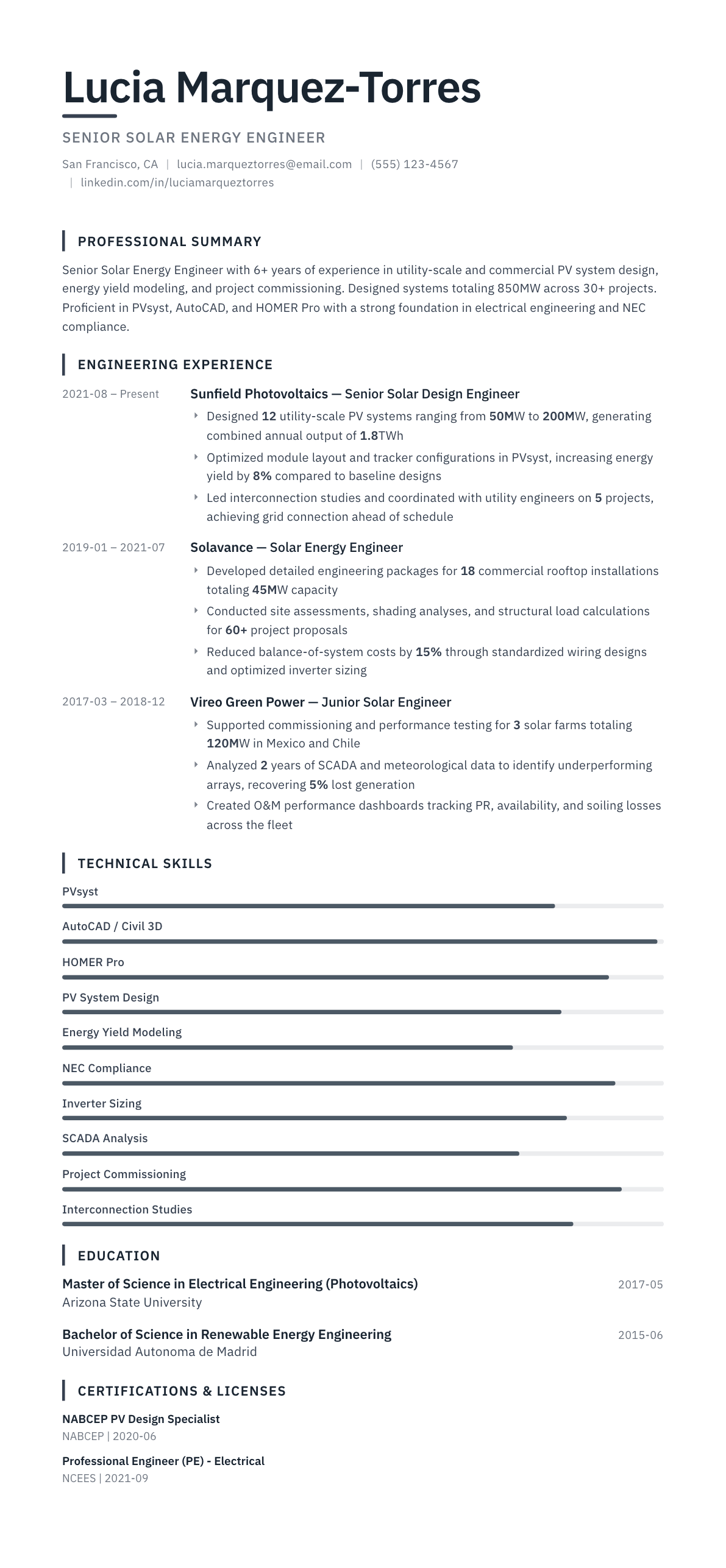
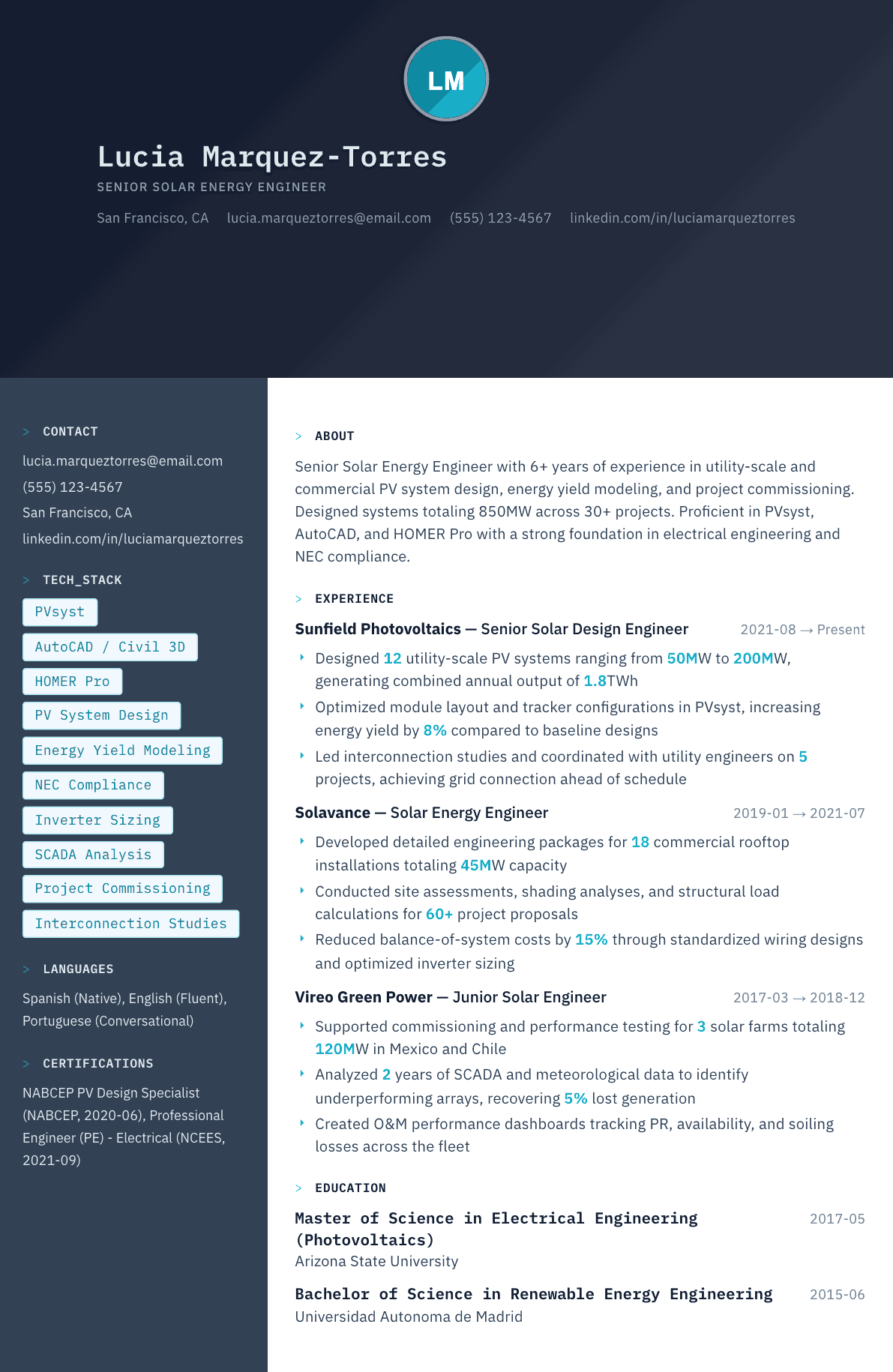
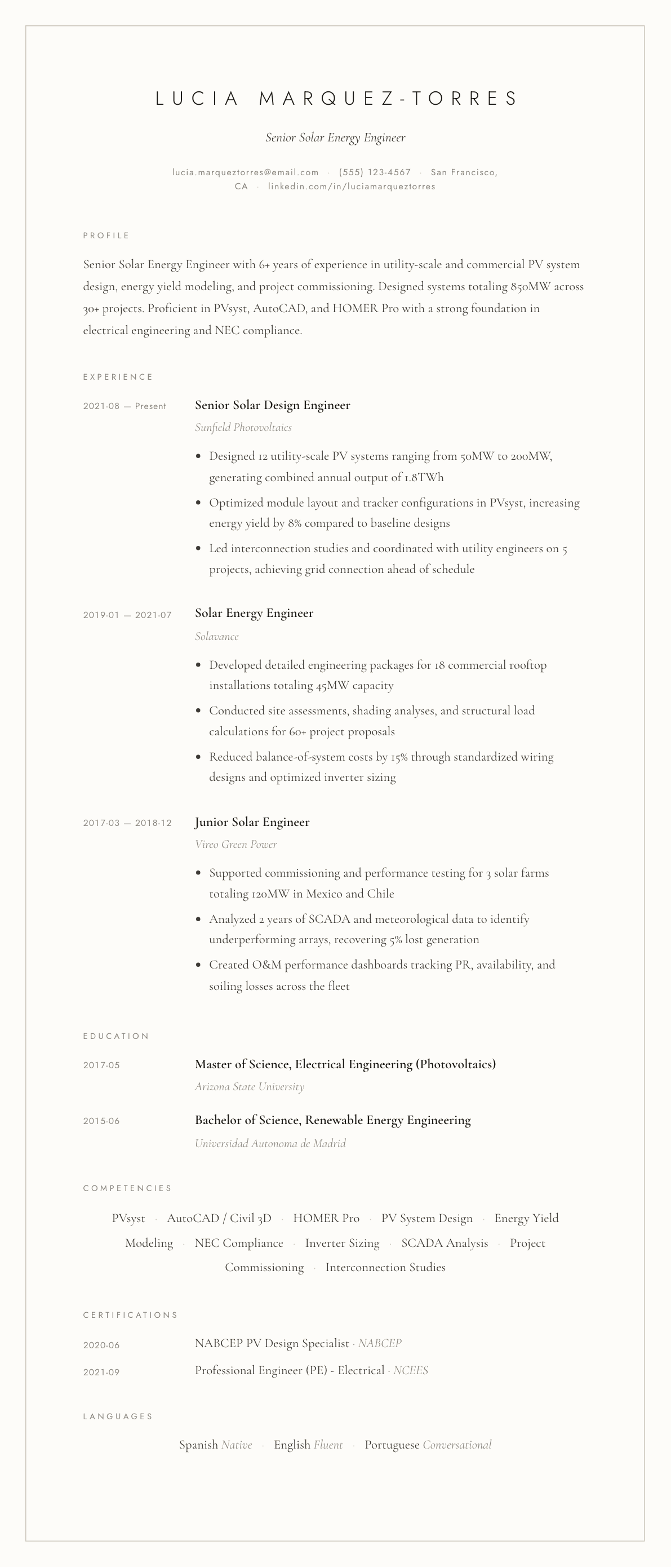
Example Solar Energy Engineer summary
NABCEP-certified Solar Energy Engineer with 6+ years designing utility-scale and commercial PV systems totaling 850MW. Expert in PVsyst, energy yield optimization, and NEC-compliant electrical design. PE-licensed with a track record of increasing energy output by 8% and reducing BOS costs by 15%.
Skills to list on a Solar Energy Engineer resume
- PVsyst
- Helioscope
- AutoCAD
- HOMER Pro
- PV System Design
- Energy Yield Modeling
- NEC / IEEE Standards
- Inverter Sizing
- Interconnection Studies
- SCADA / Monitoring
- Project Commissioning
- Electrical Engineering
What actually gets this resume read
- List solar-specific software prominently: PVsyst, Helioscope, AutoCAD, HOMER Pro, SAM.
- Quantify system capacity designed: MW installed, energy output, and cost savings achieved.
- Include NEC, IEEE, and IEC standards compliance experience relevant to solar installations.
- Mention NABCEP certification or PE license near the top of your resume.
- Describe project types: utility-scale, commercial rooftop, community solar, or off-grid systems.
How to write a solar energy engineer resume
Solar engineering splits into segments that barely overlap on a resume. Utility-scale design is a civil and electrical exercise in tracker rows, collection systems and interconnection. Commercial rooftop is a structural and code exercise. Residential is a volume design operation. Operations and maintenance engineering is a diagnostics job on assets already built. The hiring manager works in one of those segments and reads for it.
The second thing she reads for is whether you have stamped, sealed or defended a design. Solar plans go to an authority having jurisdiction, to a utility interconnection review and to an independent engineer, and each of those readers pushes back. An engineer who has taken comments and revised a package is worth more than one who has only drawn layouts.
This guide covers how to declare segment and scale, how to write design bullets around code and yield rather than software, the standards a solar employer expects you to name, summaries at three levels, and the field experience that makes a design engineer credible.
Segment, scale and stage in the first two lines
Say whether you work on utility-scale, commercial, industrial or residential systems, and whether your projects are ground-mount fixed tilt, single-axis tracker, rooftop, carport or floating. Then give scale in the industry unit: megawatts of direct current designed, project count, and whether the systems included storage.
Add the stage you cover: feasibility and preliminary layout, permit design, issued for construction packages, construction support, commissioning, or performance engineering on operating assets. Employers hire for a stage, and generalist language costs you the match.
- Header: name, city and state, phone, email, and licensure status.
- Order: summary, technical skills, project experience, notable projects list, education, certifications.
- A short project table in text form works well: project, capacity, mounting type, your role.
Design bullets: code and yield, not just software
Naming a modeling package tells a reader you have a license to it. Naming what you sized and why tells her you can do the job. String sizing against temperature extremes, direct to alternating current ratio selection, conductor and overcurrent protection sizing, voltage drop budgets, grounding and bonding, arc fault and rapid shutdown requirements, and equipment pad and foundation coordination are the decisions a design engineer actually makes.
Energy yield work should name the model, the losses you accounted for and the confidence level reported. Soiling, shading and row-to-row backtracking, thermal losses, mismatch, availability, and degradation assumptions are the parameters that get challenged, so showing you own them signals real experience.
Say who reviewed your work. Independent engineer review, utility interconnection study comments, and authority having jurisdiction plan check comments are all external tests, and surviving them is the credential that matters most in this field.
Codes and standards a solar employer expects
Name the electrical code articles governing photovoltaic systems and energy storage, the structural code basis for wind and snow loading, the fire code access requirements for rooftops, and the equipment standards for modules, inverters and racking. Interconnection work also brings in the distributed energy resource interconnection standard and the associated inverter certification requirements.
For utility-scale work, add the studies you have supported: short circuit and coordination, arc flash, load flow, grounding grid, and the power quality and ride-through requirements the interconnecting utility imposes. An engineer who can discuss these is being hired for a different pay band than one who cannot.
Field, commissioning and performance work
Design engineers who have been to site write better packages, so put your field time on the page. Site assessments, geotechnical and topographic coordination, construction requests for information, punch lists, and commissioning tests such as insulation resistance, polarity checks, current-voltage curve tracing and capacity testing all count.
On operating assets, name the performance work: performance ratio tracking, availability and downtime attribution, inverter fault analysis, string-level underperformance detection, soiling loss quantification, and warranty claims supported with evidence. Diagnostics on a built plant is a distinct skill from designing one, and it should be visible if you have it.
Licensure, education and the transition into solar
An electrical or mechanical engineering degree is the usual route, and licensure matters for anyone who wants to stamp drawings. List the license discipline and states, or the passed fundamentals examination if you are on the path. Industry certification carries weight for design and installation roles and is worth naming with the specialty.
If you are moving in from another electrical or construction field, translate the overlap directly: power distribution design, protection and coordination, structural steel detailing, or field commissioning all transfer. Then add the solar-specific evidence, such as a design package you produced or a certification you completed, so the reader sees more than enthusiasm.
Solar Energy Engineer resume summary examples
Junior design engineer
Electrical engineering graduate with a year producing residential and small commercial photovoltaic permit sets, including string sizing, single-line diagrams and structural attachment details. Trained on the electrical code articles for photovoltaic systems and completed an industry photovoltaic design specialty exam.
Five years in
Solar design engineer with 5 years producing issued-for-construction packages for commercial rooftop and ground-mount systems totaling 90 MW. Owns string and conductor sizing, energy yield modeling and plan check response, and supports commissioning and current-voltage curve testing in the field.
Lead engineer
Lead solar engineer and licensed professional engineer with 11 years on utility-scale projects, responsible for electrical design across 600 MW of tracker installations. Owns collection system layout, protection coordination input and interconnection study response, and reviews the work of 4 design engineers.
Work experience bullets: before and after
Before: Designed solar PV systems using industry software.
After: Produced issued-for-construction electrical packages for 14 ground-mount projects totaling 180 MW, covering string sizing, collection circuit conductor selection and grounding across 4 different tracker vendors.
Project count, capacity and the specific design decisions show scope that a software name alone never conveys.
Before: Performed energy yield modeling for projects.
After: Modeled annual energy for 20 sites with site-specific soiling, backtracking and availability assumptions, and reconciled the estimate against metered output on 3 operating plants after their first year.
Naming the loss assumptions and the post-construction reconciliation shows the estimates were tested against reality.
Before: Handled permitting for solar installations.
After: Resolved plan check comments from 25 authorities having jurisdiction on rooftop systems, revising rapid shutdown and fire access details to obtain permits without a second round of comments on 22 of them.
The comment volume and first-pass approval rate prove code fluency rather than form submission.
Before: Supported construction and commissioning.
After: Ran commissioning on a 40 MW site, performing insulation resistance and polarity checks on 900 strings and current-voltage curve tracing on underperforming circuits before capacity testing.
Named tests and string counts show hands-on commissioning rather than site attendance.
Before: Improved performance of operating solar plants.
After: Attributed a persistent performance ratio shortfall across a 60 MW portfolio to inverter derating during high ambient temperature, and specified a cooling retrofit that recovered a measurable share of summer output.
A diagnosed root cause with a specified fix demonstrates performance engineering, not general monitoring.
Hard skills
- Photovoltaic system design
- String sizing and array configuration
- Single-line and three-line diagrams
- Energy yield modeling with PVsyst
- Shading and backtracking analysis
- Electrical code compliance for photovoltaic systems
- Inverter selection and DC to AC ratio optimization
- Grounding, bonding and overcurrent protection
- Structural load and attachment coordination
- Interconnection studies and utility coordination
- AutoCAD and Helioscope
- Commissioning and current-voltage curve tracing
- Performance ratio and availability analysis
Soft skills
- Responding to plan check and reviewer comments
- Coordination with construction crews
- Clear technical documentation
- Managing multiple concurrent project deadlines
- Explaining design tradeoffs to developers
Certifications worth listing
- PV Design Specialist (North American Board of Certified Energy Practitioners)
- PV Installation Professional (North American Board of Certified Energy Practitioners)
- Professional Engineer (PE), Electrical (State engineering licensing boards, via NCEES examinations)
- Fundamentals of Engineering (FE) (NCEES)
- OSHA 30-Hour Construction (OSHA Training Institute Education Centers)
Mistakes that cost solar energy engineer candidates the interview
- Leaving the segment out, so a utility-scale employer cannot tell whether your megawatts came from rooftops or tracker fields.
- Listing modeling software instead of the sizing and code decisions the software only supports.
- Quoting capacity without saying which part of the design you owned or which stage you covered.
- Skipping external review entirely, when surviving plan check and interconnection comments is the real proof of competence.
- Omitting field and commissioning experience, which is what separates a designer whose packages build cleanly.
- Naming standards vaguely instead of the specific code areas that govern photovoltaic and storage installations.
Solar Energy Engineer resume questions
How do I show project scale on a solar engineer resume?
Give capacity in megawatts of direct current, the project count, the mounting type and your role on each stage. Capacity alone is misleading, because a single large project and twenty small ones represent very different design volumes and different problems.
Is a professional engineer license required for solar design?
It is required to stamp drawings, which many permit and construction packages need. Unlicensed engineers do substantial design work under a licensed reviewer, so state your status honestly and list the fundamentals examination if you have passed it.
Which certification helps most for a solar engineering role?
The design specialty credential from the recognized North American certification body is the one design employers recognize, and the installation credential helps for field-facing roles. Neither replaces code fluency, so pair the certification with examples of packages you produced.
How do I move into solar from another electrical engineering job?
Lead with the transferable work: power distribution design, protection and coordination, load calculations and construction support. Then name the solar-specific study or certification you completed and any design package you have produced, even on a small system.
Should I list every project I have worked on?
No. Give a short list of representative projects with capacity, mounting type, location type and your role, then summarize the rest by count and total capacity. A reviewer wants the range and the depth, not a complete portfolio inventory.
Related resume examples
- Renewable Energy Analyst Resume example
- Electrical Power Engineer Resume example
- Wind Energy Technician Resume example
- Civil Engineer Resume example
- Electrical Engineer Resume example
- Power Systems Engineer Resume example