Sustainability Manager Resume Examples: read this first
Build a Sustainability Manager Resume That Drives Change
By Mustafa Tarabya, founder of CVBooster · Published · Updated
Create a sustainability manager resume highlighting ESG reporting, carbon reduction, and corporate sustainability strategy with ATS-optimized templates for mission-driven organizations.
Sample resumes for a sustainability manager
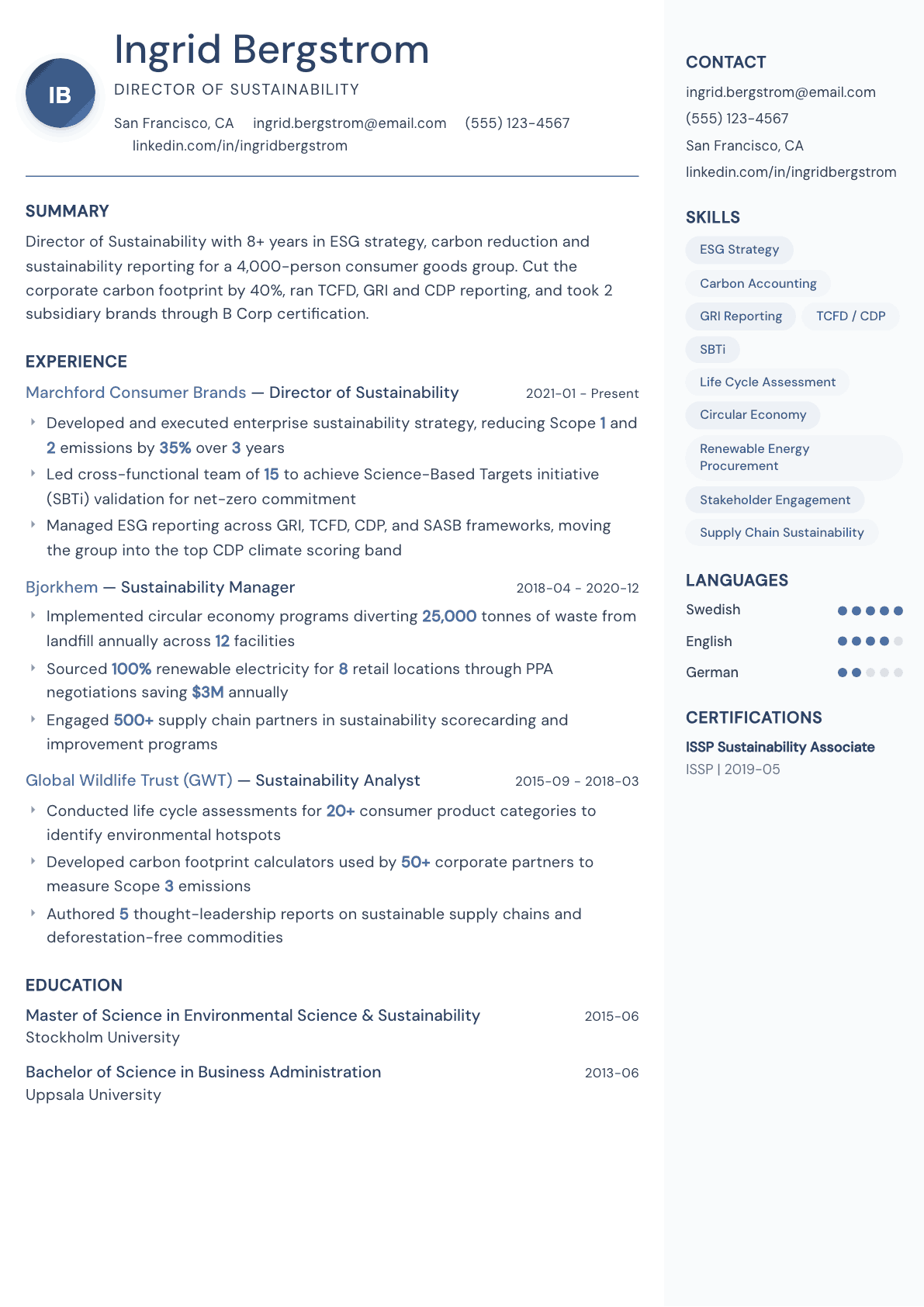
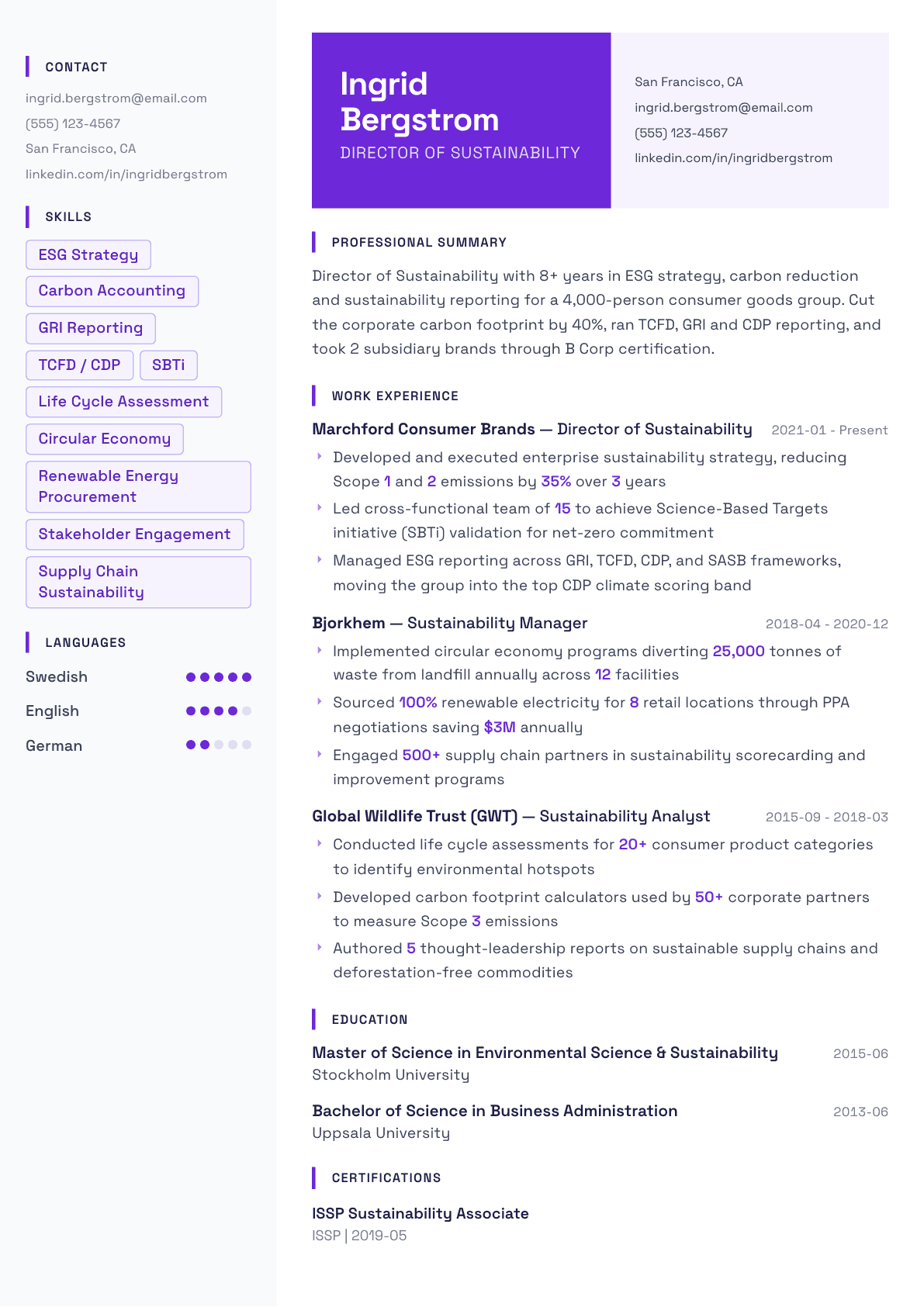
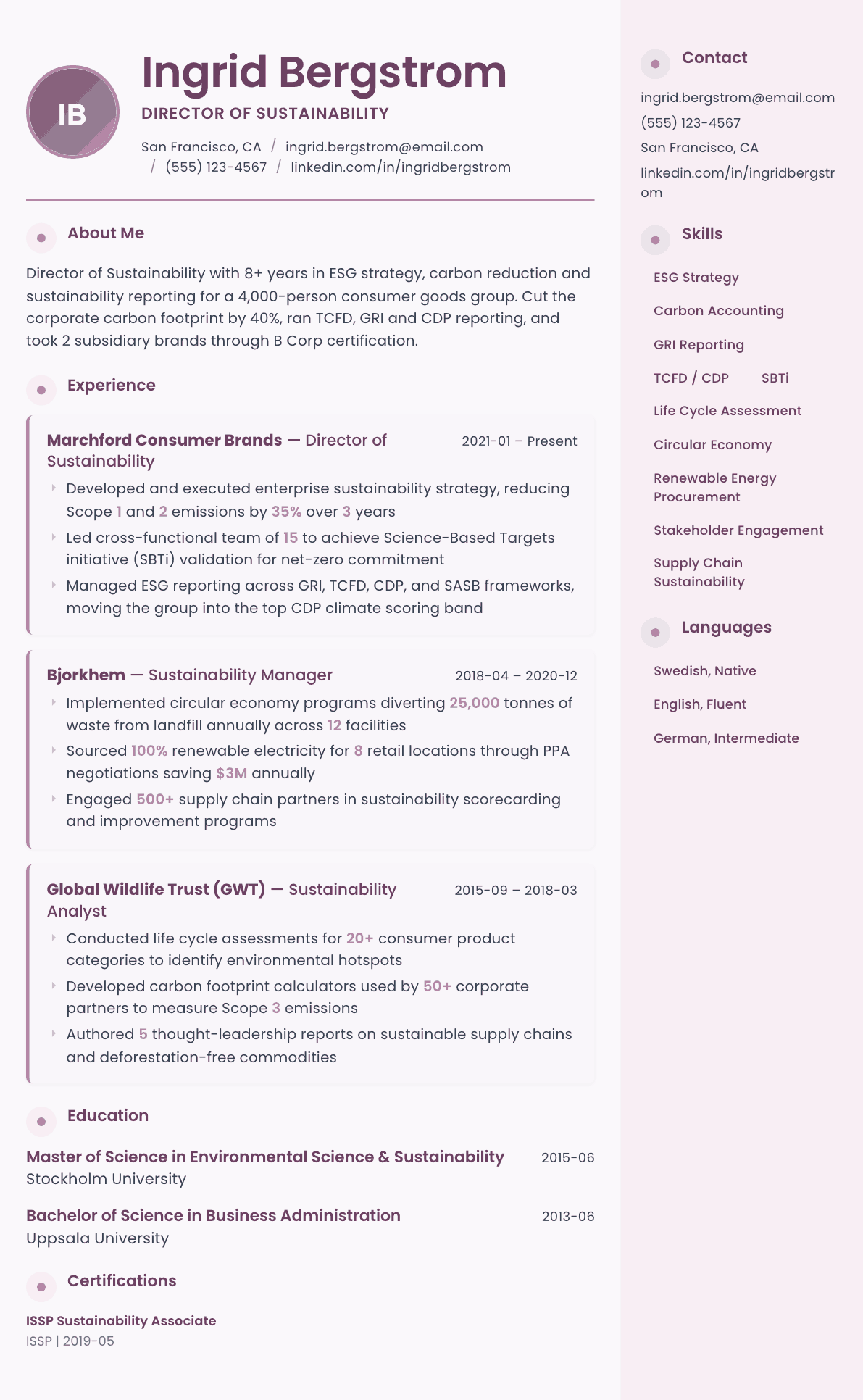
The same sustainability manager content laid out in three CVBooster templates, so you can see what the finished document looks like before you write a word.
Example Sustainability Manager summary
Sustainability Director with 8+ years building ESG strategy and carbon reduction programs inside consumer goods manufacturing. Cut emissions by 40%, secured SBTi validation of a net-zero target, and lifted the group into the top CDP climate band. Runs GRI, TCFD and SASB reporting and a 500-supplier sustainability program.
Skills to list on a Sustainability Manager resume
- ESG Strategy
- Carbon Accounting
- GRI / SASB Reporting
- TCFD / CDP
- Science-Based Targets
- Life Cycle Assessment
- Circular Economy
- Renewable Energy Procurement
- Supply Chain Sustainability
- ISO 14001
- Stakeholder Engagement
- Climate Risk Assessment
What actually gets this resume read
- Quantify environmental impact: carbon reduced, waste diverted, water saved, or renewable energy procured.
- Highlight ESG reporting frameworks: GRI, TCFD, CDP, SASB, CSRD, or integrated reporting.
- Include certifications: ISSP, LEED, B Corp Analyst, GHG Protocol, or ISO 14001.
- Describe stakeholder engagement: board presentations, investor communications, and supply chain programs.
- Mention science-based targets, net-zero commitments, or climate-related financial disclosures.
How to write a sustainability manager resume
A sustainability manager resume is screened by people who have grown tired of good intentions. The talent partner filters on framework names: GRI, TCFD, CDP, SASB, CSRD, SBTi. The hiring executive, usually a VP of ESG, a general counsel or a chief operating officer, reads the experience section to find out whether you have ever moved a number that an auditor later checked.
The gap that sinks most applications is the distance between advocacy and delivery. Plenty of candidates can describe a materiality assessment. Far fewer can show a completed Scope 3 screening across purchased goods and logistics, a supplier engagement program that lifted response rates, and a disclosure that survived limited assurance without a restatement.
This guide covers the structure that ESG hiring teams expect, how to write the summary when your background is engineering, compliance or communications, how to phrase carbon work so it reads as auditable, and the questions candidates raise most when they move from a coordinator title to a manager one.
Format: reverse chronological, disclosure work made visible
Keep it to two pages once you are past a first program role. Reverse chronological order is the norm because ESG hiring is sequence sensitive: a reader wants to see the point where you moved from collecting data to owning a public disclosure, and a functional layout hides exactly that.
Give reporting its own visible home. Many strong candidates bury the frameworks inside a paragraph and lose the keyword match. A short block under each role, or a dedicated reporting and assurance section, lets a screener confirm in seconds that you have filed a CDP questionnaire and written a GRI content index rather than only read about them.
- Header: name, city, and a line naming your reporting scope, for example enterprise ESG reporting and Scope 1 to 3 inventory.
- Order: summary, reporting and frameworks, experience, education, certifications, technical skills.
- Coordinators moving up should add a projects block covering the inventory boundary they built and the assurance cycle they supported.
Summary: scope of the inventory, the frameworks, the boundary
Three lines. Name the sector, because a carbon program at a food manufacturer and one at a software firm share almost nothing operationally. Name the emissions scopes you own, the frameworks you file under, and one result that a finance team would recognize as real.
If you are crossing in from EHS, facilities, supply chain or corporate communications, name the crossing openly and attach the transferable asset to it. An environmental engineer moving into ESG should point at the ISO 14001 system already run and the utility data already reconciled, not at general enthusiasm for climate work.
Experience: emissions boundary, spend covered, who signed it off
Open each role with the operating context: revenue band avoided, but sites, countries, employee count, and the share of spend inside your Scope 3 boundary. A sustainability manager covering four manufacturing sites in two countries is a different hire from one coordinating a franchise network of hundreds of leased locations, and the title alone will not tell a reader which you are.
Then write bullets that show the mechanism. Where did the reduction come from: a power purchase agreement, a refrigerant change, a fleet electrification schedule, a heat recovery retrofit, a supplier switch. Reductions with no named lever read as accounting adjustments, and experienced readers treat them that way.
Say who checked your work. Limited assurance from an external provider, an internal audit review, a board ESG committee, an investor rating submission. Governance is what separates a reporting professional from someone who has built a spreadsheet.
Frameworks and data: name the standard and the version discipline
List the frameworks you have filed under rather than the ones you have heard of, and be precise about your part. Writing a full GRI content index is not the same as supplying two indicators to it. For carbon work, name the GHG Protocol corporate standard, the Scope 3 categories you actually calculated, and the emission factor sources you used, such as national inventory factors or supplier specific data.
Tools matter to screeners because they signal maturity. Name the ESG data platform you have worked in, the life cycle assessment software if you have run one, and the spreadsheet or database discipline behind your inventory. If your program is still on spreadsheets, say so plainly and describe the controls you put around them.
Keywords the screener is scanning for
Corporate ESG postings recycle a narrow vocabulary: materiality assessment, double materiality, science based targets, decarbonization roadmap, Scope 3 category screening, supplier engagement, climate risk scenario analysis, circular economy, waste diversion, renewable energy procurement, assurance readiness. Use the posting wording once in the summary and once inside a bullet where you can prove it.
Avoid the reverse trap of writing a keyword wall. ESG teams are small and the person reading you is often the person you would report to, so a claim you cannot defend in the first interview costs more than a missing term.
Sustainability Manager resume summary examples
First sustainability role
Environmental science graduate with two years in EHS data collection across six distribution sites, including utility reconciliation and waste diversion tracking. Built the first Scope 1 and 2 inventory under the GHG Protocol and supported a GRI index. Seeking a sustainability manager role in consumer manufacturing.
Five years in
Sustainability manager for a food manufacturer with nine plants in three countries. Owns the Scope 1 to 3 inventory covering most of procurement spend, files CDP Climate and Water, and runs supplier engagement. Delivered a refrigerant transition and a heat recovery retrofit that cut site energy intensity by 18%.
Head of sustainability
Head of sustainability with eleven years across retail and logistics, currently leading a team of six on a validated science based target. Owns double materiality, TCFD aligned climate scenario work, CSRD readiness and limited assurance across all disclosed indicators. Reports quarterly to the board ESG committee.
Work experience bullets: before and after
Before: Responsible for corporate sustainability initiatives.
After: Owned the sustainability program for nine plants across three countries, covering the GHG inventory, waste diversion, water intensity and the annual CDP Climate submission.
The reader learns the footprint and the deliverables instead of a title restated as a duty.
Before: Reduced the company carbon footprint significantly.
After: Cut Scope 1 and 2 emissions by 34% over three years through a virtual power purchase agreement, an R404A refrigerant phase out and LED retrofits at six sites.
Naming the levers makes the reduction verifiable rather than a number a reader has to trust.
Before: Handled ESG reporting for the organization.
After: Authored the GRI content index and TCFD aligned climate disclosure, and prepared 22 indicators for limited assurance with no restatements in two consecutive cycles.
Assurance survival is the proof point ESG leaders look for, and the weak version omits it entirely.
Before: Worked with suppliers on sustainability.
After: Ran a supplier engagement program across the top 150 vendors by spend, lifting primary emissions data coverage from a quarter of Scope 3 category one to just over half.
Spend coverage and a named Scope 3 category turn vague outreach into a measurable boundary improvement.
Before: Presented sustainability updates to leadership.
After: Briefed the board ESG committee quarterly on target progress and climate risk, and led the internal review that closed a scenario analysis gap flagged by an investor rating agency.
It shows the governance audience and a specific gap closed, which is what senior ESG hiring tests for.
Hard skills
- GHG Protocol corporate accounting
- Scope 3 category screening
- GRI reporting
- TCFD aligned climate disclosure
- CDP questionnaire submission
- SASB and industry metric mapping
- CSRD and double materiality
- Science based target setting
- Life cycle assessment
- Renewable energy procurement and power purchase agreements
- ISO 14001 environmental management systems
- Waste diversion and circularity programs
- ESG data platform administration
- Assurance readiness and evidence files
Soft skills
- Cross functional influence without authority
- Executive briefing
- Supplier negotiation
- Translating technical data for finance teams
- Program prioritization under constrained budgets
- Stakeholder facilitation
Certifications worth listing
- ISSP Sustainability Associate (ISSP-SA) (International Society of Sustainability Professionals)
- ISSP Certified Sustainability Professional (ISSP-CSP) (International Society of Sustainability Professionals)
- LEED AP (Green Business Certification Inc.)
- GRI Certified Sustainability Professional (Global Reporting Initiative)
- Certified Energy Manager (CEM) (Association of Energy Engineers)
- ISO 14001 Lead Auditor (Exemplar Global)
Mistakes that cost sustainability manager candidates the interview
- Listing frameworks you have read rather than filed under, which collapses in the first technical interview.
- Reporting emissions reductions with no lever attached, so the reader cannot tell a real project from a boundary change.
- Leaving out the Scope 3 categories you calculated, which is the single detail that separates a mature program from a partial one.
- Writing the resume as advocacy prose about climate urgency instead of describing the systems and controls you built.
- Omitting assurance and audit involvement, which is the part a listed company cares about most.
- Using a heavy graphic template with green icons; ESG applicant tracking systems parse them badly and the visual gimmick reads as unserious.
- Failing to state the operating footprint, so a reader cannot judge whether your program covered four sites or four hundred.
Sustainability Manager resume questions
How do I move into sustainability management from an EHS or engineering role?
State the move in the summary and lead with the overlap. Utility data reconciliation, ISO 14001 system ownership, waste manifests and refrigerant records are all carbon accounting inputs. Reframe those as inventory work, then add one reporting artifact such as a GHG inventory or a CDP response.
Should I list every ESG framework I know?
No. List only the ones you have delivered against, and say what your role was in each. A short honest list of GRI, CDP and the GHG Protocol beats a long list where a hiring manager finds the first two answers hollow when she asks about them.
How long should a sustainability manager resume be?
Two pages once you have more than about four years of program experience. One page is right for a first move into the field. Keep the second page for reporting cycles, assurance history and technical projects rather than repeating responsibilities.
Do I need a technical certification to be taken seriously?
Not always, but one helps when your degree is not environmental. An ISSP credential, a GRI professional certificate or an energy management credential signals that you learned the reporting mechanics formally rather than picking them up loosely on the job.
What if my program never reached a science based target?
Say what stage you reached and why. Baseline year set, boundary defined, category screening complete, target under internal review. Hiring managers know most programs sit mid path, and a candidate who describes the real stage reads as more credible than one who implies completion.
Related resume examples
- Energy Consultant Resume example
- Environmental Scientist Resume example
- Renewable Energy Analyst Resume example
- Industrial Engineer Resume example
- Validation Engineer Resume example
- Wind Energy Technician Resume example