Energy Consultant Resume Examples: the lines they read
Energize Your Energy Consultant Resume
By Mustafa Tarabya, founder of CVBooster · Published · Updated
Build an energy consultant resume showcasing energy audits, efficiency programs, and decarbonization strategy expertise with ATS-optimized templates for consulting and advisory roles.
Sample resumes for a energy consultant
The same energy consultant content laid out in three CVBooster templates, so you can see what the finished document looks like before you write a word.
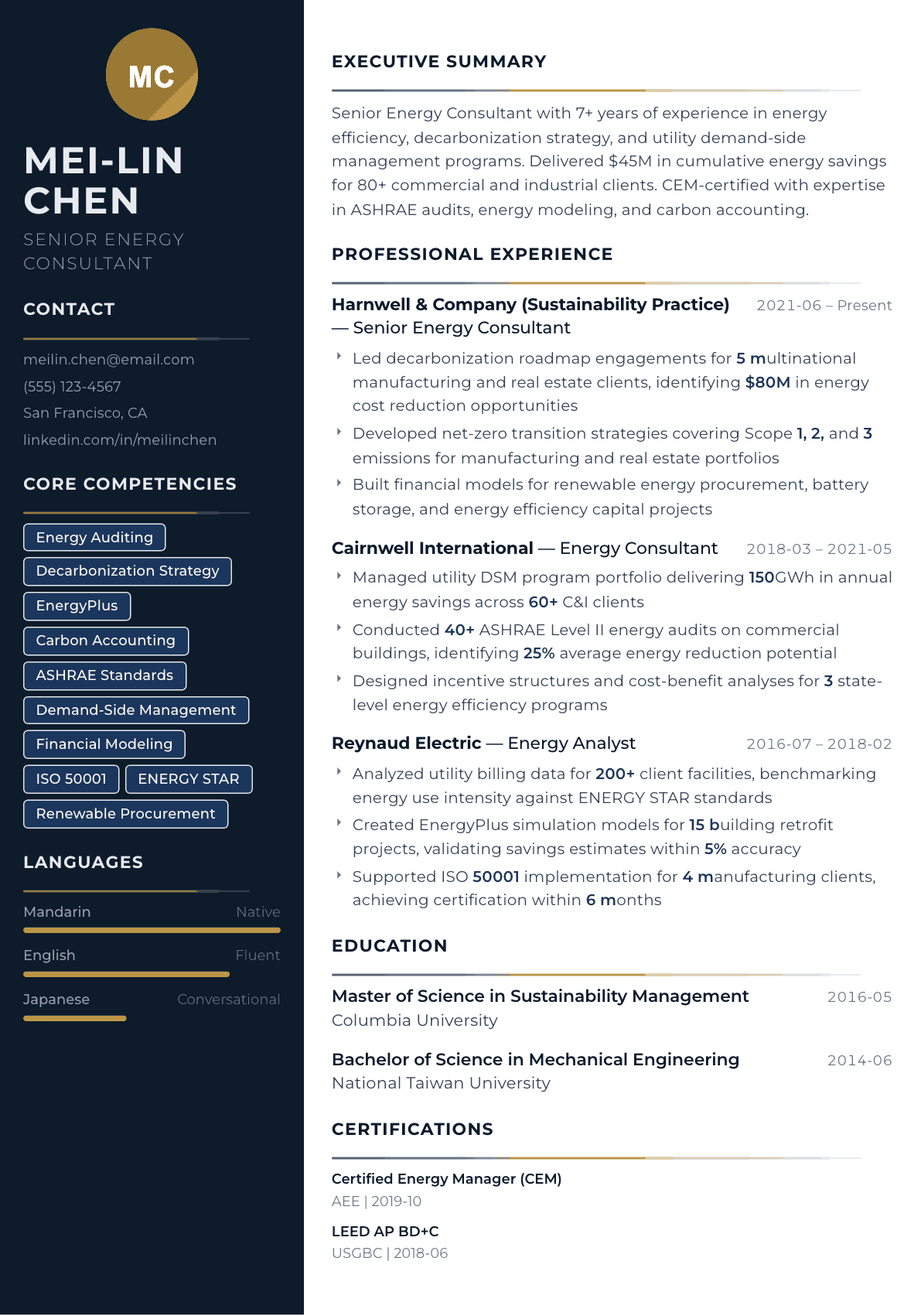
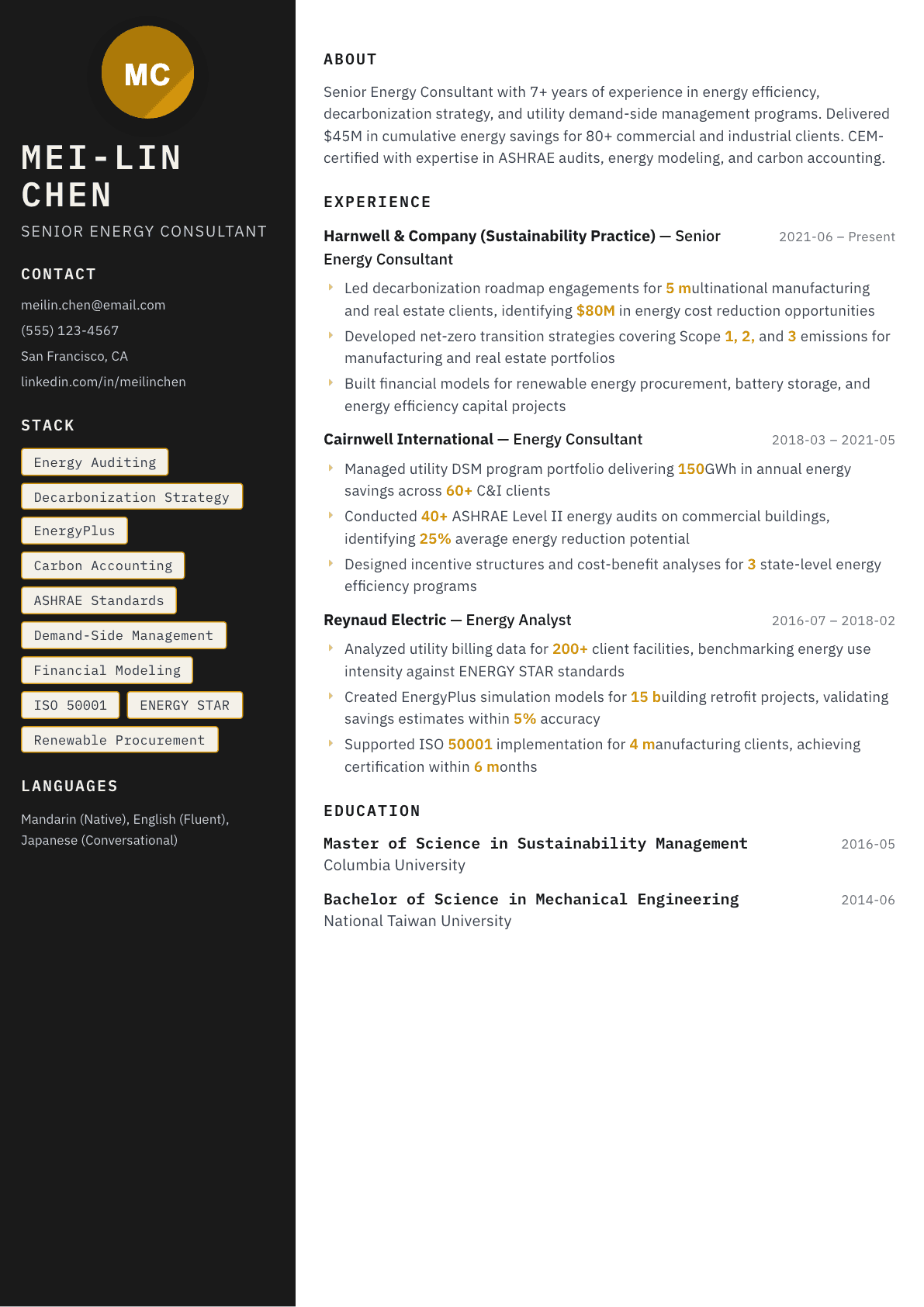
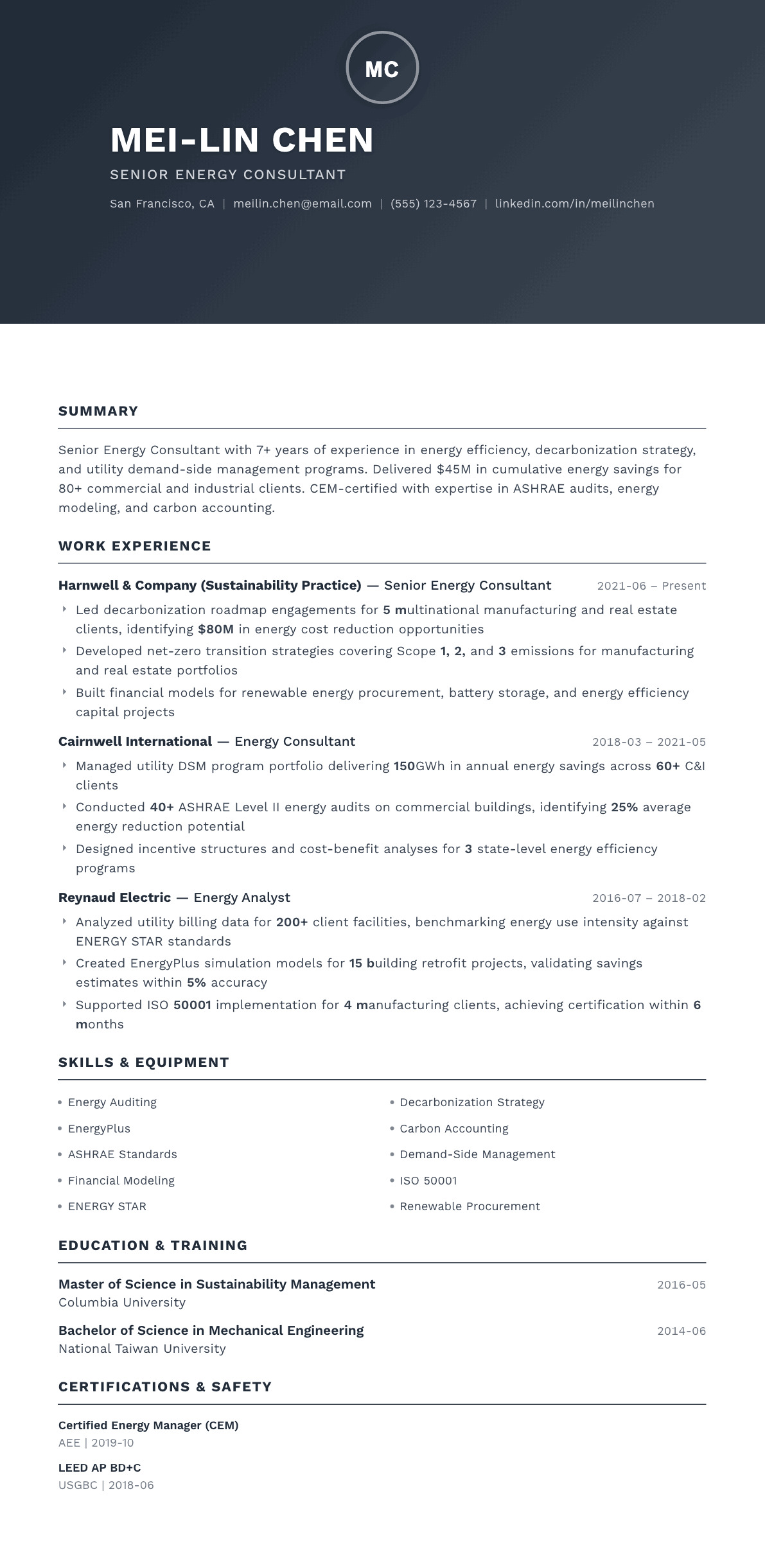
Example Energy Consultant summary
CEM-certified Energy Consultant with 7+ years delivering energy efficiency and decarbonization strategies for commercial and industrial clients. Generated $45M in cumulative savings across 80+ engagements. Expert in ASHRAE audits, EnergyPlus modeling, and net-zero roadmaps. LEED AP with deep utility DSM program experience.
Skills to list on a Energy Consultant resume
- Energy Auditing
- Decarbonization Strategy
- Carbon Accounting
- EnergyPlus
- eQUEST
- ASHRAE Standards
- Demand-Side Management
- ISO 50001
- ENERGY STAR
- Financial Modeling
- Renewable Procurement
- LEED / Green Building
What actually gets this resume read
- Quantify energy savings delivered: kWh, therms, dollars, or carbon tons reduced for clients.
- Highlight certifications prominently: CEM, CEA, LEED AP, BPI, or CMVP.
- Include energy modeling tools: EnergyPlus, eQUEST, Trane TRACE, or RETScreen.
- Describe client types and portfolio scale: number of buildings, square footage, or industrial facilities.
- Mention regulatory and utility program experience: DSM, ESCO, Title 24, IECC, or ASHRAE 90.1.
How to write a energy consultant resume
Energy consulting resumes are read by people who sell hours. A consulting principal is asking whether you can walk a building, find the savings, defend them in a report, and stand in front of a client when the utility asks for evidence. An energy services company is asking whether you can size a project that survives measurement and verification after installation.
That means the credible energy consultant resume is built on audits completed, measures recommended, and savings that were verified rather than estimated. Anyone can claim a savings figure. The candidates who advance are the ones who name the audit level, the modeling tool, the verification method and the utility program the project ran through.
This guide covers the section order energy consulting and efficiency firms expect, summaries for an analyst, a consultant and a practice lead, before and after bullets built from audit and modeling work, and the questions that come up when engineers move into consulting or sustainability roles.
Format: certifications visible, portfolio scale quantified
Certifications drive this market, so put them after your name and again in their own block near the top. A Certified Energy Manager, a Certified Measurement and Verification Professional and a LEED accreditation are all screened for by name, and a reader who has to hunt for them assumes you do not hold them.
Then quantify your portfolio the way the industry does: number of facilities assessed, total floor area, building types, and industrial process types if you work outside commercial buildings. A consultant who has audited hospitals and data centers is a different hire from one who has audited small retail, and floor area is the shorthand that says which one you are.
- Header: name, credentials, location, phone, email.
- Order: summary, certifications, consulting experience, representative engagements, technical skills and modeling tools, education.
- Keep an engagements block with client sector, scope and outcome for the projects closest to the posting.
Summary: audit depth, sector, and what happens after the report
Say the depth of work you do. Walkthrough assessments, energy audits at the levels described in the ASHRAE audit standard, retro commissioning, whole building modeling, or full decarbonization roadmaps are different products with different price tags, and clients buy them separately.
Then name the sector and the money side. Consulting is bought because someone needs a business case, so state whether you build the financial analysis behind the recommendation: simple payback, internal rate of return, life cycle cost, incentive stacking and utility program applications. A technical consultant who cannot build the case is half a hire.
Experience: audit, model, measure, verify
Build each role around the delivery cycle. Start with data and field work: utility bill analysis and normalization, interval data review, submetering and logger deployment, and the field survey of lighting, HVAC, controls, envelope, compressed air, refrigeration and process loads.
Then modeling. Name the tool and the purpose: whole building simulation in EnergyPlus, eQUEST or Trane TRACE for design and retrofit comparison, calibrated models against measured consumption, and spreadsheet calculations where a full model is not warranted. Say when you calibrated a model, because calibration is the skill clients pay for and most candidates never mention.
Finish with what happened. Measures recommended and measures actually implemented are different numbers and a good consultant reports both. Then verification: the measurement and verification option you used from the international performance measurement and verification protocol, the baseline period, the reporting period, and whether the savings held. Savings that were verified rather than projected are the strongest evidence on this resume.
Programs, standards and the regulatory layer
Efficiency work lives inside programs, so name them. Utility demand side management and custom incentive programs, energy service performance contracts, building performance standards and benchmarking ordinances, and the energy codes your projects were held to including the ASHRAE energy standard and the state code you worked under.
On the carbon side, be precise rather than fashionable. Greenhouse gas inventories built to the greenhouse gas protocol, scope one, two and three boundaries, emission factor sources, renewable energy certificate and power purchase agreement analysis, and energy management systems built to ISO 50001. These phrases are the ones corporate sustainability clients screen for.
Skills and the consulting behaviors that get you staffed
Split the technical list from the commercial one. Technical: modeling tools, metering and logging hardware, benchmarking platforms such as ENERGY STAR Portfolio Manager, and data analysis in Excel, Python or a building analytics platform. Commercial: proposal writing, scoping and fee estimation, client presentations, and utility program application management.
Consulting firms promote on utilization and repeat work, so mention proposals written and won, engagements delivered on budget, and clients who came back. That is the language a practice lead uses internally about you.
Energy Consultant resume summary examples
Energy analyst
Energy analyst with 2 years supporting commercial building assessments. Completed utility bill analysis for 60 sites, deployed loggers and conducted lighting and HVAC surveys on 25 audits, and built savings calculations and incentive applications for a utility custom program.
Energy consultant, six years
Certified Energy Manager with 6 years auditing commercial and healthcare facilities totaling 9 million square feet. Leads investment grade audits, builds calibrated eQUEST models, and delivered measures that verified at 94% of projected savings under an IPMVP option C plan.
Practice lead
Energy consulting practice lead with 12 years across efficiency and decarbonization. Manages a 7 person team, owns proposals and fee structures, has directed 40 industrial and campus engagements, and built greenhouse gas inventories and net zero roadmaps for 6 corporate clients under the greenhouse gas protocol.
Work experience bullets: before and after
Before: Conducted energy audits for commercial clients.
After: Led 18 investment grade audits across office, hospital and cold storage facilities totaling 4 million square feet, covering HVAC, controls, lighting, refrigeration and compressed air systems.
Audit depth, building types and floor area let a firm judge whether you can staff their client mix.
Before: Used energy modeling software.
After: Built whole building models in eQUEST and calibrated them against 12 months of interval data to within the tolerance in the verification protocol, then used the calibrated model to rank 9 retrofit measures.
Calibration against measured data is the distinguishing modeling skill, and the ranking shows the model was used for a decision.
Before: Helped clients save energy and money.
After: Recommended 34 measures across a manufacturing portfolio, of which 21 were implemented, and verified savings under an IPMVP option B plan with submetering on the affected process lines.
Splitting recommended from implemented and naming the verification option is what an experienced reviewer trusts.
Before: Worked with utility incentive programs.
After: Managed 26 custom incentive applications through 3 utility programs, prepared the engineering calculations the program reviewer required, and secured approval on every submission without a technical rejection.
Application volume and the reviewer relationship show you can actually capture the incentives you promise.
Before: Prepared sustainability reports for clients.
After: Built scope 1 and 2 greenhouse gas inventories for a 40 site portfolio to the greenhouse gas protocol, documented emission factor sources and boundaries, and delivered a phased decarbonization roadmap with capital and operating estimates.
Naming the standard, the boundaries and the roadmap output separates real inventory work from a marketing report.
Hard skills
- ASHRAE energy audits
- Retro commissioning
- EnergyPlus and OpenStudio
- eQUEST and Trane TRACE
- Model calibration against interval data
- IPMVP measurement and verification
- Utility bill and interval data analysis
- ENERGY STAR Portfolio Manager benchmarking
- Greenhouse gas inventory to the GHG Protocol
- ISO 50001 energy management systems
- Life cycle cost and payback analysis
- Utility demand side management programs
- Submetering and data logger deployment
Soft skills
- Client presentation and defense of findings
- Proposal writing and fee scoping
- Facility staff interviews during site visits
- Translating engineering findings for finance teams
- Managing concurrent engagements
Certifications worth listing
- Certified Energy Manager (CEM) (Association of Energy Engineers)
- Certified Measurement and Verification Professional (CMVP) (Association of Energy Engineers)
- Certified Energy Auditor (CEA) (Association of Energy Engineers)
- LEED AP Operations and Maintenance (Green Business Certification Inc.)
- Building Analyst Professional (Building Performance Institute)
- Professional Engineer (PE) (State board of professional engineers, exam by NCEES)
Mistakes that cost energy consultant candidates the interview
- Reporting projected savings as if they were verified, which an experienced interviewer will test with a single question about the measurement plan.
- Leaving certifications out of the header when the entire market screens on the credential acronyms.
- Describing audits without the audit level or building type, so a firm cannot tell a walkthrough from an investment grade study.
- Listing modeling tools without ever mentioning calibration, the skill that distinguishes a modeler from a software user.
- Ignoring the financial analysis, which makes you look like a technician rather than a consultant clients will pay for.
- Writing about decarbonization in general terms without naming inventory boundaries, emission factors or the standard applied.
Energy Consultant resume questions
Which certification should I get first as an energy consultant?
The Certified Energy Manager is the credential most postings name, and it is the one that unlocks senior consulting titles. Add the measurement and verification credential next if you work on performance contracts, since that is where savings must be proven contractually.
How do I quantify savings without inventing numbers?
Report what you can support: energy units saved, the baseline period, the verification option used, and whether the figure is projected or measured. If a client will not let you publish results, describe the scope and the measure types instead of guessing at a total.
Do I need an engineering degree for this work?
Many consultants come from engineering, but the field also hires from building science, facilities operations and environmental studies backgrounds. Without an engineering degree, lean harder on certifications, field audit volume and modeling work you can demonstrate.
How should I present work done for confidential clients?
Use sector and scale instead of names: a regional hospital system, a national grocery chain, a semiconductor plant. Give facility counts and floor area so the scope is still legible, and keep any figure you quote inside what your agreement allows.
What is the difference between an energy consultant and a sustainability manager resume?
A consultant sells assessments and studies to external clients, so throughput, proposals and verified savings matter most. A sustainability manager owns one organization's targets and reporting, so governance, inventory ownership and internal program delivery lead instead.
Related resume examples
- Sustainability Manager Resume example
- Renewable Energy Analyst Resume example
- Solar Energy Engineer Resume example
- Quality Engineer Resume example
- Environmental Engineer Resume example
- Facilities Engineer Resume example