Retail Associate Resume Examples: the lines they read
Retail Store Resume for a Retail Associate in Any Retail Industry Job
By Mustafa Tarabya, founder of CVBooster · Published · Updated
Retail store resume and resume for a retail position: a complete retail associate sample, register and floor bullets, and notes for Canada and Australia.
Sample resumes for a retail associate
The same retail associate content laid out in three CVBooster templates, so you can see what the finished document looks like before you write a word.
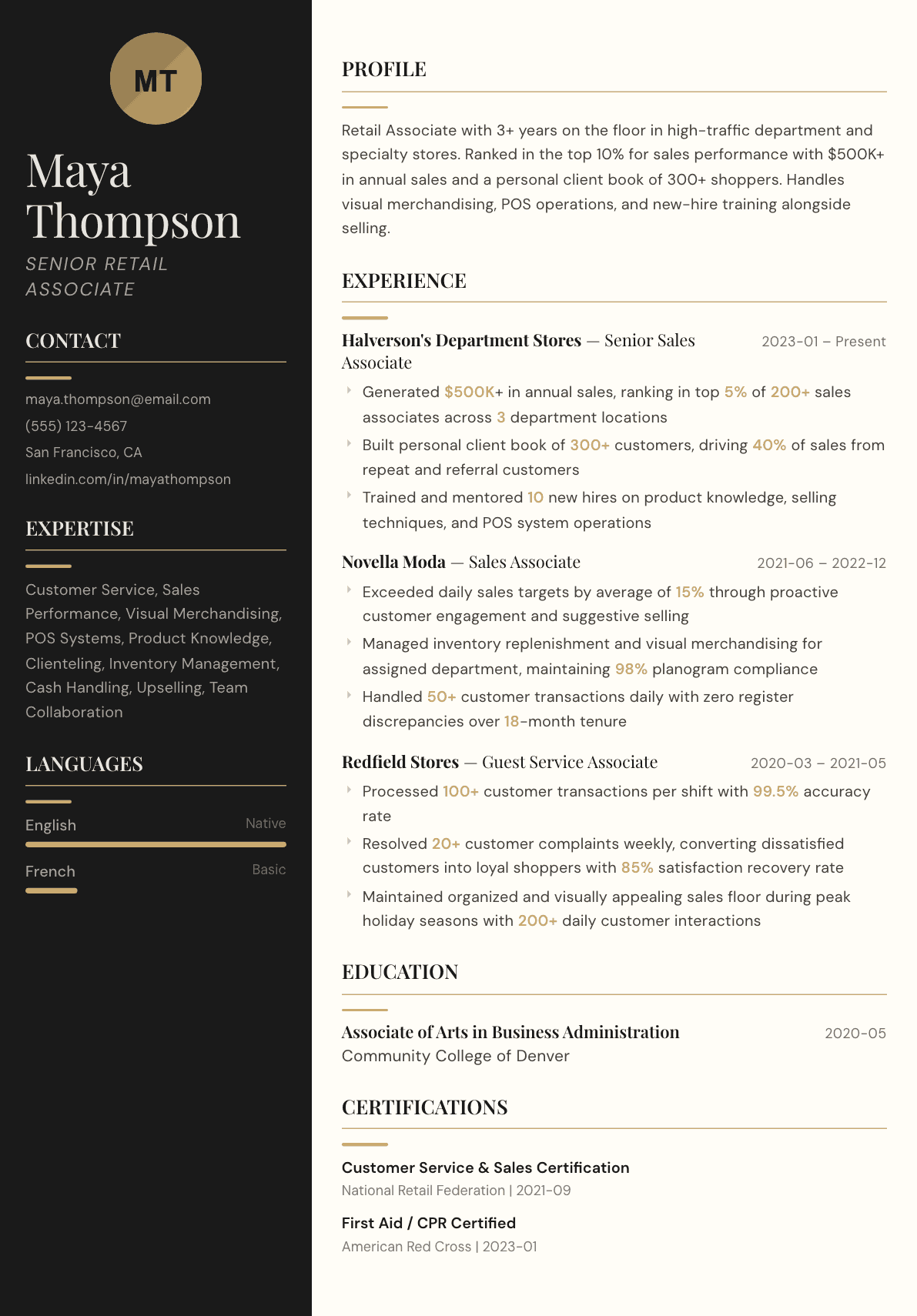
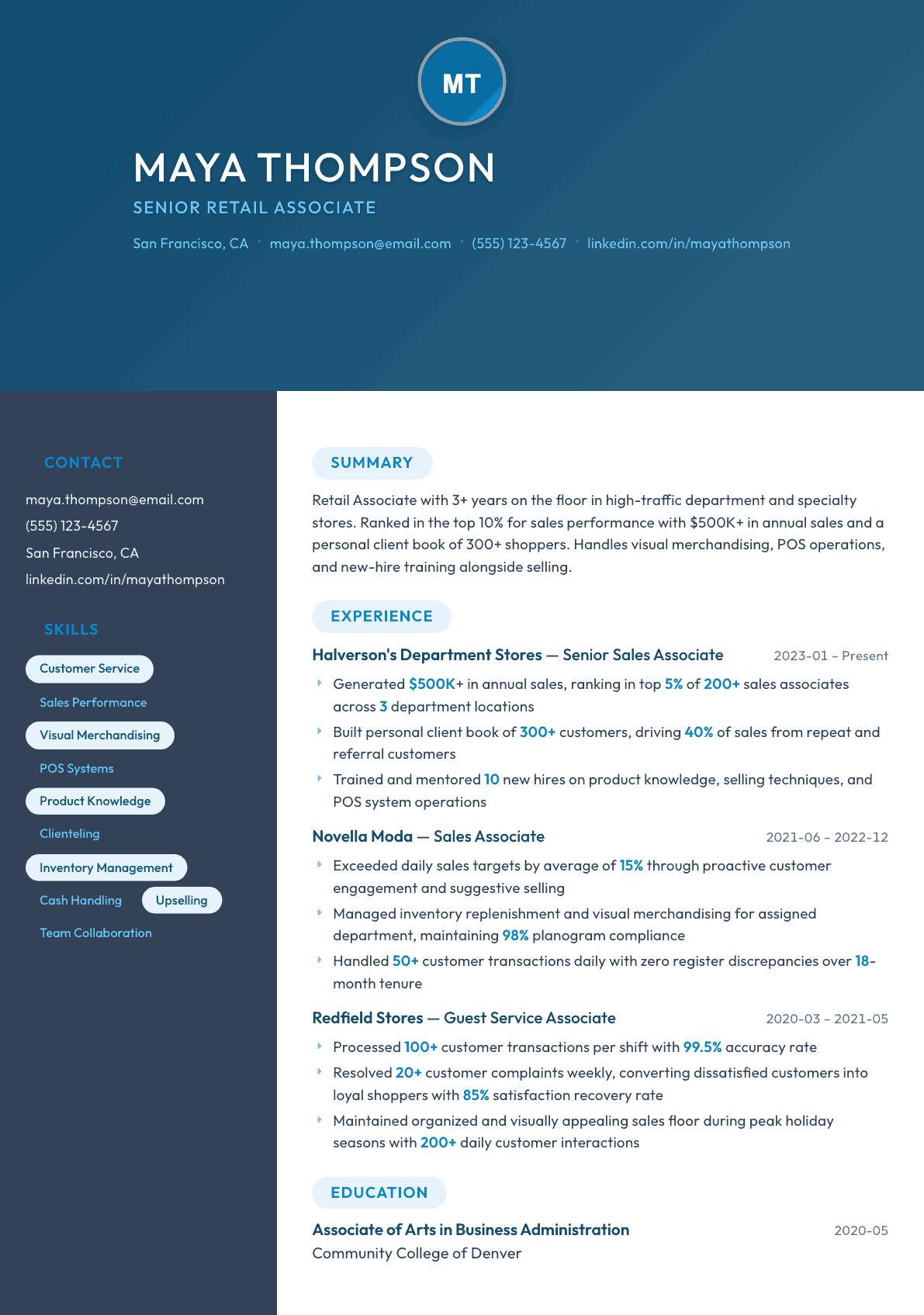
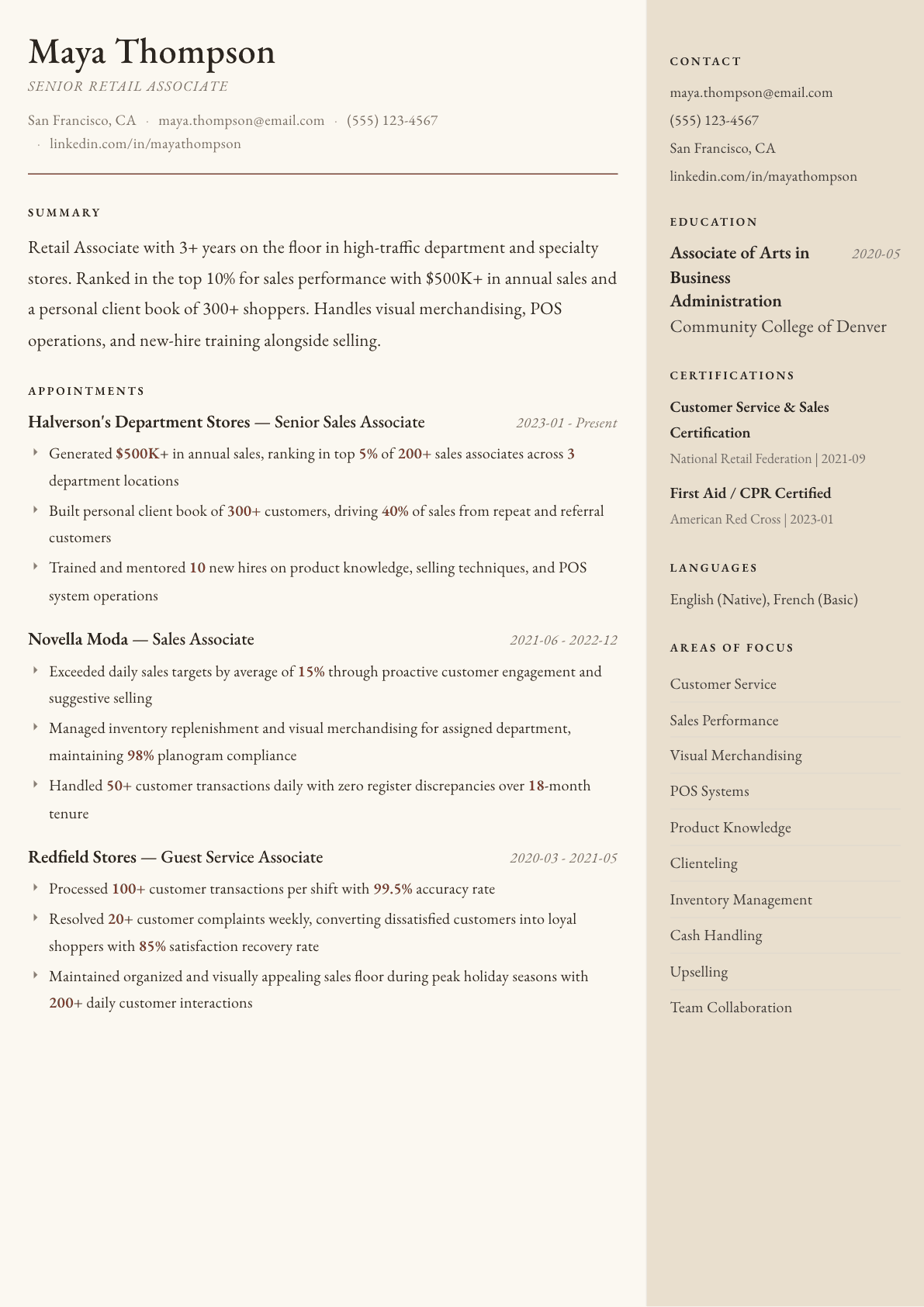
Example Retail Associate summary
Retail Associate with 3 years of experience generating $500K+ in annual sales at Halverson's Department Stores. Ranked in the top 5% of 200+ associates with a personal client book of 300+ customers, and 40% of sales coming from repeat shoppers. Trains new hires on product knowledge and POS.
Skills to list on a Retail Associate resume
- Customer Service
- Retail Sales
- Visual Merchandising
- POS Systems
- Product Knowledge
- Clienteling
- Cash Handling
- Inventory Management
- Upselling / Cross-Selling
- Loss Prevention
- Team Collaboration
- Conflict Resolution
- Opening / Closing Procedures
What actually gets this resume read
- Quantify sales performance: daily/monthly/annual sales volume, ranking among peers, and conversion rates.
- Highlight customer service excellence: satisfaction scores, complaint resolution rates, and repeat business driven.
- Include product knowledge across categories and brands relevant to where you are applying.
- Mention POS systems and retail technology you are proficient with.
- Showcase visual merchandising, inventory management, and operational contributions beyond direct selling.
How to write a retail associate resume
A retail associate resume is usually read in under a minute by a store manager who is short staffed and screening a stack of applications. That manager is checking three things: your availability, whether you have handled a register and a sales floor before, and whether anything on the page suggests you will show up reliably. The resumes that get called first make all three obvious without the manager hunting for them.
Retail is also one of the few fields where quantifying is easy and almost nobody does it. Transactions per shift, sales against a daily target, add on rate, loyalty program signups, a shrink figure, or the number of shifts you covered at short notice all turn a generic duties list into evidence. A candidate who says they handled a hundred transactions a shift with an accurate till has answered the manager question before it is asked.
The same rules hold for any retail worker resume, whether the posting says associate, sales clerk, cashier or floor and stock team member. This guide covers the layout store managers scan, the retail skills for a resume and how to group them, how to write a summary when your experience is short, a complete resume for a retail position, how a retail store resume shifts across the retail industry and in Canada and Australia, how to build bullets from register and floor work, which systems and compliance training to name, and the questions retail associates ask when they apply for their first job or move up to a keyholder role.
Format: one page, availability visible
One page, always. Put your availability near the top, either in the header or as a single line under the summary: weekday evenings, weekends, holiday season, and whether you can open or close. Scheduling is the constraint that decides most retail hires, and a manager who cannot find your availability will move on to a resume that shows it.
Keep the layout simple and readable on a phone, because many retail applications are opened on one. Reverse chronological order, clear dates including months, and a store type on every job so the manager can see whether you have worked a high volume environment before.
- Header: name, city, phone, email, and availability in a single line.
- Order: summary, experience, skills and systems, education, certifications or training.
- Every job: store type, department, whether it was full or part time, and shift pattern.
- Include seasonal roles rather than hiding them, since holiday experience is directly relevant.
Summary: environment, strength, availability
Two or three lines is enough. Name the store environment you have worked in, what you were strongest at, and what you are looking for. An associate with two years in a high volume apparel store who is strongest on the register and on floor recovery has said something usable. A line about being a hardworking team player who loves helping customers appears on almost every application in the pile.
If this is your first job, use the summary to name the setting you can already handle and the availability you offer. School, sports, volunteer work and family responsibilities all produce genuinely relevant habits: punctuality, working to a schedule, dealing with people who are frustrated, handling money accurately.
Sales associate tasks for a resume: what you did on shift, with numbers
Write bullets around the parts of the shift that a manager cares about: point of sale accuracy, sales against a personal or department target, add on and loyalty attachment, stock replenishment, visual standards, fitting room control, returns and exchanges, and customer recovery when something went wrong. Each of these can carry a number, and most candidates leave them all bare.
Include the operational work, not just selling. Opening and closing procedures, cash counts and drawer reconciliation, delivery intake, stock counts and cycle counts, price changes and markdowns, and loss prevention awareness are the tasks that make an associate useful beyond the busy hours. A manager reading a resume that shows both selling and operations sees someone who needs less supervision.
Name the times of year and the traffic level you have worked. Holiday season, back to school, a store opening, a refit or a clearance event all describe pressure that a manager will recognize, and surviving one of them is a credible signal of reliability.
- Transactions per shift and register accuracy or discrepancy record.
- Sales against target, add on rate, and loyalty or credit program signups.
- Replenishment, planogram compliance, and visual merchandising you owned.
- Opening and closing duties, cash handling, and any keyholder responsibility.
- Training of new hires and shifts you covered at short notice.
Retail skills for a resume: systems, compliance and the keywords managers look for
Name the point of sale system you used, the handheld or inventory device, the scheduling app, and any customer or loyalty platform. Managers know the training cost of each, and an associate who already knows the register saves a full shift of supervision in the first week.
Add product knowledge and compliance training where the store type calls for it: age restricted sales training for alcohol or tobacco, food safety for grocery and prepared food, fitting or measurement skills in apparel and footwear, or basic technical knowledge in electronics. These are concrete and quick to verify, which makes them worth more than another adjective.
The retail skills worth listing are customer service, point of sale, cash handling, sales targets, add on selling, loyalty program, stock replenishment, visual merchandising, planogram, inventory counts, returns and exchanges, loss prevention, opening and closing, and keyholder. Group them in two lines rather than a long column. Written out for an invented associate, Leah Brennan, it reads: Till and floor: Square POS, cash handling and drawer counts, returns, loyalty signups, add on selling. Stock: deliveries, replenishment, planograms, cycle counts, age restricted sales training. Larger chains screen with software, so match the store language: guest, client, team member and associate mean the same thing, but each employer uses only one.
Resume for a retail store associate: a complete sample
A resume for a retail store associate, or any retail position, follows the same pattern whether the posting says retail associate, sales associate, cashier or stock associate. Here is a complete sample for a candidate with one year of retail and a school background, applying to a clothing store.
Match the title line to the posting. If the store advertises a sales associate, the resume says sales associate, because that is the phrase the manager looks for first, and a retail store sales associate resume leads with the selling bullets rather than the stockroom ones.
- Header: Sofia Ramirez, Retail Associate, city, phone and email.
- Availability: weekday evenings after 4 p.m., all day Saturday and Sunday, and open for holiday shifts.
- Summary: Retail associate with one year at a busy pharmacy chain, comfortable on the register, the sales floor and the stockroom. Known for an accurate till and for covering shifts at short notice. Looking for a part time role with more floor and visual merchandising work.
- Experience: register and cash handling, customer questions and returns, restocking and price changes, and loyalty signups, each as a bullet with a number where you have one.
- Education and extras: high school or college, a school job or volunteer role, and any food handling or age restricted sales training.
- Skills: the POS system by name, cash handling, handheld inventory scanners, merchandising, and any second language you use with customers.
Retail store resume across the retail industry, including Canada and Australia
A resume for the retail industry changes less between stores than people expect, which is why the resume examples for retail sales below are single lines you can swap into the same page. A grocery store, a fashion boutique, an electronics chain and a hardware store all want the same proof: you turn up for the shifts you promise, you can run a register accurately, and customers leave with what they came for. What changes is the product vocabulary, so a retail store resume for a pharmacy front counter mentions over the counter products and privacy, and one for a hardware store mentions trade customers, paint mixing or lumber cuts.
In Canada the same layout works, with two local habits worth copying. Many postings ask for bilingual service, so list French or another language with an honest level, and stockroom roles often mention WHMIS training, which belongs in a training line if you hold it. In Australia the common title is retail assistant or sales assistant, many roles are casual, and employers often expect referees with phone numbers on the last line or a note that they are available on request. Bottle shop roles ask for a Responsible Service of Alcohol certificate, so name it when you have it.
Three retail store resume examples, one job line each. Grocery: Retail worker, Fairmont Foods, Halifax, 25 hours a week, cash and self checkout, about 120 transactions a shift with a balanced till. Fashion: Sales associate, Northline Apparel, Calgary, fitting rooms and floor sets, regularly near the top of the store loyalty signup board. Hardware: Retail associate, Pine Ridge Hardware, Kelowna, paint desk and returns, trained four new hires on the till.
- Grocery store line: Processed 250 to 300 transactions a shift on a six-lane front end and trained two new cashiers on produce codes.
- Fashion store line: Ran the fitting room and restocked the floor between rushes; reached the weekly loyalty signup target in nine of twelve weeks.
- Electronics store line: Explained phone plans and protection products to walk-in customers and set up devices at the counter.
- Canada training line: WHMIS training, safe lifting and forklift familiarisation completed with the employer.
- Australia credentials line: Responsible Service of Alcohol certificate, current; available for casual shifts including weekends and late nights.
Retail Associate resume summary examples
First retail job
Reliable and organized applicant looking for a first retail associate role, available weekday evenings, weekends and the full holiday period. Two years of volunteer work running a charity shop till on Saturdays, comfortable handling cash, restocking shelves and dealing calmly with unhappy customers.
Two years on the floor
Retail associate with two years in a high volume apparel store, handling around 90 transactions a shift with an accurate drawer and consistently exceeding the daily add on target. Trained on the point of sale and handheld inventory systems, and available for opening shifts, weekends and holiday coverage.
Senior associate and keyholder
Senior retail associate and keyholder with five years across apparel and home goods, responsible for opening and closing, cash reconciliation and the weekend floor plan. Trained eleven new hires on the register and service standards, and led the department through two holiday seasons and a store refit.
Work experience bullets: before and after
Before: Operated the cash register and helped customers.
After: Processed around 90 transactions a shift on the point of sale, including returns, exchanges and gift cards, with no drawer discrepancies across eighteen months.
Transaction volume, the transaction types and a clean drawer record answer the accuracy question a manager cares about most.
Before: Met sales goals in my department.
After: Exceeded the daily department sales target in most weeks by suggesting complementary items at the fitting room, lifting units per transaction above the store average.
Naming where the add on happened and the metric it moved shows a technique rather than a result you happened to be near.
Before: Kept the store tidy and stocked.
After: Replenished and recovered two departments before opening each shift, maintained planogram standards during a full seasonal reset, and flagged slow moving stock for markdown.
Specific operational tasks, including the reset and the markdown flagging, show initiative beyond keeping shelves neat.
Before: Dealt with difficult customers.
After: Handled returns and complaints at the service desk during peak weekends, resolving most on the spot within store policy and escalating only where a manager approval was required.
It shows judgment about what you can settle yourself and what needs escalation, which is what a manager is really assessing.
Before: Helped train new employees.
After: Trained eleven new hires on the register, the handheld stock device and the service standard, then shadowed their first solo shifts and reported readiness to the manager.
A count, the specific systems taught and the follow up turn helping into a defined responsibility.
Hard skills
- Point of sale operation
- Cash handling and reconciliation
- Returns and exchanges
- Add on and suggestive selling
- Loyalty program enrollment
- Stock replenishment
- Visual merchandising and planograms
- Inventory and cycle counts
- Handheld inventory devices
- Opening and closing procedures
- Loss prevention awareness
- Fitting room and floor management
Soft skills
- Punctuality
- Patience with frustrated customers
- Standing stamina across long shifts
- Teamwork on a busy floor
- Clear spoken communication
- Flexibility on scheduling
Certifications worth listing
- Customer Service and Sales Certification (National Retail Federation Foundation)
- Retail Industry Fundamentals (National Retail Federation Foundation)
- ServSafe Food Handler (National Restaurant Association)
Mistakes that cost retail associate candidates the interview
- Leaving availability off the page, when scheduling is the constraint that decides most retail hires.
- Listing duties from the job description instead of what you personally handled on a shift.
- Skipping every number, when transaction counts, targets, add on rates and drawer accuracy are all easy to state.
- Hiding seasonal and part time roles, which are directly relevant experience for a store manager.
- Writing a page and a half for a role that is read in under a minute on a phone.
- Naming no systems at all, so the manager assumes you will need a full shift of register training.
Retail Associate resume questions
How do I write a retail worker or retail associate resume with no work experience?
Lead with availability and reliability, then use school, sports, volunteering or family responsibility to show the habits that matter: turning up on time, working to a rota, handling money accurately and staying calm with people who are upset. Name any till, stock or customer contact you have had, even unpaid.
Should I put availability on a retail resume?
Yes, near the top in one line. Store managers build schedules around coverage gaps, usually evenings, weekends and holidays, so an applicant who states availability clearly gets screened in ahead of one whose hours the manager would have to ask about first.
What numbers can a retail associate actually use?
Transactions per shift, drawer accuracy, sales against a daily or weekly target, units per transaction, loyalty or credit signups, number of new hires trained, and the departments you covered. Approximate figures are fine as long as you can stand behind them in an interview.
How do I write a resume for the retail industry if I am switching store types?
Keep the same layout and the same register, floor and availability evidence, then change the product words to match the new store. A retail store resume for groceries talks about fresh stock and fast checkouts, while one for fashion talks about fitting rooms and visual standards. Mention any short or seasonal roles with a plain reason.
How do I show I am ready for a keyholder or supervisor role?
Point at responsibility you already carried: opening or closing, cash counts, covering the floor when the manager was away, training new starters, or handling escalated complaints. Those tasks are the actual content of a keyholder job, so naming them makes the promotion case for you.