Rideshare Driver Resume Examples: the lines they read
Turn Rideshare Driving Into a Resume Employers Respect
By Mustafa Tarabya, founder of CVBooster · Published · Updated
A rideshare driver resume example that turns trips, ratings and self-employment into hireable experience, with ATS keywords and a writing guide.
Sample resumes for a rideshare driver
The same rideshare driver content laid out in three CVBooster templates, so you can see what the finished document looks like before you write a word.
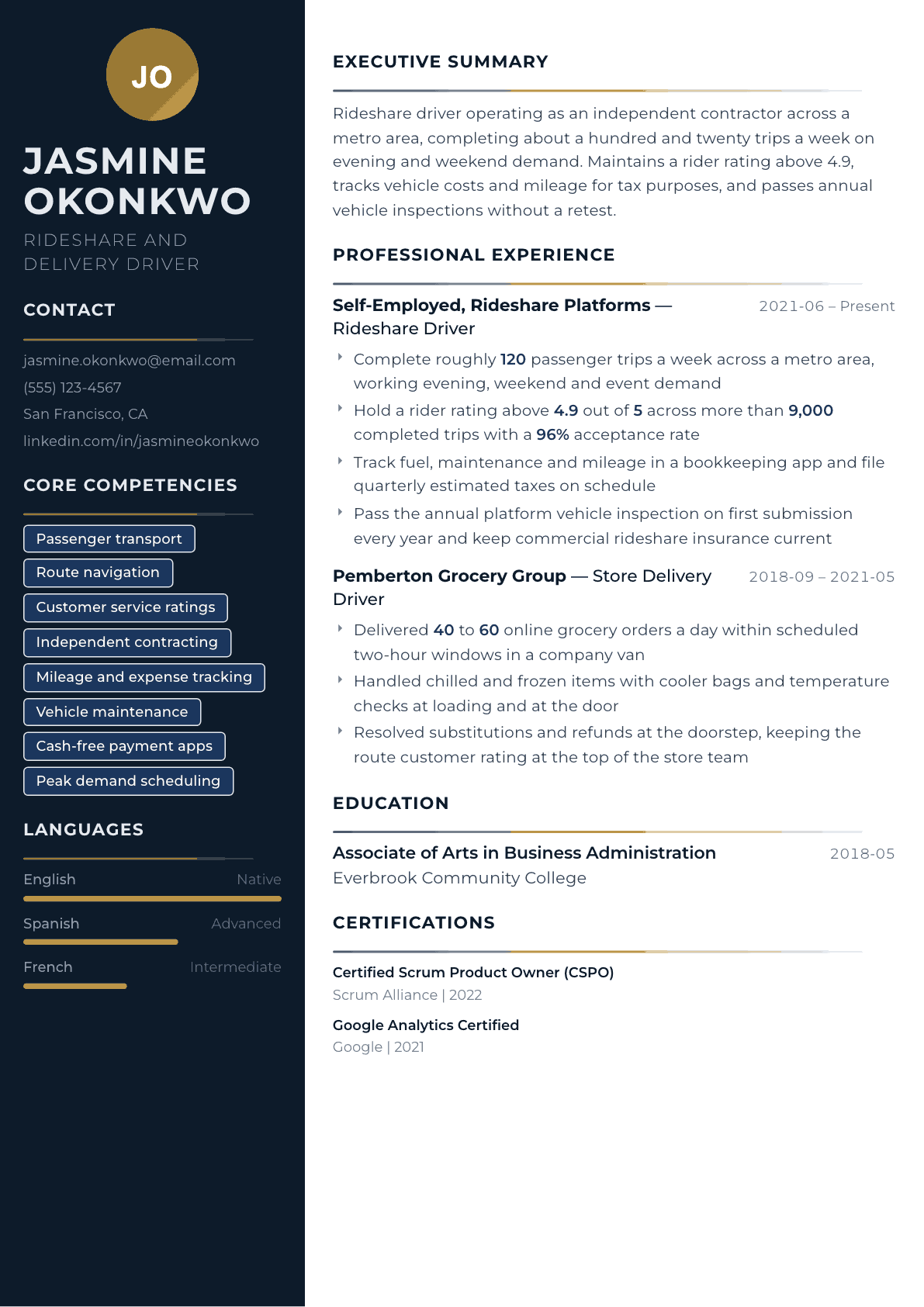
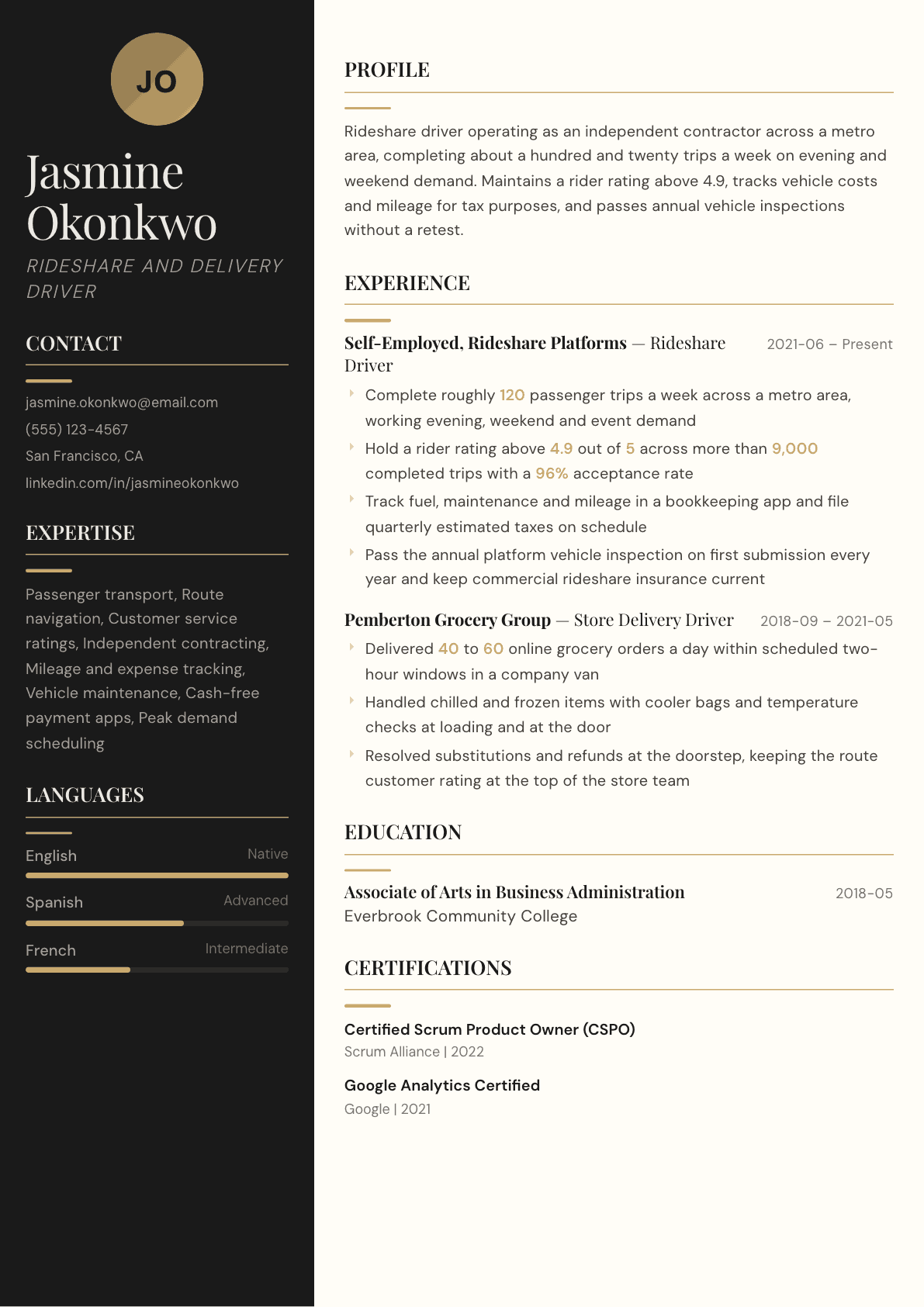
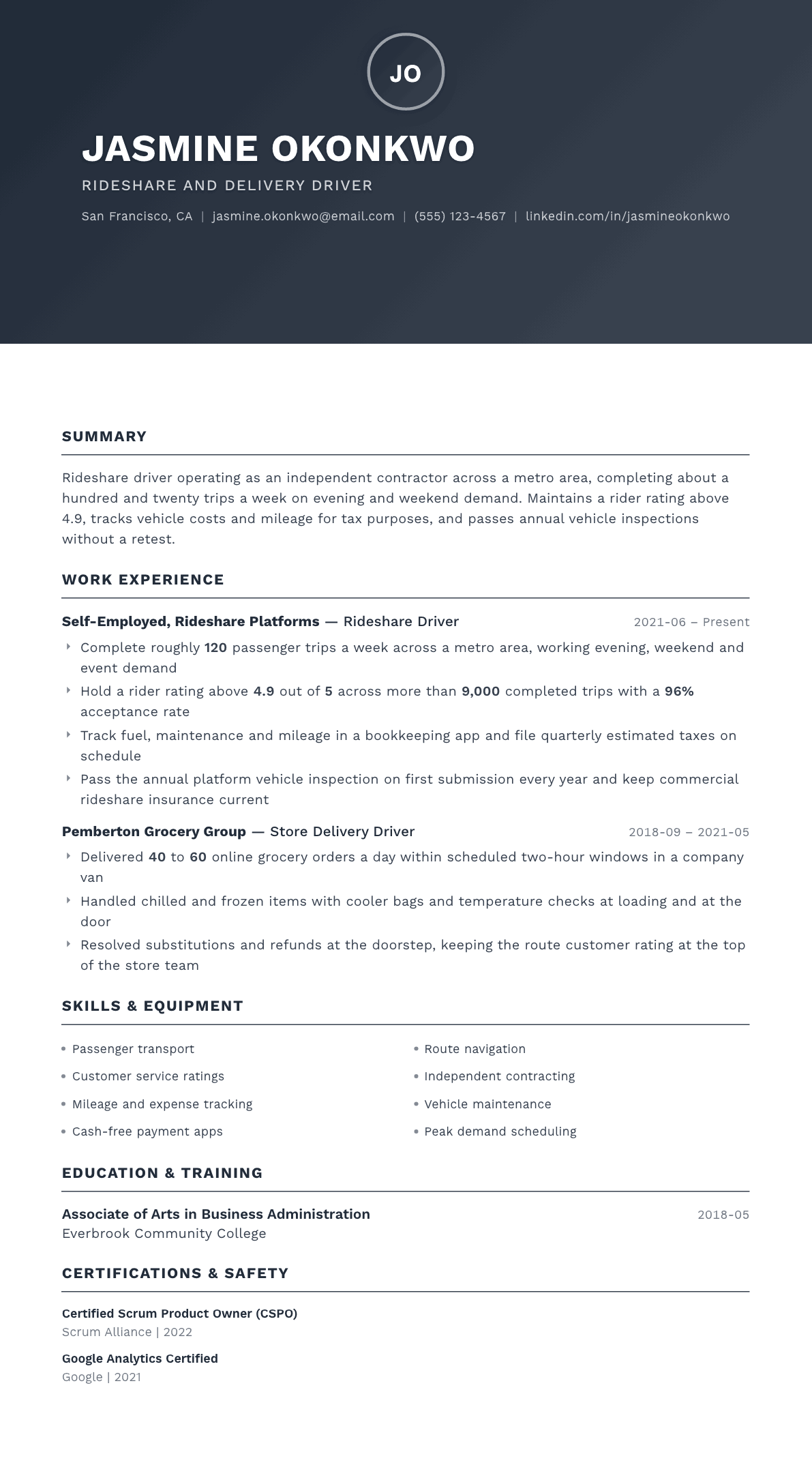
Example Rideshare Driver summary
Rideshare driver with four years as an independent contractor in a metro area, completing about a hundred and twenty trips a week and holding a rider rating above 4.9. Runs the operation like a business: annual vehicle inspections passed first time, commercial insurance current, mileage and expenses tracked, and quarterly taxes filed. Moving into a company driving role that offers a set schedule and benefits.
Skills to list on a Rideshare Driver resume
- Passenger transport
- GPS route navigation
- Customer service
- Independent contracting
- Expense and mileage tracking
- Vehicle inspection compliance
- Rideshare insurance
- Peak demand scheduling
- Conflict de-escalation
- Cashless payment apps
- Defensive driving
- Airport pickup procedures
- Food delivery handling
- Time management
What actually gets this resume read
- Treat the driving as a business: give trip volume, rating, acceptance rate and the years you kept it running.
- List yourself as self-employed with the platform type rather than leaving a gap that looks like unemployment.
- Show the operating work behind the wheel: vehicle inspections, insurance, expense tracking and quarterly taxes.
- Translate rider ratings into the language of customer service, because that is what a hiring manager is buying.
- Name the areas and shifts you covered, since airport, event and late night work each prove something different.
- If you are moving into a company driving job, say so and point at your record and clean license.
How to write a rideshare driver resume
Most rideshare drivers write themselves out of a job on the first line. They put a platform name where an employer should be, no dates, no numbers, and the reader files the years as a gap. The work was real: thousands of trips, a maintained vehicle, an insurance policy, a tax return and a rating that a customer service manager would envy. The resume simply has to say so.
The trick is to treat the driving as a one-person business, because legally and practically that is what it was. You set the schedule, absorbed the costs, passed the inspections, handled complaints without a supervisor, and kept a public score for satisfaction. Written that way, a rideshare driver page competes with any other customer service or transport application.
This guide shows how to structure that page, which numbers to use, how to translate ratings and acceptance into hiring language, three example summaries, before and after bullets, and the questions drivers ask when they move from app work into a company driving or service role.
Format: list it as self-employment with dates
Create an employer entry with a business-style label such as self-employed rideshare and delivery driver, a title, and month and year dates. That one change turns a suspicious gap into a job with a start and an end, and it is the single most valuable edit on the page.
Underneath, add a short profile block with the operating facts. Recruiters for driving roles screen on license, insurance and record, so give them the same three lines they would look for on any transport application.
- Profile: license class and state, years licensed, vehicle and insurance status, and your driving record.
- Operating facts: years driving on platforms, trips completed, rating, and the areas and shifts covered.
- Then summary, driving experience, other employment, skills, education.
- An Uber driver resume entry, written out for an invented driver: Self-employed, Rideshare Driver, Uber and Lyft, Phoenix, AZ, start month and year to present. Two years, about 3,200 trips, 4.95 rider rating, airport and late night work, clean driving record, own vehicle with rideshare insurance, mileage and expenses tracked for quarterly taxes.
Summary: volume, rating, and what you are aiming at
Open with the scale of the operation: trips a week, years, and the metro area covered. Then the rating, which is the most portable evidence you have, because it is a customer satisfaction score collected from thousands of strangers with no incentive to be kind.
End with direction. A hiring manager reading a driver application wants to know why you are leaving flexible work. Wanting a set schedule, benefits, a company vehicle or a route you own are all good answers, and stating one prevents the assumption that you will drift back to the app in a month.
Experience: run it like a business, describe it like a job
Cover four things in the bullets: volume, service quality, operating discipline and specialization. Volume is trips per week and total trips. Service quality is the rating, acceptance and cancellation behavior, and how you handled complaints. Operating discipline is inspections, insurance, maintenance, mileage tracking and quarterly taxes.
Specialization is the part almost everyone leaves out. Airport pickups run on staging lots and permit rules. Late night work is a different passenger population. Event and stadium work means road closures and surge conditions. Food and grocery delivery adds temperature handling, order accuracy and substitutions. Each one maps onto a different job you might apply for.
If you drove alongside other employment, show both entries with honest dates and note the hours. Working evenings and weekends on top of a full-time job is an argument for your work ethic that no adjective can make.
Translating platform metrics into hiring language
A rider rating is a customer satisfaction score. An acceptance rate is reliability under dispatch. A cancellation rate is commitment to the assignment. A completed trip count is transaction volume. Put the platform number in the bullet and the business meaning in the same sentence, so the reader does not have to make the translation himself.
Do the same with the money side without quoting your earnings. Tracking mileage and expenses in a bookkeeping app, filing estimated taxes quarterly, and passing an annual vehicle inspection on first submission all describe an operator who keeps records, which is a hiring signal in any job that involves a company asset.
Skills and the roles this experience maps onto
The transferable terms are passenger transport, route navigation, customer service, independent contracting, expense and mileage tracking, vehicle inspection, defensive driving, conflict de-escalation, airport pickup procedures and time management.
Aim the page at a target. Courier and delivery employers care about navigation, drop volume and reliability. Transit and shuttle employers care about passenger handling and composure. Non-emergency medical transport cares about assistance and punctuality. Customer service employers care about the rating and the complaint handling. The same driving history supports all four, worded differently.
Rideshare Driver resume summary examples
First year on the platforms
Rideshare driver with one year of evening and weekend trips in a metro area, holding a rating above 4.9 across roughly 1,800 completed trips. Passed the platform vehicle inspection on first submission, carries commercial rideshare insurance, and is seeking steady company driving work.
Four years driving
Rideshare driver operating as an independent contractor for four years, completing about 120 passenger trips a week across evening, weekend and event demand. Holds a rating above 4.9 with a 96% acceptance rate, tracks mileage and expenses for quarterly tax filing, and keeps a clean driving record.
Full-time driver moving to a company role
Full-time platform driver with six years and more than 9,000 completed passenger and delivery trips, covering airport staging, late night and stadium event work. Maintains a top-tier rating, passes annual inspections without retest, and is moving into a scheduled company driving role with benefits.
Work experience bullets: before and after
Before: Drove for rideshare apps in my spare time.
After: Completed roughly 120 passenger trips a week as an independent contractor across a metro area, working evening, weekend and event demand.
Weekly volume and the demand periods make it a described job with a workload rather than an unquantified side activity.
Before: Had a good rating from passengers.
After: Held a rider satisfaction rating above 4.9 out of 5 across more than 9,000 completed trips, with a 96% acceptance rate on dispatched requests.
It converts platform metrics into customer satisfaction and dispatch reliability, which are the terms a hiring manager buys.
Before: Paid my own expenses and taxes.
After: Tracked fuel, maintenance and mileage in a bookkeeping app and filed quarterly estimated taxes on schedule across four years of self-employment.
Specific record keeping and a filing cadence show operating discipline that a claim about paying expenses does not.
Before: Kept my car in good shape.
After: Passed the annual platform vehicle inspection on first submission every year and kept commercial rideshare insurance current with no coverage gaps.
Inspection results and continuous coverage are checkable facts about how an asset was maintained.
Before: Also delivered groceries.
After: Delivered 40 to 60 online grocery orders a day within two-hour windows, handling chilled and frozen items with cooler bags and temperature checks at loading and at the door.
Order volume, service windows and temperature handling turn a second line of work into evidence for delivery roles.
Hard skills
- Passenger transport and pickup coordination
- GPS route navigation and traffic routing
- Airport staging and permit procedures
- Independent contracting and self-scheduling
- Expense and mileage record keeping
- Vehicle inspection compliance
- Commercial rideshare insurance management
- Cashless payment and receipt handling
- Food and grocery delivery handling
- Defensive driving technique
- Peak demand and event scheduling
- Complaint and rating recovery
Soft skills
- Customer service under short interactions
- Conflict de-escalation
- Self-motivation without supervision
- Discretion with passengers
- Reliability across late hours
Certifications worth listing
- Defensive Driving Course (National Safety Council)
- First Aid and CPR (American Red Cross)
- Food Handler Certificate (ANSI-accredited food handler training provider)
Mistakes that cost rideshare driver candidates the interview
- Leaving the platform years off the resume entirely. An unexplained gap is worse than any job, and the driving years contain real evidence.
- Listing no dates or volume. Without months, trips and a rating, the entry reads as occasional work rather than an occupation.
- Forgetting the operating side. Insurance, inspections, mileage records and tax filing are what turn app driving into a business a manager respects.
- Using platform jargon without translation. Acceptance rate and surge mean nothing to a reader outside the app, so give the business meaning too.
- Applying to every driving job with one page. A courier employer and a transit agency want different halves of the same experience emphasized.
- Skipping the reason for leaving flexible work. Say plainly what you want from a scheduled role, or the reader will assume you will go back.
Rideshare Driver resume questions
Does rideshare driving count as real work experience?
Yes, when it is written with dates, volume and outcomes. It demonstrates independent work, customer service at scale, navigation, vehicle care and record keeping. Employers discount it only when the entry is a bare platform name with no numbers attached to it.
Should I put Uber driver on my resume?
Yes, if it covers time you would otherwise show as a gap. Write self-employed as the employer, a title such as rideshare driver, Uber and Lyft, and month and year dates, then bullets with trips, rating and the areas you covered. Naming the platforms is fine because recruiters recognize them; just treat them as the market you served rather than as a boss.
Should I include my rating and acceptance rate?
Include them if they are strong, and explain what they mean in the same line. A rating above 4.9 across thousands of trips is a customer satisfaction record, and an acceptance rate speaks to reliability when dispatch sends you an assignment.
What jobs does rideshare experience prepare me for?
Courier and delivery routes, shuttle and transit operator trainee positions, non-emergency medical transport, chauffeur work, and customer-facing roles in general. Each one draws on a different part of the record, so tailor the summary to the specific target before applying.
How do I explain leaving flexible driving for a fixed schedule?
Say what you want and why, such as predictable hours, benefits, a company vehicle or a route you own. Hiring managers respect a clear reason, and it removes the concern that you will return to app driving as soon as demand improves.
Related resume examples
- Taxi Driver Resume example
- Food Delivery Driver Resume example
- Delivery Driver Resume example
- Chauffeur Resume example
- Courier Resume example
- Medical Courier Resume example