Courier Resume Examples: free score, then the gap list
Write a Courier Resume That Proves You Deliver On Time
By Mustafa Tarabya, founder of CVBooster · Published · Updated
A courier resume example with stops-per-day numbers, proof-of-delivery detail, scanner and route apps, ATS keywords and a section-by-section guide.
Sample resumes for a courier
The same courier content laid out in three CVBooster templates, so you can see what the finished document looks like before you write a word.
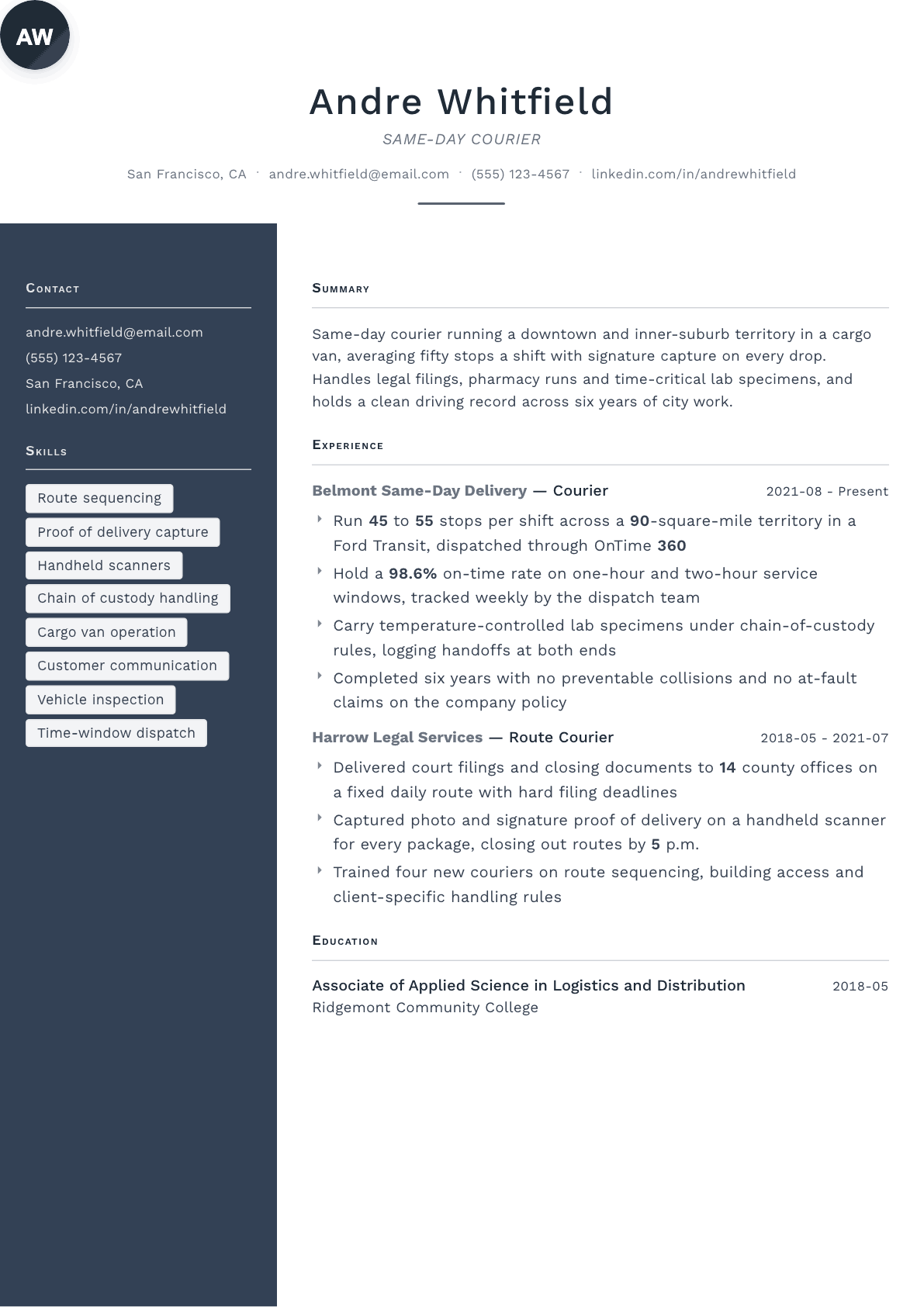
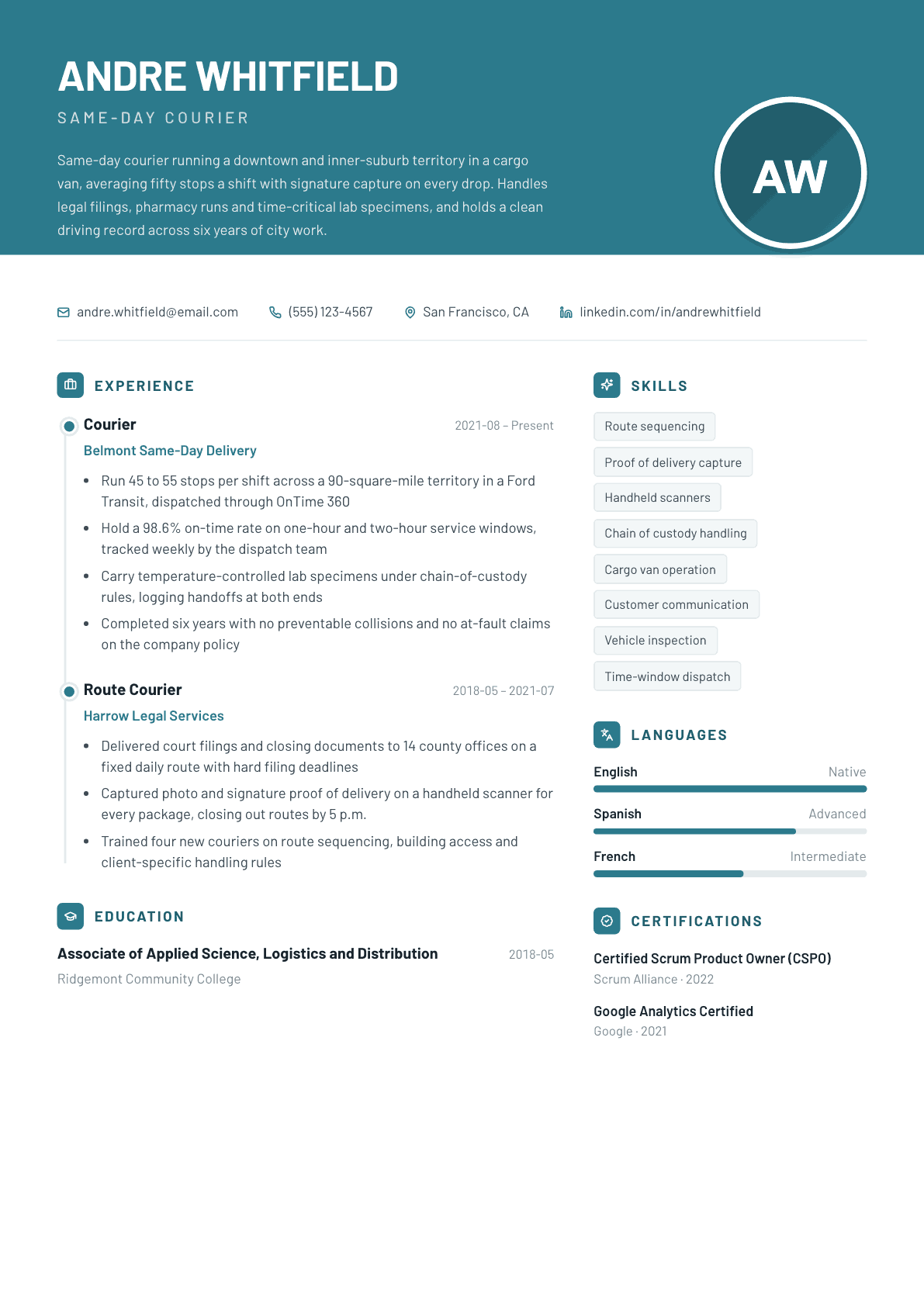
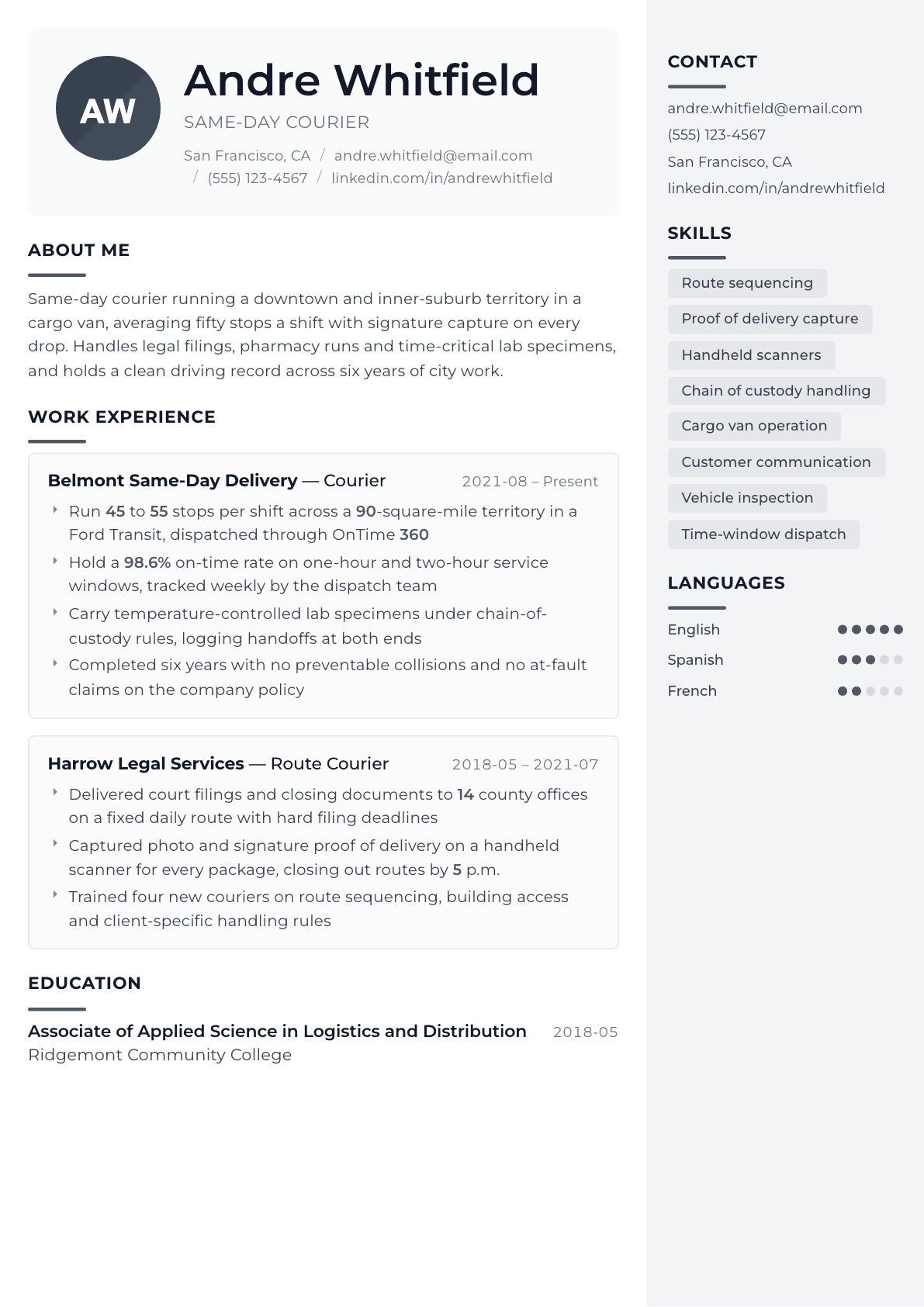
Example Courier summary
Same-day courier with six years running dense urban routes in a cargo van, averaging fifty stops a shift with signature or photo proof on every drop. Comfortable with time-critical medical and legal work, current on chain-of-custody handling, and holder of a clean motor vehicle record with no preventable collisions. Looking for a courier role with a fixed territory and steady client base.
Skills to list on a Courier resume
- Route planning
- Same-day delivery
- Proof of delivery
- Package scanning
- Cargo van operation
- GPS navigation
- Dispatch communication
- Chain of custody
- Load securement
- Customer service
- Pre-trip inspection
- Time management
- Defensive driving
- Manifest reconciliation
What actually gets this resume read
- Open with the volume you carry: stops per shift, packages per day, and the size of the territory you cover.
- Name the vehicle class you drove, because a hiring manager reads a cargo van very differently from a sedan.
- Give your on-time percentage or the service windows you held, since dispatch teams are graded on exactly that number.
- State your driving record plainly: years without a preventable collision, points on your record, and current insurability.
- List the dispatch and scanning apps you have used by name so the applicant tracking system matches the posting.
- If you moved sensitive freight such as lab specimens, cash or legal filings, say so and name the handling rules you followed.
How to write a courier resume
A courier resume is judged on two things a dispatcher can verify in under a minute: whether you can be insured to drive, and whether you can be trusted alone with somebody else's property. Everything else on the page is supporting evidence. That is why a courier resume that opens with a paragraph about being hardworking and reliable gets skimmed past, while one that opens with stops per shift, vehicle class and driving record gets a call the same afternoon.
Courier work also splits into distinct trades that pay very differently. Same-day and on-demand work is dispatch driven and priced by the run. Scheduled route work is fixed and repeatable. Medical, legal and pharmacy courier work adds handling rules, custody paperwork and background screening. A resume that does not say which of these you have done makes the reader guess, and readers guess low.
This guide covers the layout dispatchers expect, how to write the summary and the experience section around volume and proof, three example summaries at different stages, before and after bullets, and the questions couriers ask when they sit down to write the page.
Format: one page, driving credentials near the top
Keep it to a single page in reverse-chronological order. A courier hiring manager is usually a dispatcher or an operations supervisor reading between calls, so the page has to answer the screening questions in the first third: license class and state, vehicle you own or can drive, availability, and whether your record is clean.
Build a short credentials block right under your contact details rather than burying the license in the education section. Four lines is enough, and it stops the reader hunting.
- Header: name, city, phone, email, and the state that issued your driver license.
- Credentials block: license class, years licensed, endorsements if any, background clearance, and whether you supply your own vehicle.
- Then summary, experience, skills, education, and a short section for training or safety awards.
Summary: territory, volume, and the freight you are trusted with
Three lines. Name the type of courier work, the territory, the daily volume, the vehicle, and the category of goods you carry. A dispatcher building a route wants to know if you can absorb fifty stops without falling behind, and whether you have handled anything that needs a signature and a custody log.
If you are new to courier work, lead with what transfers: years of licensed driving, familiarity with the street grid, customer-facing jobs, and any work where you handled property that was not yours. Say plainly that you are looking for on-demand or route work so the reader knows where to slot you.
Experience: stops, windows, and proof of delivery
Every courier job gets a header line with the company, the vehicle you drove, and the shape of the work: on-demand, scheduled route, medical, or contracted for one client. Then three to five bullets carrying numbers a dispatcher already tracks.
The numbers that matter are stops per shift, packages per stop, territory size, service window lengths, and on-time performance. Add the tools: the dispatch platform, the scanner, the signature capture app, the route optimization software. Then add one bullet about the exceptions, because the exceptions are the job: a locked receiving dock, a customer who is out, a specimen that has to stay cold, a filing deadline at the courthouse.
Leave out the bullets that describe driving itself. Delivering packages safely and providing excellent customer service tells the reader nothing they did not already assume when they read the word courier at the top of the page.
Record and compliance: say it, do not imply it
Insurability is the gate. Write your driving record as a fact: years without a preventable collision, points on your license, and whether you have passed a background check and a drug screen for a previous employer. Vagueness here reads as something being hidden, and a courier company pays a real premium for every driver it adds to a policy.
If you carry medical, pharmacy or legal freight, name the handling rules you have worked under: chain of custody logs, tamper-evident bags, temperature checks at pickup and drop, and patient privacy training. Those phrases separate you from a general parcel driver in one line.
Skills and keywords a courier posting repeats
Courier postings reuse a small vocabulary, so mirror it exactly once in the skills list and once inside a bullet where you prove it. The recurring terms are route sequencing, proof of delivery, signature capture, handheld scanner, manifest, time-definite service, cargo van, chain of custody, pre-trip inspection and clean motor vehicle record.
Name the software rather than saying you are technology friendly. Dispatch and tracking platforms differ enough that a dispatcher reads a familiar system name as a week saved on training.
- Vehicle terms: cargo van, sprinter, box van, hand truck, lift gate, cargo securement.
- Service terms: one-hour service, same-day, time-definite, route close-out, exception reporting.
- Compliance terms: chain of custody, temperature log, background clearance, motor vehicle record.
Courier resume summary examples
First courier job
Licensed driver with four years behind the wheel and two years in customer-facing retail, moving into same-day courier work. Knows the metro street grid, comfortable with handheld scanners and route apps, holds a clean motor vehicle record, and available for early morning and weekend dispatch.
Three years on the road
Courier running an on-demand city territory in a cargo van, averaging 45 stops a shift with signature or photo proof on every drop. Holds a 98% on-time rate on one-hour and two-hour service windows and covers pharmacy runs under chain-of-custody handling. Clean record across three years.
Lead courier
Senior courier with nine years of same-day and medical route work, currently leading a team of six drivers on route design, ride-alongs and exception handling. Runs the hardest downtown territory personally, holds hazardous materials and specimen handling training, and has trained 14 new couriers to solo dispatch.
Work experience bullets: before and after
Before: Delivered packages to customers on time every day.
After: Completed 45 to 55 stops per shift across a 90-square-mile territory, closing routes with a 98.6% on-time rate against one-hour and two-hour service windows.
Volume, territory and the service window turn a claim about punctuality into a number a dispatcher can plan around.
Before: Used a scanner to log deliveries.
After: Captured signature and photo proof of delivery on a handheld scanner at every stop, cutting unresolved delivery disputes to fewer than one a quarter.
It names the evidence trail and ties it to the outcome the office actually cares about, which is disputes it does not have to investigate.
Before: Handled medical deliveries.
After: Transported temperature-controlled lab specimens under chain-of-custody rules, logging handoffs at pickup and drop and recording cooler temperatures on every run.
Specimen work is a different trade from parcel work, and the custody and temperature detail is what proves you have done it.
Before: Good driving record with no accidents.
After: Drove six years of daily city routes with no preventable collisions and no at-fault claims against the company insurance policy.
The time span and the phrase preventable collision are the terms an insurer and a safety manager use, so the claim becomes checkable.
Before: Helped train new drivers.
After: Trained four new couriers on route sequencing, building access codes and client-specific handling rules, taking each from ride-along to solo dispatch within two weeks.
The specific subjects and the time to solo show what the training produced instead of just claiming it happened.
Hard skills
- Route sequencing and optimization
- Proof of delivery and signature capture
- Handheld scanner operation
- Dispatch platform use
- Cargo van and box van operation
- Load securement and hand truck use
- Chain of custody documentation
- Temperature-controlled transport
- Pre-trip and post-trip inspection
- Manifest reconciliation
- GPS and street navigation
- Exception and damage reporting
Soft skills
- Reliability under time pressure
- Clear customer communication
- Independent problem solving
- Attention to handling detail
- Composure in traffic and delays
Certifications worth listing
- Hazardous Materials Endorsement (H) (State driver licensing agency)
- First Aid and CPR (American Red Cross)
- Defensive Driving Course (National Safety Council)
Mistakes that cost courier candidates the interview
- Hiding the driving record. If it is clean, write the years and the words no preventable collisions, because the reader will otherwise assume there is a reason you left it out.
- Listing employers with no vehicle information. Driving a sedan for document runs and driving a cargo van with a lift gate are different jobs and pay differently.
- Writing duties instead of volume. Stops per shift, packages per day and territory size are the only way a dispatcher can compare you to the driver before you.
- Skipping the tools. The dispatch system, scanner and route app you used are ATS keywords and a training cost the company would rather avoid.
- Leaving gaps unexplained. Courier companies verify employment history, and an unexplained six months invites a question you should answer on the page.
- Padding the page to two pages with unrelated jobs. One tight page reads as organized, which is exactly the trait the job requires.
Courier resume questions
Do I need a commercial license to work as a courier?
Not for most courier work. Cars, sprinters and cargo vans under the federal weight threshold are driven on a normal license. A commercial license becomes relevant only when the vehicle crosses that weight class or the load requires placards, so state your license class plainly and let the reader decide.
How do I write a courier resume when I have only driven for delivery apps?
List it as self-employment with the platform type, the years, the trip or drop volume and your customer rating. App driving proves navigation, time management and independent work. Add any handling detail such as chilled bags or restaurant pickup timing, then say plainly that you want dispatched courier work.
Should I put my own vehicle on the resume?
Yes, when you are applying to on-demand work where drivers supply the vehicle. Give the type, the cargo capacity and whether it carries commercial insurance. Owner-driver postings screen on that line first, and leaving it out means your page is set aside before anyone reads your experience.
What numbers should a courier put on a resume?
Stops per shift, packages handled per day, territory size in miles or zip codes, on-time percentage against the service window, and years without a preventable collision. Those five are the numbers dispatchers already track, so they translate directly into how a supervisor will plan your route.
How do I move from parcel courier work into medical courier routes?
Highlight anything you have carried that needed documentation, security or temperature control, and name the training you hold such as bloodborne pathogens or patient privacy. Medical routes are hired on trust and paperwork discipline, so lead with custody logging and punctuality rather than raw daily volume.
Related resume examples
- Delivery Driver Resume example
- Medical Courier Resume example
- Van Driver Resume example
- Dispatch Coordinator Resume example
- Food Delivery Driver Resume example
- Tow Truck Driver Resume example