Taxi Driver Resume Examples: free ATS score and gap list
Write a Taxi Driver Resume That Wins the Better Shifts
By Mustafa Tarabya, founder of CVBooster · Published · Updated
A taxi driver resume example with trips per shift, airport and account work, licensing detail, ATS keywords and a section-by-section writing guide.
Sample resumes for a taxi driver
The same taxi driver content laid out in three CVBooster templates, so you can see what the finished document looks like before you write a word.
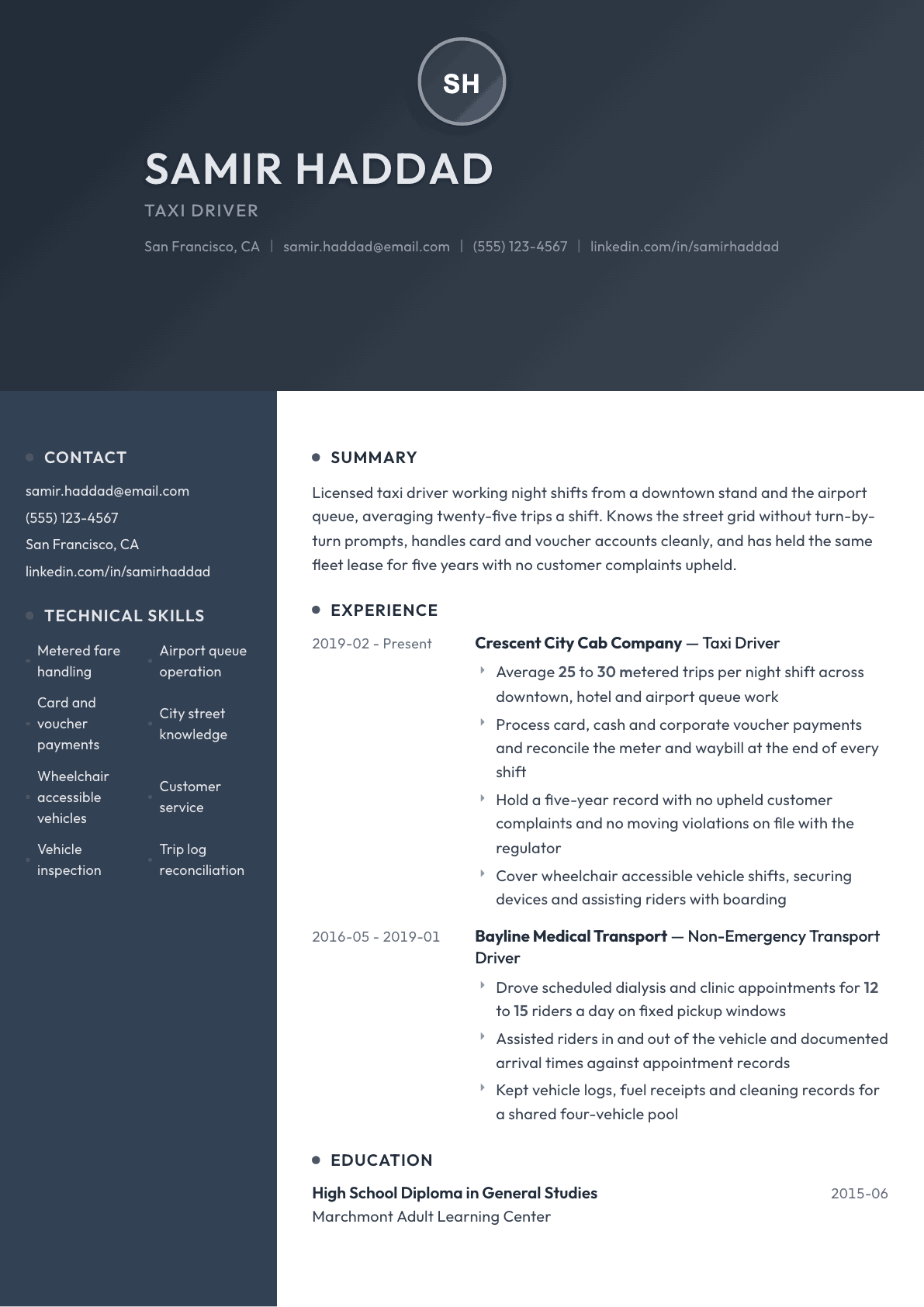
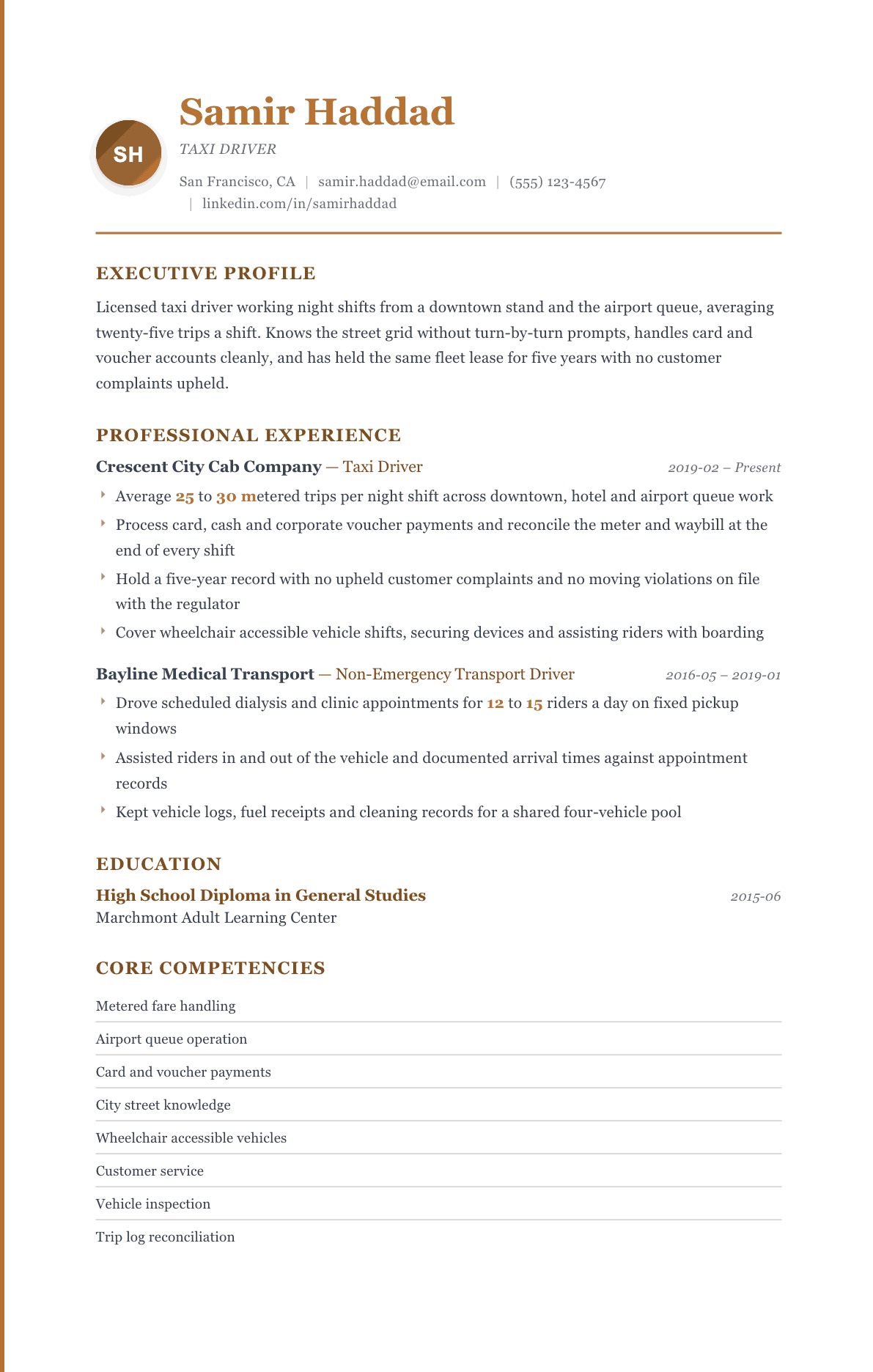
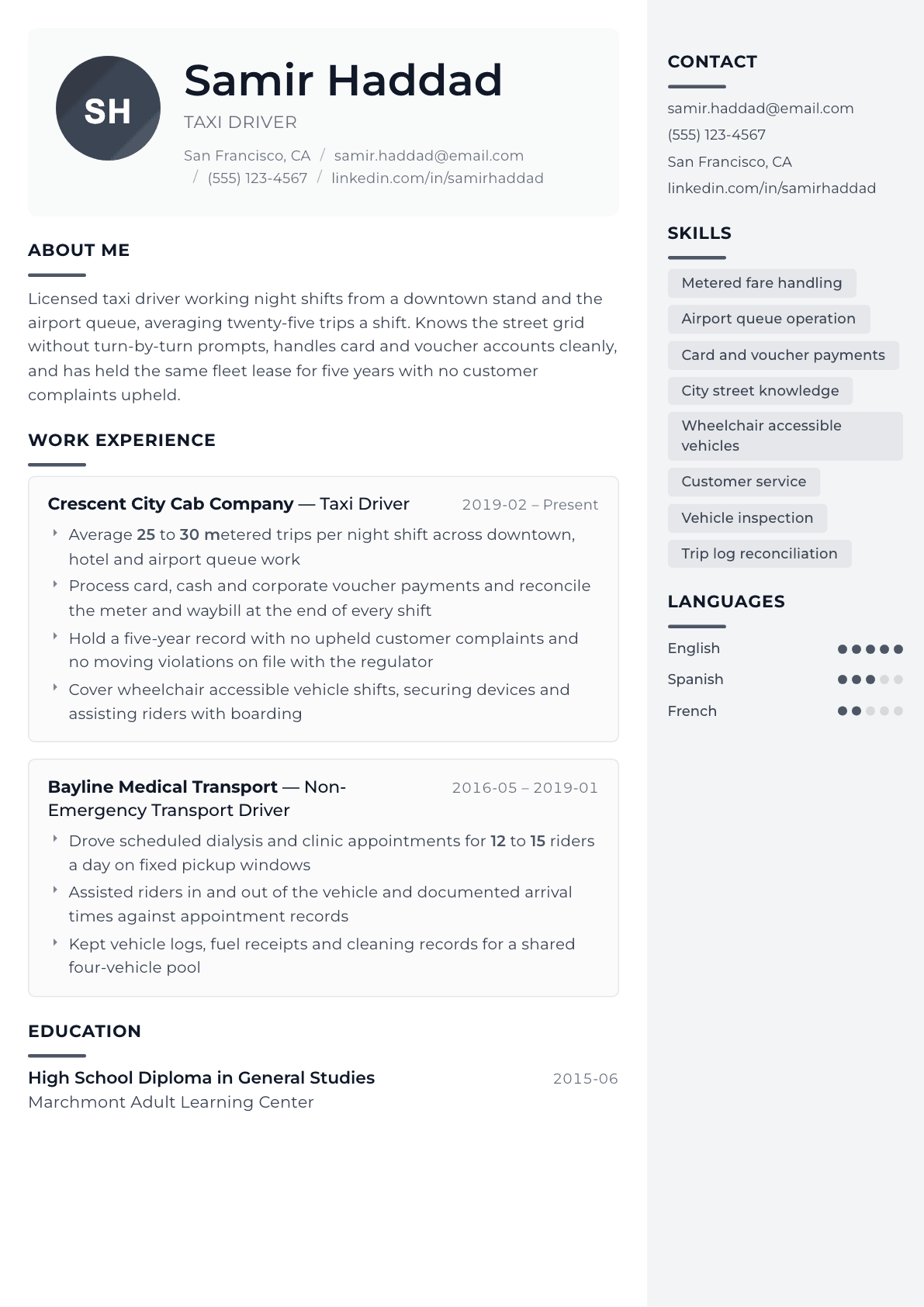
Example Taxi Driver summary
Licensed taxi driver with eight years of night and airport work in a metered cab, averaging twenty-five to thirty trips a shift. Handles cash, card and corporate voucher payments, reconciles the waybill nightly, and holds a record with no upheld complaints and no moving violations. Also covers wheelchair accessible vehicle shifts. Seeking a full-time lease with a fleet that runs steady airport hours.
Skills to list on a Taxi Driver resume
- Metered fare collection
- Card payment terminals
- Corporate account work
- Airport queue procedures
- City street knowledge
- GPS navigation
- Defensive driving
- Customer service
- Wheelchair accessible vehicles
- Vehicle cleaning and checks
- Trip and waybill records
- Cash reconciliation
- Conflict de-escalation
- Night shift operation
What actually gets this resume read
- Name your driver license or permit and the regulator that issued it, because a fleet cannot put you out without it.
- Give trips per shift and the shift you worked, since night and airport work is judged differently from day work.
- Show payment handling: meter, card terminal, corporate accounts and how you reconcile takings each shift.
- Say what you know about the city itself, including airport queues, event routes and hospital entrances.
- Include your complaint and violation record, since regulators publish it and a fleet manager will check.
- Mention accessible vehicle experience and any passenger assistance training, because those shifts are hard to cover.
How to write a taxi driver resume
A taxi driver resume gets read by a fleet manager who is deciding whether to hand you a car worth more than the week's takings and put you on the road with his company name on the roof. Three things settle it: your driver permit status with the local regulator, your record with passengers and police, and whether you can produce a full shift of fares without needing help finding the hospital entrance.
The job is also cash and account handling, dispute management and street knowledge, none of which appear on a page that only says you drove a cab. Airport queue rules, hotel accounts, corporate voucher work, medical transport contracts and accessible vehicle shifts are all specialties, and each one is worth more to a fleet than an extra year of general driving.
What follows is the layout a fleet office expects, how to write about fares and shifts in numbers, the licensing detail that has to be visible, three example summaries, before and after bullets, and the questions drivers ask when they move between fleets or into corporate and medical contract work.
Format: permit status high, one page, plain layout
Fleet offices are small and busy. Put your driving credentials in a labeled block under your contact details, then keep the rest of the page to a single column with clear job headings.
One page is right for almost every taxi application. If you have run mixed work such as cab shifts, medical transport contracts and private hire, group them by type rather than listing every short arrangement separately.
- Credentials: driver license class, local taxi or chauffeur permit and its issuing authority, years licensed to carry passengers.
- Record: moving violations, at-fault collisions, and any upheld complaints filed with the regulator.
- Availability: shifts you will run, whether you hold your own vehicle, and accessible vehicle capability.
Summary: shift, territory and trips per night
Give the shift and the territory first, because a fleet is always short of drivers for one particular slot. A driver who works nights from a downtown stand and the airport queue is filling the hardest shift there is, and that is worth stating before anything else.
Then the volume: trips per shift, and the mix between street hails, dispatch calls, airport queue and account work. Close with the record, since a fleet manager thinks about complaints and collisions the way a warehouse manager thinks about damaged pallets.
Experience: fares, payments and the difficult parts
Each job entry should give the fleet, the type of vehicle, the shift you ran and the source of your work. Then use bullets to cover trip volume, payment handling, reconciliation, passenger assistance and how you deal with the parts of the shift that go wrong.
Payment handling is a trust question and deserves a specific bullet: meter operation, card terminals, corporate vouchers, medical transport authorizations, and how the waybill and takings are reconciled at the end of the shift. A driver who mentions reconciliation without variances has answered the question the fleet manager was going to ask.
Then write the harder material. A passenger who will not pay, an intoxicated rider, an unfamiliar address at three in the morning, a road closure during a stadium exit. Fleet managers hire the driver who resolves these without an incident report or a damaged car.
Knowledge of the city is a skill, so write it as one
Turn-by-turn navigation is universal now, which is exactly why real street knowledge stands out. Say what you know that an app does not tell you: which hospital door takes wheelchair arrivals, where the airport holding lot feeds from, which hotel ranks are worth working after a convention, how the one-way system behaves during rush hour.
Also name the queue and stand rules you work under. Airport dispatch systems, hotel arrangements and stand etiquette are governed by procedure, and a driver who follows them keeps the fleet in good standing with the venue.
Skills and keywords used in taxi and private hire postings
The recurring terms are metered fare, dispatch calls, airport queue, corporate accounts, card terminal, waybill, trip log, passenger assistance, wheelchair accessible vehicle, defensive driving, clean driving record and customer service.
For medical and contract transport add appointment windows, authorization numbers, non-emergency transport, and assisting riders in and out of the vehicle, since those contracts are steady work and fleets value drivers who can hold them.
Taxi Driver resume summary examples
First fleet lease
Licensed driver with five years of accident-free driving and a new taxi driver permit, moving into full-time cab work. Knows the city grid from three years of pizza and parts delivery, comfortable with card terminals and dispatch apps, and available for night and weekend shifts.
Four years driving nights
Taxi driver working night shifts from a downtown stand and the airport queue, averaging 25 to 30 metered trips a shift. Handles cash, card and corporate voucher payments and reconciles the waybill nightly, with no upheld complaints and no moving violations in four years.
Senior driver on contract work
Taxi driver with twelve years across street, airport and contract work, currently holding two corporate accounts and a non-emergency medical transport contract. Covers wheelchair accessible vehicle shifts, mentors new drivers on queue rules and reconciliation, and has a clean regulator record throughout.
Work experience bullets: before and after
Before: Picked up passengers around the city.
After: Averaged 25 to 30 metered trips per night shift across downtown stands, hotel ranks and the airport queue, working peak event and closing-time demand.
Trip volume and the work sources describe a shift a fleet manager can compare against his own dispatch data.
Before: Took payments from passengers.
After: Processed cash, card and corporate voucher payments and reconciled the meter, waybill and takings at the end of every shift with no variances recorded.
Payment types plus a reconciliation record answers the trust question that decides whether a fleet hands over a car.
Before: Was polite to customers.
After: Held a five-year record with no upheld complaints filed with the regulator, including regular late-night and event work.
A regulator record is external evidence, and noting the difficult shifts makes the record more impressive rather than less.
Before: Helped passengers with disabilities.
After: Covered wheelchair accessible vehicle shifts, securing mobility devices and assisting riders with boarding and stowing walkers and oxygen equipment.
Naming the equipment and the assistance shows trained accessible work, which fleets struggle to staff.
Before: Drove people to medical appointments.
After: Ran scheduled dialysis and clinic transports for 12 to 15 riders a day on fixed pickup windows, documenting arrival times against appointment records.
Rider counts, appointment windows and documentation show contract discipline, not just another category of passenger.
Hard skills
- Metered fare operation
- Dispatch system and radio use
- Airport queue procedures
- Card terminal and voucher processing
- Waybill and trip log reconciliation
- Wheelchair accessible vehicle operation
- Passenger assistance and stowage
- City street and route knowledge
- Vehicle daily checks and cleaning
- Non-emergency medical transport
- Defensive driving technique
- Cash handling and float management
Soft skills
- Reading a passenger quickly
- Composure at night
- Discretion with riders
- Local knowledge and curiosity
- Steady temperament in disputes
Certifications worth listing
- Defensive Driving Course (National Safety Council)
- First Aid and CPR (American Heart Association)
- Chauffeur License (State driver licensing agency)
Mistakes that cost taxi driver candidates the interview
- Not naming the permit and the issuing authority. Taxi work is locally regulated and a fleet cannot roster a driver whose permit status is unclear.
- Describing the job as driving people around. Fares, payment types, queue work and contract runs are the parts that distinguish one driver from another.
- Skipping the reconciliation detail. A fleet hands over cash, a car and its reputation, so the accounting habit belongs on the page.
- Leaving out shift preference. Fleets are usually short on nights and weekends, and stating your availability can decide the application on its own.
- Ignoring accessible vehicle capability. Those shifts are hard to cover and drivers who can run them get first pick of the roster.
- Overstating the record. Regulators keep complaint and violation history, so anything on your page will be measured against their file.
Taxi Driver resume questions
What license do I need to drive a taxi?
A standard driver license plus a local taxi, hackney or chauffeur permit issued by the city, county or state authority that regulates cabs. Requirements usually include a defensive driving course, a background check and a medical form, so list what you already hold.
How do I write a taxi driver resume with no professional driving history?
Lead with the years you have been licensed and any driving that was paid, including delivery, courier or shuttle work. Add customer-facing jobs to show composure with the public, then state the shifts you can cover and your clean record.
Should I include how much I earned per shift?
No. Earnings depend on the lease agreement, the fleet, the city and the season, so the figure means little to another employer. Trip counts, shift length, account work and your record are far more useful evidence of a productive driver.
How can a taxi driver stand out from other applicants?
Specialization. Airport queue experience, corporate accounts, medical transport contracts and accessible vehicle capability are all difficult for a fleet to staff. Naming even one of them changes you from an interchangeable driver into someone who fills a specific gap.
Is taxi experience useful when applying for other driving jobs?
Very. It proves long shifts alone, city navigation, cash and card handling and constant public contact. Translate it for the target job: courier employers care about the navigation and reliability, while transit agencies care about passenger handling and composure.
Related resume examples
- Rideshare Driver Resume example
- Chauffeur Resume example
- Bus Driver Resume example
- Delivery Driver Resume example
- Van Driver Resume example
- Courier Resume example