Medical Courier Resume Examples: the lines they read
Write a Medical Courier Resume That Wins Route Assignments
By Mustafa Tarabya, founder of CVBooster · Published · Updated
Build a medical courier resume with specimen handling examples, chain of custody keywords, and a route history that dispatchers trust.
Sample resumes for a medical courier
The same medical courier content laid out in three CVBooster templates, so you can see what the finished document looks like before you write a word.
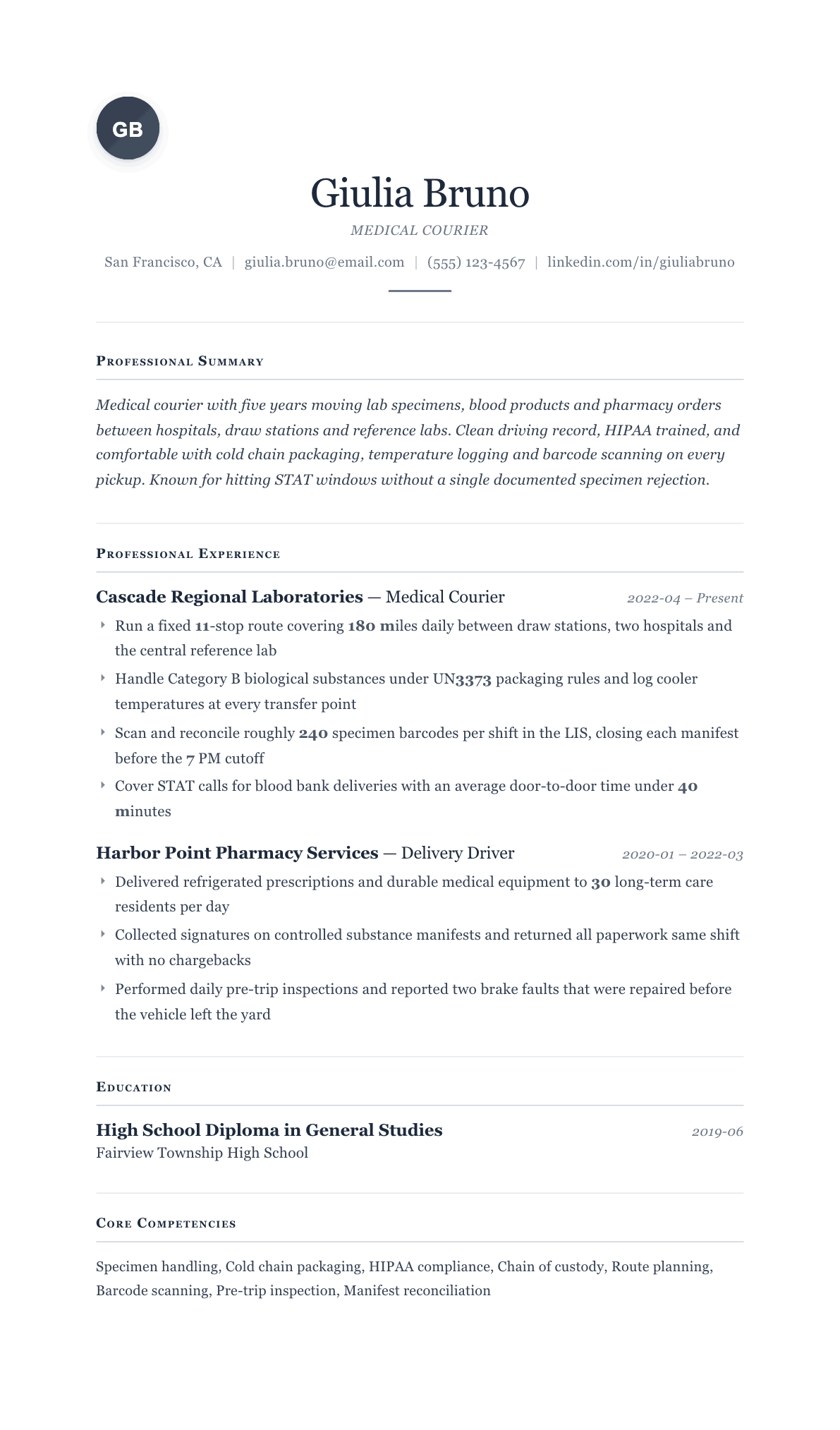
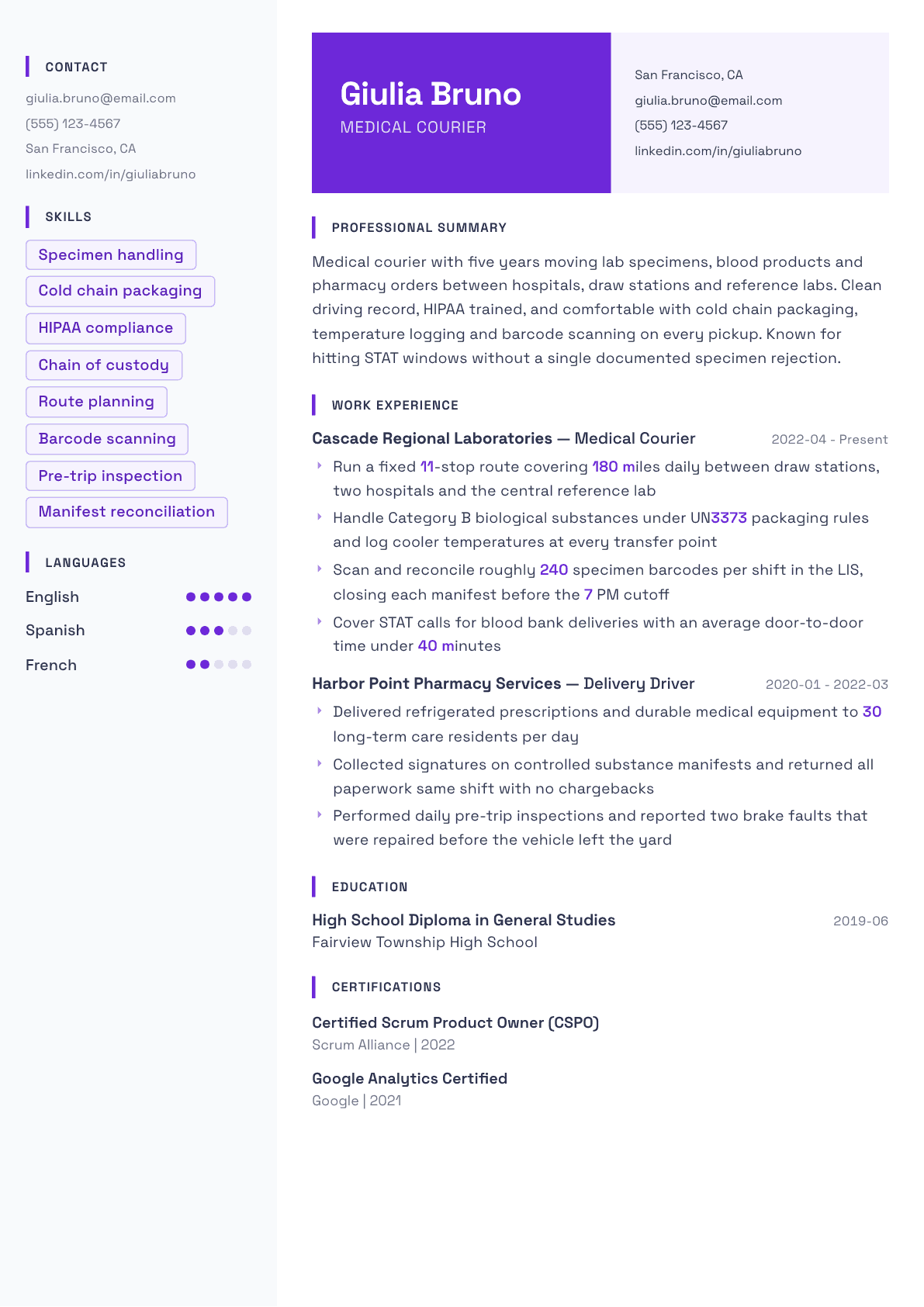
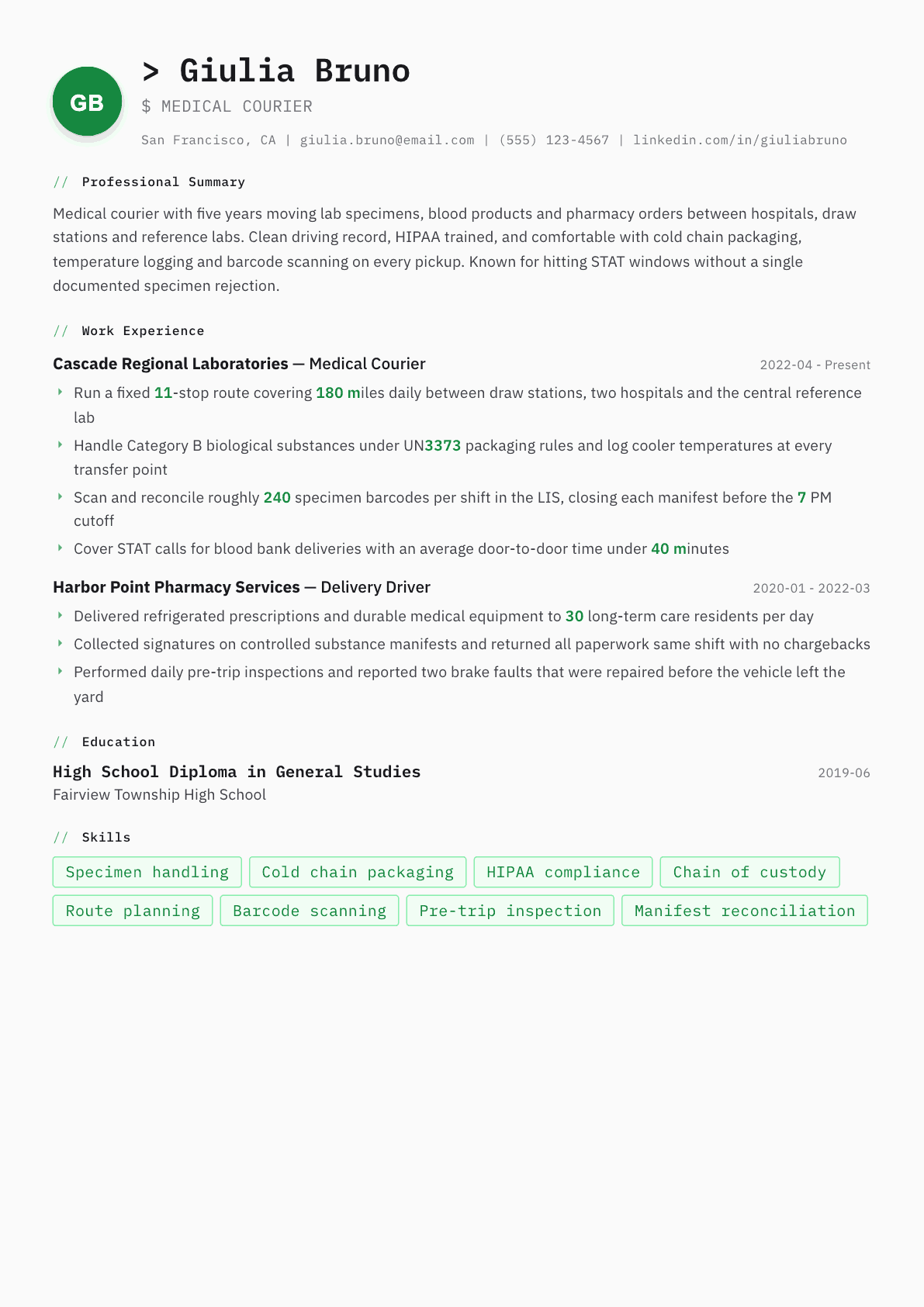
Example Medical Courier summary
Dependable medical courier with five years transporting laboratory specimens, blood products and pharmacy orders across hospital and clinic networks. Skilled in cold chain packaging, chain of custody documentation and barcode reconciliation, with a clean driving record and current HIPAA training. Seeking a route position with a reference laboratory where accuracy under a tight cutoff matters more than raw speed.
Skills to list on a Medical Courier resume
- Specimen transport
- Cold chain handling
- HIPAA compliance
- Chain of custody documentation
- UN3373 packaging
- Route optimization
- Barcode and manifest scanning
- Temperature logging
- Bloodborne pathogen safety
- Defensive driving
- Pre-trip and post-trip inspection
- STAT delivery response
- Customer service at clinical sites
- GPS navigation
What actually gets this resume read
- Name the specimen types you carry: blood, urine, tissue, blood bank products, pharmacy orders and vaccines.
- State your driving record status and license class near the top, because dispatch screens on that first.
- Show route size in real numbers: stops per shift, miles per day, and the cutoff time you hit.
- Mention UN3373 packaging, cooler temperature logging and any bloodborne pathogen training you have completed.
- Prove reliability with on-time and rejection statistics, since a rejected specimen means a patient gets redrawn.
- List the scanning or tracking software you used, and say whether you worked from a fixed or on-demand route.
How to write a medical courier resume
A medical courier resume is screened by a logistics supervisor who has been burned before. Somewhere in the last year a driver mishandled a cooler, a specimen arrived warm, and a patient had to come back for a second draw. That memory is what the supervisor brings to your resume, so the file that gets a call is the one that proves you understand what is inside the bag, not just how fast you drive.
The work sits on top of two separate rulebooks. One is driving: license class, motor vehicle record, pre-trip inspection, fuel and mileage logs. The other is clinical handling: temperature ranges, secondary containment, biohazard labeling, chain of custody signatures and patient privacy. A resume that covers only the driving half reads like a food delivery history, and that is exactly how it gets sorted.
This guide covers how to structure the page, what belongs in each route description, which credentials are worth listing, three summaries for different stages of a courier career, and the before-and-after bullets that turn a vague delivery history into evidence you can be trusted with blood products.
Format: one page, driving credentials at the top
Keep it to a single page in reverse-chronological order. Dispatch managers read fast and they read on a phone between calls. Put a compact credential line under your name with license class, state, motor vehicle record status and any endorsement, because a hiring decision cannot move until someone confirms you are insurable on the company policy.
Avoid decorative columns and icon rows. Courier hiring often runs through a staffing portal that parses the file into fields, and a two-column layout can scramble your employment dates into a mess that a recruiter will not untangle for you.
- Header: name, city and state, phone, email, license class and state, motor vehicle record status.
- Order: summary, certifications and training, courier experience, other driving experience, education.
- If you own the vehicle you drive for contract work, say so and give the type, because independent contractor routes require it.
Summary: what you carry, where, and on what clock
Three lines. Name the cargo type, the network you served, the route pattern and the reliability record. A courier who writes that they carried lab specimens between draw stations and a reference laboratory on a fixed evening route has already answered the first three questions a dispatcher would ask on the phone.
If you are crossing over from parcel, food or pharmacy delivery, name the transferable pieces directly: route density, signature capture, refrigerated handling, and the fact that you have never had a preventable accident. Then name the clinical training you completed so the reader can see you closed the gap on purpose.
Experience: describe the route, not the driving
Every position needs the route shape before the bullets start. Stops per shift, miles per day, the geography, whether the route was fixed, on-demand or a mix, and what the cutoff time was. A fixed 11-stop route feeding a 7 PM courier cutoff is a completely different job from an on-demand STAT rotation, and the reader wants to know which one you have lived.
Then write bullets around handling, not motion. Specimen categories, cooler and dry ice use, temperature logging at transfer, UN3373 packaging for Category B substances, ambient versus refrigerated versus frozen, and blood bank product rules. Add the paperwork: manifest reconciliation, barcode scanning into a laboratory information system, and signature capture for controlled items.
Cut the bullets that describe driving itself. Every courier operated a vehicle, followed traffic laws and delivered packages on time. Those lines take the space that a specimen rejection rate or an on-time record should occupy.
- Give the route in numbers: stops, miles, shift length, and the cutoff you were accountable to.
- Name the cargo: blood tubes, urine, tissue, cultures, blood bank products, pharmacy orders, vaccines, radiology media.
- Show the paper trail: manifests reconciled, barcodes scanned, custody signatures collected, temperature logs completed.
- Include facility relationships, because a courier who is welcome at a nursing station gets better handoffs.
Training and compliance: short section, real names
List training with the body that provided it and the year it was last refreshed. HIPAA privacy training, bloodborne pathogen training, defensive driving and dangerous goods handling all belong here. This section exists because a compliance officer has to sign off on you before your first route, and a resume that already answers their checklist speeds that up.
Do not inflate. Writing that you are certified in hazardous materials when you completed a shipper awareness module is the kind of claim that unravels in an interview and costs you the role. Name exactly what you took.
Keywords that get a courier file surfaced
Laboratory and hospital postings recycle a small vocabulary: specimen transport, chain of custody, cold chain, STAT delivery, biohazard, secondary containment, route optimization, manifest, HIPAA, clean driving record and pre-trip inspection. Use the phrases the posting uses in your skills list and once more inside a bullet where they are attached to real work.
Include the software by name if you used it: a laboratory information system, a route management application, or a scanning handheld. Naming the tool tells a supervisor how short your onboarding will be.
Medical Courier resume summary examples
First courier role
Reliable driver with three years of route delivery and a clean motor vehicle record, moving into medical transport after completing HIPAA and bloodborne pathogen training. Comfortable with signature capture, refrigerated handling and early morning schedules. Seeking a fixed lab route where accuracy and a documented handoff matter more than volume.
Four years on route
Medical courier with four years running fixed and STAT routes between draw stations, two hospitals and a reference lab. Handles Category B specimens under UN3373 packaging, logs cooler temperatures at every transfer, and scans about 240 barcodes per shift. No documented specimen rejection in three years.
Lead courier
Lead medical courier with nine years across laboratory, pharmacy and blood bank transport, currently training new drivers and building route sheets for a six-vehicle operation. Experienced with dry ice handling, controlled substance manifests and after-hours STAT coverage. Reduced late arrivals at the evening cutoff by 30% after redesigning two routes.
Work experience bullets: before and after
Before: Delivered medical packages to hospitals and clinics on time.
After: Ran a fixed 11-stop route of 180 miles daily between six draw stations, two hospitals and the central reference lab, closing every manifest before the evening cutoff.
Stops, mileage, facility types and the cutoff give a dispatcher the shape of the route instead of a claim about punctuality.
Before: Followed safety procedures when handling specimens.
After: Packaged Category B biological substances under UN3373 rules with absorbent secondary containment and logged cooler temperatures at pickup and delivery on every transfer.
The standard, the containment method and the logging habit prove specific handling knowledge rather than general caution.
Before: Used a scanner to track deliveries.
After: Scanned and reconciled roughly 240 specimen barcodes per shift in the laboratory information system, catching mislabeled tubes at pickup before they reached accessioning.
The volume and the catch show what the scanning was for, which is the part a lab manager cares about.
Before: Responded to urgent delivery requests.
After: Covered STAT blood bank calls on an on-call rotation with an average door-to-door time under 40 minutes, including overnight transfers between two campuses.
Naming the cargo, the response time and the rotation turns urgency into a measurable service level.
Before: Maintained the company vehicle.
After: Completed daily pre-trip and post-trip inspections, reported two brake faults that were repaired before dispatch, and kept the vehicle in service across three winters with no missed route.
An inspection outcome and an uptime record show reliability, while vehicle maintenance alone is an assumed duty.
Hard skills
- Specimen transport
- Cold chain handling
- UN3373 packaging
- Temperature logging
- Chain of custody documentation
- Manifest reconciliation
- Barcode scanning
- Dry ice handling
- Route planning
- Pre-trip and post-trip inspection
- HIPAA privacy practice
- Bloodborne pathogen precautions
- GPS and route management software
- Controlled substance delivery paperwork
Soft skills
- Punctuality under a fixed cutoff
- Calm handling of route changes
- Clear handoff communication
- Discretion with patient information
- Independent problem solving
- Professional presence in clinical settings
Certifications worth listing
- Basic Life Support (BLS) (American Heart Association)
- OSHA 10-Hour General Industry (OSHA Training Institute)
- Dangerous Goods Regulations Training (International Air Transport Association)
- Smith System Defensive Driving (Smith System Driver Improvement Institute)
Mistakes that cost medical courier candidates the interview
- Writing the resume as a general delivery history, which hides the clinical handling knowledge that separates this job from parcel work.
- Leaving out the motor vehicle record status, so the recruiter cannot tell whether you are insurable without calling you first.
- Listing only the employer name with no route detail, which makes a nine-stop clinic loop look identical to a hospital STAT rotation.
- Claiming certifications you have not earned, such as full hazardous materials training when you completed an awareness module.
- Ignoring the paperwork side entirely, when manifests, custody signatures and temperature logs are what audits look at.
- Burying the availability question. Early morning, evening and weekend coverage should be stated, because route hours are the first scheduling conflict.
Medical Courier resume questions
Do I need a special license to be a medical courier?
Most routes run in a car, minivan or cargo van and need only a standard license, a clean motor vehicle record and insurability on the company policy. A commercial license is needed only when the vehicle weight rating requires it, which is uncommon for specimen work.
How do I get a medical courier job with no clinical background?
Complete HIPAA and bloodborne pathogen training before you apply, list them with the provider, and translate your delivery history into route language: stops per shift, signature capture, refrigerated cargo and on-time record. That combination answers the two things a supervisor screens for.
What should I put on a medical courier resume if my routes were confidential?
Describe the route by type and scale rather than by client name. Say you served hospital draw stations, dialysis centers or long-term care sites, give the stop count and mileage, and leave out anything covered by your contract. Scale reads clearly without identifying the customer.
Should I list every driving job I have had?
List the courier and delivery roles in full and compress unrelated driving into a short line. What matters is continuous driving history with no gaps a background screener has to ask about, plus enough detail on the medical routes to show handling knowledge.
How do I show reliability without inventing numbers?
Use records you can actually defend: attendance, years without a preventable accident, routes covered without a missed cutoff, or the absence of documented specimen rejections. If you never tracked a metric, describe the practice instead, such as verifying every label against the manifest before leaving a site.
Related resume examples
- Courier Resume example
- Delivery Driver Resume example
- Truck Driver Resume example
- Dispatch Coordinator Resume example
- Van Driver Resume example
- Rideshare Driver Resume example