Warehouse Resume: Certs, Throughput, Safety
By Mustafa Tarabya, founder of CVBooster · Published · Updated
12 min read
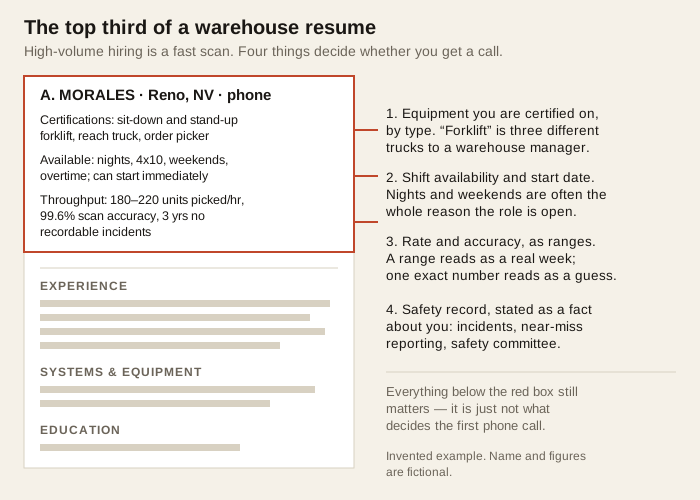
Put your equipment certifications, your shift availability, your rate and your safety record in the top third of page one. Warehouse hiring is fast and high-volume, and the person scanning your resume is checking four things before they decide whether to call. Make all four visible without scrolling.
This is one of the few resumes where being plain is an advantage. No design, no summary paragraph about your passion for logistics, no clever layout. Facts, in the order a warehouse manager needs them.
How should you write forklift certification?
By naming the specific trucks you are certified and evaluated on, not by writing "forklift certified". A warehouse manager reading that word does not know whether you can safely take a reach truck into a narrow aisle, and that is precisely the thing they need to know.
It is worth understanding how the certification actually works, because a lot of resumes describe it wrongly. Under the US federal standard for powered industrial trucks, the employer certifies that each operator has been trained and evaluated, and the certification record includes "the name of the operator, the date of the training, the date of the evaluation, and the identity of the person(s) performing the training or evaluation". The same standard says an evaluation of each operator's performance "shall be conducted at least once every three years".
Two consequences follow. First, forklift training is tied to the equipment and the workplace, so a new employer will normally evaluate you themselves rather than simply accept a card. Second, your resume should say what you were trained and evaluated on, by whom, and when — which is far more useful than a bare claim of being certified.
- Name the truck types: sit-down counterbalance, stand-up counterbalance, reach truck, order picker or cherry picker, pallet jack, walkie rider, turret truck, clamp truck
- Say who trained and evaluated you, and when it was last done
- Add related tickets you hold: pallet jack, aerial or scissor lift, overhead crane, hazmat handling
- Include safety training with the course name: lockout/tagout, fall protection, first aid, CPR
- If your training was in another country, name the scheme so it can be recognised
- Do not write a certification you cannot produce a record for
Tip: If your last evaluation is old, write it honestly and add a line saying you are ready to be re-evaluated on arrival. That is a normal part of onboarding, and saying it first reads as someone who understands the standard rather than someone hiding a lapse.
Which throughput numbers hold up?
The ones your warehouse management system printed on a board or a scorecard. Warehouses measure almost everything, so you rarely need to estimate — and where you do estimate, give a range, because a range is what a real week looks like.
- Picking rate: units, lines or cases per hour, and how it compared to the site's target
- Loading and unloading: trailers or containers per shift, pallets per hour
- Accuracy: scan or pick accuracy, and short and damage rates if your site tracked them
- Inventory: cycle counts completed, count accuracy, shrink in your area
- Order volume: orders shipped per shift or per peak day
- Equipment hours: how much of your shift was on a truck versus on foot
- Peak season: how the volume changed and what you hit during it
Write the unit every time. "180 to 220 units picked per hour against a 175 target" is a claim someone can test on your first shift and you will be fine. "Increased productivity by 40%" is a claim with no unit, no baseline and no source, and it belongs to a resume genre that warehouse managers have learned to ignore.
One honest caveat: rates depend on the site, the product and the pick path. If you moved between a case-pick grocery operation and a small-item e-commerce site, say so, and let the numbers sit next to the context that explains them.
How do you put safety on a resume without sounding generic?
By stating facts about your own record and your own participation, rather than describing yourself as safety-conscious. Everyone writes that phrase, and it carries no information at all.
- How long you have worked without a recordable incident, stated as a period
- Near-miss and hazard reports you filed, which is a positive signal rather than a negative one
- Safety committee membership, toolbox talks you ran, or new-starter safety inductions you delivered
- Pre-shift equipment inspections as a routine you owned
- Specific training with its real name, and the date
- Any audit or inspection your area passed, described as the area's result rather than yours alone
Do not quote a site-wide injury statistic as if it were your achievement, and do not invent an incident-free figure. Warehouse managers talk to each other, references are quick, and this is exactly the kind of claim that gets checked.
Why does shift availability belong near the top?
Because it is often the reason the role is open. Day shifts fill themselves. Nights, weekends, four-by-ten schedules, split shifts and peak-season overtime are harder to staff, and an applicant who says plainly that they can work them moves up the list immediately.
- The shifts you can work, named the way the industry names them: nights, 4x10, 3x12, weekend days, split, rotating
- Whether you can do overtime, and whether you are available for peak season
- How soon you can start, and whether you can start on short notice
- Whether you have reliable transport to a site with limited public transport, which for many facilities is a genuine hiring factor
- Any physical requirements from the ad that you can meet, in the ad's own terms
Say only what is true. Availability is checked on day one, and a mismatch here ends the job faster than any other line on the page.
Which systems should you name?
The warehouse management system, the handheld and the ERP, by name. These are real filters, because a picker who already knows the site's WMS is productive in days rather than weeks.
- Warehouse management systems: Manhattan Associates, Blue Yonder, SAP EWM, Oracle WMS, Körber, Infor
- ERP and inventory systems: SAP, Oracle, NetSuite, Dynamics
- Handhelds, RF scanning, voice picking headsets, pick-to-light
- Shipping and carrier systems, and the paperwork you handled: bills of lading, packing slips, customs documents
- Automation you have worked alongside: conveyors, sorters, AS/RS, AMRs
- Basic office tools only where you actually used them for the job, such as inventory spreadsheets
What does a strong warehouse resume look like?
Everything below is an invented example. The name, the employer and every figure are fictional, and they show the shape rather than something to copy.
Example header block: "A. MORALES — Reno, NV — phone — email. Certified: sit-down and stand-up counterbalance forklift, reach truck, order picker; last evaluated 03/2026 by site safety lead. Available: nights, 4x10, weekends, overtime; can start immediately. Rate: 180 to 220 units picked per hour, 99.6% scan accuracy. Three years with no recordable incidents."
Example experience heading: "Warehouse Associate II — Cascade Distribution, Sparks, NV. February 2023 to present. 600,000 sq ft e-commerce fulfilment centre, night shift 4x10, roughly 40,000 units shipped a night at peak."
- Example bullet: "Pick 180 to 220 units an hour on RF against a site target of 175, at 99.6% scan accuracy, working small-item pick paths across three zones."
- Example bullet: "Operate reach truck and order picker for replenishment in narrow aisle up to 30 feet, roughly six hours of a ten-hour shift, with pre-shift inspection logged every night."
- Example bullet: "Run cycle counts for two zones in Manhattan WMS, reconciling variances with the inventory control lead and clearing an average of 40 count discrepancies a week."
- Example bullet: "Trained nine seasonal hires on RF handheld picking and pallet jack use during two peak seasons, including the pre-shift safety walk."
- Example bullet: "Sit on the site safety committee and file near-miss reports; three years on shift with no recordable incident."
Read those again and notice how little there is to argue with. Every line is a fact from a scorecard, a schedule or a training record, and any of them could be confirmed by a supervisor in one phone call.
What if you have no warehouse experience yet?
Lead with the parts of your history that transfer, and be specific about them. If a GED is your highest credential, put it in the education line the way our GED on resume examples show. Warehouse hiring is one of the more open doors in the labour market, and managers are used to reading resumes from people entering the field. If you are moving up to run the shift, the supervisor resume examples show the next version of this page.
- Physical work of any kind: construction, landscaping, moving, farm work, kitchen work, retail stockroom
- Any inventory or stock handling, even in a shop
- Reliability evidence: attendance, a long stint at one employer, shift work you already do
- Licences you hold, including a driving licence and any equipment ticket
- Military service, where equipment, logistics and safety discipline transfer directly
- Your availability, stated up front, because it is the strongest thing a new starter can offer
Weak bullets, and what they should say instead
Warehouse resumes usually fail by being too general, not too short. These pairs are invented examples of the same work written badly and then written properly.
Weak: "Responsible for picking and packing customer orders in a fast-paced environment." Rewritten: "Pick 180 to 220 units an hour on RF against a site target of 175, at 99.6% scan accuracy, working small-item pick paths across three zones on a ten-hour night."
"Fast-paced environment" is filler; the rate is the fact. If you do not remember your exact number, give the range you know you held and say what the target was.
Weak: "Forklift certified with experience operating warehouse equipment." Rewritten: "Operate reach truck and order picker for narrow-aisle replenishment up to 30 feet, roughly six hours of a ten-hour shift, with pre-shift inspection logged nightly; last trained and evaluated 03/2026 by the site safety lead."
The rewrite answers the three questions a warehouse manager has about any equipment claim: which truck, how much of your time, and when were you last evaluated on it.
Weak: "Maintained a safe working environment at all times." Rewritten: "Sit on the site safety committee, file near-miss reports, and deliver the pre-shift safety walk for seasonal hires; three years on shift with no recordable incident."
Filing near-misses is worth stating out loud. It signals someone who reports rather than hides, which is the behaviour every safety manager is trying to hire for.
Weak: "Improved warehouse efficiency by 40%." Rewritten: "Resequenced the replenishment run for two aisles with the shift lead, cutting the number of empty pick faces reported at the start of nights."
A percentage with no unit and no baseline reads as invented, because it usually is. Describing the change you made is both more honest and more impressive, since it shows you think about the process rather than just moving through it.
The rest of the worked example: systems and equipment
Continuing the invented example from earlier, with a fictional employer and fictional figures.
Example systems and equipment block: "Equipment — sit-down and stand-up counterbalance forklift, reach truck up to 30 ft, order picker, electric pallet jack, walkie rider. Systems — Manhattan WMS, RF handheld scanning, voice picking, SAP for goods receipt. Documentation — bills of lading, packing slips, cycle count sheets, damage and discrepancy reports. Training — lockout/tagout 2025, first aid and CPR 2024, forklift training and evaluation 03/2026."
Example availability block, placed directly under the header: "Available nights and weekends, 4x10 or 3x12, overtime and peak season. Can start immediately. Own transport."
Those two blocks are perhaps 60 words and they answer most of a screening call. On a resume that has to survive a twenty-second scan, they are worth more than any paragraph you could write about yourself.
Picker, forklift operator, or supervisor?
Warehouse roles share a building and not much else. Move the emphasis to match the posting.
- Picker and packer: rate, accuracy, zones, pick method (RF, voice, pick-to-light, paper) and how you held up through peak.
- Forklift and equipment operator: truck types, aisle width, rack height, last evaluation date, and the damage record you can honestly claim.
- Shipping and receiving: trailers loaded or unloaded per shift, dock door management, carrier paperwork, and the checks you ran on inbound loads.
- Inventory control and cycle counting: count accuracy, variance investigation, shrink in your area, and how you worked with the WMS to correct it.
- Returns and reverse logistics: volume, grading decisions, and the disposition rules you followed.
- Team lead or supervisor: headcount on your shift, how you set assignments, the metrics you owned for the area, training you delivered, and disciplinary or attendance processes you ran.
- Cold storage, hazmat or food-grade sites: name the environment and any handling standard, because those are genuine differentiators and not every applicant has worked in them.
Tip: If you are aiming a step up — picker to forklift, or associate to lead — put the evidence for the higher role above the evidence for the current one. Training seasonal hires, covering the lead's days off, or running a zone are all lead-shaped facts, and they should not be buried in your fifth bullet.
What does warehouse hiring actually look like?
It is usually the fastest hiring process you will meet, and it is designed for volume. That shapes what your resume has to do.
- An online application or a walk-in hiring day, often with knockout questions on shift availability, start date and equipment experience.
- A short screen, sometimes a text message or a five-minute call, confirming shift, transport and start date.
- A brief interview focused on reliability, safety and whether you can do the shift pattern, rather than on career narrative.
- Pre-employment checks where the employer requires them, which can include background checks and, at many sites, a drug screen.
- Onboarding, where equipment operators are normally trained and evaluated by the new employer regardless of what you already hold, because that certification is tied to the workplace.
- A probation period judged almost entirely on attendance, rate and safety, which are the same three things your resume should have led with.
The whole sequence can run inside a week. That is the argument for a plain, one-page document with the four decisive facts at the top: there is no stage in this process where anyone will slow down to find them.
The check before you send it
- Equipment is named by truck type, not as "forklift certified"
- Your last training and evaluation date is on the page
- Rates are written with units, and as ranges
- Your safety record is a fact, not an adjective
- Shift availability and start date are in the top third
- The WMS and handheld are named
- One page, plain formatting, no graphics or columns
For a ready layout with a sample summary, skills and role-specific tips, see our warehouse worker resume page at /resume/warehouse-worker. Use that for the frame, and use this guide for the four facts that get you the call.
Related articles
- Blue Collar Resume: 5 Examples for Trades and Labor Jobs
- Accounting Executive Resume: 5 Examples by Career Level
- Administration Resume Examples: 8 Samples, Entry to Manager
- Aged Care Resume: 6 Australian Examples and a Template
More articles
- Weaknesses for Job Interviews: Answers That Survive a Follow-Up
- Well Paid Trades in Australia: 12 Ranked by Real Pay
- Wendy's Interview Questions: Crew and Manager Answers