Sanitation Worker Resume Examples: the lines they read
Write a Sanitation Worker Resume That Gets You on a Route
By Mustafa Tarabya, founder of CVBooster · Published · Updated
Sanitation worker resume example, keywords and a writing guide covering route volume, CDL, safety record and rear loader experience.
Sample resumes for a sanitation worker
The same sanitation worker content laid out in three CVBooster templates, so you can see what the finished document looks like before you write a word.
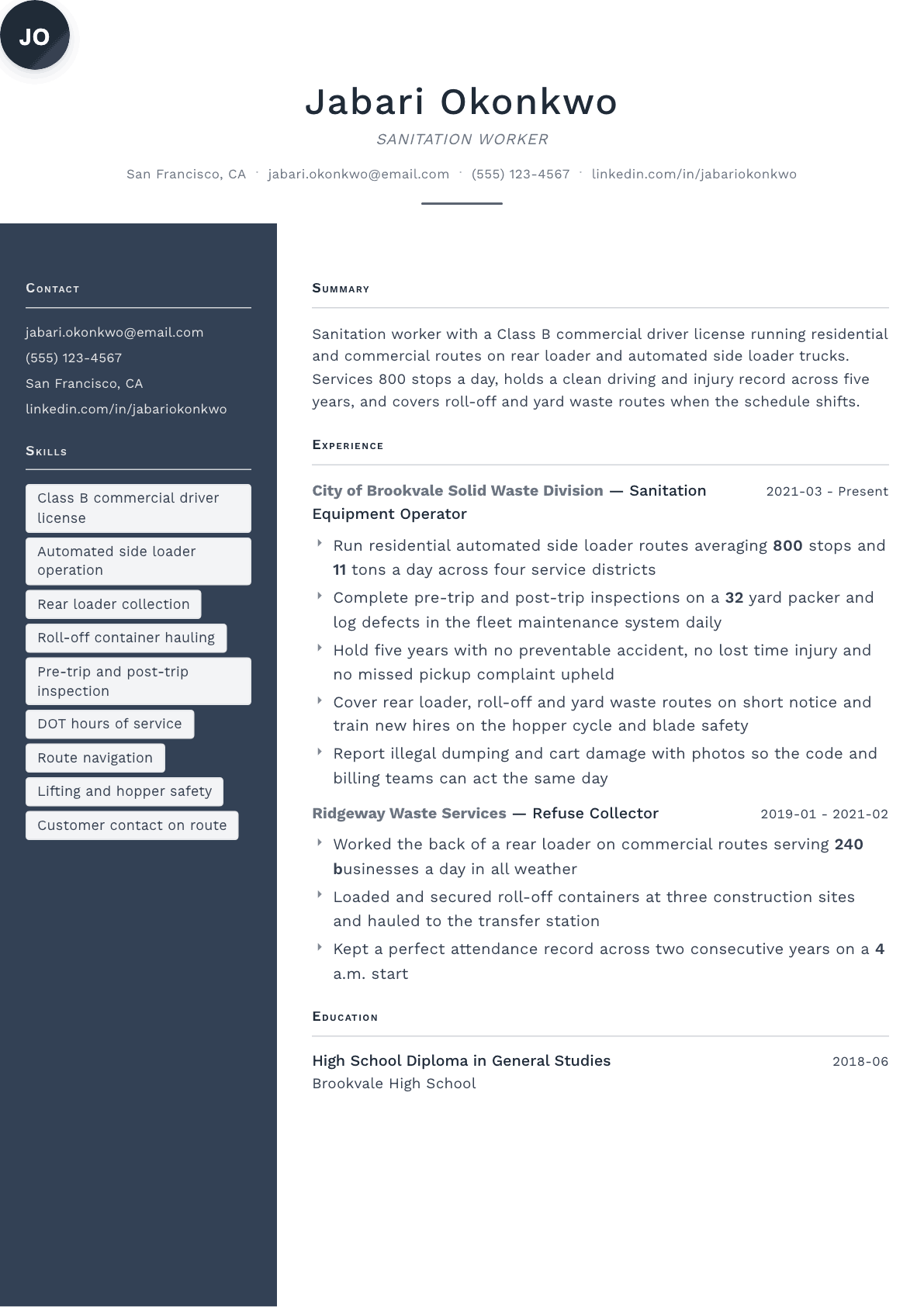
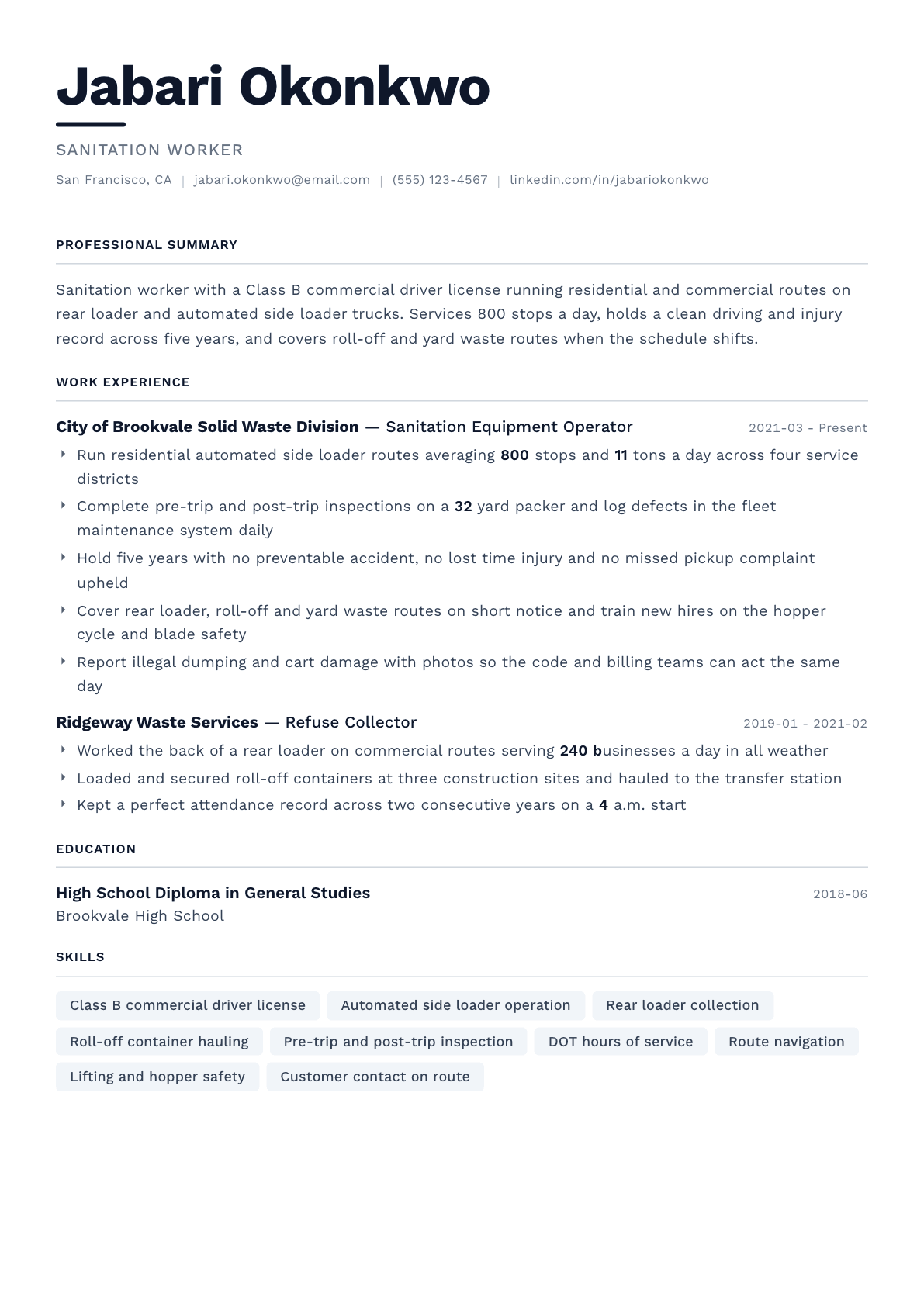
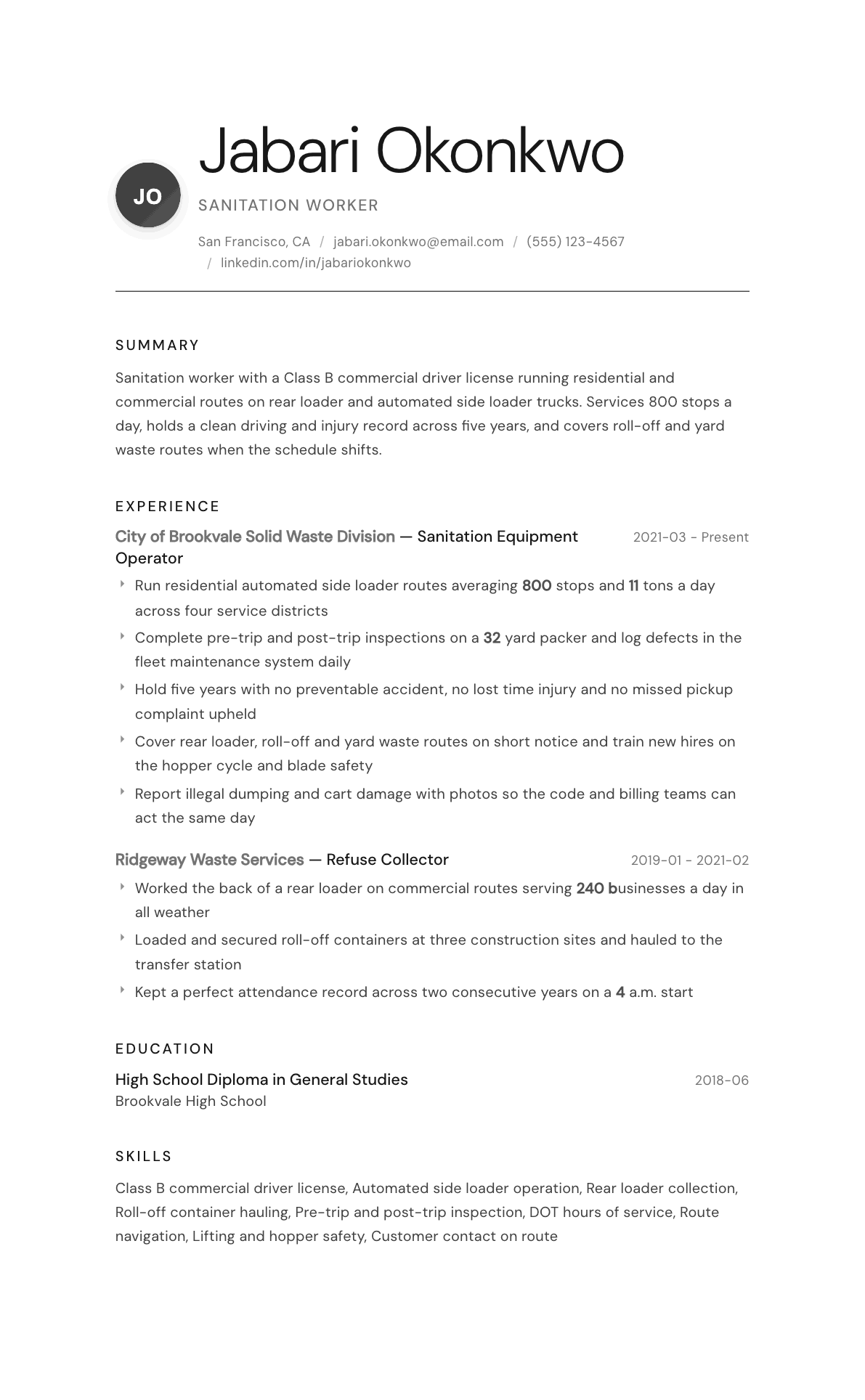
Example Sanitation Worker summary
Sanitation worker with five years on municipal and private hauling routes, holding a Class B commercial driver license and running automated side loader, rear loader and roll-off equipment. Services 800 residential stops a day, completes pre-trip and post-trip inspections without exception, and carries a clean record with no preventable accident, no lost time injury and no upheld missed pickup complaint.
Skills to list on a Sanitation Worker resume
- Commercial driver license Class B
- Automated side loader operation
- Rear loader refuse collection
- Front loader commercial routes
- Roll-off container hauling
- Yard waste and bulk collection
- Recycling stream separation
- Pre-trip and post-trip inspection
- DOT hours of service compliance
- Hydraulic packer operation
- Route sheet and GPS navigation
- Backing and spotter procedure
- Lifting and lowering technique
- Transfer station and landfill procedure
- Resident contact and complaint reporting
What actually gets this resume read
- Put your commercial driver license class and endorsements in the first two lines, since it is the screening filter.
- Give stops per day and tonnage, because a supervisor uses those two figures to judge whether you can hold a route.
- Name the truck types you have run, as automated side loader, rear loader and roll-off are learned separately.
- State your accident and injury record in years, since safety history decides most sanitation hires outright.
- Show your attendance record, because a route that goes uncovered turns into a call to the council office.
- Mention pre-trip inspection and defect reporting, which is the habit fleet supervisors look for on the page.
- Add any transfer station, landfill or recycling facility experience, since those routes pay and schedule differently.
How to write a sanitation worker resume
A solid waste supervisor filling a sanitation crew seat is protecting a route that has to run whether or not anyone called in sick. Every uncovered route becomes a resident complaint, and every accident becomes an incident file and an insurance claim. So the hiring decision comes down to three things: what you are licensed to drive, how much route you can carry, and whether you have hurt anyone or anything.
Most applications for this work are thin because candidates assume the job needs no resume. It does. Two applicants with the same license look identical until one of them states stops per day, truck types run, years without a preventable accident and a clean attendance record. That page gets called first, every time.
This guide covers how to lay out a sanitation worker resume, what a supervisor actually reads, three summaries at different experience levels, before and after bullet examples, and the questions collection crews ask when they move from a private hauler to a municipal division or the other way.
Format: one page, license and equipment in the top third
One page, plain layout, no columns. Municipal applications often run through a system that reformats what you upload, and a hiring packet for a crew position gets scanned quickly. Put your commercial driver license class, endorsements and medical card status in the first block so the screening question is answered before anyone reads further.
Follow the license with an equipment block. Automated side loader, rear loader, front loader, roll-off and grapple truck are learned separately, and a supervisor filling a specific route wants to see the truck named rather than the word truck. Add the packer size if you know it, because it tells an experienced reader what kind of route you ran.
- License block first: class, endorsements, air brake status, medical certificate and years held.
- Equipment block: each truck type operated, with packer or container size where you know it.
- Employer line for a sanitation worker: municipal division or private hauler, route type and service district count.
- Keep the whole page readable in one pass, since crew hiring rarely gets a second look.
Summary: license, route volume, equipment, safety record
Four short lines. What you are licensed to drive, how many stops and how much tonnage you carry in a day, which trucks you have run, and how long you have gone without a preventable accident or a lost time injury. That is the whole hiring decision in four lines, and it takes a supervisor ten seconds to read.
Do not pad it with adjectives. Hardworking and reliable appear on every application in the stack and carry no information. A clean record stated in years and a stop count stated as a number do the same job honestly.
Experience: routes, equipment, inspections, safety
Open each job with the route. Residential, commercial or roll-off, how many stops, how many tons, how many service districts, and what the start time was. A 4 a.m. start on an automated residential route is a different life from a commercial front loader route that begins at midnight, and a supervisor hiring for one wants to see the other described accurately.
Equipment bullets should carry the real detail: which trucks, hopper and blade operation, arm and grabber control on an automated unit, hydraulic controls, container handling on a roll-off, and any experience at the transfer station or landfill scale. Naming a control system is what proves you have used it.
Inspections and defect reporting deserve their own bullet. Pre-trip and post-trip inspections are federally required and routinely skipped, so a candidate who says they log defects in the fleet system daily is telling a fleet supervisor the exact thing that supervisor wants to hear.
Then safety, stated in years rather than adjectives. No preventable accident, no lost time injury, no backing incident, no upheld missed pickup complaint. If you have completed defensive driving, backing and spotter training, or a hauler safety program, name the training and who ran it.
The parts of the job nobody puts on paper
A collection route is a public facing job. Crews handle residents who put out unacceptable material, carts blocked by parked cars, damaged containers and questions about missed pickups, and the way that goes determines whether a call reaches the council office. Say how you handle it: photograph the issue, tag the cart, report it the same day so billing or code enforcement can act.
Physical reality belongs on the page too, stated matter of factly. Repeated lifting, working the back of a rear loader in weather, walking a route on foot when a truck goes down, and covering unfamiliar routes on short notice. A supervisor hires for stamina and flexibility as much as for skill, and both can be shown with facts rather than claims.
Keywords, credentials and moving between employers
Match the posting words: refuse collection, solid waste, automated side loader, rear loader, roll-off, yard waste, bulk pickup, recycling stream, transfer station, route sheet, pre-trip inspection, hours of service. Municipal recruitments screen on these terms and often list them as minimum qualifications.
Moving between a private hauler and a municipal division works in both directions, but the pitch changes. Municipal supervisors care about resident service, contract routes and civil service reliability, while private haulers care about productivity, container counts and route efficiency. Lead with the half your target employer cares about and keep the rest on the page.
- State the commercial driver license class and any endorsements exactly as the state issued them.
- Give tonnage as well as stops, since tonnage is how a division measures a route.
- Include experience at a transfer station, landfill or materials recovery facility if you have it.
- Note any training you have delivered to new hires, which reads as lead worker capability.
Sanitation Worker resume summary examples
New to collection
Class B commercial driver license holder with two years working the back of a rear loader on commercial routes serving 240 businesses a day in all weather. Loaded and secured roll-off containers and hauled to the transfer station. Perfect attendance across two years on an early start. Seeking a municipal collection seat.
Four years on a route
Sanitation equipment operator running automated side loader residential routes averaging 800 stops and 11 tons a day across four service districts. Completes pre-trip and post-trip inspections on a 32 yard packer, logs defects daily, and holds five years with no preventable accident and no lost time injury.
Lead operator
Lead sanitation operator covering residential, commercial, roll-off and yard waste routes on short notice and training new hires on hopper cycle, blade safety and backing procedure. Runs route sheets and GPS navigation, reports illegal dumping and cart damage with photographs, and holds a clean driving and injury record.
Work experience bullets: before and after
Before: Collected trash on assigned routes.
After: Ran automated side loader residential routes averaging 800 stops and 11 tons a day across four service districts on a 4 a.m. start.
Stops, tonnage, districts and start time let a supervisor judge whether you can hold their heaviest route.
Before: Operated garbage trucks safely.
After: Operated automated side loader, rear loader and roll-off equipment including arm and grabber controls, hopper and blade cycles, and container hookup at three construction sites.
Naming the truck types and the controls proves the equipment experience a supervisor is screening for.
Before: Followed all safety procedures.
After: Held five years with no preventable accident, no lost time injury and no backing incident, and completed defensive driving and spotter training through the division safety program.
A record stated in years plus named training is verifiable where following procedures is not.
Before: Checked the truck before starting.
After: Completed pre-trip and post-trip inspections on a 32 yard packer every shift and logged hydraulic, brake and light defects in the fleet maintenance system the same day.
The equipment, the frequency and the reporting system show a habit a fleet supervisor can rely on.
Before: Helped train new employees.
After: Trained six new hires on hopper cycle timing, blade safety, backing with a spotter and route sheet navigation, and rode along through their first solo week.
A trainee count and the specific topics covered turn a vague mention into demonstrated lead worker capability.
Hard skills
- Commercial driver license Class B operation
- Automated side loader operation
- Rear loader refuse collection
- Front loader commercial routes
- Roll-off container hauling
- Yard waste and bulk item collection
- Recycling stream separation
- Pre-trip and post-trip inspection
- Hours of service compliance
- Hydraulic packer and blade operation
- Backing and spotter procedure
- Route sheet and GPS navigation
- Transfer station and landfill procedure
- Cart repair and container tagging
Soft skills
- Stamina across a full route in heat, rain and ice
- Steady temper with residents who are angry about a missed cart
- Reliability on an early start every scheduled day
- Awareness of traffic and pedestrians while working a moving route
- Willingness to pick up an unfamiliar route without a briefing
Certifications worth listing
- Commercial Driver License Class B (State Department of Motor Vehicles)
- Medical Examiner Certificate (Federal Motor Carrier Safety Administration)
- Manager of Landfill Operations (Solid Waste Association of North America)
Mistakes that cost sanitation worker candidates the interview
- Leaving the commercial driver license class off the top of the page, where it is the first screening question.
- Writing collected refuse on assigned routes with no stop count, tonnage or district detail behind it.
- Naming trucks generically instead of specifying automated side loader, rear loader, front loader or roll-off.
- Claiming a strong safety record without stating the number of years behind it.
- Skipping attendance history when route coverage is the problem a supervisor is hiring to solve.
- Filling the page with adjectives like dependable and hardworking that every other applicant also wrote.
Sanitation Worker resume questions
Do I need a commercial driver license to be hired as a sanitation worker?
For a helper or collector seat many employers do not require one, while any operator seat does. If you are working toward the license, say which class you are pursuing and your test date, because supervisors often hire helpers who are close to licensing.
How do I show route productivity fairly?
Give stops and tonnage per day together with the route type, since a commercial route with fewer stops can move more tonnage than a residential one. Adding the number of service districts you covered shows flexibility alongside raw volume.
Does a private hauling background help with a municipal application?
Yes. Route work transfers directly and municipal divisions value operators who arrive already productive. Emphasize resident contact, service quality and reliability rather than only speed, because a public division is judged on complaints as much as on volume.
Should I mention accidents or violations on my record?
Do not list them on the resume, but be ready to explain them honestly, since a motor vehicle record check happens before any offer. What you can state on the page is the period since your last preventable incident, which frames the record on your terms.
What moves a sanitation worker into a higher paying seat?
Endorsements, heavier equipment and lead responsibilities. Adding roll-off and grapple experience, taking on training duties, and moving toward heavy equipment at a transfer station or landfill are the usual steps, so put each new capability on the page as soon as you earn it.
Related resume examples
- Truck Driver Resume example
- Delivery Driver Resume example
- Postal Worker Resume example
- Public Works Director Resume example
- Mail Carrier Resume example
- Food Safety Inspector Resume example