GC Jobs Screening Questions: 8 Worked Answer Examples
By Mustafa Tarabya, founder of CVBooster · Published · Updated
15 min read
The gc jobs screening questions examples below are written the way a board reads them: one qualification at a time, met or not met. The constraint is that your résumé does not rescue a thin answer, since each essential qualification is scored from its own box. The rules quoted here were read in September 2026 on canada.ca, from the Public Service Commission of Canada, alongside the Public Service Employment Act. Eight complete answers follow, covering education, four experience criteria, official languages and two assets, each annotated against the rule it satisfies. Written by Mustafa Tarabya, who hired for his own company, read every application himself and now writes CVBooster's guides.
What a screening board is actually doing
Federal appointments run on merit as set out in law. Section 30(1) of the Public Service Employment Act says appointments "shall be made on the basis of merit and must be free from political influence". Section 30(2)(a) then ties merit to the essential qualifications for the work, as established by the deputy head, including official language proficiency.
Two consequences follow, and they are the whole of the screening stage.
- Every essential qualification has to be met. There is no averaging, so four strong answers and one empty box is a rejection.
- The board is satisfied by evidence, not by assertion. The Public Service Commission puts it plainly: "Don’t just state that you have the experience or education; provide details or examples".
Asset qualifications sit in section 30(2)(b) as additional qualifications the deputy head may consider an asset. They do not qualify you, and they very often select you.
Education, answered in full
Ngozi Eze is applying to a PM-02 program officer posting from outside the public service.
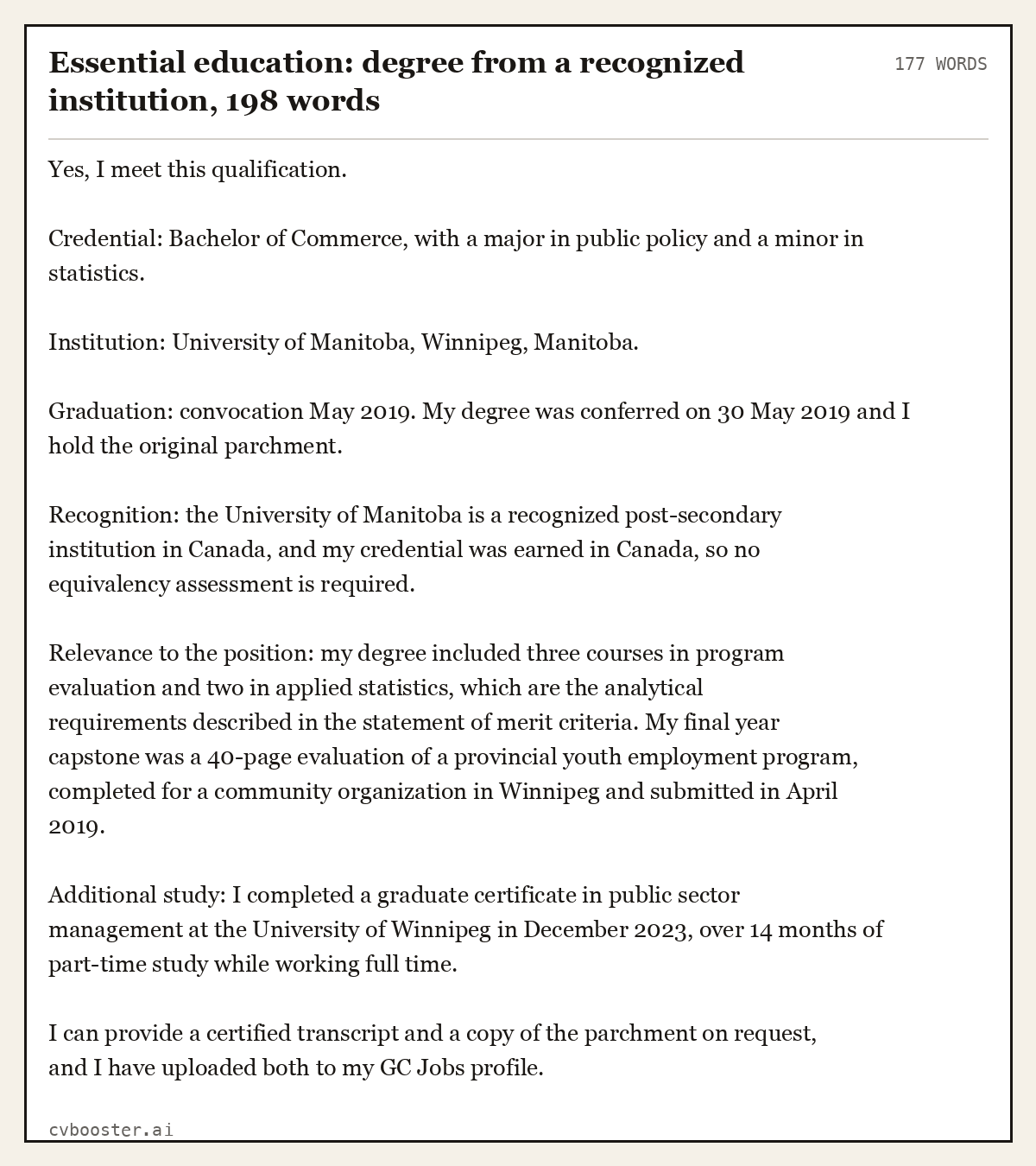
Essential education: degree from a recognized institution, 198 words (177 words)
Yes, I meet this qualification.
Credential: Bachelor of Commerce, with a major in public policy and a minor in statistics.
Institution: University of Manitoba, Winnipeg, Manitoba.
Graduation: convocation May 2019. My degree was conferred on 30 May 2019 and I hold the original parchment.
Recognition: the University of Manitoba is a recognized post-secondary institution in Canada, and my credential was earned in Canada, so no equivalency assessment is required.
Relevance to the position: my degree included three courses in program evaluation and two in applied statistics, which are the analytical requirements described in the statement of merit criteria. My final year capstone was a 40-page evaluation of a provincial youth employment program, completed for a community organization in Winnipeg and submitted in April 2019.
Additional study: I completed a graduate certificate in public sector management at the University of Winnipeg in December 2023, over 14 months of part-time study while working full time.
I can provide a certified transcript and a copy of the parchment on request, and I have uploaded both to my GC Jobs profile.
What the sifter is scoring
- Rule quoted: "Don’t just state that you have the experience or education; provide details or examples" (Public Service Commission of Canada, GC Jobs tips). The credential, the institution, the date and the parchment are the details, not a claim to hold a degree.
- Rule quoted: "Avoid acronyms to ensure the person reading your application understands". She writes Bachelor of Commerce, not B.Comm.
- Why the recognition line matters: if you studied outside Canada, this is where you name the credential assessment service, the date of its report and the Canadian equivalency it states. Start that assessment weeks before you find the posting, because it takes time and postings close fast.
The four facts every experience answer needs
Every essential experience answer is the same shape, whatever the criterion says.
| Fact | What the board is looking for | What sinks it |
|---|---|---|
| Where | Organization and branch, spelled out | An acronym the board does not know |
| When | Month and year to month and year, plus the total you calculated | Only a year, or no dates at all |
| What you did | Tasks, volumes, your own role, written as I | A copied job description |
| What resulted | The decision, product or measurable change | Nothing, or a claim with no number |
Two further rules from the same page cost people jobs when ignored: "Use the exact keywords and skills from the screening question in your answer. Do not use synonyms." and "Use “I,” not “we” to talk about your work".
Tip: Draft in a word processor and keep every answer in a master file tagged by criterion. The second federal application takes half the time of the first because you are editing, not writing.
Four essential experience answers
Experience providing client service to internal or external clients
Marc Tremblay is a recreation coordinator applying to an administrative officer posting.
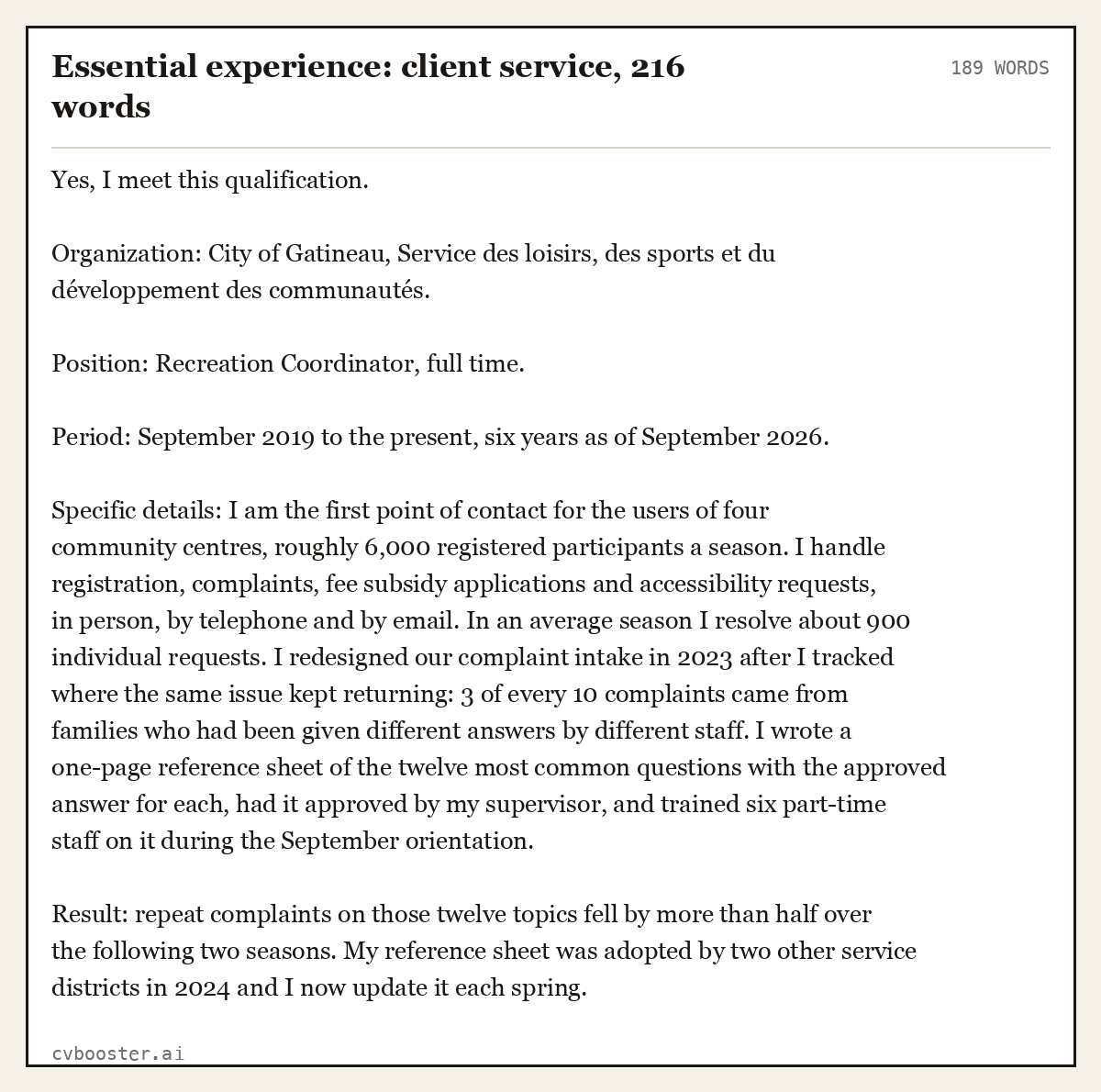
Essential experience: client service, 216 words (189 words)
Yes, I meet this qualification.
Organization: City of Gatineau, Service des loisirs, des sports et du développement des communautés.
Position: Recreation Coordinator, full time.
Period: September 2019 to the present, six years as of September 2026.
Specific details: I am the first point of contact for the users of four community centres, roughly 6,000 registered participants a season. I handle registration, complaints, fee subsidy applications and accessibility requests, in person, by telephone and by email. In an average season I resolve about 900 individual requests. I redesigned our complaint intake in 2023 after I tracked where the same issue kept returning: 3 of every 10 complaints came from families who had been given different answers by different staff. I wrote a one-page reference sheet of the twelve most common questions with the approved answer for each, had it approved by my supervisor, and trained six part-time staff on it during the September orientation.
Result: repeat complaints on those twelve topics fell by more than half over the following two seasons. My reference sheet was adopted by two other service districts in 2024 and I now update it each spring.
What the sifter is scoring
- Rule quoted: "When answering “yes” to a screening question, write a full answer in the box below it to prove you have the experience in question". The word yes on its own is a not met.
- Keyword discipline: the criterion says client service, so the answer says client service. It does not say customer care or stakeholder relations.
- Duration stated: six years, calculated for the board. Never leave the board to do arithmetic on your dates.
Experience analyzing data and preparing written reports for management
Harpreet Sandhu works for a regional health authority in British Columbia.
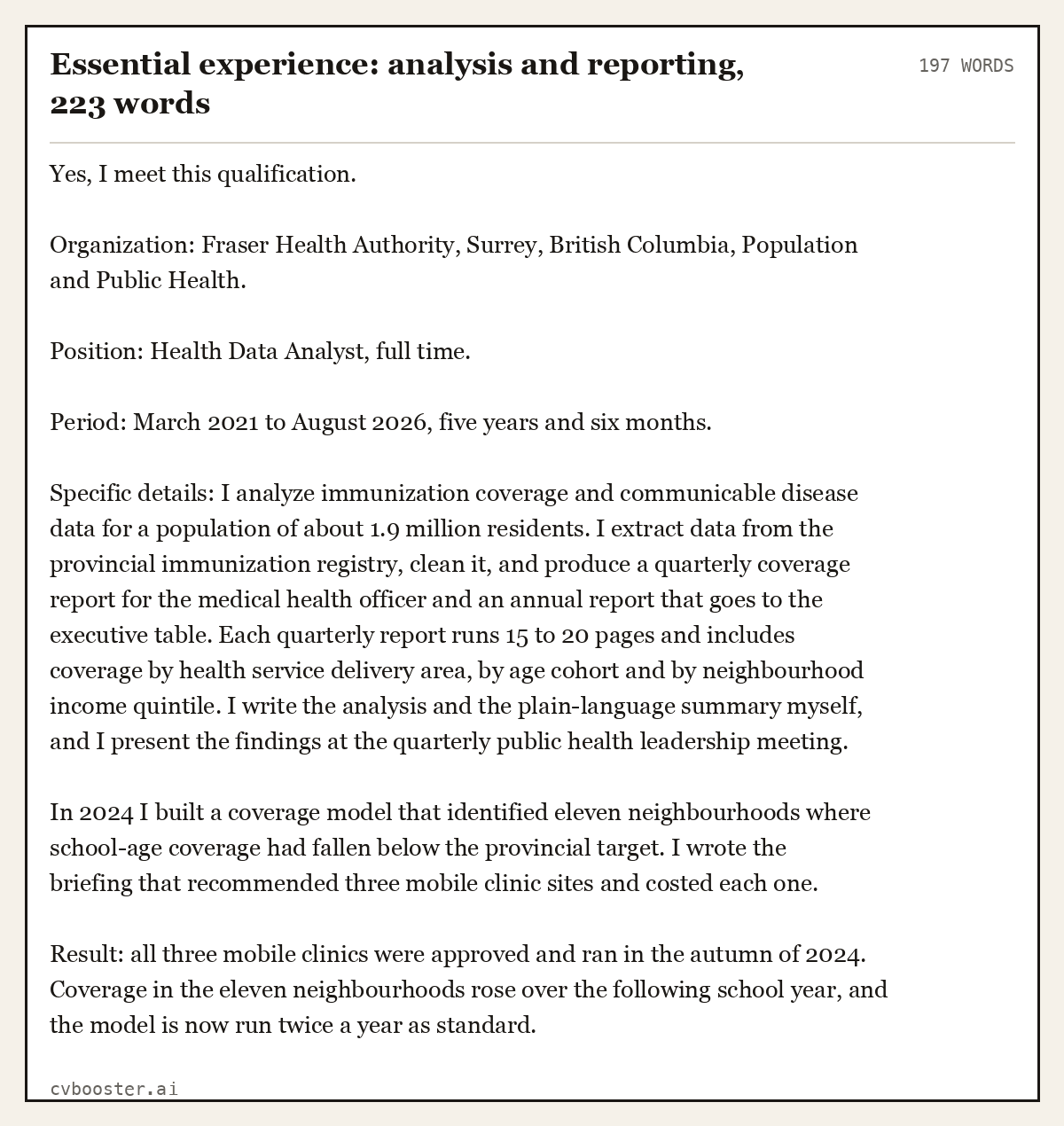
Essential experience: analysis and reporting, 223 words (197 words)
Yes, I meet this qualification.
Organization: Fraser Health Authority, Surrey, British Columbia, Population and Public Health.
Position: Health Data Analyst, full time.
Period: March 2021 to August 2026, five years and six months.
Specific details: I analyze immunization coverage and communicable disease data for a population of about 1.9 million residents. I extract data from the provincial immunization registry, clean it, and produce a quarterly coverage report for the medical health officer and an annual report that goes to the executive table. Each quarterly report runs 15 to 20 pages and includes coverage by health service delivery area, by age cohort and by neighbourhood income quintile. I write the analysis and the plain-language summary myself, and I present the findings at the quarterly public health leadership meeting.
In 2024 I built a coverage model that identified eleven neighbourhoods where school-age coverage had fallen below the provincial target. I wrote the briefing that recommended three mobile clinic sites and costed each one.
Result: all three mobile clinics were approved and ran in the autumn of 2024. Coverage in the eleven neighbourhoods rose over the following school year, and the model is now run twice a year as standard.
What the sifter is scoring
- Both halves answered: the criterion joins analyzing and preparing reports. The answer evidences each separately, which is what "If the question uses “and” you must demonstrate that you have all the skills or experiences required" requires.
- Seniority of audience named: medical health officer and executive table. A board scoring a reporting criterion is looking for who read the report.
- No acronyms: health service delivery area is written out, not abbreviated.
Experience managing projects and coordinating the work of others
Emily Doucette is applying from the non-profit sector in Nova Scotia.
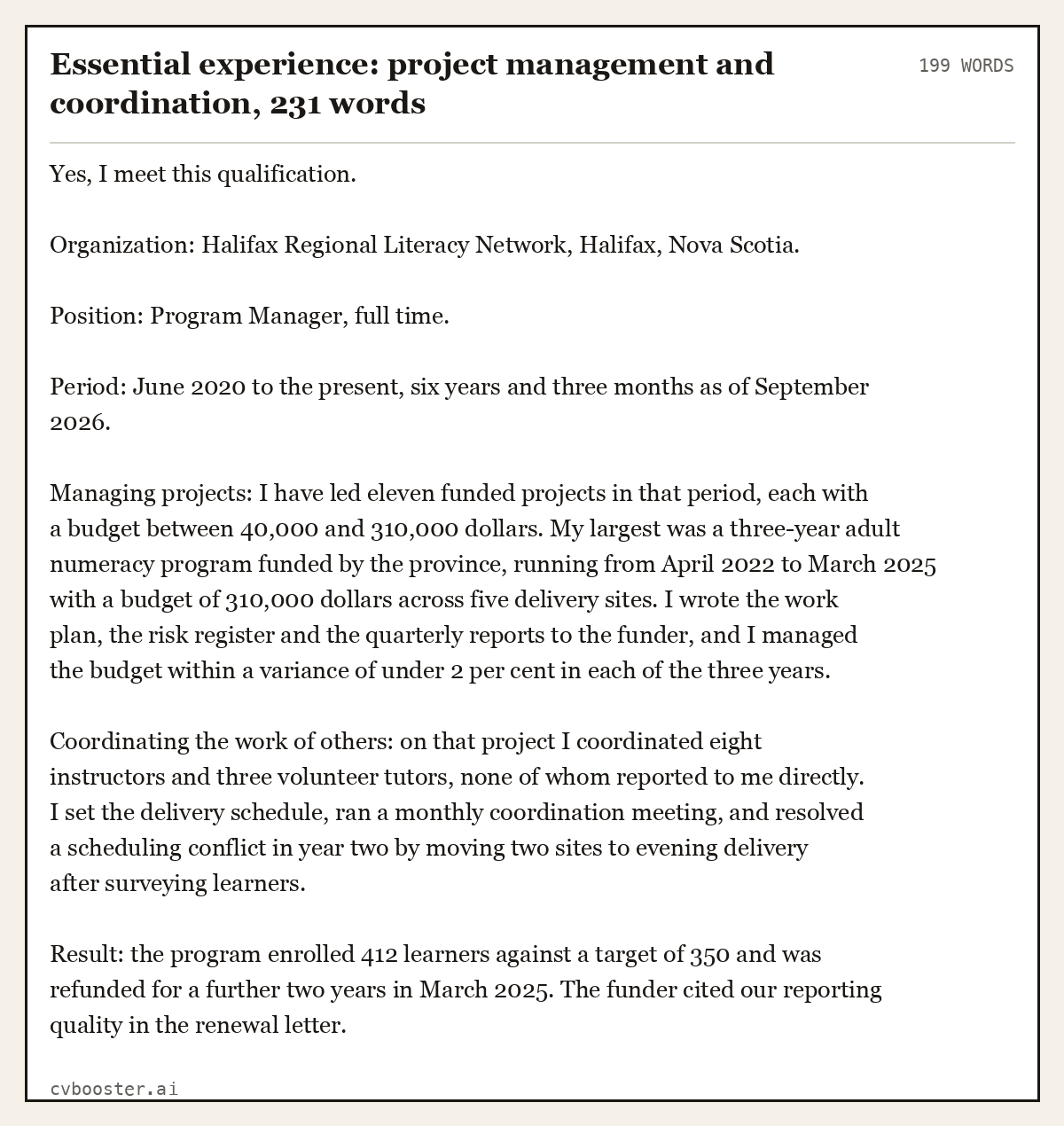
Essential experience: project management and coordination, 231 words (199 words)
Yes, I meet this qualification.
Organization: Halifax Regional Literacy Network, Halifax, Nova Scotia.
Position: Program Manager, full time.
Period: June 2020 to the present, six years and three months as of September 2026.
Managing projects: I have led eleven funded projects in that period, each with a budget between 40,000 and 310,000 dollars. My largest was a three-year adult numeracy program funded by the province, running from April 2022 to March 2025 with a budget of 310,000 dollars across five delivery sites. I wrote the work plan, the risk register and the quarterly reports to the funder, and I managed the budget within a variance of under 2 per cent in each of the three years.
Coordinating the work of others: on that project I coordinated eight instructors and three volunteer tutors, none of whom reported to me directly. I set the delivery schedule, ran a monthly coordination meeting, and resolved a scheduling conflict in year two by moving two sites to evening delivery after surveying learners.
Result: the program enrolled 412 learners against a target of 350 and was refunded for a further two years in March 2025. The funder cited our reporting quality in the renewal letter.
What the sifter is scoring
- The and trap handled on the page: two labelled paragraphs, one for managing projects and one for coordinating others, each with its own evidence. A single blended paragraph invites the board to find one half missing.
- Rule quoted: "Use “I,” not “we” to talk about your work". Every verb in the answer has her name behind it.
- Numbers a real person would know: budget, variance, enrolment against target. Invented figures come apart at reference check.
Experience supervising staff
Daniel Okafor is applying to an operations posting from the private sector.
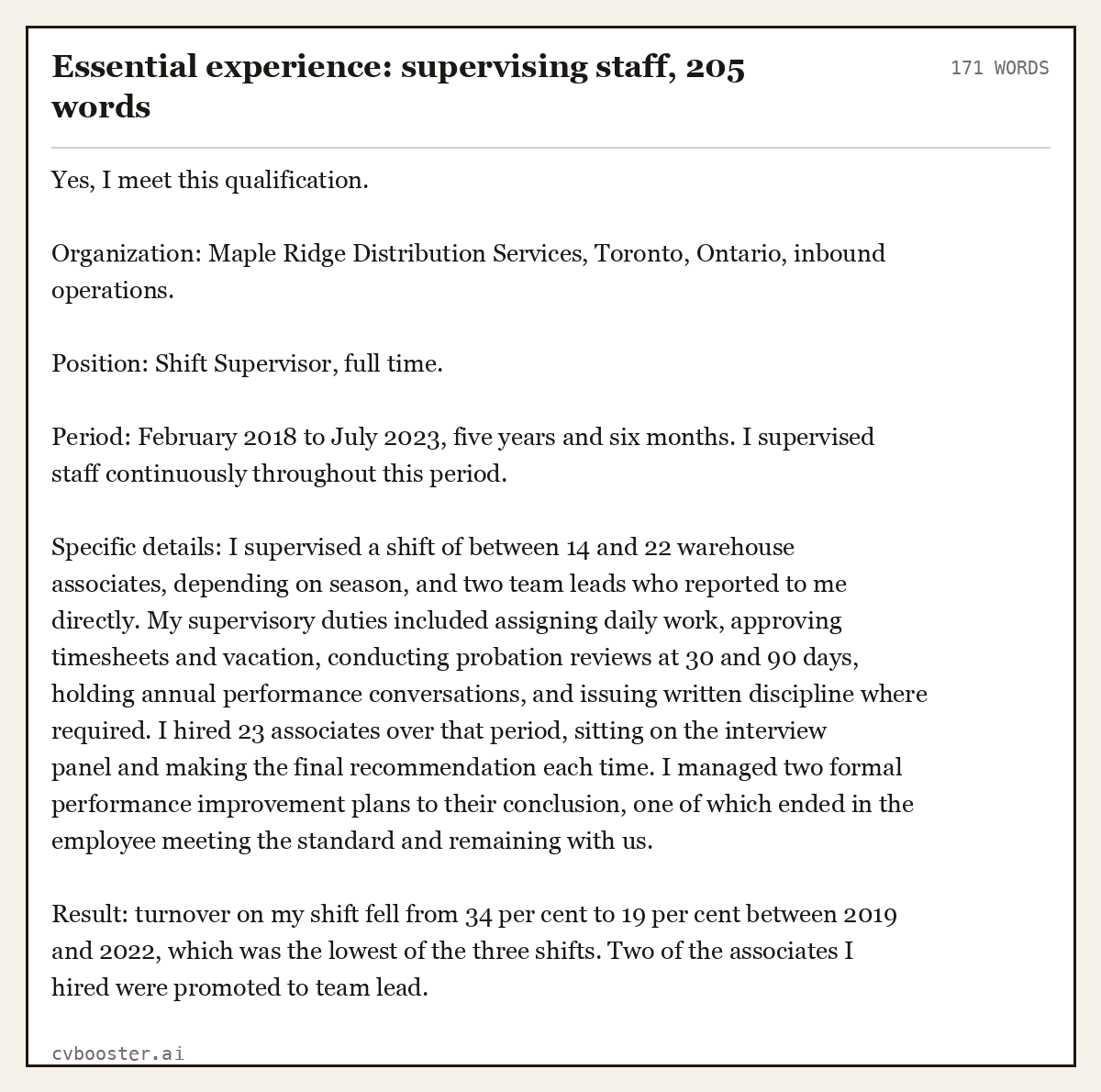
Essential experience: supervising staff, 205 words (171 words)
Yes, I meet this qualification.
Organization: Maple Ridge Distribution Services, Toronto, Ontario, inbound operations.
Position: Shift Supervisor, full time.
Period: February 2018 to July 2023, five years and six months. I supervised staff continuously throughout this period.
Specific details: I supervised a shift of between 14 and 22 warehouse associates, depending on season, and two team leads who reported to me directly. My supervisory duties included assigning daily work, approving timesheets and vacation, conducting probation reviews at 30 and 90 days, holding annual performance conversations, and issuing written discipline where required. I hired 23 associates over that period, sitting on the interview panel and making the final recommendation each time. I managed two formal performance improvement plans to their conclusion, one of which ended in the employee meeting the standard and remaining with us.
Result: turnover on my shift fell from 34 per cent to 19 per cent between 2019 and 2022, which was the lowest of the three shifts. Two of the associates I hired were promoted to team lead.
What the sifter is scoring
- The word the criterion used: supervising. The answer uses supervised and supervisory rather than led or oversaw.
- Continuity stated: boards check whether the supervisory element ran through the whole period or for three months of it. He answers that before he is asked.
- Evidence of the unpleasant part: discipline and a performance plan. Supervision answers that contain only motivation read as team lead experience, not supervision.
The and versus or trap
One conjunction changes what you have to prove, and the GC Jobs tips page states both sides of it.
- "If the question uses “and” you must demonstrate that you have all the skills or experiences required". Answer each element in its own labelled paragraph.
- "If the question uses “or” you need to demonstrate that you have at least one of the skills". Covering both does no harm, but one is enough.
- A criterion listing three activities joined by and is three sub-questions inside one box. Answer them in the poster's order, using the poster's words.
The same care applies to the asterisked footnotes under the experience list. A footnote defining significant experience as approximately three years is the threshold, not a suggestion, so put the total in your first line.
Official languages, answered in full
Ryan Coughlin is applying to a bilingual imperative BBB position.
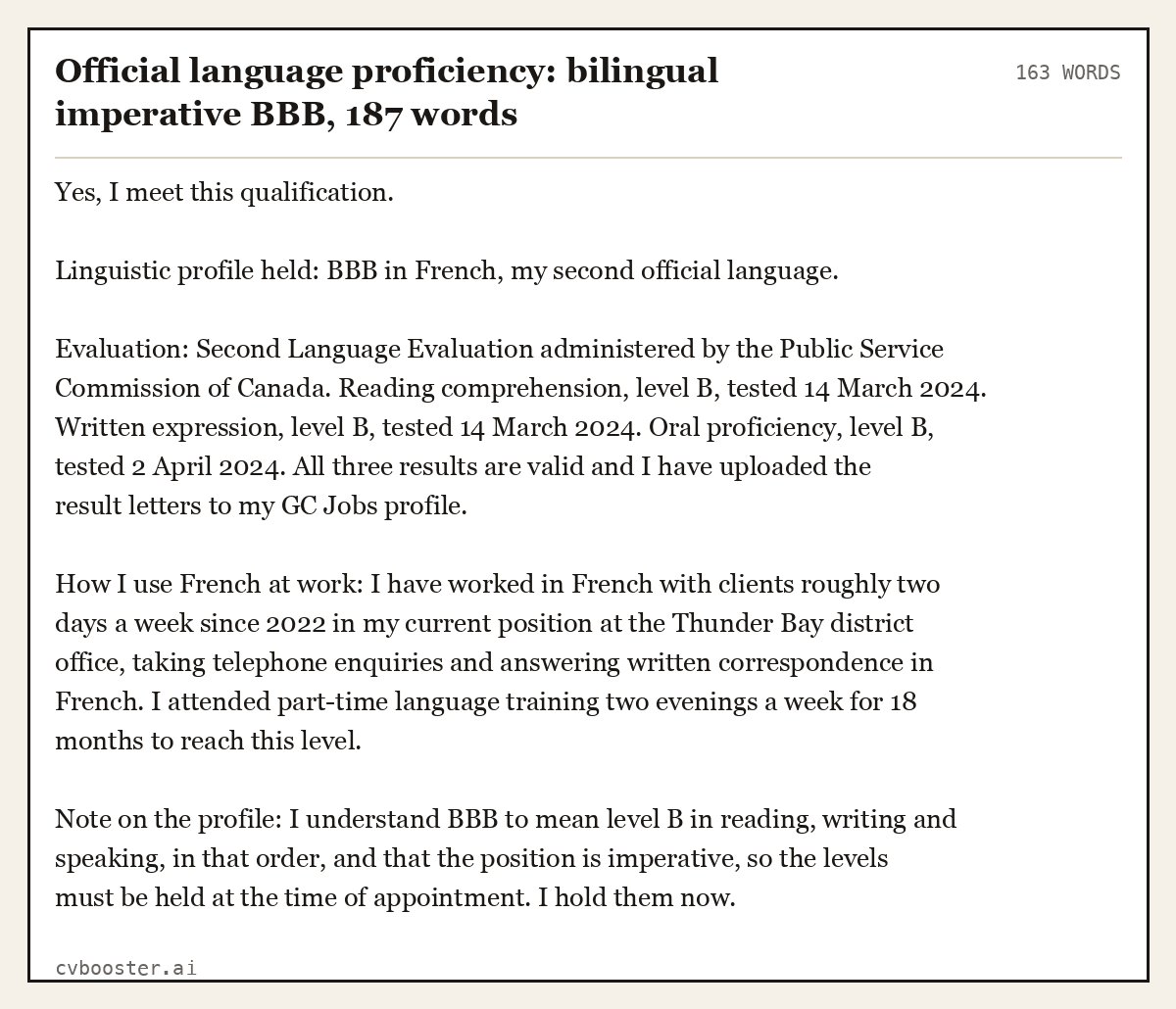
Official language proficiency: bilingual imperative BBB, 187 words (163 words)
Yes, I meet this qualification.
Linguistic profile held: BBB in French, my second official language.
Evaluation: Second Language Evaluation administered by the Public Service Commission of Canada. Reading comprehension, level B, tested 14 March 2024. Written expression, level B, tested 14 March 2024. Oral proficiency, level B, tested 2 April 2024. All three results are valid and I have uploaded the result letters to my GC Jobs profile.
How I use French at work: I have worked in French with clients roughly two days a week since 2022 in my current position at the Thunder Bay district office, taking telephone enquiries and answering written correspondence in French. I attended part-time language training two evenings a week for 18 months to reach this level.
Note on the profile: I understand BBB to mean level B in reading, writing and speaking, in that order, and that the position is imperative, so the levels must be held at the time of appointment. I hold them now.
What the sifter is scoring
- The order of the three letters: written comprehension, written expression and oral proficiency. Candidates who guess the order often claim the wrong thing.
- Imperative versus non-imperative: imperative means you hold or obtain the levels at appointment and is the norm. Non-imperative means the successful candidate becomes bilingual through training, and it is the exception.
- What the symbols mean: a dash in a profile means that skill is not required. An X means the result did not reach level A in that ability. An E means exemption from further testing in that ability.
The two asset answers that decide the pool
Assets do not qualify you. When a manager has forty qualified candidates and one job, assets are the filter, so answer them at eleven at night with the same care as the essentials.
Aisha Rahman is answering an asset experience criterion on a financial officer posting.
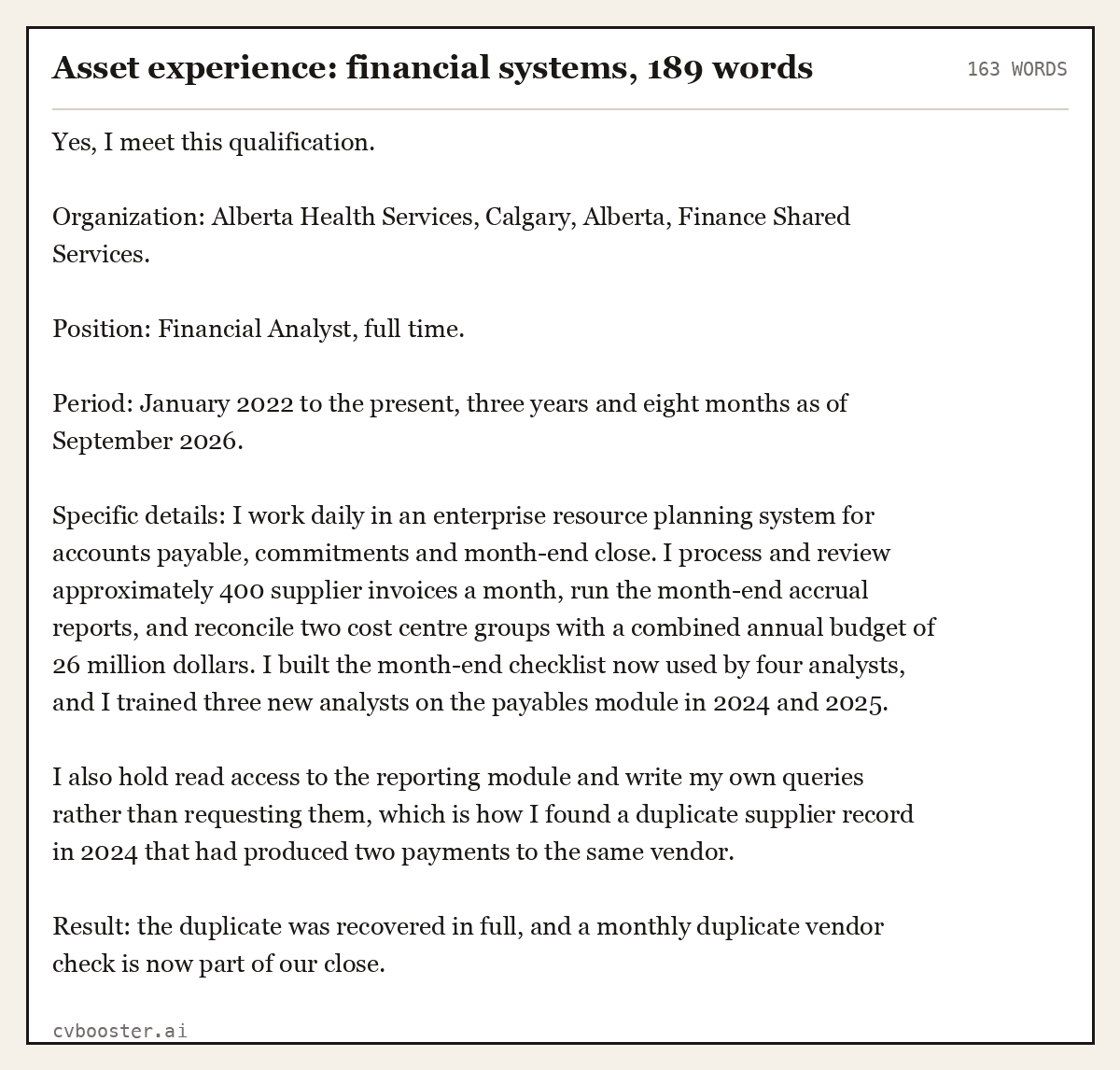
Asset experience: financial systems, 189 words (163 words)
Yes, I meet this qualification.
Organization: Alberta Health Services, Calgary, Alberta, Finance Shared Services.
Position: Financial Analyst, full time.
Period: January 2022 to the present, three years and eight months as of September 2026.
Specific details: I work daily in an enterprise resource planning system for accounts payable, commitments and month-end close. I process and review approximately 400 supplier invoices a month, run the month-end accrual reports, and reconcile two cost centre groups with a combined annual budget of 26 million dollars. I built the month-end checklist now used by four analysts, and I trained three new analysts on the payables module in 2024 and 2025.
I also hold read access to the reporting module and write my own queries rather than requesting them, which is how I found a duplicate supplier record in 2024 that had produced two payments to the same vendor.
Result: the duplicate was recovered in full, and a monthly duplicate vendor check is now part of our close.
What the sifter is scoring
- Assets get the four facts too: where, when, what and what resulted. Most candidates write one sentence here and lose the tie-break.
- Named systems, no code names: the answer describes the function rather than an internal project nickname the board will not recognize.
- Recency is visible: to the present, with a total. Asset experience from a decade ago is worth naming, but say so.
Jean-Paul Girard is answering an asset education criterion.
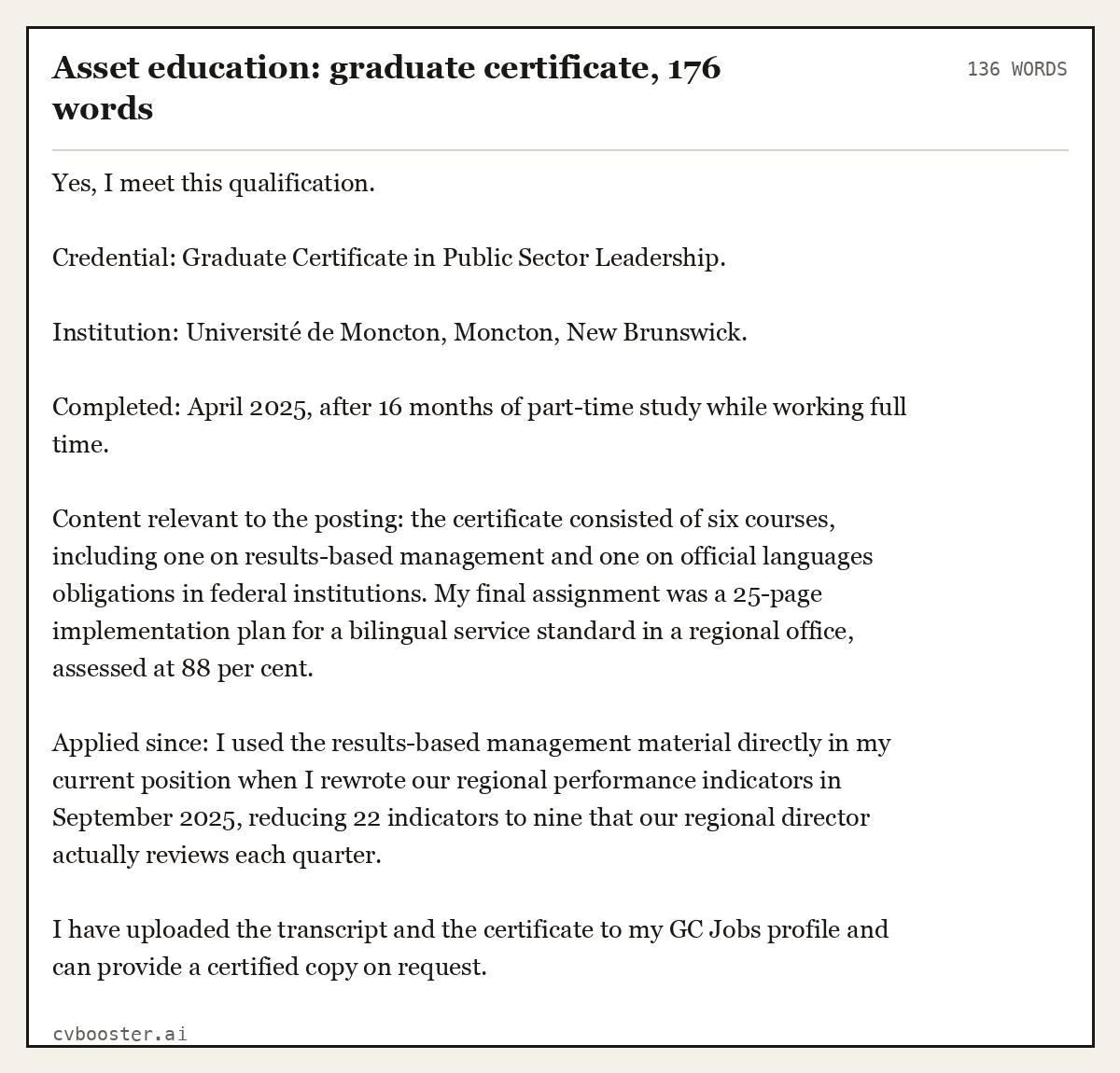
Asset education: graduate certificate, 176 words (136 words)
Yes, I meet this qualification.
Credential: Graduate Certificate in Public Sector Leadership.
Institution: Université de Moncton, Moncton, New Brunswick.
Completed: April 2025, after 16 months of part-time study while working full time.
Content relevant to the posting: the certificate consisted of six courses, including one on results-based management and one on official languages obligations in federal institutions. My final assignment was a 25-page implementation plan for a bilingual service standard in a regional office, assessed at 88 per cent.
Applied since: I used the results-based management material directly in my current position when I rewrote our regional performance indicators in September 2025, reducing 22 indicators to nine that our regional director actually reviews each quarter.
I have uploaded the transcript and the certificate to my GC Jobs profile and can provide a certified copy on request.
What the sifter is scoring
- Asset education still needs the date and the institution. A credential with no completion date is treated as in progress.
- The applied since paragraph is optional and it wins the tie-break. It shows the credential produced something at work.
- Honest framing: if a certificate is in progress, say so and give the expected completion date rather than implying it is finished.
Before you submit
- Every essential qualification has an organization, a position title, month and year dates, a calculated total, a specific example and a result.
- Every answer repeats the criterion's own words rather than a synonym.
- Every and in a criterion is answered on both sides, and every asterisked definition is met explicitly on the page.
- No answer says see my résumé, and no sentence about your own work says we.
- No acronyms and no internal project nicknames.
- Your résumé is plain unformatted text, because "Create a very simple, unformatted résumé for GC Jobs (no bullets, underlines or bold) as the system will remove most formatting when you paste."
- You submitted before the closing date and time on the poster, and resubmitted if you retrieved the application to edit it.
If the answer is no anyway, email the contact person named at the bottom of the poster and ask which criterion failed. The reply is usually specific enough to fix. Then apply wider, and keep every answer in the master file. A federal résumé to sit behind these answers is on federal resume example, the letter that accompanies a non-federal application is on cover letter sample canada, and the structure these answers borrow is on star method answers examples.
Frequently asked questions
What are examples of screening questions?
On GC Jobs a screening question repeats an essential qualification and asks you to prove it: experience providing client service, experience analyzing data and preparing reports, experience supervising staff, a degree from a recognized post-secondary institution, and official language proficiency at a stated profile. Asset questions follow the same form. Eight full answers to questions of exactly these types are above.
What are some good screening questions for job applicants?
A good screening question names one qualification, states a measurable threshold, and can be answered met or not met from written evidence. Federal postings do this by defining terms in footnotes, for example defining significant experience as approximately three years. Vague questions such as are you a team player cannot be scored consistently and are not used at the federal screening stage.
What are the questions asked in a screening interview?
A GC Jobs screening stage is normally a paper exercise, not an interview. The written answers you give against the essential qualifications decide whether you proceed. Where a short screening call does happen, it usually confirms dates, availability, language profile and conditions of employment such as reliability status or security clearance, rather than testing competencies. Competencies are assessed later by written test or board.
What is the 30-60-90 rule in an interview?
The 30-60-90 day plan is a private sector interview practice where a candidate sets out what they would do in their first, third and fourth months. It is not part of the Government of Canada screening process and no federal poster asks for one. The figure is widely repeated online without a source. Spend the time on your screening answers instead, because that is where federal candidates are actually eliminated.
Related articles
- Skills to Put on a Job Application Form
- Cover Letter Sample Canada: 5 Full Letters, Annotated
- Entry Level Project Manager: 5 Routes In With No Degree
- Entry Level Roles With No Experience: 6 Routes That Work
More articles
- Google Docs Resume Templates: the free ones, and the catch
- Hard Skills for a Resume: How to List Them
- High Paying Low Stress Jobs in the UK: 10 With CV Lines