Food Safety Inspector Resume Examples: read this first
Build a Food Safety Inspector Resume That Demonstrates Rigor
By Mustafa Tarabya, founder of CVBooster · Published · Updated
Create a thorough Food Safety Inspector resume highlighting regulatory compliance expertise, inspection experience, HACCP knowledge, and public health protection.
Sample resumes for a food safety inspector
The same food safety inspector content laid out in three CVBooster templates, so you can see what the finished document looks like before you write a word.
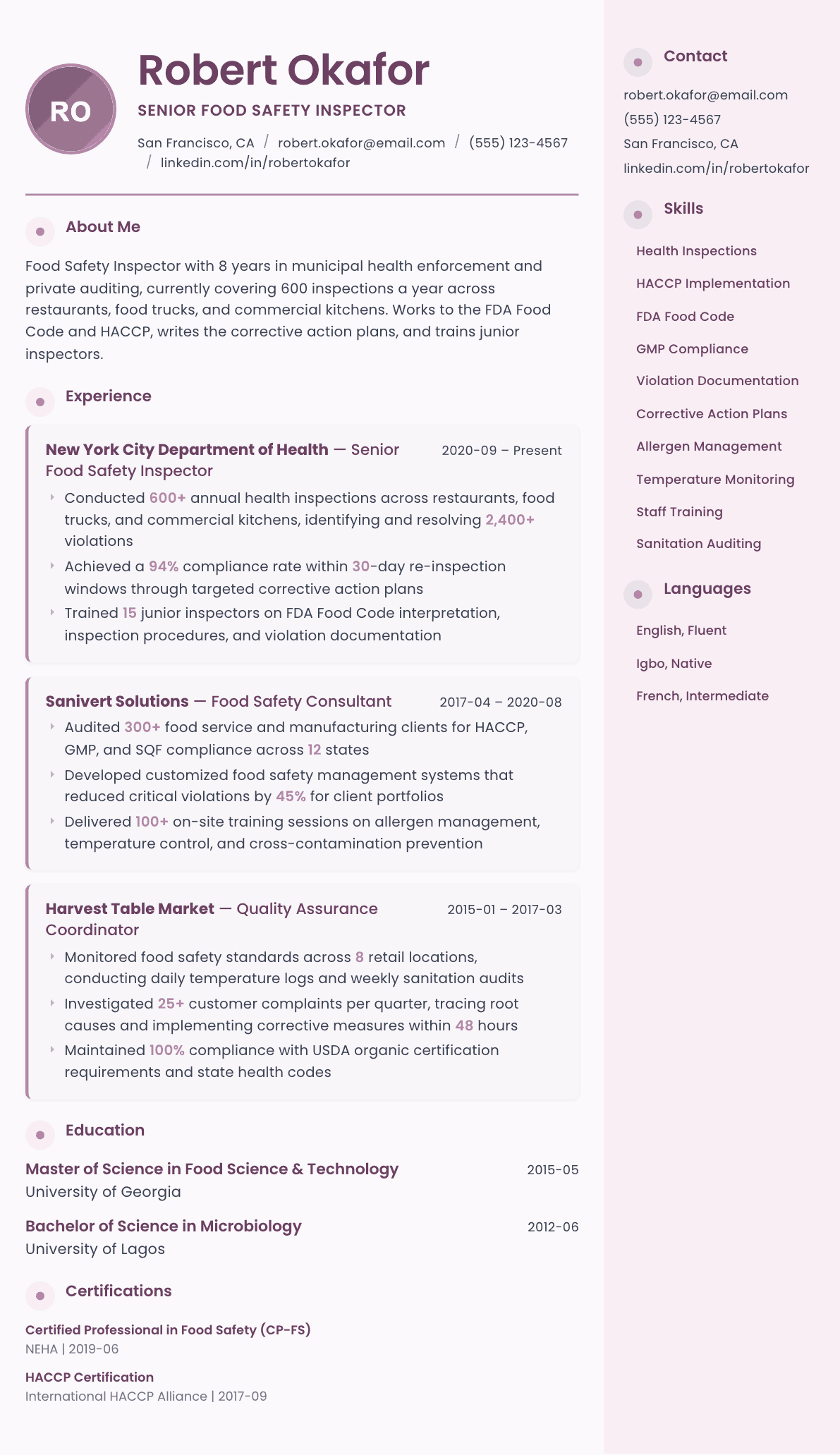
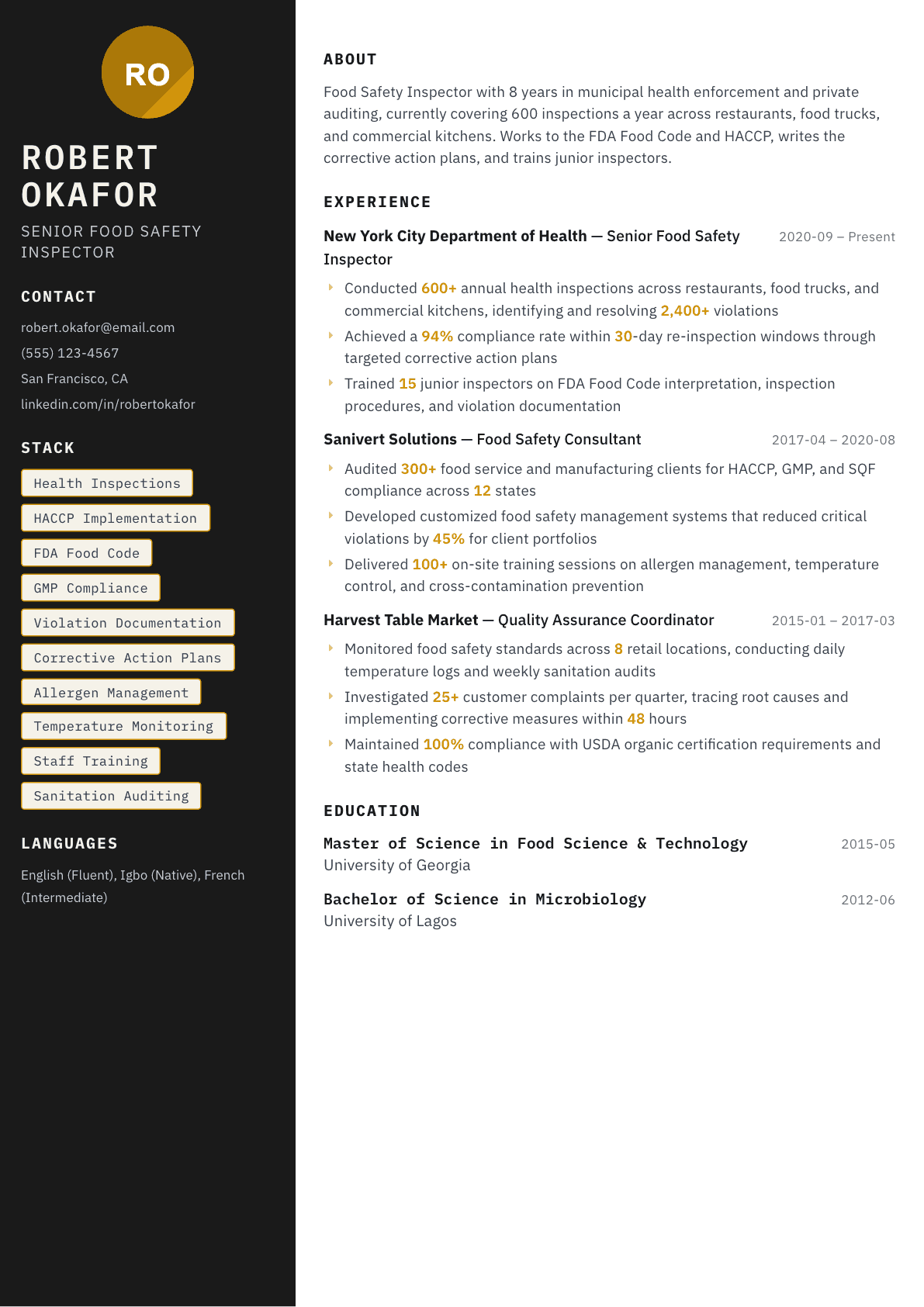
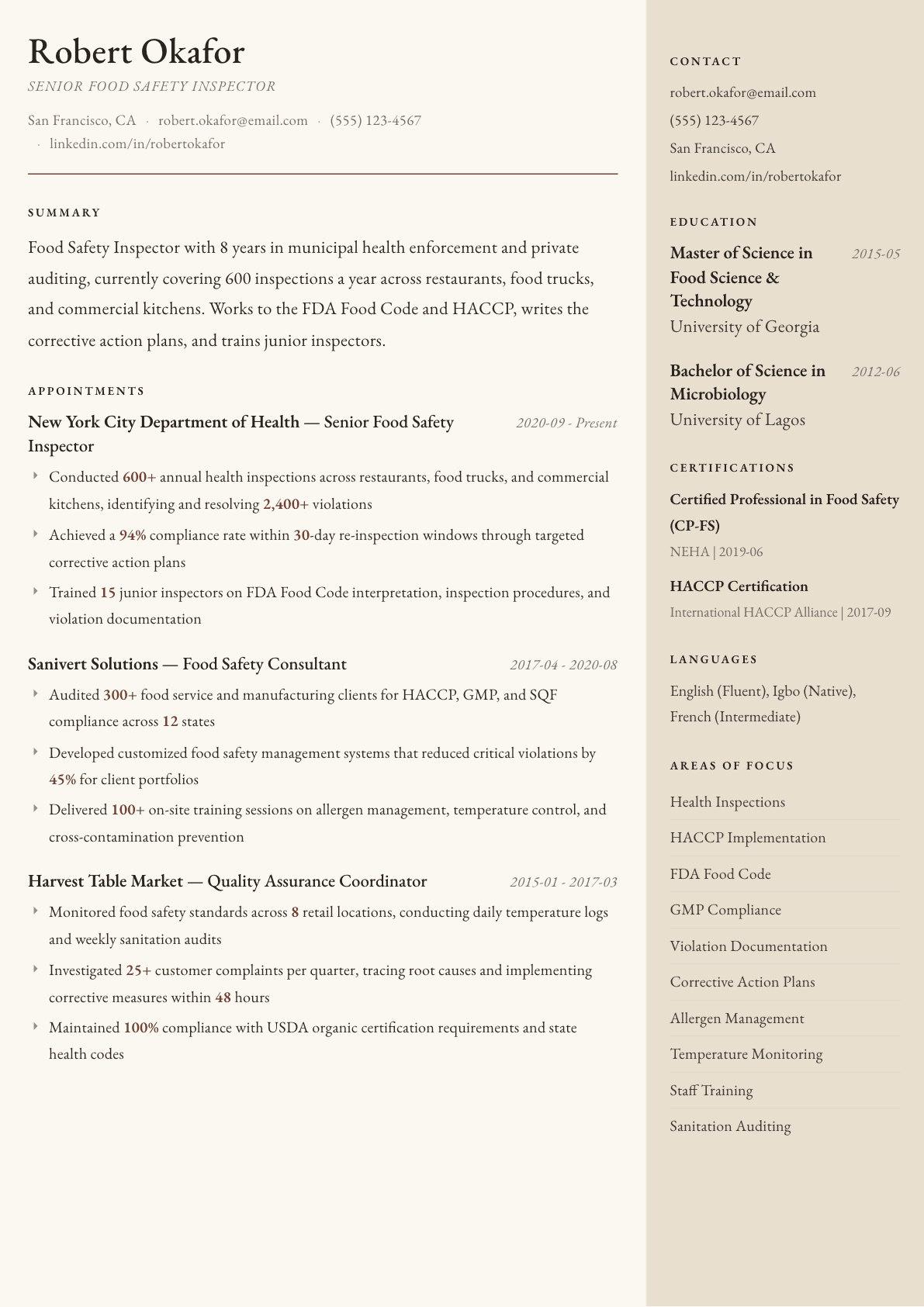
Example Food Safety Inspector summary
Food Safety Inspector, 8 years, 600 inspections a year and 94% compliance at 30-day re-inspection. Works across restaurants, manufacturing, and retail food service under the FDA Food Code, HACCP, and GMP. CP-FS certified.
Skills to list on a Food Safety Inspector resume
- Health Inspections
- HACCP
- FDA Food Code
- GMP Compliance
- SQF Auditing
- Violation Documentation
- Corrective Action Plans
- Allergen Management
- Temperature Monitoring
- Sanitation Protocols
- Staff Training
- Root Cause Analysis
- Foodborne Illness Investigation
- Report Writing
What actually gets this resume read
- Quantify inspection volume: facilities inspected per year, violations identified, and compliance improvement rates.
- Highlight regulatory framework expertise including FDA Food Code, HACCP, GMP, SQF, and state-specific health codes.
- Showcase training delivery experience with participation numbers and resulting compliance improvements.
- Include certifications (CP-FS, REHS, HACCP) prominently as they are often minimum requirements for inspector roles.
- Demonstrate investigative skills through foodborne illness response, complaint resolution, and root cause analysis examples.
How to write a food safety inspector resume
A food safety inspector resume is screened against a legal minimum before a human forms an opinion of it. Regulatory postings at a health department or a state agriculture department specify a science coursework requirement, often a set number of semester hours in biological or physical sciences, and a registration or credential in environmental health. If a personnel analyst cannot verify those from your page, the file stops there regardless of how good an inspector you are.
Once past that gate, the reader is an environmental health supervisor who wants to know whether you can hold a caseload and write a defensible report. This job is enforcement and documentation. Every observation you record can end up in an administrative hearing, a permit suspension or a foodborne illness investigation, so the quality of your writing is a professional qualification and not a soft skill.
This guide covers each section in the order a regulatory hiring panel reads it, with example summaries for a new inspector, an experienced field inspector and a senior or supervising inspector, before and after bullets that make regulatory work checkable, and the questions candidates ask when they move between public sector inspection and private auditing.
Format: two pages, credentials and coursework visible up top
Two pages is normal because this job carries credentials, jurisdiction detail and training hours that a screener must confirm. Reverse chronological, plain formatting, no columns, because public agency application systems flatten layout. If the posting names a minimum science coursework requirement, put a short line under education listing the relevant courses and hours instead of making an analyst count them from a transcript.
Give each job a jurisdiction line: the agency, the type of facilities in your district, the number of permitted establishments, and the inspection frequency required by code. Environmental health specialist for a county district of 900 permitted food facilities on a risk-based frequency tells a supervisor exactly what your caseload looked like.
- Header: name, credentials such as REHS or RS, city and state, phone, email.
- Order: summary, credentials, experience, training, education with science coursework, systems.
- State the code you enforce: the FDA Food Code edition adopted by your state, plus state and local amendments.
Summary: caseload, facility types, code and enforcement record
Three lines. Give the annual inspection count, the facility types you cover, the code you enforce, and your credential. A supervisor is buying throughput and defensibility, so a number of inspections a year and a clean record on appeals says more than any statement about being detail oriented.
Name any specialization, because environmental health is broad and hiring is often for a specific program. Temporary events and mobile food units, plan review for new construction, foodborne illness investigation, dairy or meat and poultry, retail versus manufacturing, water and pool programs, or vector control each represent a different desk.
Experience: inspections, violations, enforcement and follow-through
Quantify the field work. Routine inspections per year and the frequency required by risk category. Follow-up and reinspection counts. Violations cited, split between priority, priority foundation and core items, which is the vocabulary of the current code and a strong signal that you know it. Compliance rate at reinspection. Complaint investigations and the median time from complaint to site visit.
Then the enforcement ladder, because that is where an inspector either holds up or does not. Voluntary correction on site, written corrective action plans, embargo and condemnation of product, permit suspension, closure orders, administrative hearings you testified at, and any citation that was appealed and upheld. Sustained enforcement is the strongest evidence a resume can carry that your documentation is sound.
Add the technical program work. Plan review of new and remodeled facilities against equipment and finish standards. HACCP plan review and verification for specialized processes such as reduced oxygen packaging, acidification or curing. Variance requests. Foodborne illness outbreak investigation including case interviews, menu and food history collection, sample collection and chain of custody, and coordination with the state epidemiology program.
Education, outreach and the part of the job that is not enforcement
Most of an inspector's effect comes from operators changing behavior between visits, so show the education work. Food manager and food handler classes taught, operator training sessions delivered, translated materials or classes offered in a second language, and pre-opening consultations that prevented violations rather than citing them.
A second language is a genuine qualification in this field. Many food operations are run by owners who are more comfortable in a language other than English, and an inspector who can explain a cooling violation directly rather than through a family member gets compliance faster. List language and proficiency level plainly.
- Name the inspection software you have used, such as HealthSpace, Accela, Inspect2GO or a state system.
- Include field equipment competence: calibrated thermometers, thermocouples, sanitizer test kits, light meters, pH and water activity meters.
- Note any standardization you have completed with a state or federal standardization officer.
Credentials and continuing education
The Registered Environmental Health Specialist or Registered Sanitarian credential from the National Environmental Health Association is the backbone credential for public sector inspection and is required outright in several states. The Certified Professional in Food Safety credential from the same association reads well for candidates moving toward supervision or private auditing.
Standardization against the FDA retail program standards is the credential that specifically proves your inspections are consistent with a standardization officer's, and it is worth a labeled line. Add HACCP training, FDA and state courses, and any third party auditing scheme certification such as SQF, BRCGS or FSSC where you have worked on the private side. List continuing education hours if the credential requires them, since a supervisor confirms currency.
Food Safety Inspector resume summary examples
New inspector
Environmental health graduate with 45 semester hours of biological and physical science and a registered environmental health specialist credential in progress. Completed a departmental internship conducting 120 supervised retail food inspections, trained on the current FDA Food Code, and fluent in Spanish.
Field inspector
Registered environmental health specialist conducting 600 inspections a year across restaurants, mobile units and commissaries in a county district, citing priority and priority foundation violations under the state-adopted Food Code. Reached a 94% compliance rate at 30-day reinspection and investigated 40 illness complaints.
Senior or supervising inspector
Senior environmental health specialist and standardized inspector supervising five field staff across a metropolitan district of 2,000 permitted facilities. Leads plan review, HACCP variance evaluation and outbreak response, and has testified at administrative hearings with every citation upheld.
Work experience bullets: before and after
Before: Conducted health inspections at food establishments.
After: Conducted 600 routine and follow-up inspections a year across restaurants, mobile units, commissaries and temporary events, meeting the risk-based frequency required by state code for every facility in the district.
Volume, facility types and meeting the statutory frequency prove you carried a full regulatory caseload.
Before: Identified and documented food safety violations.
After: Documented 2,400 violations classified as priority, priority foundation and core, with photographic evidence and temperature readings recorded at the time of observation for every priority item.
Using the code's own violation classification and describing the evidence standard shows a defensible inspection record.
Before: Worked with operators to improve compliance.
After: Achieved a 94% compliance rate at 30-day reinspection by issuing written corrective action plans with dated milestones and delivering on-site food manager training in English and Spanish.
The compliance figure plus the mechanism turns a cooperative attitude into a measurable enforcement result.
Before: Investigated foodborne illness complaints.
After: Investigated 40 foodborne illness complaints a year, conducting case interviews and food histories, collecting samples under chain of custody, and coordinating with the state epidemiology unit on two confirmed outbreaks.
Naming the investigative steps and the partner agency shows outbreak work rather than complaint intake.
Before: Took enforcement action against non-compliant facilities.
After: Issued 18 permit suspensions and 6 closure orders for imminent health hazards, and testified at four administrative hearings where every citation was upheld on the strength of the written report.
Sustained enforcement at hearing is the only external verification that your documentation holds up.
Hard skills
- FDA Food Code interpretation
- Risk-based inspection scheduling
- Violation classification and documentation
- HACCP plan review and verification
- Plan review for new construction
- Foodborne illness outbreak investigation
- Sample collection and chain of custody
- Temperature and sanitizer field testing
- Permit suspension and closure procedures
- Administrative hearing testimony
- HealthSpace and Accela inspection systems
- Food manager and handler training delivery
Soft skills
- Technical writing for the record
- Impartiality under pressure
- De-escalation with operators
- Consistency between inspections
- Clear explanation of code
- Time management across a district
Certifications worth listing
- Registered Environmental Health Specialist / Registered Sanitarian (REHS/RS) (National Environmental Health Association)
- Certified Professional in Food Safety (CP-FS) (National Environmental Health Association)
- ServSafe Food Protection Manager (National Restaurant Association)
- HACCP Manager Certification (International HACCP Alliance accredited program)
- SQF Auditor Certification (SQF Institute)
- Certified Food Safety and Quality Auditor (CFSQA) (American Society for Quality)
Mistakes that cost food safety inspector candidates the interview
- Leaving the science coursework hours off the page when the classification specification names a minimum.
- Writing inspected facilities without the annual count, the facility types or the required inspection frequency.
- Never naming the code edition you enforce, which is the single clearest test of regulatory currency.
- Omitting enforcement outcomes such as suspensions, closures and hearings, which is where inspection quality is proven.
- Ignoring plan review and HACCP work, which are the technical duties that separate a senior inspector from a routine one.
- Applying private auditing language such as audit scores to a public health posting that runs on citations and code sections.
Food Safety Inspector resume questions
What education do I need to be a food safety inspector?
Most public agencies require a bachelor's degree with a specified minimum of semester hours in biological, chemical or physical sciences, and many require or prefer the registered environmental health specialist credential. Read the classification specification and list the qualifying coursework directly on your resume.
Is the REHS credential required?
It is required outright in several states and listed as preferred in many others, and it usually comes with a pay differential. If you are eligible and have not sat the examination, put your candidacy on the resume so a screener knows you are on the path.
How do I move from private food safety auditing to a health department?
Translate the vocabulary. Convert audit findings into code violations, scheme requirements into regulatory sections, and client reports into inspection documentation. Then address the gap directly: public inspectors carry enforcement authority, and a panel wants evidence you can issue a citation, not just a nonconformance.
What numbers belong on a food safety inspector resume?
Inspections per year, permitted facilities in your district, violations cited by classification, compliance rate at reinspection, complaint investigations and median response time, and enforcement actions including suspensions and hearings. Those are the figures an environmental health supervisor tracks.
Does a second language help on this resume?
Considerably. Many food operations are run by owners more comfortable in another language, and an inspector who can explain a cooling or date-marking violation directly gets faster correction. State the language and an honest proficiency level in the header.
Related resume examples
- Executive Chef Resume example
- Restaurant Manager Resume example
- Food & Beverage Director Resume example
- Health Inspector Resume example
- Sanitation Worker Resume example
- Code Enforcement Officer Resume example