How to Address Selection Criteria: 6 Worked STAR Examples
By Mustafa Tarabya, founder of CVBooster · Published · Updated
16 min read
To address selection criteria, give every criterion its own heading in the advert's exact words, then answer it with one example built from a situation, your actions and a sized result. The advert's limit decides the shape, because a 120-word response and a 400-word response are different documents rather than the same one trimmed. The rules quoted below come from iworkfor.SA, Jobs and Skills WA, JobAccess and the Australian Public Service Commission. Six complete responses follow, at APS4 through to AO5, each annotated against the criterion it answers. Written by Mustafa Tarabya, who hired for his own company, read every application himself and now writes CVBooster's guides. Checked September 2026.
What the panel is actually scoring
Each criterion is marked on its own, so a strong paragraph under the wrong heading earns nothing.
Quoted: "For each criteria or statement, you are required to provide a response that highlights your skills, and or experience and an example to show your competence or ability to perform the task." (iworkfor.SA, Addressing selection criteria)
Compressed method, before the examples: copy the criterion as your heading, name where and when your example happened, describe the challenge, spend most of your words on what you personally did, and end with a result that can be checked. Those four moves are set out by JobAccess and match the STAR model in the Australian Public Service Commission's Applying for an APS job.
Analysis, decision making and written communication
Analysis and research, APS4, 250 words
Criterion answered: "analysis and research", quoted from the official criteria list in iworkfor.SA's guide.
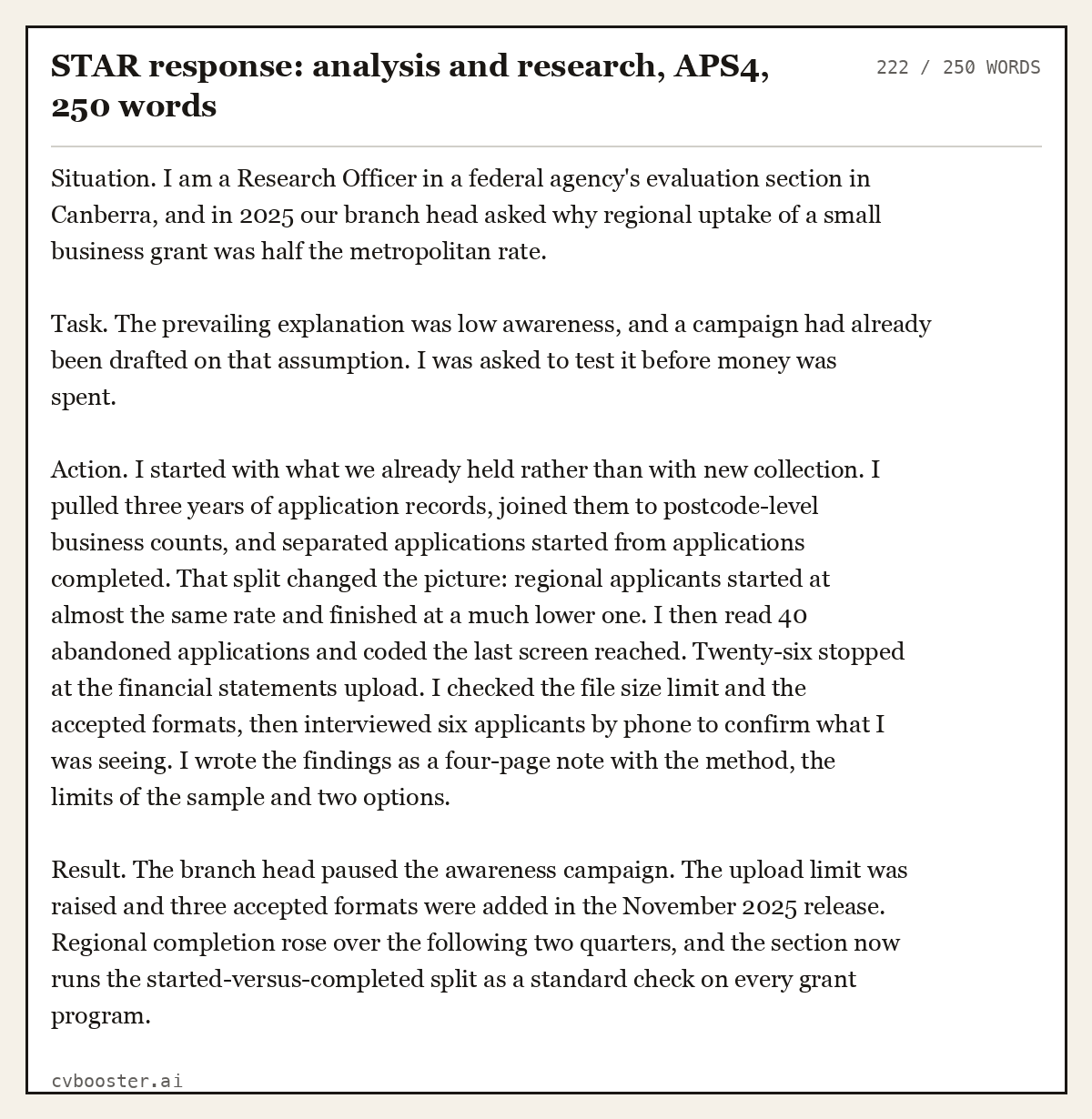
STAR response: analysis and research, APS4, 250 words (222 words)
Situation. I am a Research Officer in a federal agency's evaluation section in Canberra, and in 2025 our branch head asked why regional uptake of a small business grant was half the metropolitan rate.
Task. The prevailing explanation was low awareness, and a campaign had already been drafted on that assumption. I was asked to test it before money was spent.
Action. I started with what we already held rather than with new collection. I pulled three years of application records, joined them to postcode-level business counts, and separated applications started from applications completed. That split changed the picture: regional applicants started at almost the same rate and finished at a much lower one. I then read 40 abandoned applications and coded the last screen reached. Twenty-six stopped at the financial statements upload. I checked the file size limit and the accepted formats, then interviewed six applicants by phone to confirm what I was seeing. I wrote the findings as a four-page note with the method, the limits of the sample and two options.
Result. The branch head paused the awareness campaign. The upload limit was raised and three accepted formats were added in the November 2025 release. Regional completion rose over the following two quarters, and the section now runs the started-versus-completed split as a standard check on every grant program.
What the sifter is scoring
- Criterion wording quoted: "analysis and research" (iworkfor.SA, list of criteria examples). Evidence offered: existing data used first, a hypothesis tested rather than assumed, a coded sample of 40 files.
- Move two of the JobAccess method, the challenge: a campaign had already been drafted on an assumption nobody had tested.
- Why the result scores: it names what stopped, what changed in a release, and what became standard practice.
Decision making, VPS4, 200 words
Criterion answered: "decision making", quoted from the same official list.
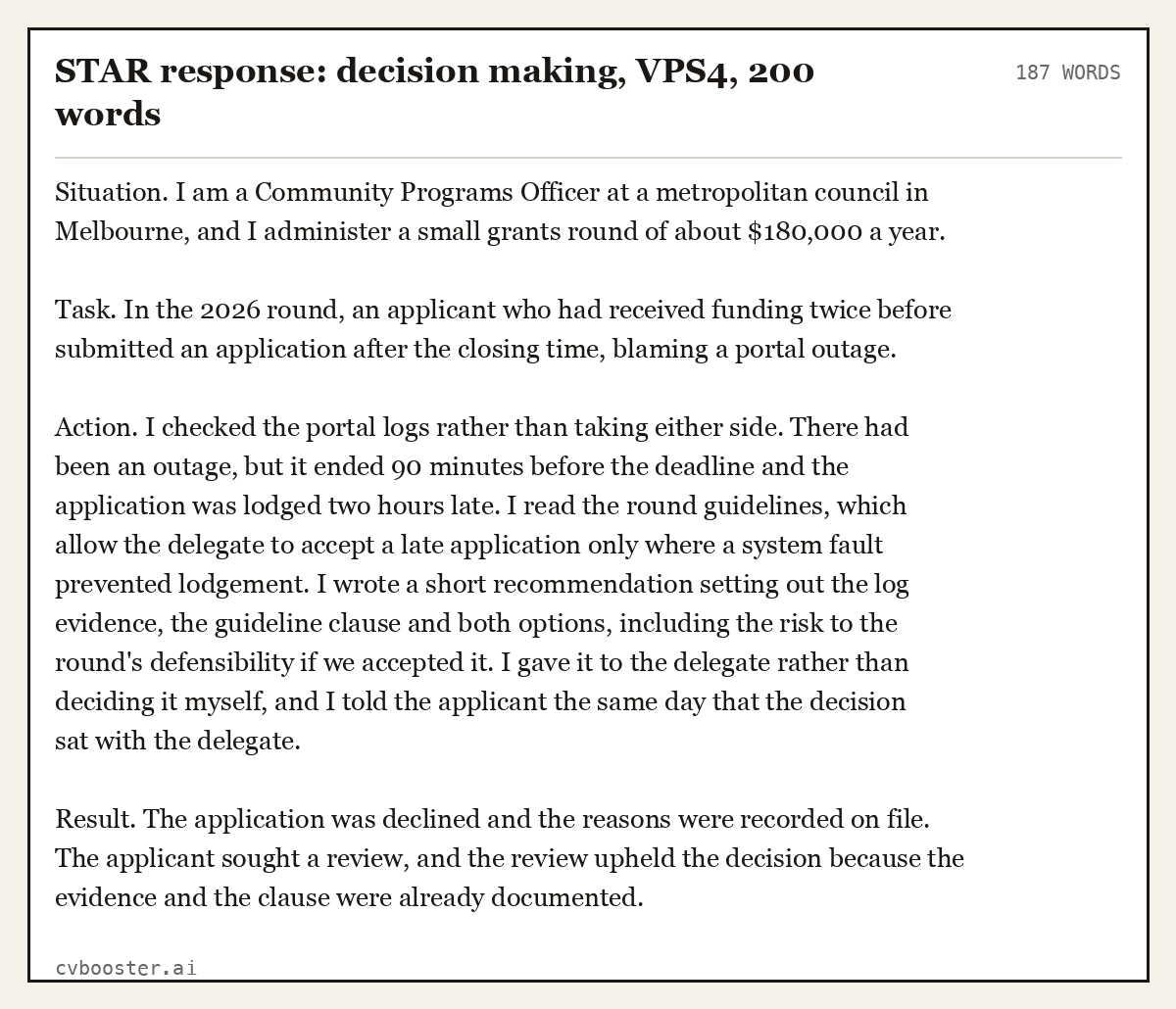
STAR response: decision making, VPS4, 200 words (187 words)
Situation. I am a Community Programs Officer at a metropolitan council in Melbourne, and I administer a small grants round of about $180,000 a year.
Task. In the 2026 round, an applicant who had received funding twice before submitted an application after the closing time, blaming a portal outage.
Action. I checked the portal logs rather than taking either side. There had been an outage, but it ended 90 minutes before the deadline and the application was lodged two hours late. I read the round guidelines, which allow the delegate to accept a late application only where a system fault prevented lodgement. I wrote a short recommendation setting out the log evidence, the guideline clause and both options, including the risk to the round's defensibility if we accepted it. I gave it to the delegate rather than deciding it myself, and I told the applicant the same day that the decision sat with the delegate.
Result. The application was declined and the reasons were recorded on file. The applicant sought a review, and the review upheld the decision because the evidence and the clause were already documented.
What the sifter is scoring
- Criterion wording quoted: "decision making" (iworkfor.SA). Evidence offered: evidence gathered, the rule located, the delegate's authority respected.
- What most applicants miss: the decision here was not the applicant's outcome. It was recognising whose decision it was.
Written communication, HEW6, 300 words
Criterion answered: "written communication skills", quoted from the same list, in the version universities usually extend to reports for senior management.
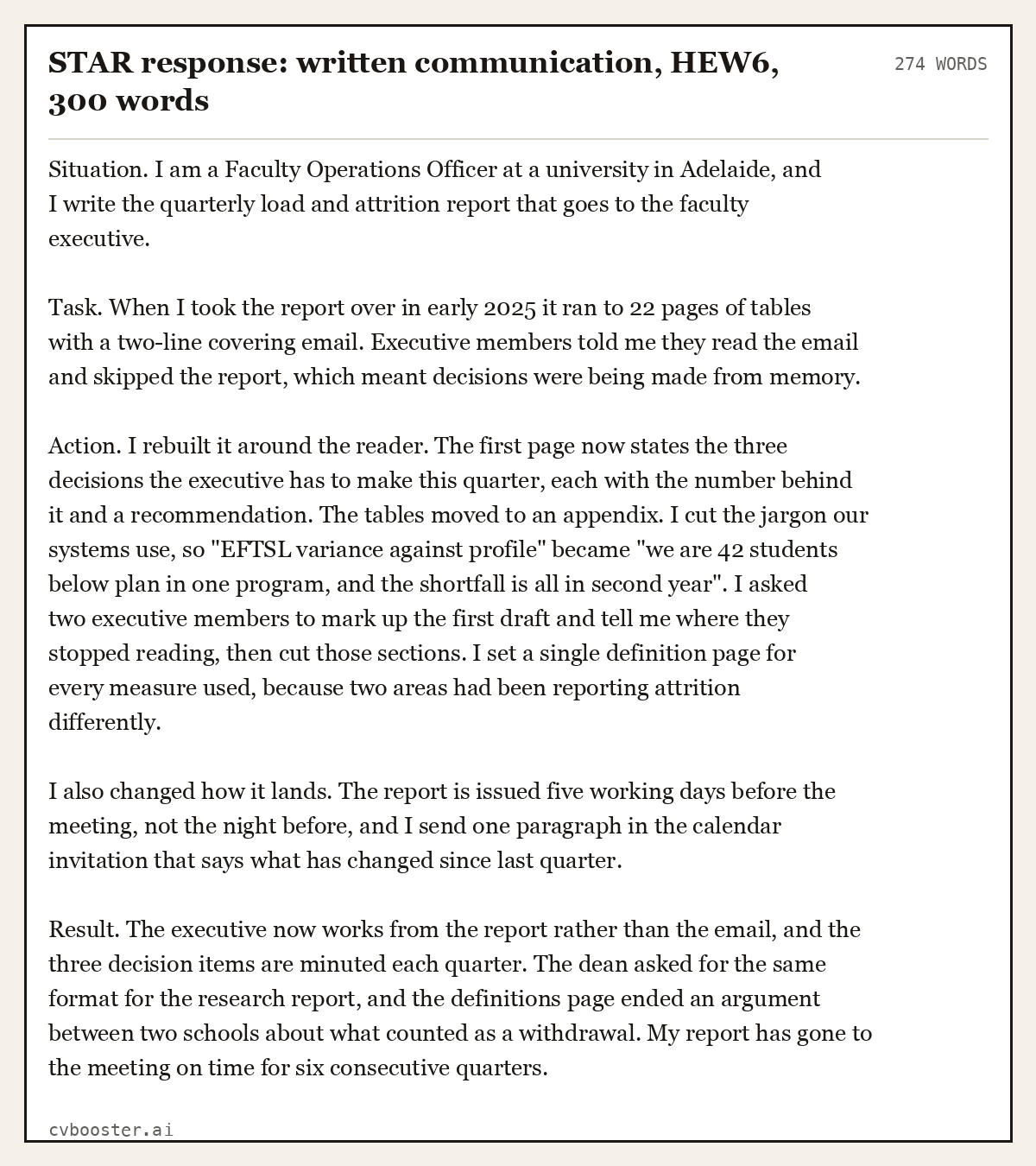
STAR response: written communication, HEW6, 300 words (274 words)
Situation. I am a Faculty Operations Officer at a university in Adelaide, and I write the quarterly load and attrition report that goes to the faculty executive.
Task. When I took the report over in early 2025 it ran to 22 pages of tables with a two-line covering email. Executive members told me they read the email and skipped the report, which meant decisions were being made from memory.
Action. I rebuilt it around the reader. The first page now states the three decisions the executive has to make this quarter, each with the number behind it and a recommendation. The tables moved to an appendix. I cut the jargon our systems use, so "EFTSL variance against profile" became "we are 42 students below plan in one program, and the shortfall is all in second year". I asked two executive members to mark up the first draft and tell me where they stopped reading, then cut those sections. I set a single definition page for every measure used, because two areas had been reporting attrition differently.
I also changed how it lands. The report is issued five working days before the meeting, not the night before, and I send one paragraph in the calendar invitation that says what has changed since last quarter.
Result. The executive now works from the report rather than the email, and the three decision items are minuted each quarter. The dean asked for the same format for the research report, and the definitions page ended an argument between two schools about what counted as a withdrawal. My report has gone to the meeting on time for six consecutive quarters.
What the sifter is scoring
- Criterion wording quoted: "written communication skills" (iworkfor.SA). Evidence offered: a named document, a named audience, a structural change and reader testing.
- Official instruction quoted: "Employers are often inundated with applications, so anything that makes reading your application easier will be beneficial" (Jobs and Skills WA), which is the same principle the response describes applying to its own report.
Negotiation, adapting to change and supervision
Negotiation and stakeholder liaison, HSO Level 5, 300 words
Criterion answered: "negotiation", quoted from the official iworkfor.SA list.
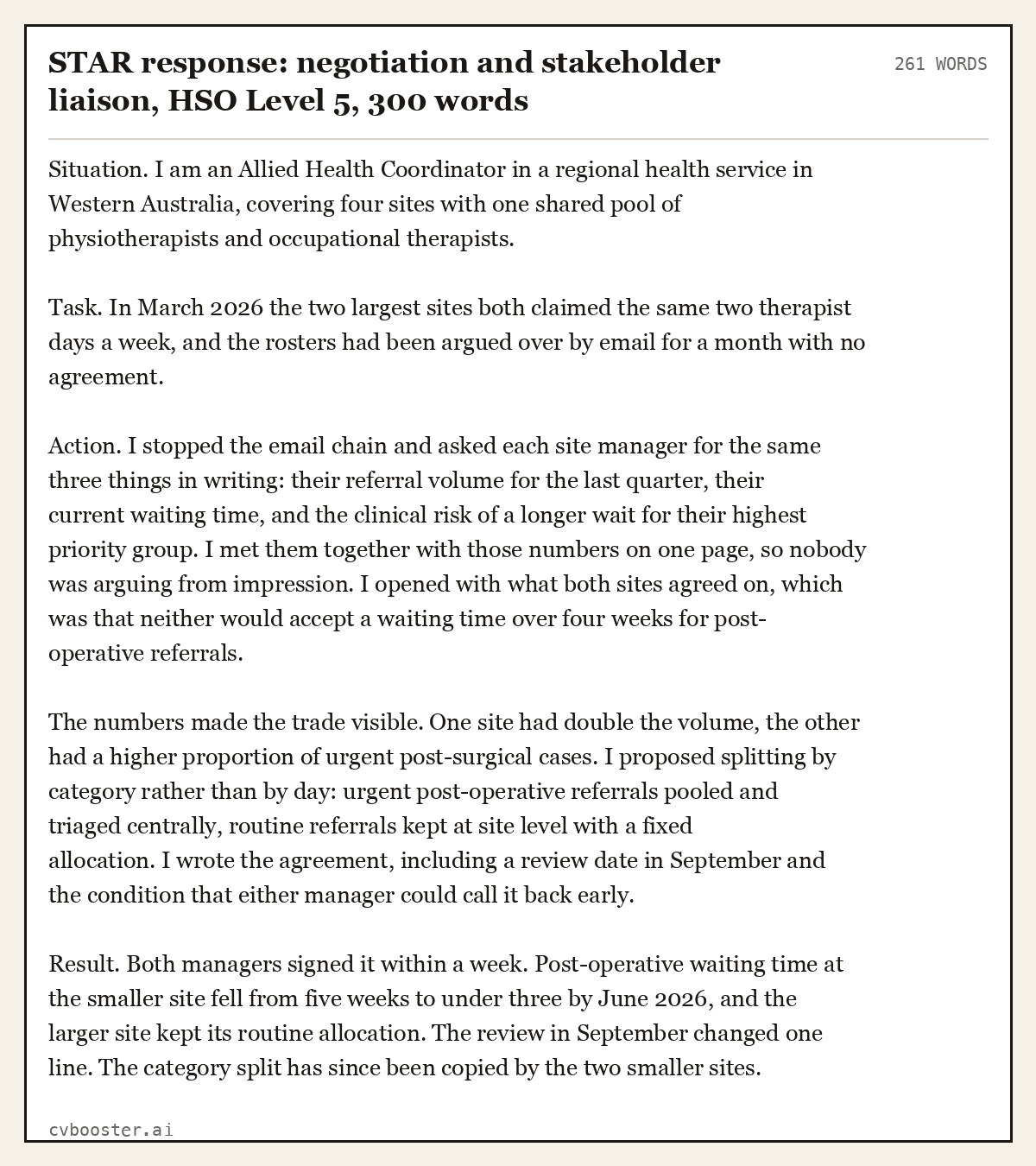
STAR response: negotiation and stakeholder liaison, HSO Level 5, 300 words (261 words)
Situation. I am an Allied Health Coordinator in a regional health service in Western Australia, covering four sites with one shared pool of physiotherapists and occupational therapists.
Task. In March 2026 the two largest sites both claimed the same two therapist days a week, and the rosters had been argued over by email for a month with no agreement.
Action. I stopped the email chain and asked each site manager for the same three things in writing: their referral volume for the last quarter, their current waiting time, and the clinical risk of a longer wait for their highest priority group. I met them together with those numbers on one page, so nobody was arguing from impression. I opened with what both sites agreed on, which was that neither would accept a waiting time over four weeks for post-operative referrals.
The numbers made the trade visible. One site had double the volume, the other had a higher proportion of urgent post-surgical cases. I proposed splitting by category rather than by day: urgent post-operative referrals pooled and triaged centrally, routine referrals kept at site level with a fixed allocation. I wrote the agreement, including a review date in September and the condition that either manager could call it back early.
Result. Both managers signed it within a week. Post-operative waiting time at the smaller site fell from five weeks to under three by June 2026, and the larger site kept its routine allocation. The review in September changed one line. The category split has since been copied by the two smaller sites.
What the sifter is scoring
- Criterion wording quoted: "negotiation" and "interpersonal/verbal communication" (iworkfor.SA). Evidence offered: shared facts established first, common ground named, a written agreement with a review date.
- What a panel scores here: the applicant negotiated a structure, not a compromise. The outcome is durable and reviewable.
Adapting to change and learning new skills, Education Support Level 1, 250 words
Criterion answered: "Demonstrated your ability to learn new skills and adapt to change", quoted from the JobAccess sample criterion.
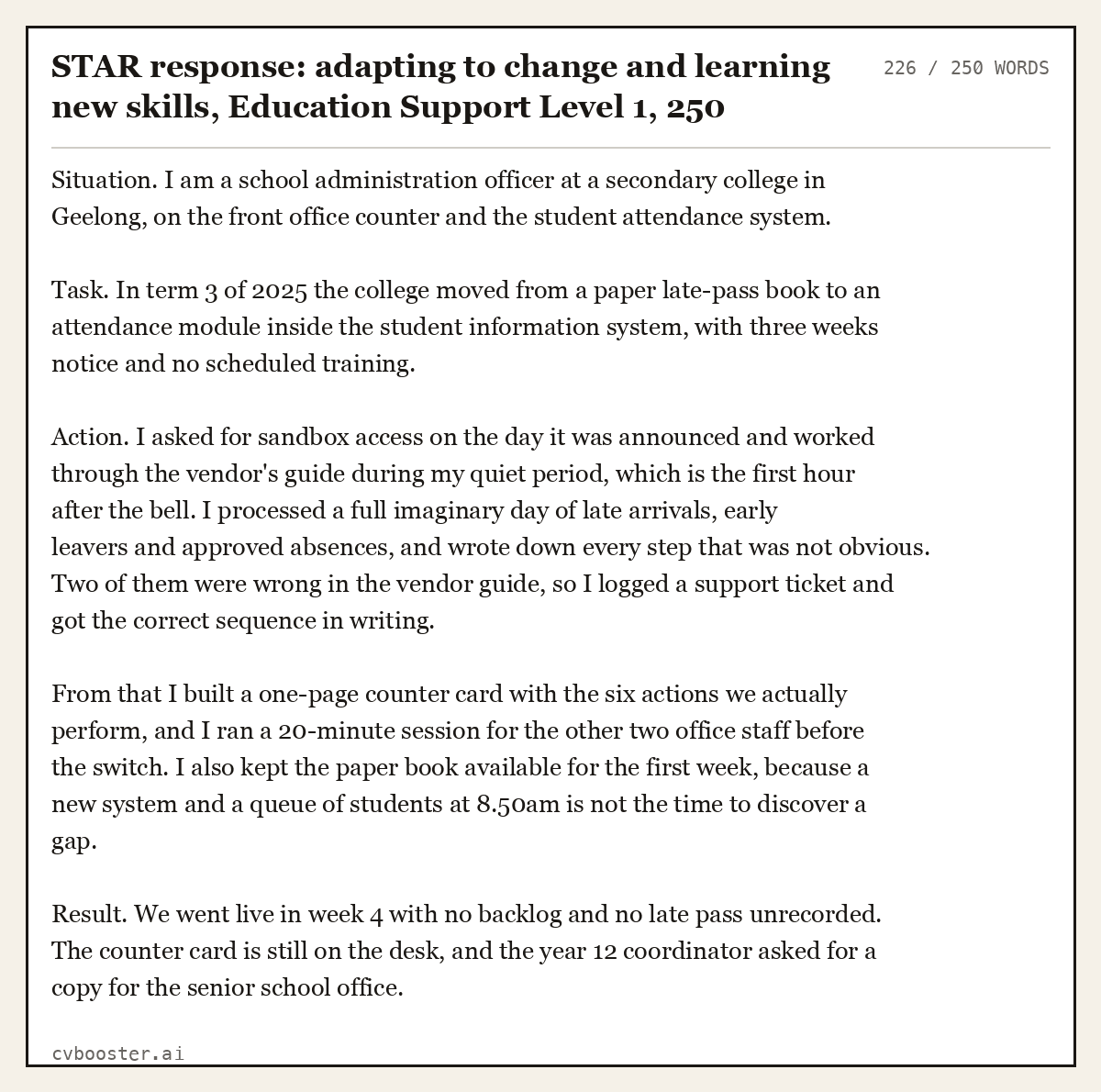
STAR response: adapting to change and learning new skills, Education Support Level 1, 250 words (226 words)
Situation. I am a school administration officer at a secondary college in Geelong, on the front office counter and the student attendance system.
Task. In term 3 of 2025 the college moved from a paper late-pass book to an attendance module inside the student information system, with three weeks notice and no scheduled training.
Action. I asked for sandbox access on the day it was announced and worked through the vendor's guide during my quiet period, which is the first hour after the bell. I processed a full imaginary day of late arrivals, early leavers and approved absences, and wrote down every step that was not obvious. Two of them were wrong in the vendor guide, so I logged a support ticket and got the correct sequence in writing.
From that I built a one-page counter card with the six actions we actually perform, and I ran a 20-minute session for the other two office staff before the switch. I also kept the paper book available for the first week, because a new system and a queue of students at 8.50am is not the time to discover a gap.
Result. We went live in week 4 with no backlog and no late pass unrecorded. The counter card is still on the desk, and the year 12 coordinator asked for a copy for the senior school office.
What the sifter is scoring
- Criterion wording quoted: "Demonstrated your ability to learn new skills and adapt to change" (JobAccess sample criterion). Evidence offered: sandbox practice, a documented sequence, a fallback for week one.
- Advert wording quoted: "A commitment to professional learning and growth for both self and others" (careers.vic.gov.au, Education Support advert, criterion SC6). Evidence offered: the 20-minute session run for colleagues.
Supervision and managing a small team, AO5, 400 words
Criterion answered: "supervisory/management", quoted from the official iworkfor.SA list.
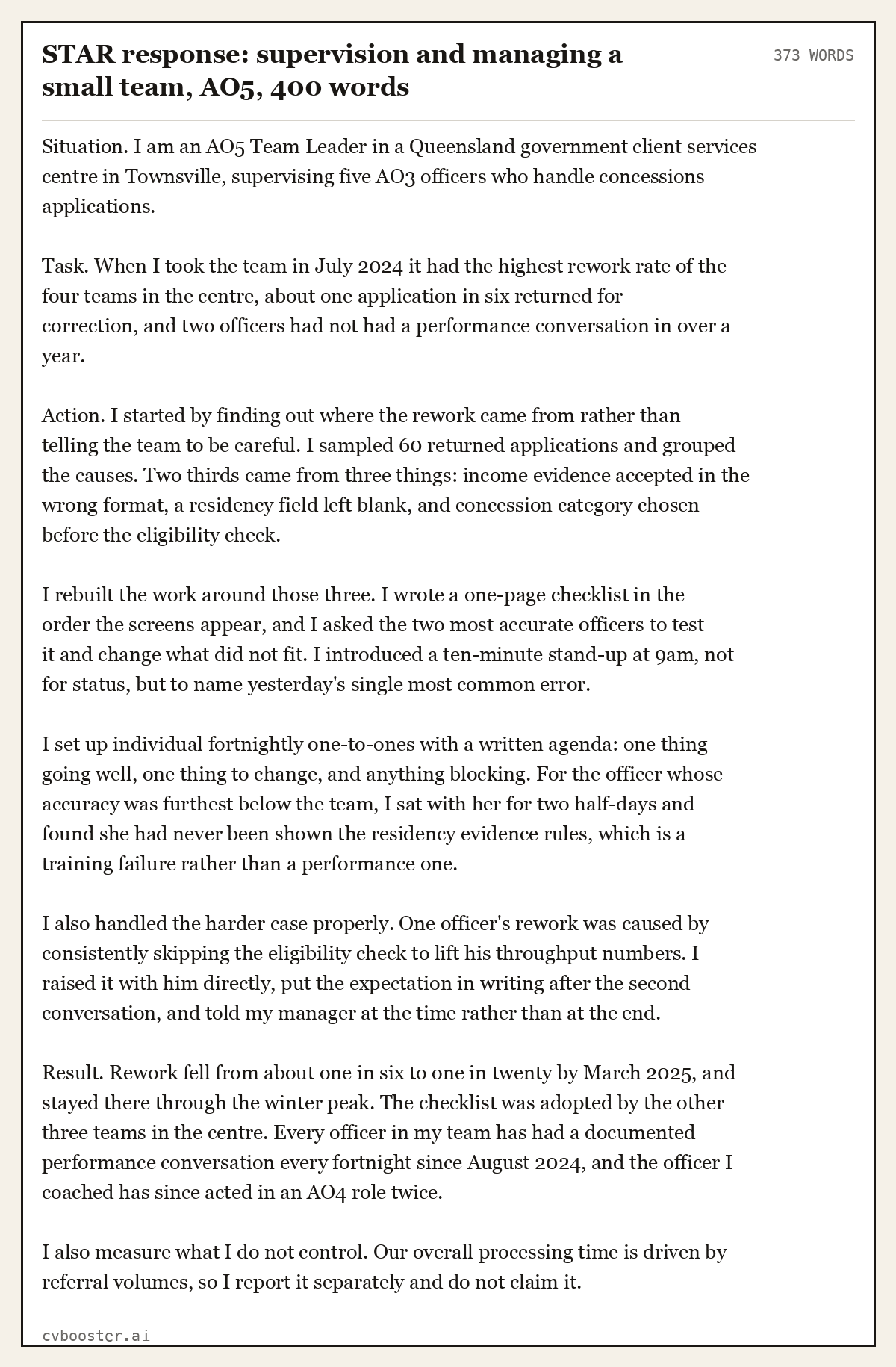
STAR response: supervision and managing a small team, AO5, 400 words (373 words)
Situation. I am an AO5 Team Leader in a Queensland government client services centre in Townsville, supervising five AO3 officers who handle concessions applications.
Task. When I took the team in July 2024 it had the highest rework rate of the four teams in the centre, about one application in six returned for correction, and two officers had not had a performance conversation in over a year.
Action. I started by finding out where the rework came from rather than telling the team to be careful. I sampled 60 returned applications and grouped the causes. Two thirds came from three things: income evidence accepted in the wrong format, a residency field left blank, and concession category chosen before the eligibility check.
I rebuilt the work around those three. I wrote a one-page checklist in the order the screens appear, and I asked the two most accurate officers to test it and change what did not fit. I introduced a ten-minute stand-up at 9am, not for status, but to name yesterday's single most common error.
I set up individual fortnightly one-to-ones with a written agenda: one thing going well, one thing to change, and anything blocking. For the officer whose accuracy was furthest below the team, I sat with her for two half-days and found she had never been shown the residency evidence rules, which is a training failure rather than a performance one.
I also handled the harder case properly. One officer's rework was caused by consistently skipping the eligibility check to lift his throughput numbers. I raised it with him directly, put the expectation in writing after the second conversation, and told my manager at the time rather than at the end.
Result. Rework fell from about one in six to one in twenty by March 2025, and stayed there through the winter peak. The checklist was adopted by the other three teams in the centre. Every officer in my team has had a documented performance conversation every fortnight since August 2024, and the officer I coached has since acted in an AO4 role twice.
I also measure what I do not control. Our overall processing time is driven by referral volumes, so I report it separately and do not claim it.
What the sifter is scoring
- Criterion wording quoted: "supervisory/management" (iworkfor.SA, criteria list). Evidence offered: a diagnosed cause, a tool built with the team, fortnightly one-to-ones, and one documented performance conversation.
- Official instruction quoted: the APSC tells applicants to give "actual, specific examples of what you have done, how well you did it, what you achieved". Evidence offered: a rework figure before, after, and held through a winter peak.
- The closing paragraph: it separates the applicant's own contribution from the team's environment, which is what a level descriptor at AO5 is testing.
Extract the rules before you write a sentence
Pull these out of the position description and the applicant information package first.
- The exact wording of every criterion, including the sub-clauses after the comma. A criterion that mentions reports for senior management contains two things to prove, not one.
- Which criteria are essential and which are desirable. Essential criteria are screened first, and a blank one can end the application.
- The limit and what it applies to. Some limits are per criterion, some cap the whole document at two or three pages.
- Whether responses go in a separate document or inside the online form, and in what file format.
- The closing time and its time zone. Public sector portals close hard, and late lodgement is rarely accepted.
- Any mandatory qualification, registration or clearance, such as a Working with Children Check, since these are verified rather than argued.
Then copy each criterion into your draft as a heading, in the same order and the same words. The iworkfor.SA guide says to do this literally: give each one a title "using exactly the same wording as appears on the selection criteria form", by copy and paste.
STAR or SAO, and the word budget
STAR means Situation, Task, Action, Result, and it is what most Australian careers services teach. Some Victorian guidance uses the shorter SAO, meaning Situation, Action, Outcome, and expects a much shorter response.
In most criteria the task is already stated by the criterion, so writing it out again burns words you need elsewhere. Budget by the limit:
- 120 words: one clause of situation, three sentences of action, one result sentence.
- 250 words: about 40 situation, 30 task, 130 action, 50 result.
- 400 words and above: label the parts of the criterion as sub-headings and answer each, which Jobs and Skills WA recommends when a criterion is "made up of several parts".
Why most responses die on the result
The pattern is predictable. The situation is fine, the action is detailed, and then the last sentence collapses into a claim that the project went well and the manager was pleased. That is the applicant announcing the conclusion the panel is supposed to reach.
A result does two jobs. It proves the action worked, and it sizes the work so the panel can judge whether your level matches the role. Eight ways to size a result when your work produces no obvious numbers:
- Volume and frequency. Around 40 enquiries a day, three committees, a caseload of 22.
- Before and after state. Describe how the work was done before, and how it is done now.
- Time. Turnaround, waiting period, or how long the task took before and after.
- Reach. Who else uses your work now, and where.
- Durability. Say how long it has survived, especially through a change of manager.
- Third-party verification. An audit with no findings, an accreditation retained, a procedure signed off.
- Error and rework. Name the check that would have caught the problem, then say it did not recur.
- Adoption. Name who started using your work, and when.
If you cannot size a result at all, you picked the wrong example. A modest piece of work described precisely scores better than an impressive one with a vague ending.
The sentences that cost marks
- Before: "I have strong analytical skills and can interpret complex data sets." After: "Splitting applications started from applications completed showed the problem was an upload limit, not awareness."
- Before: "I make sound decisions in line with policy and guidelines." After: "The guidelines allow a late application only where a system fault prevented lodgement, so I took the logs to the delegate."
- Before: "I have excellent negotiation skills and can bring stakeholders together." After: "Both managers arrived with the same three numbers on one page, so nobody argued from impression."
- Before: "I am adaptable and embrace change in the workplace." After: "I asked for sandbox access on the day it was announced and processed an imaginary day of late passes before go live."
- Before: "I supervise a team and support them to achieve their KPIs." After: "I sampled 60 returned applications, found three causes, and rework fell from one in six to one in twenty."
Tip: the fix is always the same. Replace the adjective with the thing you actually did on a particular day.
What gets an application screened out
- Leaving a criterion blank, or writing "refer to my resume", which is scored as not demonstrated.
- Going over the stated limit. Some panels stop reading, some online forms truncate silently.
- Answering the criterion you wish had been asked.
- Hypothetical evidence. A sentence beginning "I would approach this by" proves nothing.
- Team credit with no personal action. "We implemented" leaves a panel nothing to score.
- Claims that contradict your resume, especially dates and job titles.
- A pasted paragraph naming the wrong employer.
Build the evidence bank once
Most people write this document from scratch every time, which is why it feels crushing. Build a private file of 12 to 15 examples from the last five to seven years instead. Write each one once, with the situation, your specific actions, the dates and a sized result, and tag it with the criteria it can answer.
Each application then becomes selection rather than invention. Pick the closest example, cut it to the stated limit, and rewrite the opening clause to mirror the employer's wording. Keep the numbers accurate, because a well-run panel builds its interview questions from the same criteria you just answered.
Related pages: selection criteria examples for ten criteria answered at 250 words, attention to detail selection criteria examples for that criterion at four lengths, and the APS statement of claims example or the APS one page pitch example for federal formats.
Frequently asked questions
What are common selection criteria examples?
The criteria that recur across Australian adverts are communication, teamwork, problem solving, organisational skills, customer service, attention to detail, leadership, initiative and computer skills. The iworkfor.SA list adds analysis and research, decision making, negotiation, presentation, independence and supervisory skills. Six of those are answered in full on this page.
How to write the selection criteria?
Write one response per criterion, under the criterion's exact heading, in the advert's order, marked essential or desirable. Use one example, name where and when it happened, spend the bulk of the words on your own actions, and finish with a result that carries a number, a date or a named verification. Stay inside the stated limit.
What are 5 personal skills examples?
Communication, teamwork, problem solving, initiative and time management are the five personal skills Australian adverts ask for most often. Each is only worth marks with an example attached: a situation with a date, actions you took yourself, and an outcome someone else could confirm. Listed as adjectives they are scored as not demonstrated.
How should I respond to selection criteria in my cover letter?
Only merge them into a cover letter if the advert asks for that, which usually means a two-page letter addressing the criteria in order with a short paragraph each. If the advert asks for a separate statement of claims, keep the letter to one page and put the evidence in the statement. Never split one criterion across both documents.
More in this series: Australian Public Service applications
- APS Statement of Claims Example: APS4, APS5 and APS6
- Attention to Detail Selection Criteria Examples: 4 Answers
- Selection Criteria Examples: 10 Full 250-Word Responses
Related articles
- Selection Criteria Examples: 10 Full 250-Word Responses
- Attention to Detail Selection Criteria Examples: 4 Answers
- APS Statement of Claims Example: APS4, APS5 and APS6
- Selection Criteria Examples Nursing: 3 Full Responses
More articles
- Adjectives to Describe Yourself and the Sentence for Each
- AI Cover Letters in the UK: What Employers Actually Notice
- Is an AI Resume Builder Worth It: when it is, when it is not