Network Engineer Resume Examples: the lines they read
Networking Engineer Resume Sample and Network Engineer Guide
By Mustafa Tarabya, founder of CVBooster · Published · Updated
Networking engineer resume sample and guide: a full network engineer resume plus junior, mid and senior entries showing routing, switching, security and automation.
Sample resumes for a network engineer
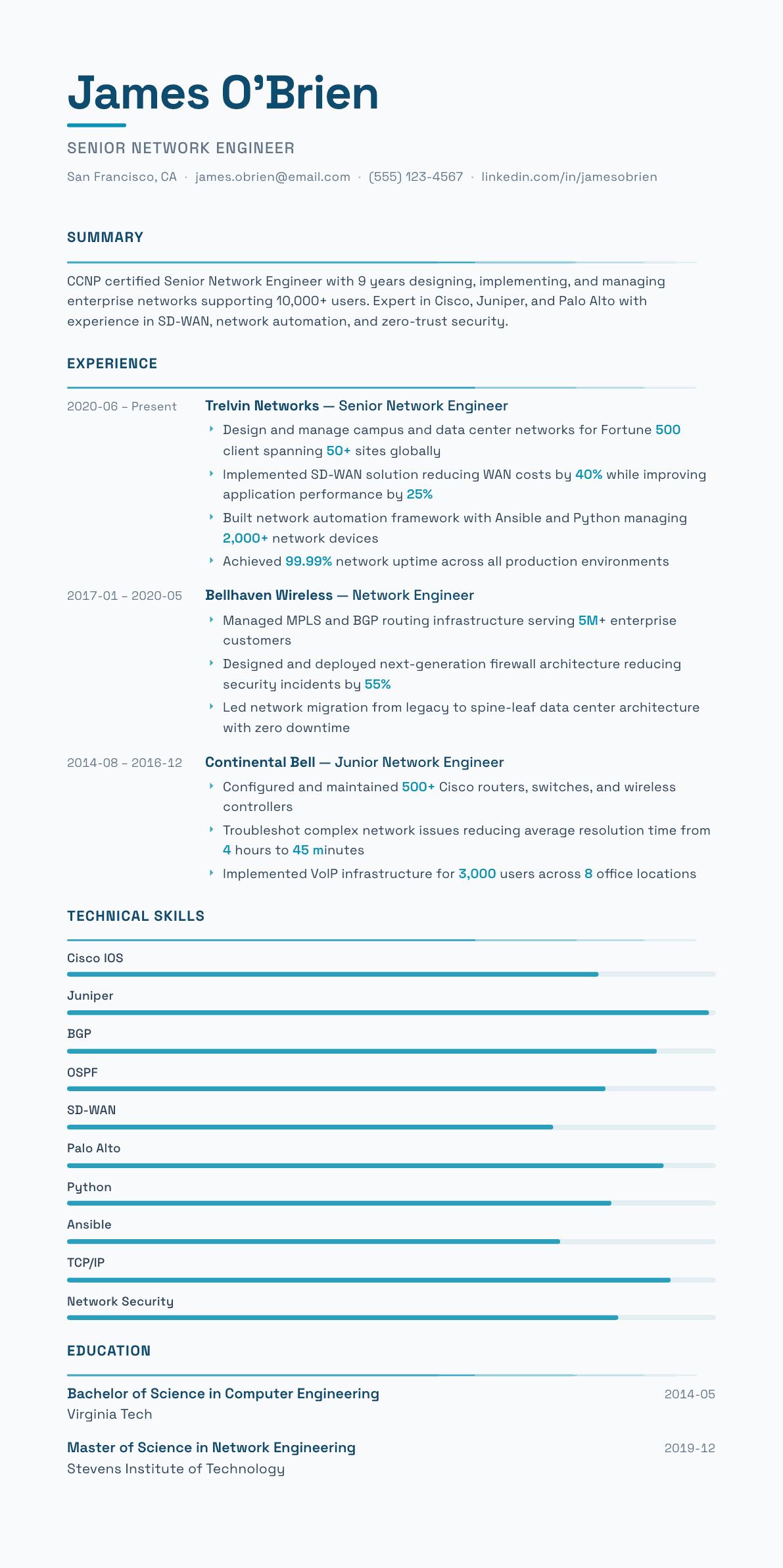
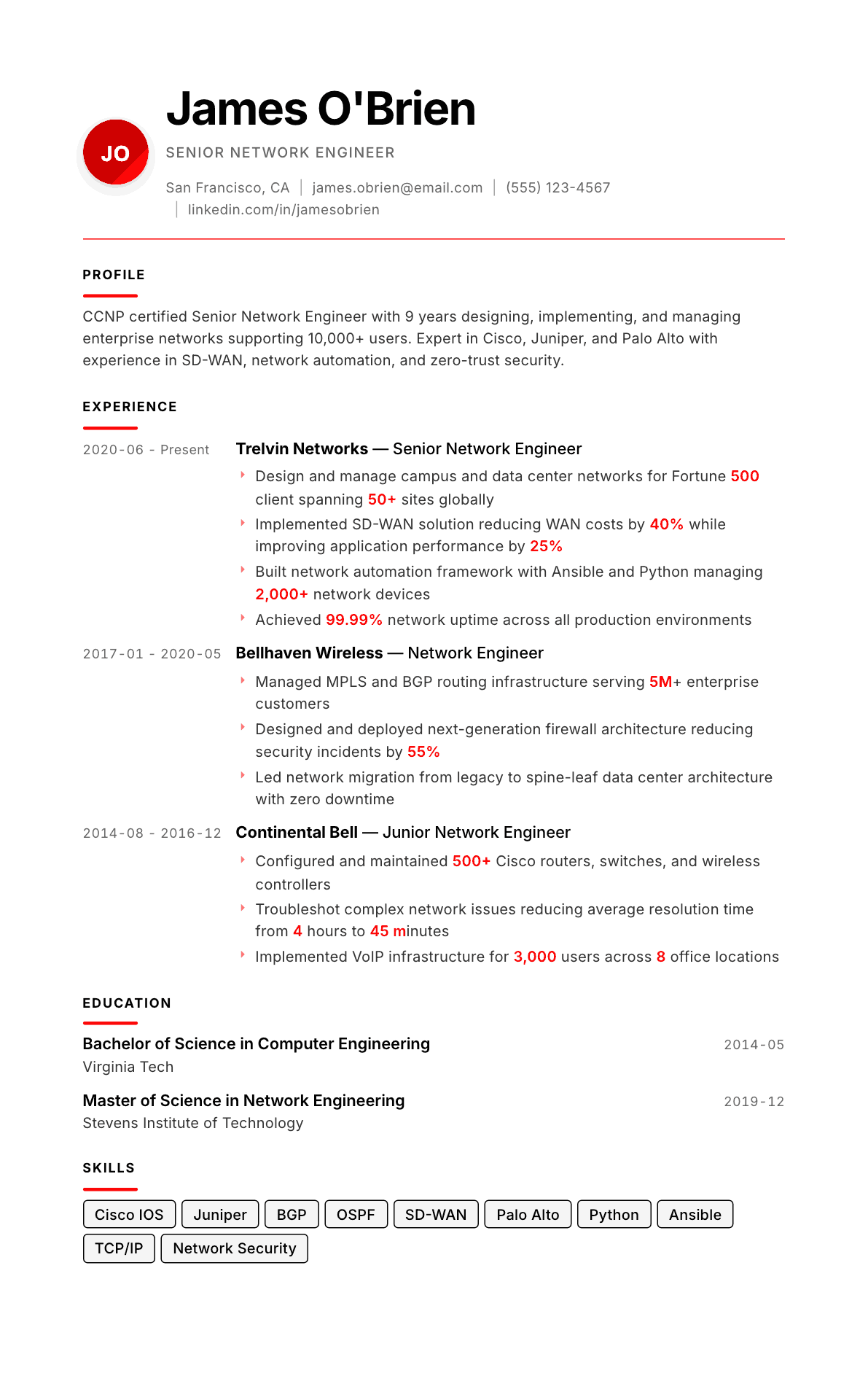
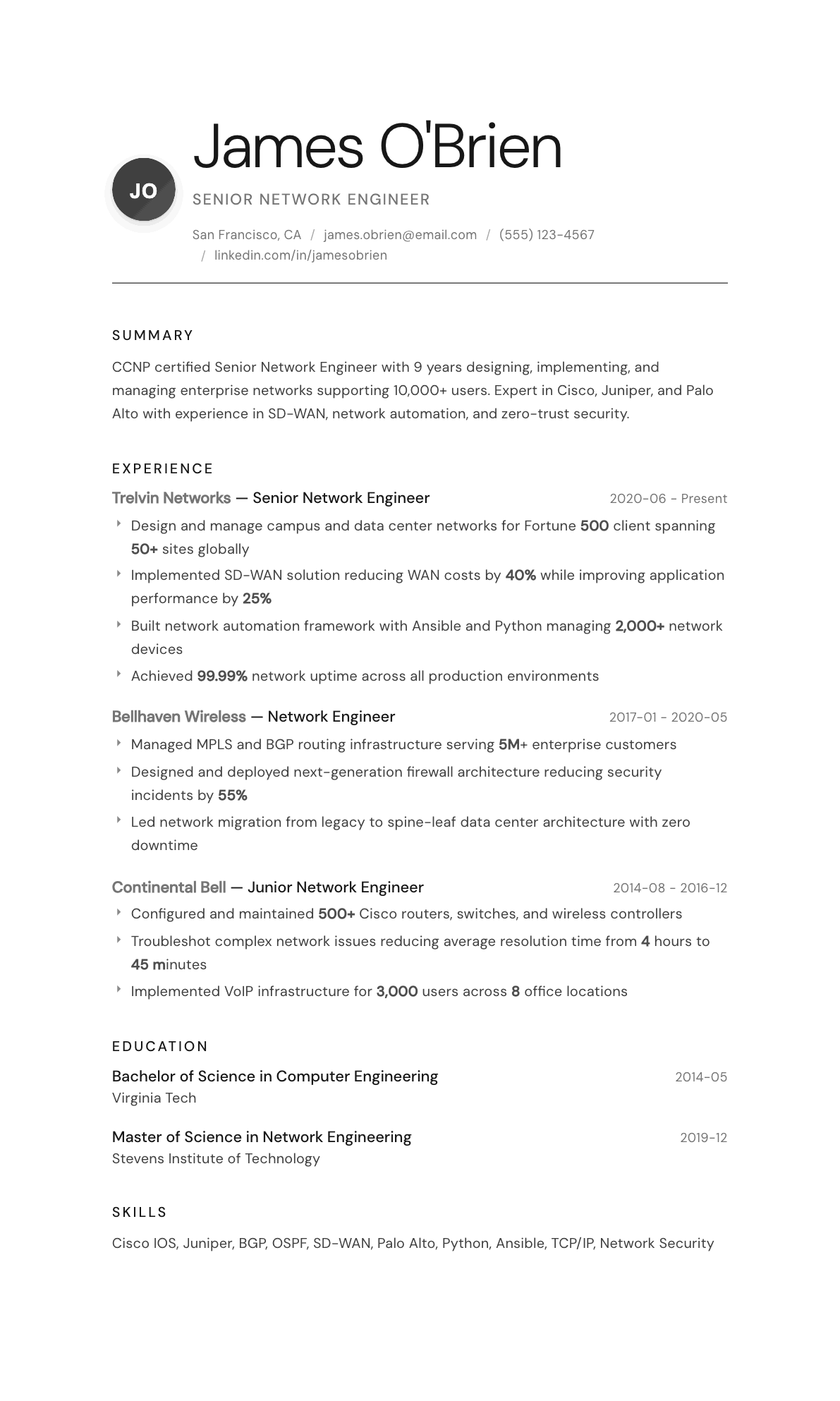
The same network engineer content laid out in three CVBooster templates, so you can see what the finished document looks like before you write a word.
Example Network Engineer summary
CCNP certified Senior Network Engineer with 9 years designing enterprise networks supporting 10,000+ users. Expert in SD-WAN, network automation, and zero-trust security with 99.99% uptime record.
Skills to list on a Network Engineer resume
- Cisco IOS
- Juniper
- BGP
- OSPF
- MPLS
- SD-WAN
- Palo Alto
- Python
- Ansible
- TCP/IP
- Network Security
- VPN
- DNS
- Load Balancing
What actually gets this resume read
- Lead with networking certifications (CCNP, CCIE, JNCP).
- Quantify network size, uptime, and performance improvements.
- Include automation skills (Python, Ansible) alongside traditional networking.
- Show SD-WAN and cloud networking experience.
- Highlight security-related networking expertise.
How to write a network engineer resume
Network engineering is one of the few technology fields where a certification number still opens the first door. Recruiters filter on CCNA, CCNP, CCIE, JNCIA and PCNSE because those strings are easy to search and because the exam content maps closely to the daily work. That filter is why a strong network engineer with no certifications gets passed over by a weaker one who has them, and why the certification block belongs near the top of the page rather than buried under education.
The hiring manager reads for something different. She wants the shape of the networks you have run: how many sites, how many devices, whether you touched the routing core or only the access layer, whether you have carried a pager for a network that people notice when it breaks. A resume that says "managed network infrastructure" gives her nothing to size you against, and she has a stack of them.
This guide covers where the certifications go, how to describe a network so a reader can picture its topology, a networking engineer resume sample at three levels, the automation skills that now separate candidates who are competing for the same role, and the way to write about outages without sounding like you caused them.
Format: certifications first, then the networks you have run
Reverse-chronological, one page for under seven years, two pages beyond that. Put a certifications line directly under the summary with the credential, the issuer and the track, then repeat it in a fuller section with dates lower down. Recertification matters in this field, so an expired CCNP that you are actively renewing should say so rather than sit there looking stale.
Under experience, give each employer a one-line network profile before the bullets. Site count, user or endpoint count, device count and vendor mix. "Forty-eight sites, six thousand endpoints, Cisco Catalyst and Nexus core with Palo Alto edge" tells a reader more than five generic bullets ever will.
- Header: name, credentials such as CCNP or JNCIP after the name, city, phone, email.
- Order: summary, certifications, experience, technical skills by domain, education.
- Add a clearance line if you hold one, because federal and defense postings filter on it.
- Keep vendor names spelled the way the posting spells them: Cisco IOS-XE, NX-OS, Junos, PAN-OS.
Summary: scale, layer, vendors, and whether you automate
Name the highest certification you hold, the years, the size of the largest environment you have owned, and the layer you work at. There is a real difference between an engineer who configures access switches and VLANs and one who owns BGP peering with carriers, and the summary is where you settle it.
End with automation. The market has split into engineers who configure devices by hand and engineers who describe intent in Ansible, Python or Terraform and let a pipeline push it. If you belong to the second group, say it in the summary, because it is the single fastest way to look current.
Experience: routing, switching, security and the change window
Write bullets at protocol level. BGP route reflectors and communities, OSPF area design, EVPN VXLAN fabrics, spanning tree redesign, QoS policy for voice and video, multicast for trading or media, IPv6 dual stack. Anyone can write "configured routers", and the phrase tells the reader nothing about whether you can read a routing table under pressure.
Migrations and cutovers are your strongest material. Describe the before state, the target, the maintenance window and the rollback plan. A core switch replacement executed inside a four hour window with a tested back-out is exactly the story a manager is hoping to hear, because it proves planning as well as configuration.
Include the operational side: monitoring with SolarWinds, LibreNMS, ThousandEyes or Grafana, packet capture with Wireshark, change control through a formal review board, and the incident work. Say what the failure was, how you isolated it and what you changed so it could not repeat, without hedging.
Networking engineer resume sample: junior, mid level and senior
Networking engineer and network engineer are the same job, and postings use both. What changes between levels is not the title but the size of the network and how much of it you own. The sample lines below show one experience entry at each level, written the way this guide recommends: a network profile first, then protocol-level bullets with a number in each.
A junior entry proves you can work safely inside someone else's design. A mid-level entry proves you can change the design and survive the change window. A senior entry proves you decide what the network becomes and who builds it. Pick the level that matches the posting and copy the shape, not the facts.
- Junior sample: Network Engineer I, regional hospital group, 12 sites and 2,400 endpoints on Cisco Catalyst. Provisioned VLANs and switch ports for 300 new clinical devices, closed 40 to 60 network tickets a month and documented every closet in NetBox. CCNA.
- Mid-level sample: Network Engineer, logistics company, 48 sites, Cisco core with Palo Alto edge. Replaced two core switches inside a four hour window with a tested rollback, moved 30 branches to SD-WAN and wrote Ansible playbooks that cut a fleet-wide config change from two days to forty minutes. CCNP Enterprise.
- Senior sample: Senior Network Engineer, payments company, three data centers and two cloud regions. Designed the EVPN VXLAN fabric and BGP peering with two carriers, led the hybrid connectivity design to AWS over Direct Connect and mentored four engineers through CCNP. CCIE Enterprise Infrastructure.
- Certification line sample for the top of the page: CCNP Enterprise (Cisco, current), PCNSE (Palo Alto Networks), AWS Certified Advanced Networking Specialty.
Automation and cloud networking: the current dividing line
Two candidates with the same CCNP are separated by what they can script. Name the libraries, not just the language: Netmiko, NAPALM, Nornir, Ansible network collections, pyATS and Genie for validation, Batfish for pre-change modeling. Then say what the automation replaced, such as a config push that used to take an engineer two days across a few hundred devices.
Cloud networking is now part of the job even in on-premises shops. Transit gateways, VPC and VNet peering, direct connect and express route circuits, cloud load balancers, and the routing between a data center and a cloud region. If you have designed a hybrid path and dealt with asymmetric routing across it, that belongs on the page.
- Configuration management: Ansible, Terraform for cloud network resources, Git as the source of truth.
- Validation and testing: pyATS, Batfish, pre and post change state comparison.
- Software-defined networking: Cisco SD-WAN, Meraki, Versa, Fortinet SD-WAN, ACI or NSX.
- Segmentation work: zero trust design, microsegmentation, network access control with ISE or ClearPass.
Skills section: sort by domain, not alphabetically
Group into routing and switching, security, wireless, automation, cloud, and monitoring. A wireless-heavy posting scans for controllers, survey tools, 802.11ax and RF planning, and those terms vanish inside a single flat list that starts with Ansible and ends with VLAN.
Mirror the posting's exact protocol names once each. A job that asks for BGP, MPLS L3VPN and DMVPN should find all three on your page in your own sentences, because a recruiter searching the applicant tracking system is matching strings, and a manager reading afterwards is matching meaning.
Network Engineer resume summary examples
First network role
CCNA certified network technician with two years on a service desk supporting 800 users, configuring access switches, VLANs and wireless controllers. Home lab running BGP and OSPF on virtual routers, and Python scripting for config backups. Ready for a junior network engineer position.
Five years in
CCNP Enterprise network engineer with five years across 40 branch sites and two data centers, running BGP with three carriers and a Cisco SD-WAN overlay. Automated device configuration with Ansible and Netmiko, replacing a two day manual push with a 20 minute pipeline run.
Principal network engineer
Principal network engineer and CCIE with twelve years designing enterprise and data center networks, including an EVPN VXLAN fabric across two sites and a zero trust segmentation program covering 15k endpoints. Sets standards, reviews change plans and leads major migrations for a team of nine.
Work experience bullets: before and after
Before: Managed company network infrastructure.
After: Owned a 48 site enterprise network of 900 Cisco switches, routers and wireless access points serving 6,000 users, with BGP peering to two carriers and Palo Alto firewalls at each edge.
Device count, user count, vendor and routing protocol let a manager size your experience against her own environment.
Before: Improved network performance.
After: Redesigned QoS policy and WAN path selection across the SD-WAN overlay, cutting voice jitter on the three worst branch circuits from 45ms to under 10ms during business hours.
It names the technology, the measurement and the traffic type instead of asserting a vague improvement.
Before: Used automation tools for network tasks.
After: Built an Ansible and Netmiko workflow that pushes validated configuration to 2,000 devices from Git, with pyATS pre and post checks, replacing a manual process that took two engineers three days per change window.
The toolchain, the validation step and the labor it replaced turn a tool list into a working system.
Before: Handled network outages and troubleshooting.
After: Isolated a broadcast storm to a mislabeled loop in a branch access layer using span captures and interface counters, restored service in 22 minutes, and closed the gap by enabling storm control and BPDU guard estate wide.
A specific fault, the method, the recovery time and the permanent fix show diagnostic ability rather than firefighting.
Before: Worked on data center network upgrade.
After: Migrated a legacy three tier data center to a spine and leaf EVPN VXLAN fabric across two halls, cutting over 200 racks in six weekend windows with a tested rollback and no unplanned downtime.
The target architecture, the scope and the change discipline are what a hiring manager is looking to verify.
Hard skills
- BGP
- OSPF and EIGRP
- MPLS and L3VPN
- EVPN VXLAN
- Cisco IOS-XE and NX-OS
- Juniper Junos
- Palo Alto PAN-OS
- SD-WAN (Cisco, Meraki, Versa)
- Wireless LAN design and 802.11ax
- Network access control (ISE, ClearPass)
- Ansible and Netmiko
- Python for network automation
- Wireshark and packet analysis
- Cloud networking (transit gateway, VPC peering, direct connect)
Soft skills
- Change window planning and rollback discipline
- Incident communication to non-technical stakeholders
- Vendor and carrier escalation
- Documentation and diagramming
- On-call judgment under pressure
Certifications worth listing
- CCNA (Cisco)
- CCNP Enterprise (Cisco)
- CCIE Enterprise Infrastructure (Cisco)
- JNCIA-Junos (Juniper Networks)
- JNCIP-ENT (Juniper Networks)
- PCNSE (Palo Alto Networks)
- Network+ (CompTIA)
- AWS Certified Advanced Networking - Specialty (Amazon Web Services)
Mistakes that cost network engineer candidates the interview
- Hiding certifications at the bottom of the page, where the recruiter screening on credential keywords never reaches them.
- Writing "configured routers and switches" without a single protocol name, which is the most common bullet in the entire applicant pool.
- Giving no scale at all, so the reader cannot tell a ten person office from a multi-site enterprise.
- Ignoring automation entirely, which reads as an engineer who stopped learning when the command line interface was enough.
- Listing every vendor product ever touched, including ones you saw in training, which invites a question you cannot answer.
- Describing outages passively so it is unclear whether you resolved the incident or watched someone else resolve it.
Network Engineer resume questions
Where can I find a networking engineer resume sample?
The sample resume at the top of this page is a complete networking engineer resume for a senior candidate, and the section on junior, mid level and senior samples shows one experience entry for each level. Copy the structure, a network profile line followed by protocol-level bullets with numbers, and replace every fact with your own.
Do I need a CCNA to get a network engineer job?
Not legally, but many recruiters screen on it and some applicant tracking systems reject files without it. If you have production experience and no certification, name the protocols and platforms heavily in your own sentences, and consider taking the exam anyway because it removes an easy reason to skip you.
Should I list an expired certification?
Yes, with an honest status. Write the credential, the issuer and either the current expiry or a note that renewal is in progress. Removing it loses you the keyword match, and pretending it is current is the kind of thing that surfaces during a background check.
How do I show network automation experience if I am not a programmer?
Describe the automation you have actually run, however small. A Python script that backs up configurations nightly, an Ansible playbook that standardizes banner and syslog settings, or a Git repository holding device templates are all real automation, and naming the library and the manual work it replaced is enough.
How should a network engineer resume handle cloud experience?
Treat it as a networking domain, not as a separate career. Write about routing between on-premises and cloud, transit gateway or virtual WAN design, hybrid DNS, security group and firewall policy, and any asymmetric routing you had to resolve. That framing keeps you a network engineer who works in cloud rather than a beginner cloud engineer.
Related resume examples
- Cloud Architect Resume example
- Security Engineer Resume example
- Infrastructure Engineer Resume example
- Network Administrator Resume example
- Site Reliability Engineer Resume example
- DevOps Engineer Resume example