Cloud Security Engineer Resume Examples: free ATS score
Secure Your Future with a Cloud Security Engineer Resume
By Mustafa Tarabya, founder of CVBooster · Published · Updated
Build a robust cloud security engineer resume demonstrating your expertise in cloud-native security, compliance frameworks, and zero-trust architecture.
Sample resumes for a cloud security engineer
The same cloud security engineer content laid out in three CVBooster templates, so you can see what the finished document looks like before you write a word.
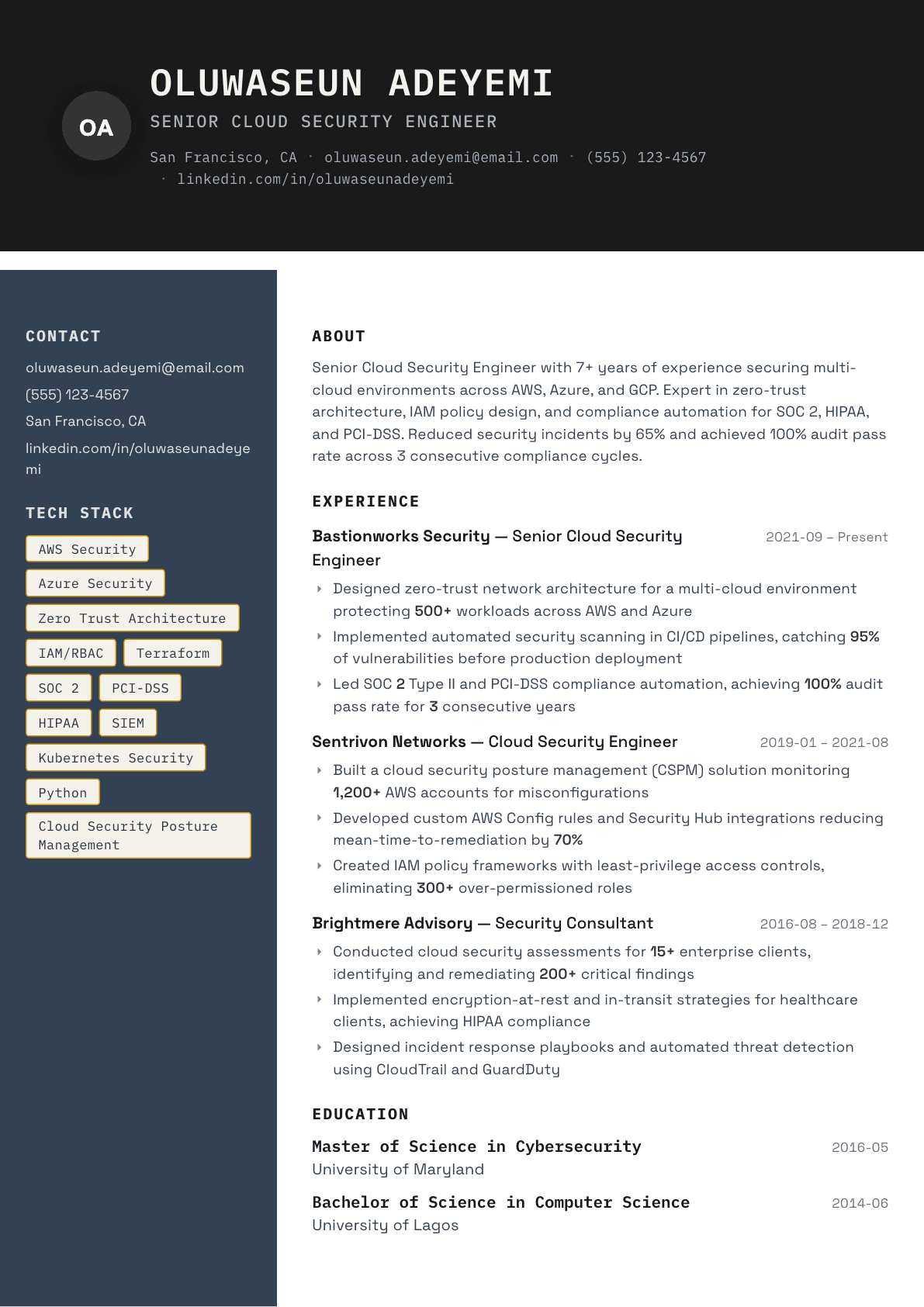
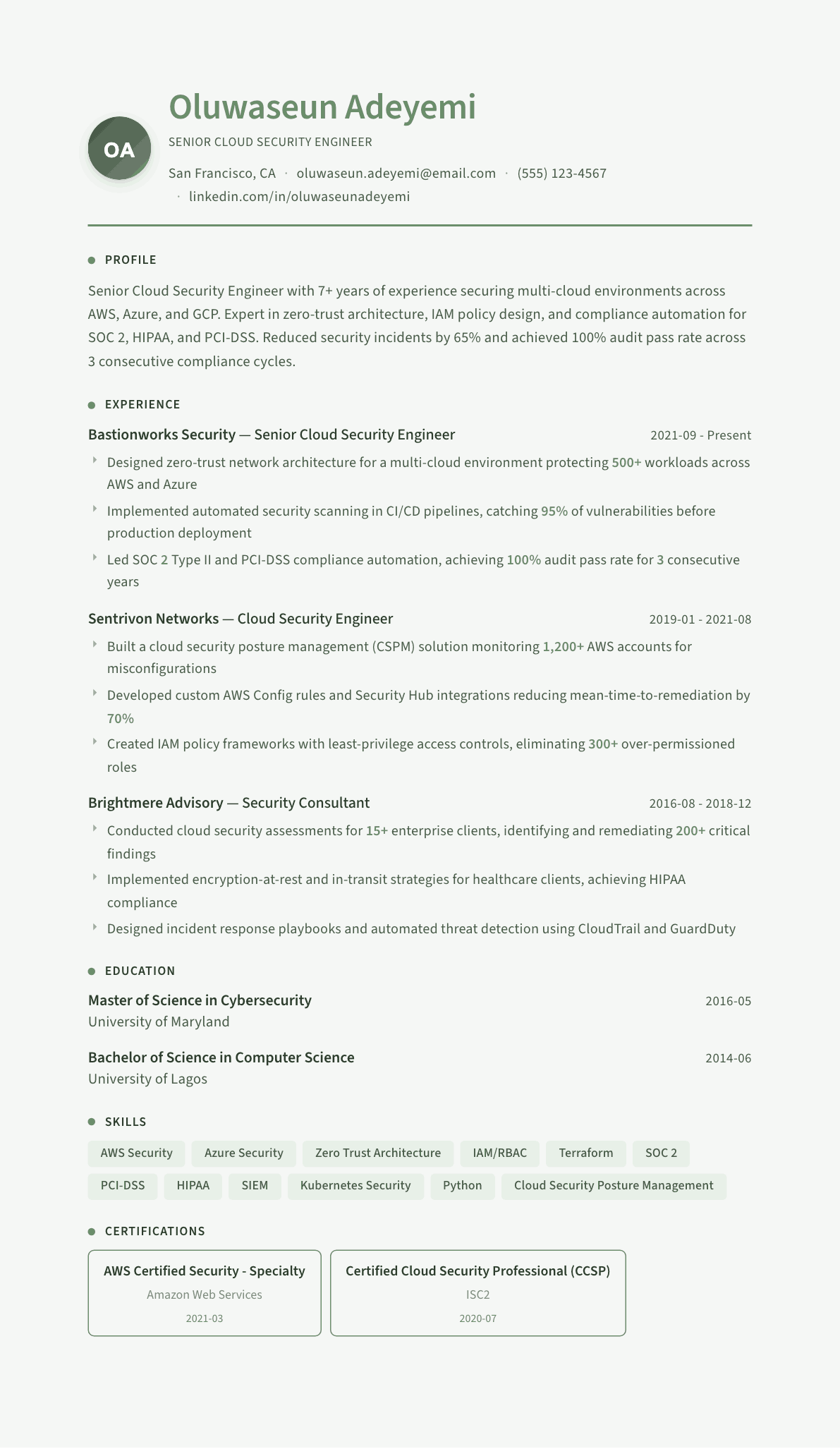
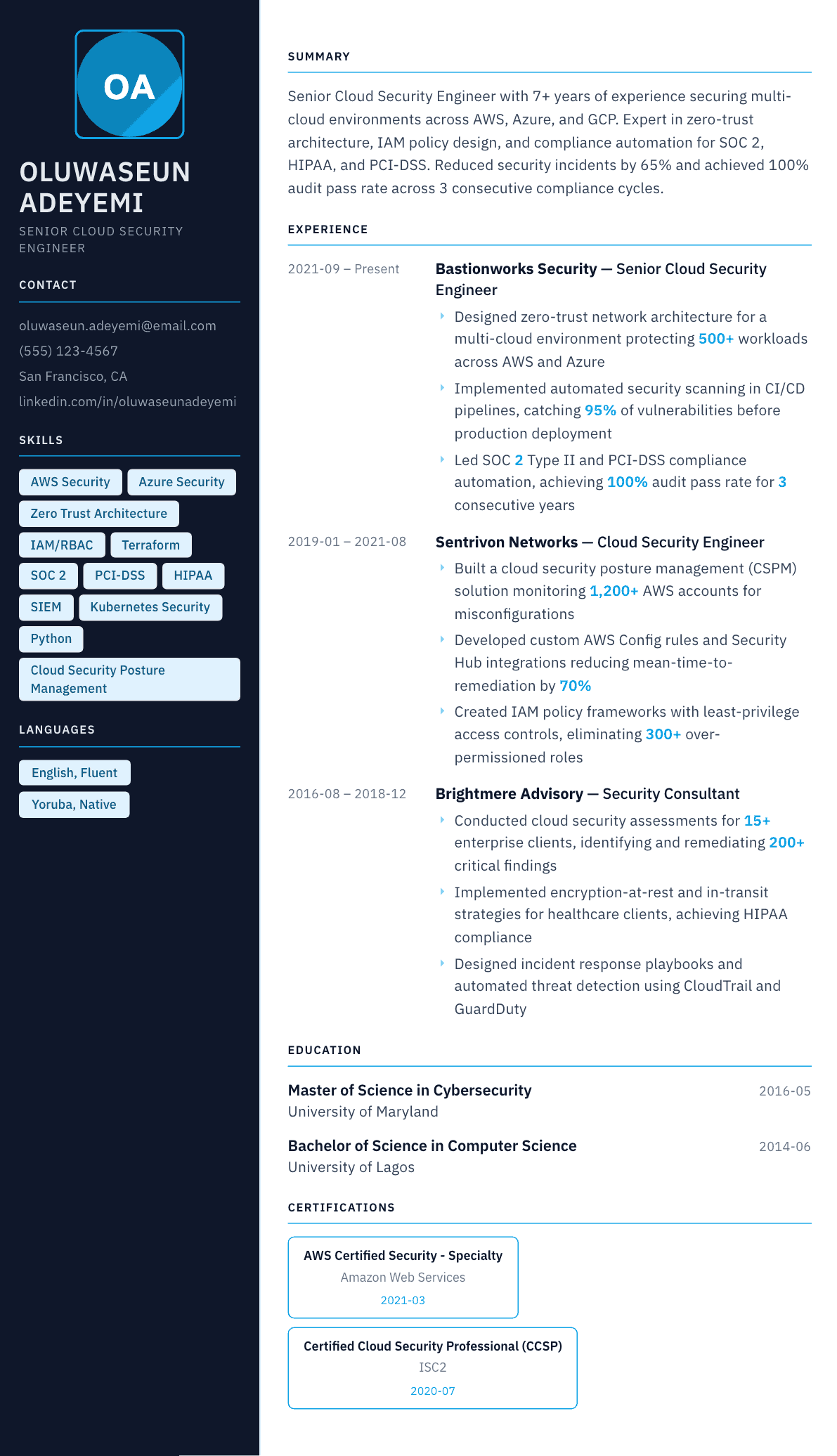
Example Cloud Security Engineer summary
Senior Cloud Security Engineer with 7 years of experience securing multi-cloud environments across AWS, Azure, and GCP. Designed zero-trust architectures protecting 500+ workloads and achieved 100% audit pass rate across SOC 2 and PCI-DSS compliance cycles. Expert in IAM policy design, CSPM, and security automation in CI/CD pipelines.
Skills to list on a Cloud Security Engineer resume
- AWS Security
- Azure Security
- GCP Security
- Zero Trust Architecture
- IAM/RBAC
- Terraform
- SOC 2/PCI-DSS/HIPAA
- SIEM & SOAR
- Kubernetes Security
- Python
- Incident Response
- Vulnerability Management
What actually gets this resume read
- List compliance frameworks you have implemented: SOC 2, HIPAA, PCI-DSS, FedRAMP, ISO 27001.
- Quantify security improvements: incidents reduced, vulnerabilities caught, or remediation time decreased.
- Highlight cloud-native security tools: GuardDuty, Security Hub, Defender for Cloud, or Prisma Cloud.
- Include certifications prominently: CCSP, AWS Security Specialty, CISSP, or OSCP.
- Demonstrate automation: security-as-code, policy-as-code (OPA/Rego), or automated compliance scanning.
How to write a cloud security engineer resume
A cloud security engineer resume gets screened by a security manager who has been burned twice: once by a hire who could quote frameworks but could not read an identity policy, and once by a hire who could build detections but never got a control past an auditor. The page has to prove both halves, engineering depth and audit credibility, or it lands in the maybe pile.
The signal that separates candidates is specificity about the control plane. Which identity model you designed, which findings you triaged and from which posture tool, which compliance regime the environment sat under, and how much of it you automated. Words like hardened and best practices are invisible to this reader because everyone uses them.
This guide sets out how to structure each section, three summaries at the levels security managers recognize, before-and-after bullets, and the questions engineers ask when moving from a security operations center or a platform team into cloud security.
Format: two pages, certifications and clearances near the top
One page works until roughly five years in, then two. Reverse chronological, single column. Security postings often route through recruiters who filter on credentials before a human reads anything, so keep certifications in a labeled block high on page one, with the issuing body spelled out.
If you hold a government clearance or have worked in a regulated program, say so in the header area with the level and status. It changes which roles you are eligible for and screeners look for it first.
- Header: name, title, location, email, certifications in short form, clearance if you hold one.
- Order: summary, certifications, experience, technical skills grouped by domain, education.
- Keep the compliance regimes as plain text so the parser catches SOC 2, PCI DSS, HIPAA and ISO 27001.
Summary: the estate, the regime, and the thing you built
Three lines. Name the clouds you have secured, the size of the estate in accounts or subscriptions, the compliance regime the environment answered to, and the single most defensible thing you have built: a zero trust access model, a detection pipeline, an automated remediation layer, a first-time audit pass.
Cloud security has an unusually broad title, so state your center of gravity. Posture and compliance, identity engineering, detection and response, or container and workload security are different day jobs. A manager hiring for one reads a generic summary as a candidate for none of them.
Experience: controls you designed, findings you closed, alerts you built
Under each job, give the environment: cloud, account count, workload type and the regulatory context. Then write bullets in the shape control, mechanism, result. A least-privilege rewrite of delegated admin roles, implemented as permission boundaries in Terraform, that removed a class of standing access. A detection for anomalous role assumption, written as a query in the security information and event management platform, that fired on a real credential leak.
Include the operational side. Security engineers who have never worked an incident read as theoretical. Name what you did in one: the containment step, the credential rotation, the forensic evidence you preserved, the write-up you produced.
Name the tooling honestly. Cloud native posture and detection tools such as GuardDuty, Security Hub, Defender for Cloud and Security Command Center sit next to third party posture platforms and open-source scanners. Say which you configured versus which you only consumed alerts from.
Automation: the difference between an engineer and a reviewer
The title says engineer, so at least a quarter of the page should be code and pipelines. Policy as code with Open Policy Agent and Rego, infrastructure scanning in the pull request with tfsec or Checkov, secret scanning before merge, automated remediation functions that quarantine a public storage bucket, and evidence collection that produces audit artifacts without a spreadsheet.
Say what the automation replaced. A control that used to be a quarterly manual review and now runs on every deployment is a much stronger claim than a list of tools that exist in the environment.
Compliance: name the regime, the scope and your role in it
Write compliance work as engineering, not paperwork. State the framework, whether the scope was the whole estate or one product boundary, which controls you owned, and the outcome of the assessment. An engineer who mapped controls to actual cloud configuration and produced the evidence automatically is describing a technical contribution.
Be precise about your part. Supporting an audit, owning a control family and running the readiness program are three different levels of responsibility, and inflating one to the next is easy for an auditor-turned-manager to spot.
Cloud Security Engineer resume summary examples
Moving in from the security operations center
Security analyst with 3 years in a 24-hour operations center, now focused on cloud. Rebuilt AWS detections in Splunk covering role assumption and key exposure, wrote the first Terraform guardrails for a 9-account organization, and holds the AWS Security Specialty certification.
Four years in cloud security
Cloud security engineer with 4 years across AWS and Azure in a healthcare environment under HIPAA. Owns the posture program for 55 accounts, cut open critical findings 72% in two quarters, and automated bucket and key remediation with event-driven functions.
Lead or staff engineer
Staff cloud security engineer with 9 years securing multi-cloud estates. Designed the zero trust access model for 600 workloads, replaced standing admin access with just-in-time elevation, and led the readiness program for a first-time SOC 2 Type II with no exceptions raised.
Work experience bullets: before and after
Before: Responsible for cloud security across AWS environments.
After: Owned the security posture of a 55-account AWS organization: service control policies by environment, centralized CloudTrail and Config into a dedicated audit account, and a weekly findings review with the platform team.
Naming the account count and the three concrete mechanisms shows ownership rather than an assigned area.
Before: Implemented least privilege access policies.
After: Rewrote 140 IAM roles against 90 days of access analyzer data, removed wildcard actions from every delegated admin role, and enforced permission boundaries so new roles cannot exceed the baseline.
The evidence source and the enforcement mechanism prove the change is durable rather than a one-time cleanup.
Before: Worked on SOC 2 compliance.
After: Owned the logical access and change management control families for SOC 2 Type II, mapped each control to a Config rule, and generated auditor evidence from the API instead of screenshots, cutting evidence collection from 3 weeks to 2 days.
Naming the control families and the evidence method turns compliance support into engineering work.
Before: Used security tools to find vulnerabilities.
After: Added Checkov and secret scanning to the Terraform pull request pipeline, blocking merges on high findings, which stopped 26 public security group rules and 4 committed access keys before deployment.
A prevention count at the point of change is stronger than a scanner that only reports after the fact.
Before: Handled security incidents when they occurred.
After: Led containment on a leaked deployment key: revoked the credential within 12 minutes, rotated the dependent secrets, preserved CloudTrail evidence for the investigation, and wrote the postmortem that produced the short-lived credential standard.
A timeline and a resulting standard show incident handling that changed the environment, not just closed a ticket.
Hard skills
- AWS security services
- Azure security services
- Google Cloud security services
- Identity and access policy design
- Cloud security posture management
- Kubernetes and container security
- Terraform and policy as code
- SIEM detection engineering
- Vulnerability management
- Secrets management
- Incident response and forensics
- Network segmentation and private connectivity
- SOC 2, PCI DSS, HIPAA and ISO 27001 controls
- Python automation
Soft skills
- Writing clear postmortems
- Negotiating fixes with engineering teams
- Risk communication to leadership
- Working with external auditors
- Prioritizing findings by real exposure
- Calm under incident pressure
Certifications worth listing
- Certified Cloud Security Professional (CCSP) (ISC2)
- Certified Information Systems Security Professional (CISSP) (ISC2)
- AWS Certified Security Specialty (Amazon Web Services)
- Microsoft Certified: Azure Security Engineer Associate (Microsoft)
- Professional Cloud Security Engineer (Google Cloud)
- Certificate of Cloud Security Knowledge (CCSK) (Cloud Security Alliance)
- Offensive Security Certified Professional (OSCP) (OffSec)
Mistakes that cost cloud security engineer candidates the interview
- Listing frameworks without saying which controls you personally owned, which reads as audit support rather than security engineering.
- Filling the skills block with vendor product names you have only seen in a demo. Managers ask how you tuned the tool.
- Counting alerts instead of outcomes. The number of findings a scanner produced says nothing about what you fixed.
- Leaving out identity work. Access design is the core of cloud security and its absence suggests you sat on the reporting side.
- Writing the whole page around one cloud when the posting is explicit about a second, without saying what you have done there.
- Omitting incident experience, which makes an otherwise strong page read as posture dashboards and nothing operational.
- Using an infographic template with security icons, which strips the framework names a recruiter filters on.
Cloud Security Engineer resume questions
Do I need CISSP for a cloud security engineer role?
Not usually. CISSP is weighted for management and governance tracks, while hands-on cloud roles favor a platform security certification such as the AWS Security Specialty or the Azure Security Engineer credential. Hold both only if your work genuinely spans policy and engineering.
How do I move from a SOC analyst job into cloud security?
Reframe your detections as cloud work: which log sources, which identity events, which false positive rate you reduced. Then add build evidence such as Terraform guardrails, a posture tool you configured or automated remediation you wrote, even from a personal account.
Should I put vulnerability counts on my resume?
Only with context. A raw count of findings tells the reader how noisy your scanner is. Give the change instead: critical findings open at the start, what you changed, where they landed, and how long remediation took after the fix.
How much coding should a cloud security engineer show?
Enough that the reader believes you build controls rather than review them. Python or Go for automation, Terraform for guardrails, and policy as code are the common three. At least two or three bullets should describe something you wrote and deployed.
Can I name the compliance audits I supported at a previous employer?
Name the framework and the audit type, which are standard industry terms, but keep client names and findings detail out unless they are already public. Describe your control ownership and the outcome in general terms and no confidentiality line is crossed.
Related resume examples
- Cybersecurity Analyst Resume example
- Platform Engineer Resume example
- Infrastructure Engineer Resume example
- Cybersecurity Manager Resume example
- Security Engineer Resume example
- Cloud Architect Resume example