Strategy Director Resume Examples: the lines they read
Craft a Strategy Director Resume That Commands Attention
By Mustafa Tarabya, founder of CVBooster · Published · Updated
Create a strategy director resume that communicates boardroom-level insight, competitive analysis expertise, and a track record of driving organizational growth.
Sample resumes for a strategy director
The same strategy director content laid out in three CVBooster templates, so you can see what the finished document looks like before you write a word.
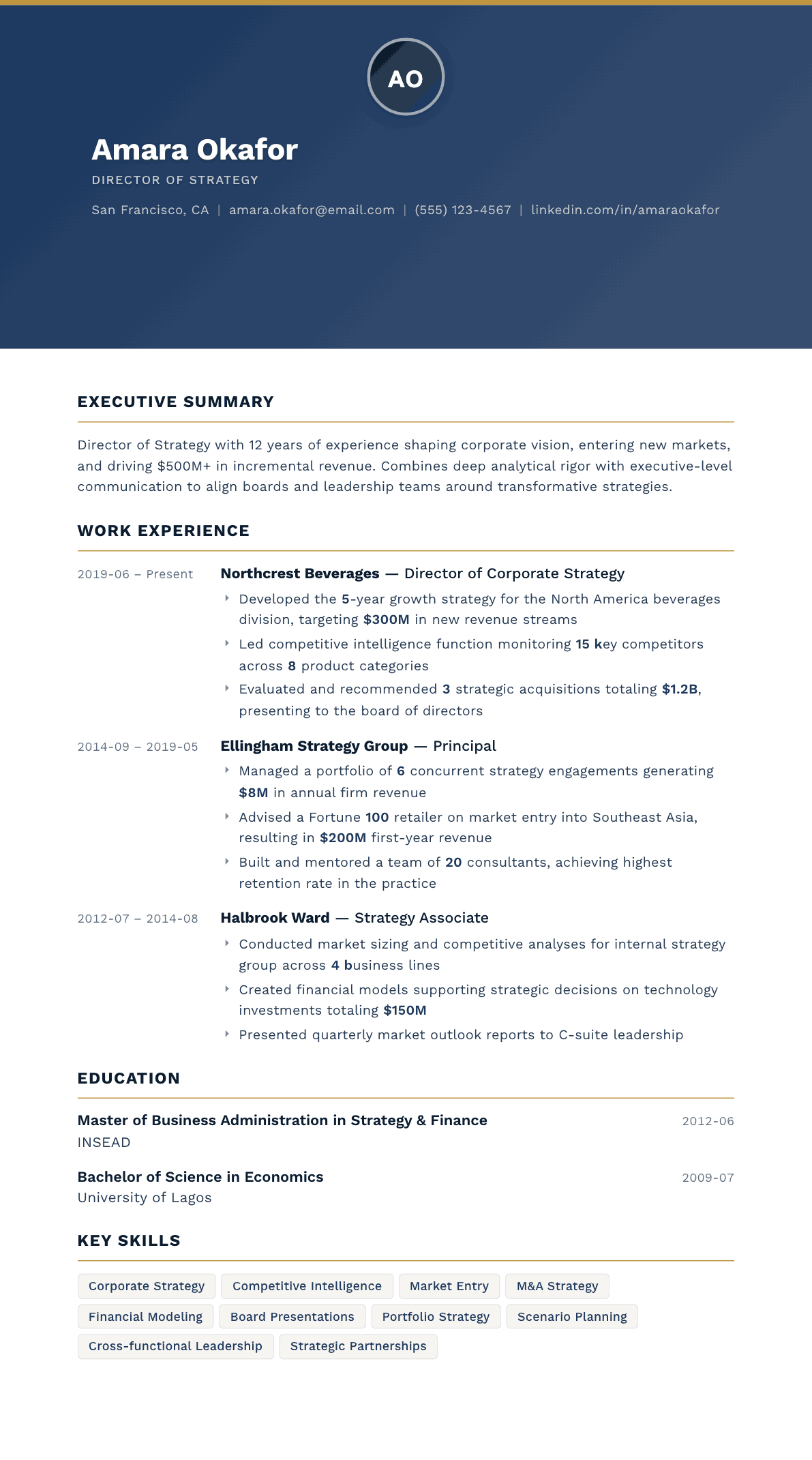
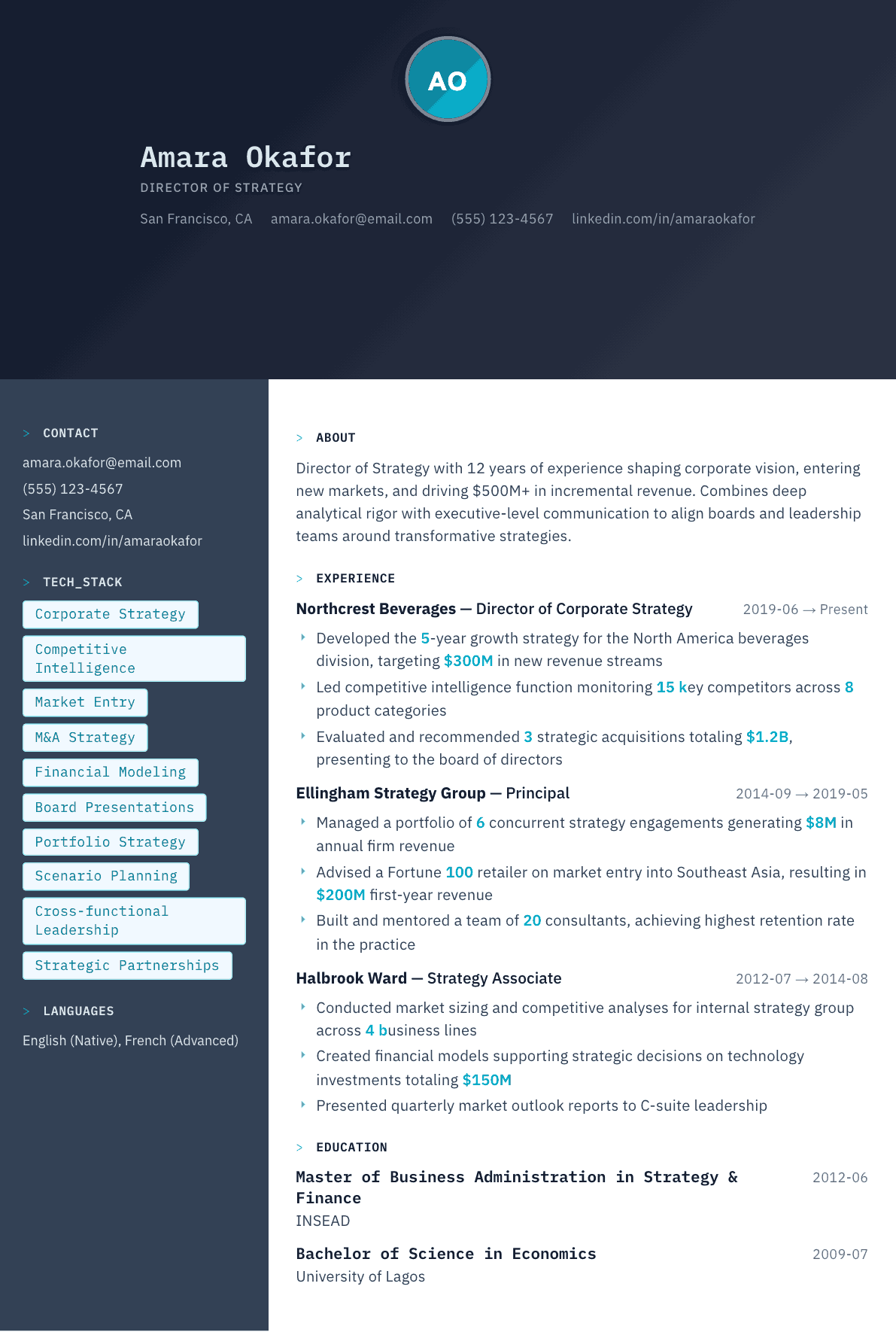
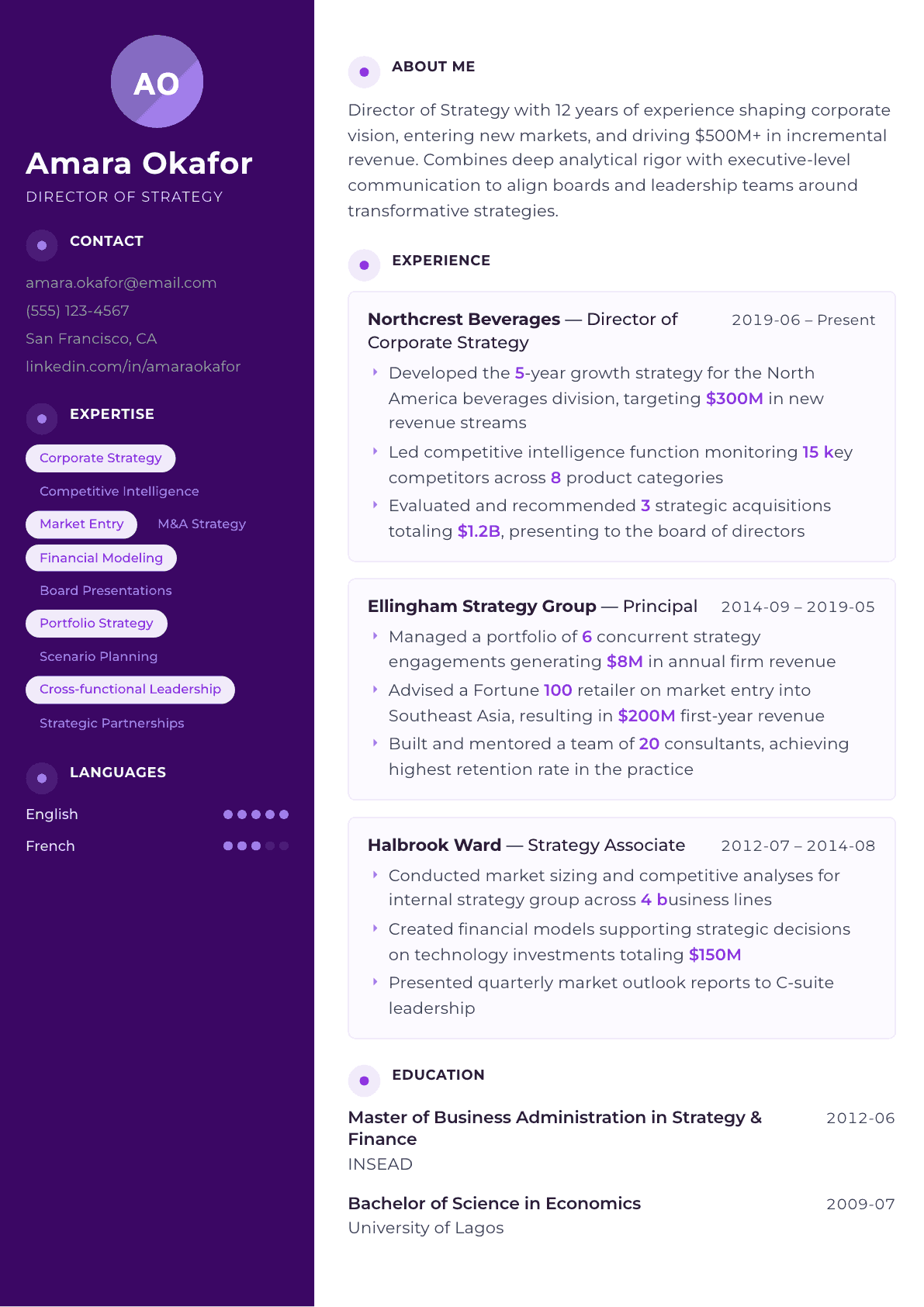
Example Strategy Director summary
Director of Strategy with 12 years of experience driving corporate growth through market expansion, M&A, and competitive positioning. Delivered $500M+ in incremental revenue across consumer goods and financial services. Adept at aligning executive teams and boards around bold, data-driven strategies. Seeking a VP Strategy role to shape the next chapter of a high-growth organization.
Skills to list on a Strategy Director resume
- Corporate Strategy
- Competitive Intelligence
- Market Entry Strategy
- M&A Advisory
- Financial Modeling
- Scenario Planning
- Board-Level Communication
- Portfolio Rationalization
- Strategic Partnerships
- Growth Strategy
- Business Case Development
- Cross-Functional Leadership
What actually gets this resume read
- Focus on strategic outcomes: market share gained, revenue generated, partnerships secured.
- Demonstrate experience presenting to boards, C-suites, and investor audiences.
- Show breadth of strategic work: M&A, market entry, competitive analysis, portfolio optimization.
- Quantify the scale of decisions you influenced (budget size, market value, headcount).
- Highlight consulting or investment banking backgrounds if applicable.
- Use a clean, executive-style template that signals seniority.
How to write a strategy director resume
A strategy director resume is screened by two readers with opposite instincts. A talent partner scans for the markers corporate development teams filter on: the firm, the MBA, the industries, the words market entry, portfolio and board. The chief strategy officer who owns the opening reads for something narrower, which is whether you have ever owned a recommendation that the company then acted on and lived with.
Most strategy resumes fail on that second read. They list engagements, workstreams and deliverables: a market sizing, a diligence, a competitor teardown. Deliverables are the raw material of the job, not the job. The director-level question is what got decided, who you had to convince, and what happened to the number afterward.
This guide covers the section order a corporate strategy team expects, how to write about work that is confidential, three summaries at different stages, before and after bullets, and the questions strategy people ask when they move from a consulting resume to a corporate one.
Format: two pages once you are past the associate years
Reverse chronological, two pages, no columns. Strategy resumes carry more per line than most, so give yourself the room instead of shrinking the font. Keep a single column so the applicant tracking system reads dates in order, and put your location in the header, because corporate strategy roles are usually tied to a headquarters.
If you are coming from a consulting firm, resist the case list format the firm taught you. A firm resume groups work by practice area and hides the client. A corporate resume groups by employer, gives the title and the reporting line, and describes clients by industry and size when the name is confidential.
- Header: name, target title, city, phone, email and professional profile.
- Order: summary, experience, education, selected engagements if you need them, then skills.
- Name the reporting line for each role. Strategy directors report anywhere from the CFO to the CEO and it changes the job.
- Two pages is standard. Three reads as an inability to prioritize, which is the skill being hired.
Summary: your mandate, your scope, the decisions you carried
Four lines. Say what kind of strategy you do, because the title covers very different jobs: corporate portfolio and M&A, growth and market entry, competitive intelligence, or operating strategy tied to the annual plan. Then the scale you worked at, the industries, and one decision that went your way.
Skip the sentence about being a data-driven leader who partners cross-functionally. Every applicant claims it, and it costs you the only four lines a chief strategy officer reads before deciding whether to keep going.
Experience: decisions, not deliverables
Write each bullet as a decision with your fingerprints on it. The pattern that works is the question, the work, the recommendation, and what the company did next. A board pack that led nowhere is worth less than a small recommendation that changed a budget line the following quarter.
Handle confidentiality by describing shape rather than names. A specialty chemicals target in the low hundreds of millions is a real description; the target company name is not yours to give. Screeners in this field read that convention as good judgment rather than as vagueness.
Show the analytical machinery once, then stop. One bullet per role can carry the method: the market model, the diligence, the scenario set. The rest should be about alignment, because a director spends more hours getting a divisional president to agree than building the model.
The evidence a corporate strategy team checks
Strategy interviews test three things on paper before they test them in a case. First, whether you can size a market from the bottom up rather than pulling a figure out of an analyst report. Second, whether you understand the economics of the business you were in and not just its slide language. Third, whether you can be trusted in front of a board.
- Market entry and expansion: geography, segment, the go or no-go call, and the entry route chosen.
- Portfolio and M&A: screens run, targets diligenced, deals recommended, deals killed, integration input.
- Annual planning: your role in the three-year plan, the target setting, and the review cadence you ran.
- Competitive intelligence: the cadence, who consumed it, and one call you made early.
- Capability building: analysts hired, a strategy function stood up, a planning process introduced.
Skills, tools and education
A strategy skills block should read like a working toolkit and not a course catalog. Name the modeling you actually do, the research sources you have licensed and used, and the systems where the numbers live, because a director who cannot pull a clean revenue cut out of the reporting layer is dependent on someone who can.
Education carries more weight here than in most fields. Put the MBA and the school on the first page. A CFA level or a quantitative graduate degree belongs there too. Certificates in generic leadership training do not, because they dilute the credentials a strategy screener respects.
Keywords a corporate strategy posting repeats
Strategy postings are written by the team that will read your resume, so the vocabulary is precise. Expect corporate development, market sizing, competitive landscape, portfolio strategy, business case, scenario planning, executive alignment, and the industry terms of the sector. Mirror the ones that are true of you in the summary and again in the bullet that proves them.
Strategy Director resume summary examples
Consultant moving in-house
Strategy professional with 4 years at a global consultancy across consumer goods and industrials, now moving in-house. Built the bottom-up market model behind a client decision to enter two new categories, and ran commercial diligence on a mid-size bolt-on acquisition. MBA in strategy and finance.
Six years in
Strategy manager with 8 years across consulting and corporate roles in beverages. Owns the three-year growth plan for a business unit, runs the quarterly competitor review for the leadership team, and led the screen that produced two bolt-on acquisitions. Comfortable presenting to a board and to a plant.
Head of strategy
Director of Strategy reporting to the CEO, with 12 years across consulting, corporate development and operating strategy. Owns portfolio review, market entry and the annual planning cycle for a multinational business. Recommended three acquisitions and the exit of one underperforming category, and built a four-person team.
Work experience bullets: before and after
Before: Conducted market sizing and competitive analysis for leadership.
After: Built a bottom-up model of the North America ready-to-drink category by channel and pack size, which set the entry sequence leadership approved for the next planning cycle.
The strong version names the market, the method and the decision that followed, so the reader sees ownership rather than analysis.
Before: Supported M&A activity.
After: Screened 40 targets against a fit and value filter, ran commercial diligence on 3 of them, and recommended one acquisition and two passes to the investment committee.
Funnel numbers and an explicit recommendation show you carried the judgment, not just the workbook.
Before: Presented findings to senior leadership.
After: Presented the category exit case to the board across two sessions, after pre-aligning the divisional president and the CFO on the underlying assumptions.
Naming the audience and the pre-alignment work shows the political half of the job that a slide count cannot.
Before: Managed the competitive intelligence process.
After: Ran a monthly competitor review covering 15 players across 8 categories, and flagged a discounter pricing move 2 quarters before it reached our share.
Cadence, coverage and one early call turn a process description into evidence of usefulness.
Before: Built financial models to support strategic decisions.
After: Built the scenario model for a technology investment program, testing 3 demand cases and a capital-constrained case, and it became the template finance reused for annual planning.
Scenarios and reuse show the model outlived the meeting it was built for.
Hard skills
- Market sizing and segmentation
- Competitive intelligence
- Corporate development and M&A screening
- Commercial due diligence
- Three-year planning and target setting
- Scenario and sensitivity modeling
- Business case development
- Portfolio review
- Pricing analysis
- Board and executive presentation design
- Financial modeling in Excel
- SQL for revenue and customer analysis
- Post-merger integration planning
Soft skills
- Executive persuasion
- Structured problem framing
- Stakeholder alignment
- Written argument
- Comfort with ambiguity
- Mentoring analysts
Certifications worth listing
- Chartered Financial Analyst (CFA) (CFA Institute)
- Certified Management Consultant (CMC) (Institute of Management Consultants USA)
- Financial Modeling and Valuation Analyst (FMVA) (Corporate Finance Institute)
Mistakes that cost strategy director candidates the interview
- Submitting the consulting case list instead of a corporate resume, so the reader cannot tell which decisions were yours.
- Filling the page with deliverables: decks built, analyses run, workshops facilitated, with no outcome attached to any of them.
- Hiding the reporting line, which leaves a screener guessing whether you sat beside the CEO or three levels below a business unit head.
- Naming confidential targets and clients, which reads as a risk rather than as evidence.
- Leading with tools. Nobody hires a strategy director for spreadsheet skills, and a long software list makes you look like an analyst promoted by tenure.
- Sending one resume to a corporate development opening and a growth strategy opening, when the two teams look for different halves of your history.
Strategy Director resume questions
How do I move from consulting to a corporate strategy director role?
Reframe engagements as ownership. Group by employer, describe clients by industry and size, and lead each bullet with the recommendation and what the client did next. Add any secondment or implementation work, because corporate teams worry that consultants leave before the plan is tested.
Should a strategy director resume be one page or two?
Two, once you have more than about six years. Portfolio, planning and deal work will not compress honestly onto one page. Keep it to two, and cut the earliest analyst roles to a single line each rather than shrinking the type to fit.
How do I write about work covered by a confidentiality agreement?
Describe the shape and not the name: the industry, the rough size, the question and the outcome. A strategy screener reads that convention as normal practice. Anything more specific about an unannounced deal will worry the person reading it.
Do I need an MBA on a strategy director resume?
Many corporate strategy teams recruit from consulting firms and MBA programs, so the degree is common in the pile and worth placing on the first page if you have it. Without one, lead harder on deals closed, plans owned and executives you have advised directly.
What metrics belong on a strategy resume?
The ones a decision turned on: market size, share movement, deal value ranges, margin points, and plan targets set and hit. Avoid quoting a headline company result you did not influence, because the first interview question will be about your specific contribution to it.
Related resume examples
- Management Consultant Resume example
- COO Resume example
- VP Operations Resume example
- Strategy Consultant Resume example
- MBA Graduate Resume example
- General Manager Resume example