Student Affairs Coordinator Resume Examples: free score
Write a Student Affairs Coordinator Resume for Higher Education
By Mustafa Tarabya, founder of CVBooster · Published · Updated
Student affairs coordinator resume examples with programming, advising and retention keywords, plus a section by section writing guide.
Sample resumes for a student affairs coordinator
The same student affairs coordinator content laid out in three CVBooster templates, so you can see what the finished document looks like before you write a word.
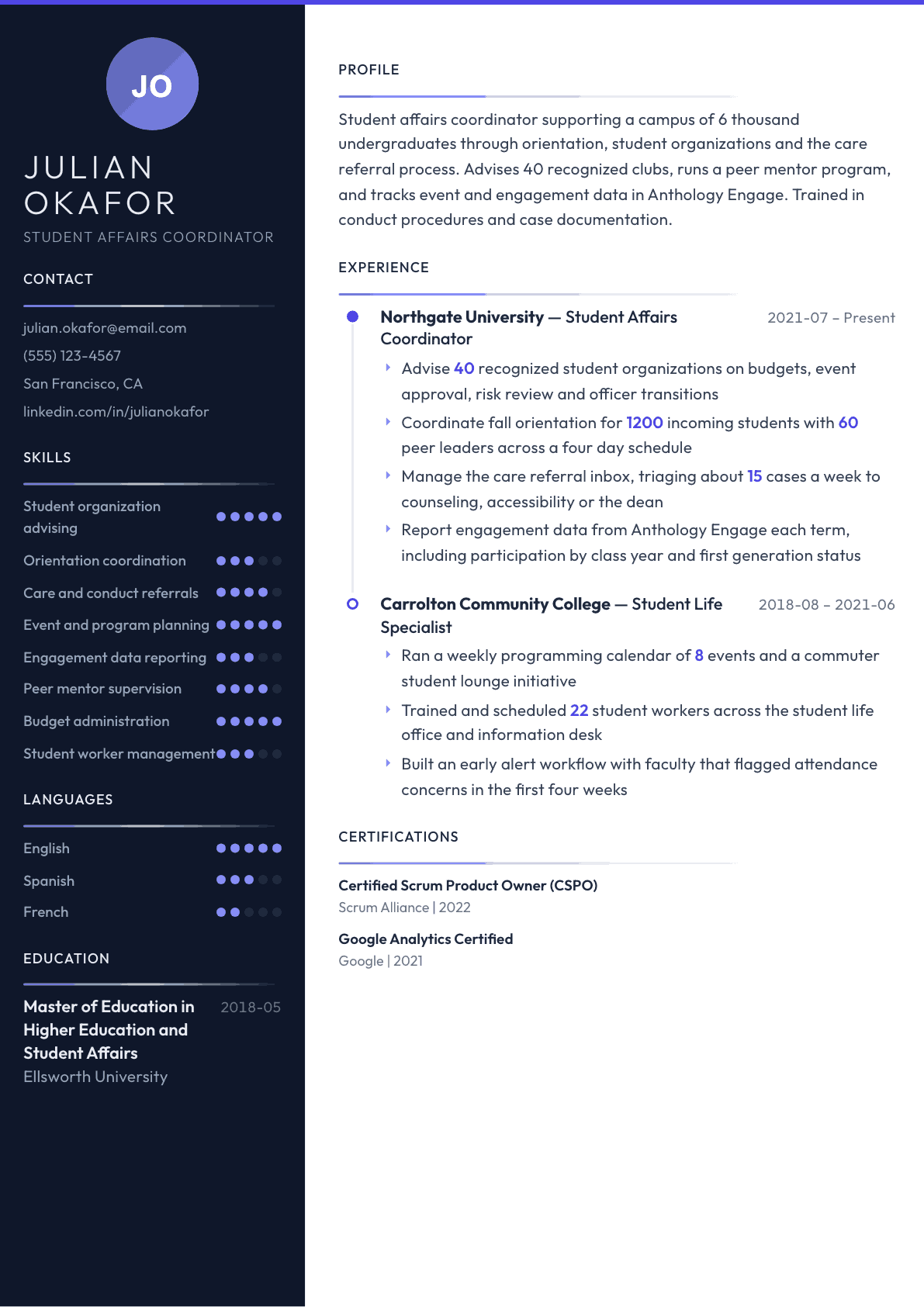
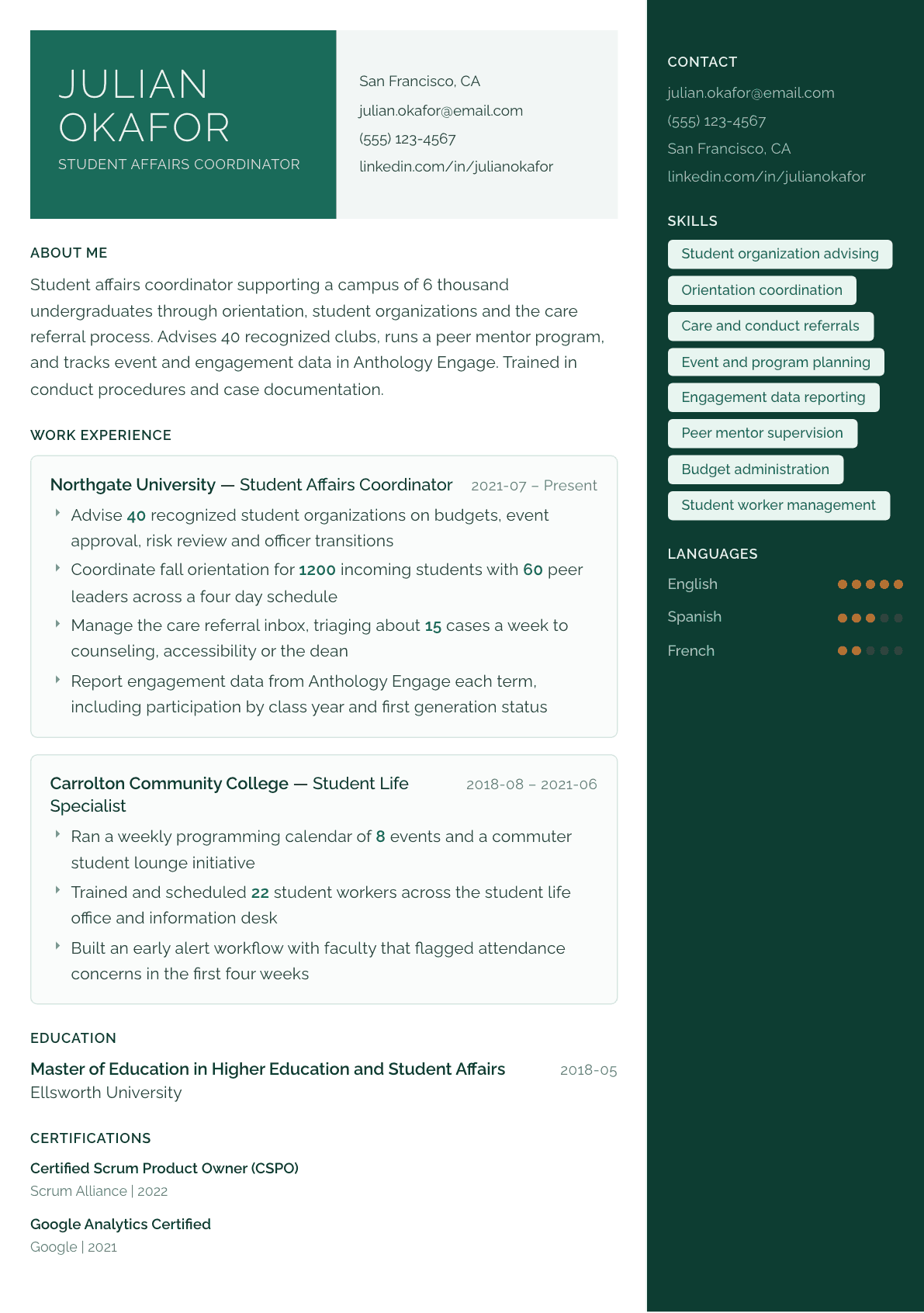
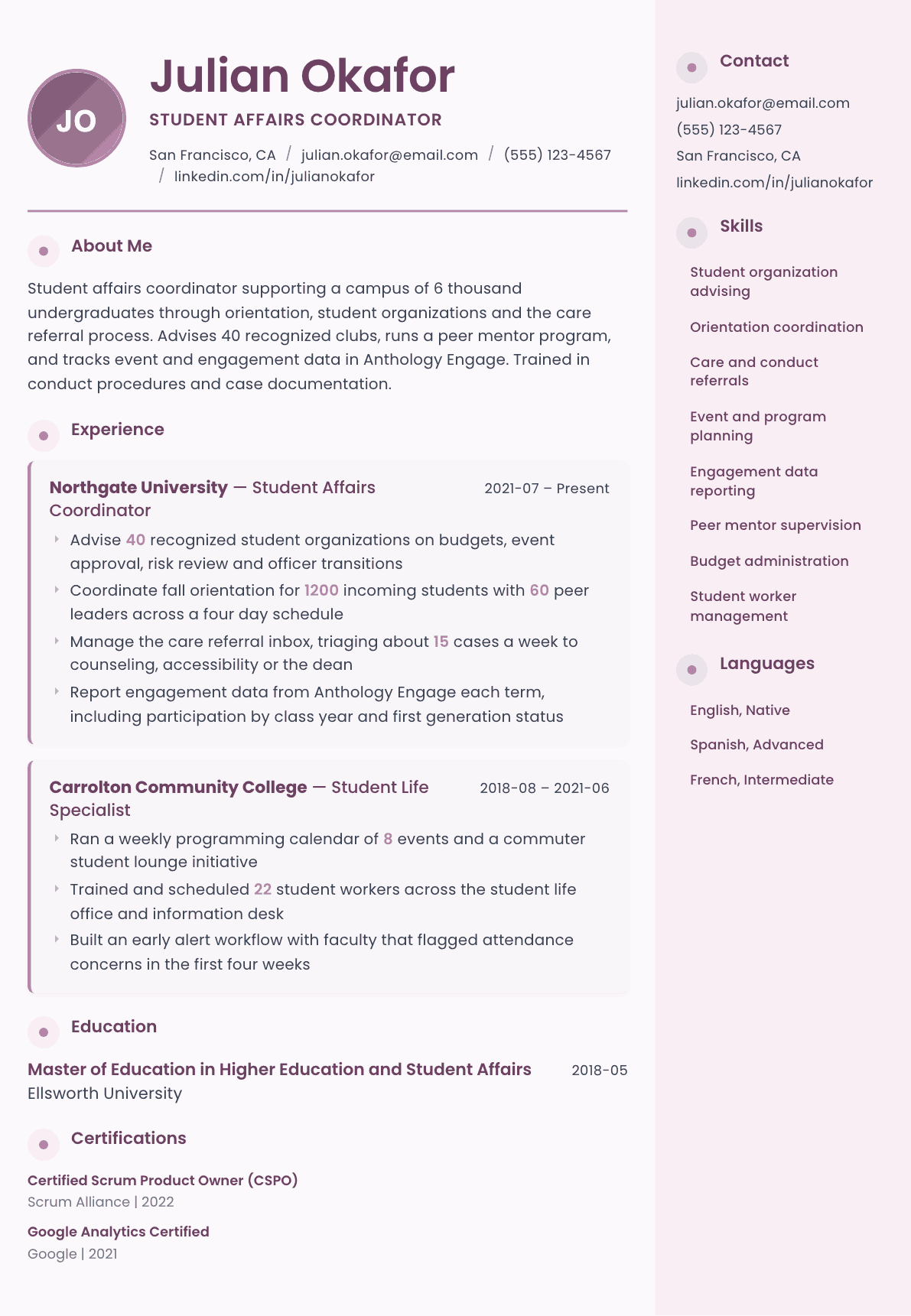
Example Student Affairs Coordinator summary
Student affairs coordinator at a campus of six thousand undergraduates, advising forty recognized organizations and coordinating a four day orientation for twelve hundred new students. Triages care referrals to counseling, accessibility and the dean, supervises peer mentors, and reports engagement data each term. Focused on early connection for first generation and commuter students who leave quietly when nothing holds them.
Skills to list on a Student Affairs Coordinator resume
- Student organization advising
- Orientation and welcome programming
- Student conduct procedures
- Care team and referral triage
- Event planning and risk review
- Leadership development programs
- Peer mentor training
- Engagement platform administration
- Assessment and learning outcomes
- Budget tracking and allocations
- Student staff supervision
- Retention initiatives
- Diversity and belonging programming
- Crisis response protocols
What actually gets this resume read
- Name the institution type and enrollment size, since a community college and a residential campus run differently.
- Give the functional areas you own: orientation, organizations, conduct, care, housing, leadership, multicultural programs.
- Quantify programming: number of events, attendance, organizations advised, student staff supervised, budget managed.
- Show assessment work, because student affairs postings now ask for learning outcomes and engagement data.
- Mention the platforms you use, such as Anthology Engage, Maxient or Slate, because search filters look for them.
- Connect your work to retention and belonging in plain terms, since that is what a dean is being asked to prove.
How to write a student affairs coordinator resume
Student affairs hiring runs through a search committee, not a single manager, and that changes what the resume has to do. A director of student life, someone from the dean of students office, a faculty member and often a student all read the same document and each is checking a different thing: functional expertise, judgment in a crisis, campus fit and whether students would actually talk to you.
The functional areas are the spine. Orientation, student organizations, leadership programs, conduct, care and case management, residence life, multicultural and identity centers, and campus activities are all distinct portfolios with their own vocabulary. A coordinator who writes only about supporting students without naming a portfolio reads as unplaceable.
This guide covers how to build a student affairs coordinator resume around functional areas and assessment, three summaries from graduate assistant through associate director, before and after bullets that turn programming language into evidence, and the questions that come up moving between institution types.
Format: one to two pages, functional areas visible, no CV sprawl
One page for a first professional role, two once you have supervised staff and owned a portfolio. Higher education tempts people toward a curriculum vitae with presentations, committees and professional memberships stretching across four pages. For a coordinator role, keep that material to a short professional service section and put the operational work first.
Make the functional areas legible at a glance. A committee member skimming should be able to say within seconds that you do orientation and organization advising, or conduct and care, and then read for depth. Ordering bullets by area rather than chronology inside a long role helps here.
- Header: name, city, phone, email, and a professional profile link if you keep one current.
- Sections: summary, student affairs experience, assessment and data, education, professional service, skills and platforms.
- Under each institution: type, enrollment, residential or commuter, and the office you sat in.
Summary: institution type, portfolio, scale, and the outcome you care about
Institution type first, because a community college, a regional public university, a small residential college and a large research campus run student affairs completely differently. Commuter populations, part time students and working adults change every assumption about programming, and a committee wants to know you understand theirs.
Then your portfolio and its scale: organizations advised, students served through orientation, cases triaged, staff supervised, budget managed. Finish with the outcome you work toward, usually retention, belonging or student learning, stated in plain language rather than in the abstractions the field is fond of.
Experience: programs, advising, cases, and the people you supervise
Programming bullets need scale and structure. Number of events, attendance, the planning cycle, the risk review process, and how you handled contracts, catering and facilities. A four day orientation for twelve hundred incoming students with sixty peer leaders is an operations project, and describing it that way shows a committee you can run one.
Advising bullets should show the hard parts. Budget approval and allocation, event registration and risk review, officer transitions, organization recognition and renewal, conflict inside a student group, and the conversation where you tell a president that an event cannot go ahead. That is the work, and it separates an advisor from a room booker.
Care and conduct bullets need care. Give volume and process without any detail that could identify a student: cases triaged weekly, referral pathways to counseling, accessibility, financial aid and the dean, documentation standards, and participation in a behavioral intervention team. Discretion in how you write this is itself a qualification.
Supervision counts more than candidates think. Student staff, peer leaders, graduate assistants and desk workers all involve hiring, training, scheduling, evaluation and occasionally dismissal. State the headcount and what you owned in the cycle.
Assessment: the section most candidates leave out
Student affairs offices are asked every year to justify their budget with evidence, so assessment ability is a genuine differentiator. Say what you measured, how you collected it, and what changed as a result. Participation by class year, engagement of first generation and commuter students, learning outcomes from a leadership program, or a post event survey that redirected the next term's calendar.
Name the platforms, because postings filter on them. Anthology Engage, Presence and similar engagement systems track participation. Maxient handles conduct and care records. Slate covers admissions communication that student affairs often touches. Qualtrics or a similar survey tool does the assessment itself.
- What you measured and the instrument you used to measure it.
- A decision or program change that followed from the data.
- Engagement platform and conduct or case management system administered.
- Learning outcomes written for a program, and how they were assessed.
Keywords, frameworks and the language committees expect
The field has a shared vocabulary and committees notice when it is used correctly: student development theory, learning outcomes, co-curricular engagement, sense of belonging, retention and persistence, risk management, restorative practice, and Title IX and Clery obligations. Use the terms you can defend in an interview and leave the rest alone.
Say something about the students you have worked with most closely: first generation, transfer, commuter, international, veteran, adult learner or residential populations. Committees hire for the gap in their own campus, and naming your population is more useful than a general commitment to serving all students.
Student Affairs Coordinator resume summary examples
Graduate assistant moving to full time
Higher education graduate with 2 years as a residence life graduate assistant supervising 14 resident advisors and an assistantship in campus activities. Coordinated a weekly programming calendar, supported organization budget approvals, and ran post event assessment for a 6 thousand student campus.
Coordinator with a portfolio
Student affairs coordinator advising 40 recognized organizations and coordinating fall orientation for 1200 incoming students with 60 peer leaders. Triages roughly 15 care referrals a week to counseling, accessibility and the dean, and reports engagement data each term by class year and first generation status.
Associate director
Associate director of student life responsible for campus activities, organization advising and leadership programs across a residential campus of 9 thousand. Supervises 3 professional staff and 30 student employees, owns the activities budget, and chairs the campus event risk review process.
Work experience bullets: before and after
Before: Advised student clubs and organizations.
After: Advised 40 recognized student organizations on budget requests, event approval and risk review, officer transitions and annual recognition renewal.
The count and the four advising functions show a real portfolio rather than an open office door.
Before: Helped run new student orientation.
After: Coordinated a 4 day fall orientation for 1200 incoming students with 60 peer leaders, owning the session schedule, facilities bookings and the leader training weekend.
Scale plus the pieces you owned turns a shared event into a project you can be trusted to run.
Before: Supported students who were struggling.
After: Managed the care referral inbox, triaging about 15 cases a week to counseling, accessibility, financial aid or the dean of students, and documenting each referral in Maxient within the day.
Volume, referral pathways and the documentation standard show process without exposing any student.
Before: Collected feedback about our programs.
After: Reported engagement data from Anthology Engage each term, breaking participation down by class year, residential status and first generation status, and cut 3 low attendance events from the spring calendar.
Naming the platform, the breakdown and the decision that followed proves assessment ability rather than data collection.
Before: Supervised student workers in the office.
After: Hired, trained and scheduled 22 student workers across the student life office and information desk, running a fall training day and mid year performance conversations with each one.
The full supervision cycle is what a committee is checking, not the headcount alone.
Hard skills
- Student organization advising
- Orientation and transition programming
- Student conduct procedures
- Care team referral and case triage
- Event planning and risk review
- Leadership program design
- Peer leader recruitment and training
- Engagement platform administration
- Assessment and learning outcomes
- Budget tracking and student fee allocation
- Student staff supervision
- Retention and persistence initiatives
- Title IX and Clery awareness
- Crisis and on-call response protocols
Soft skills
- Judgment in ambiguous situations
- Discretion with sensitive information
- Boundary setting with students
- Partnership across campus offices
- Facilitation of difficult conversations
- Steadiness during a campus incident
Certifications worth listing
- Mental Health First Aid (National Council for Mental Wellbeing)
- Certified Meeting Professional (Events Industry Council)
Mistakes that cost student affairs coordinator candidates the interview
- Writing about supporting students without naming a functional area, which leaves a committee unable to place you.
- Leaving out institution type and enrollment, when a commuter college and a residential campus are different jobs.
- Omitting assessment entirely, which is the evidence the office needs to defend its budget each year.
- Turning the resume into a four page curriculum vitae of committees and conference sessions.
- Including identifying case details, which reads as a discretion problem rather than as experience.
- Skipping supervision numbers when student staff management is a large share of the coordinator role.
- Using field abstractions with no concrete example underneath them, which a committee reads as borrowed language.
Student Affairs Coordinator resume questions
Do I need a master's degree for a student affairs coordinator role?
Many postings prefer or require a master's in higher education, counseling or a related field, though some coordinator roles accept a bachelor's with relevant experience. Assistantship or residence life experience often matters as much as the degree itself.
How do I write about care and conduct cases without breaching confidentiality?
Give volume, referral pathways, documentation standards and the systems you used, and never a case detail. Writing about process rather than incidents demonstrates the discretion the role requires, which is itself part of what is being assessed.
What counts as assessment in student affairs?
Anything that measures participation or learning and changes a decision. Attendance tracked by student group, post event surveys, engagement reports by class year, and learning outcomes written for a leadership program then evaluated against student work all count.
How do I move from a community college to a four year campus, or the reverse?
Name what transfers and what differs. Commuter programming, working adult schedules and transfer support carry into any campus, while residential life, weekend programming and on-call rotations are specific. Address the difference in the summary rather than hoping it passes.
Should I list professional associations and conference presentations?
Yes, in a short professional service section near the end. Two or three lines are enough for a coordinator role. Save a longer list for positions where scholarship is expected, and keep the operational record in the front half of the resume.