Admissions Counselor Resume Examples: what gets the call
Open Doors to Education with an Admissions Counselor Resume
By Mustafa Tarabya, founder of CVBooster · Published · Updated
Build an admissions counselor resume highlighting your recruitment expertise, application review experience, and ability to connect prospective students with the right educational programs.
Sample resumes for a admissions counselor
The same admissions counselor content laid out in three CVBooster templates, so you can see what the finished document looks like before you write a word.
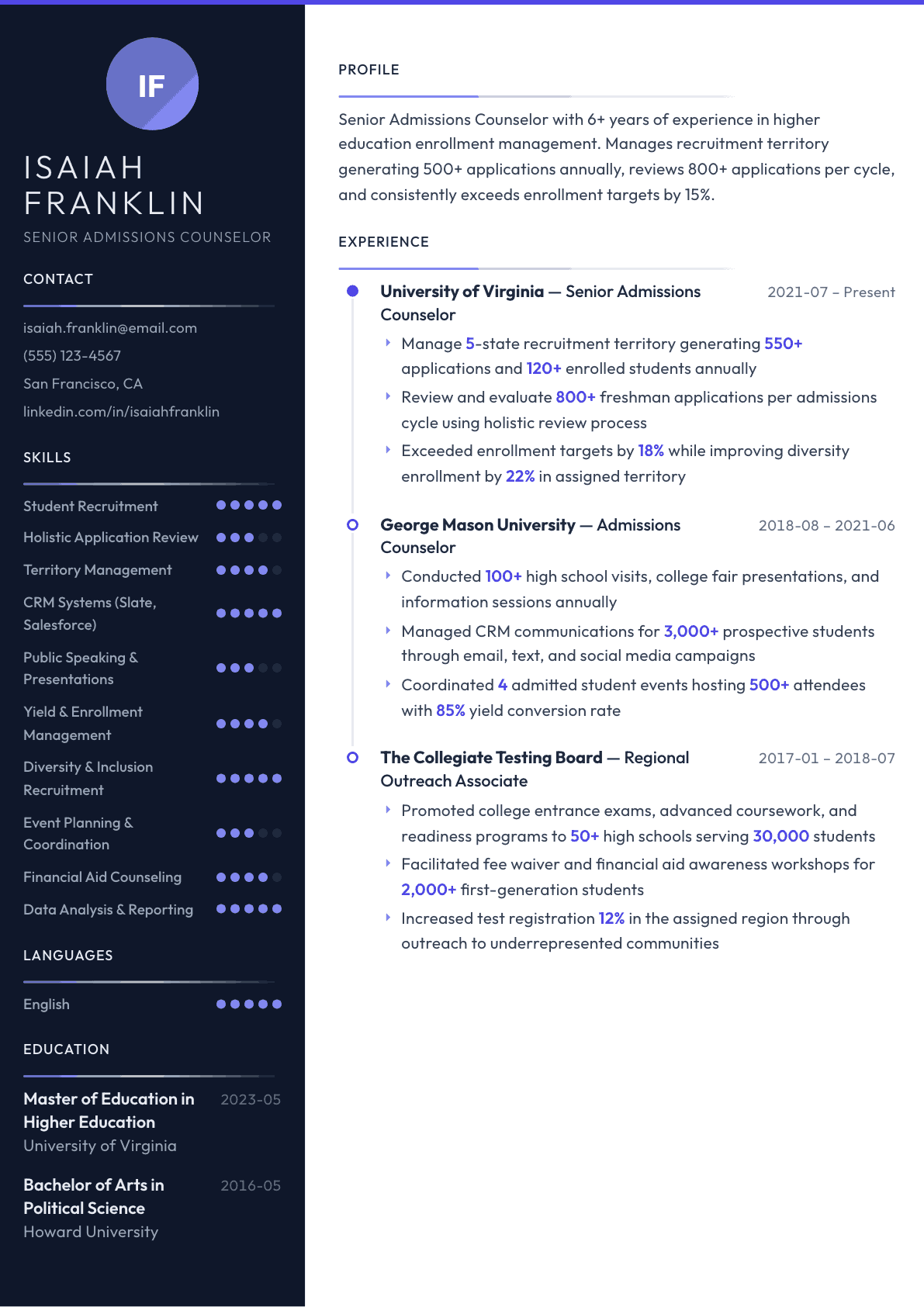
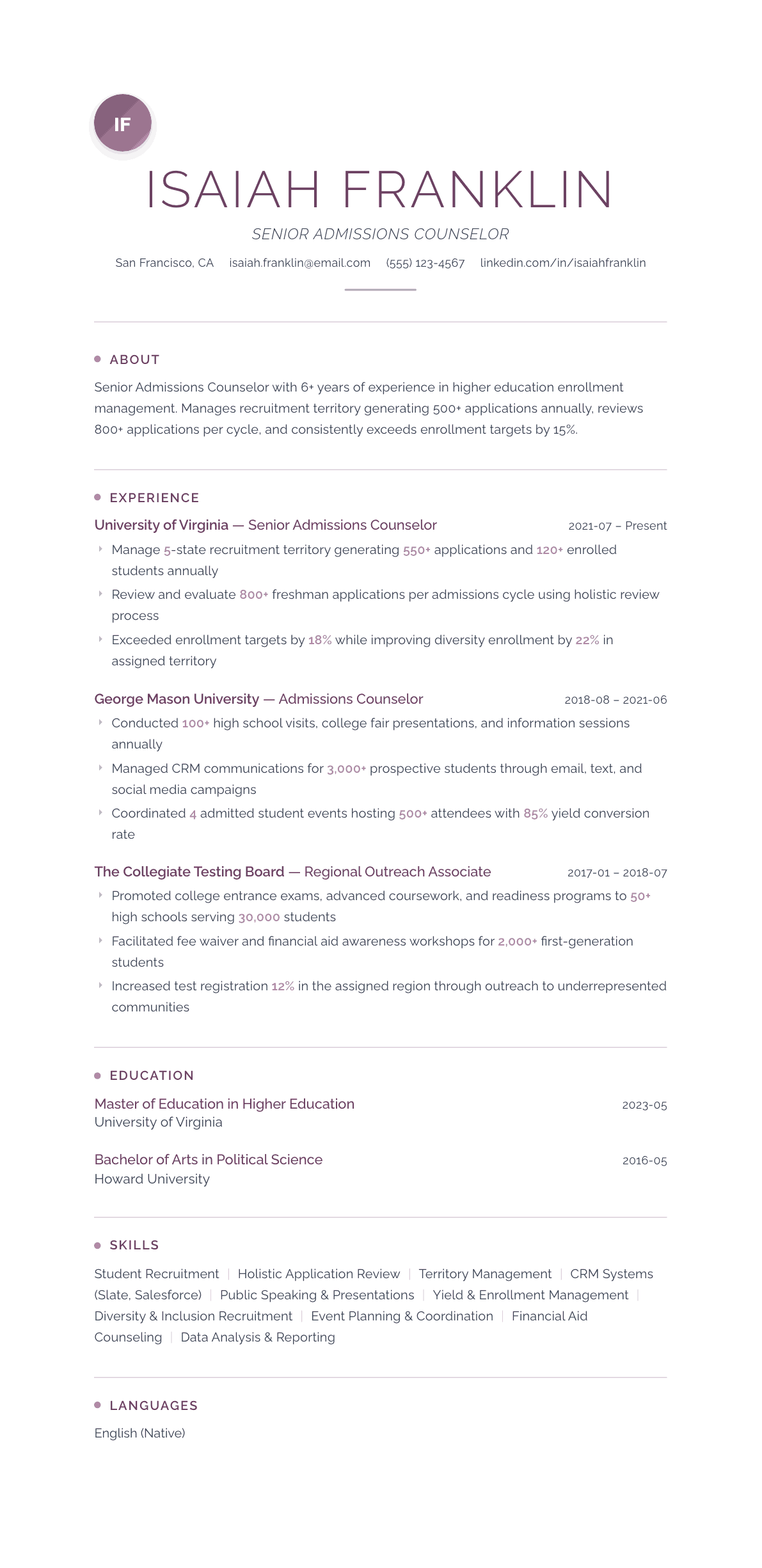
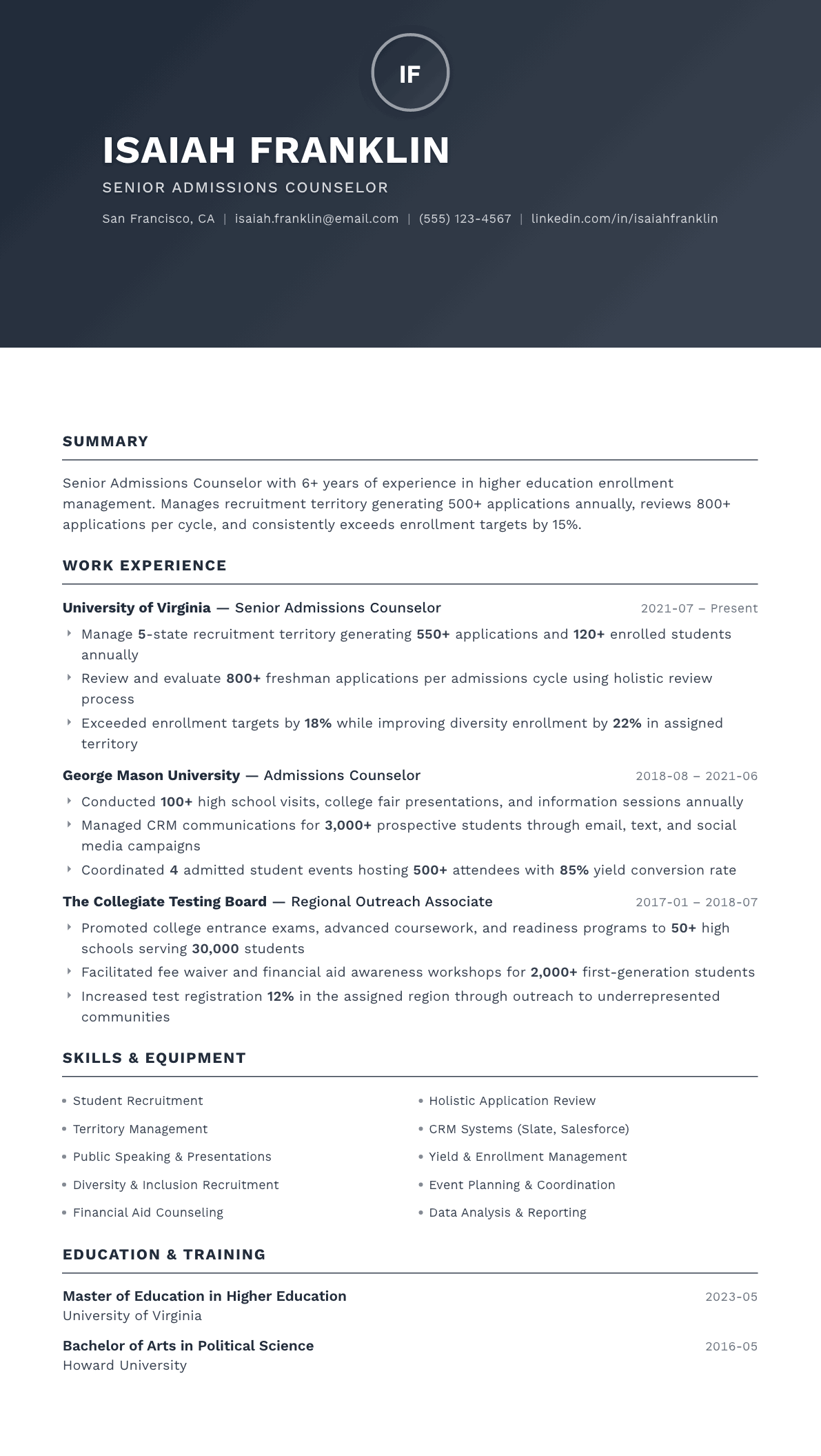
Example Admissions Counselor summary
Admissions Counselor with 6 years of higher education enrollment experience managing 5-state territories and reviewing 800+ applications per cycle. Exceeds enrollment targets by 15% with 22% improvement in diversity enrollment.
Skills to list on a Admissions Counselor resume
- Student Recruitment
- Application Review
- Territory Management
- CRM (Slate / Salesforce)
- Public Speaking
- Yield Management
- Diversity Recruitment
- Event Planning
- Financial Aid Advising
- Data Analysis
- High School Relations
- Enrollment Forecasting
What actually gets this resume read
- Quantify your territory: states covered, schools visited, applications generated, students enrolled.
- Include application review volume and process knowledge (holistic review, rubric-based evaluation).
- Highlight yield rates and enrollment target achievement to demonstrate recruitment effectiveness.
- Mention CRM experience: Slate, Salesforce, Banner, or PeopleSoft are key admissions tools.
- Show commitment to diversity and access. Equity-minded recruitment is a priority across higher education.
How to write a admissions counselor resume
An admissions counselor resume is read by a dean or director of enrollment who is thinking about next year's class. The questions in their head are territory questions: where have you recruited, how many high schools do you know by name, how many applications did you read in a cycle, and did the students you recruited actually enroll. Everything else on the page is secondary to those four answers.
The role also has an unusual shape that resumes often hide. Fall is travel: weeks on the road, evening college fairs, high school visits, and information sessions in hotel ballrooms. Winter is reading season, hundreds of files under a rubric. Spring is yield, calling admitted students and running admitted student days. A resume organized around that cycle immediately reads as written by someone who has lived it.
This guide covers how to describe a territory, how to write file reading volume without sounding clerical, which customer relationship management systems matter, and the questions counselors ask when they move between public, private, graduate and international recruitment.
Format: one page early, two once you have run a territory for years
Reverse chronological and plain. Enrollment offices hire in cohorts and search committees score against the posted qualifications, so put the required items where they are found in a first pass: the bachelor's degree, the willingness to travel, the valid driver's license, and any second language.
Say the travel part out loud. A line noting availability for six to eight weeks of fall travel and weekend programming answers the question that otherwise gets asked in the phone screen, and it signals that you understand the calendar you are joining.
- Header: name, city and state, phone, email, and a note that you hold a valid driver's license if the role involves a driving territory.
- Section order: summary, recruitment experience, systems, education, presentations and service.
- Recent graduates should lead with tour guide, orientation leader, telecounseling or alumni interviewing experience rather than unrelated retail work.
Summary: territory, funnel stage, and the class you helped build
Name the territory by states or regions, the institution type, and the part of the funnel you owned. Recruiting for a small private liberal arts college in a distant out-of-state market is a different craft from managing a dense in-state territory for a public flagship, and a director hires for the one they need.
Add a funnel result. Applications generated in your territory, admits, deposits, or the year-over-year change in enrolled students from your schools. Counselors who report only the number of visits are describing effort rather than outcome.
Experience: territory management, file reading, and yield work
Give the territory in the first line of each role: the states or counties, the number of high schools and community colleges in it, the visit count and the fair count in a fall. Then show the account management underneath it, because that is what separates a counselor who owns a territory from one who is handed a travel schedule. Counselor relationships at feeder schools, community-based organization partnerships, and the schools you added to the visit list yourself.
File reading deserves its own bullets. State the volume for a cycle, the review model you worked in, whether committee based evaluation, holistic review against a rubric, or first and second reader pairs, and any scholarship or honors committee you sat on. Reading is the work that makes a counselor promotable, so it should never be a subordinate clause.
Then yield. Admitted student calling campaigns, yield events, financial aid conversations with families, and the melt outreach that runs through summer. Naming the summer melt work signals that you stayed with the class until census rather than leaving after deposits.
Systems, data and the reporting a director expects
Name the customer relationship management platform by name. Slate is the dominant system in admissions and experience with query building, reader workflows, communication campaigns or event forms is a differentiator worth its own bullets. Salesforce, Banner, PeopleSoft and Colleague are the other names that recruiters filter on.
Show that you read your own funnel. Territory reports, application to admit and admit to enroll conversion, source tracking on inquiries, and the decisions you made from that data such as adding a school, dropping a fair, or shifting a communication flow to an earlier date.
Access, equity and the presentation skill
Recruiting is a public speaking job. Say how many presentations you have delivered and to what size audience, whether you have presented to counselor groups or parent evenings, and whether you can deliver a financial aid overview to a room of families without a script. Bilingual presentation ability, particularly in Spanish, should appear in the summary rather than at the bottom of a skills list.
Where you have worked with first-generation students, community-based organizations, transfer populations or rural districts, name the partnership rather than using access as an adjective. A concrete program is evidence, an adjective is not.
Admissions Counselor resume summary examples
Recent graduate
Recent graduate and three-year campus tour guide moving into admissions, with experience leading daily visit programs for groups of 20 families and running a telecounseling shift for admitted students. Comfortable presenting to large audiences, available for fall travel, and conversational in Spanish.
Four cycles in
Admissions counselor with four recruitment cycles managing a three-state territory of 140 high schools for a private university, reading 700 applications a cycle under a holistic rubric. Grew territory applications by 22% through added community college partnerships and a redesigned Slate communication flow.
Senior counselor moving to assistant director
Senior admissions counselor with eight cycles across domestic and international recruitment, supervising two counselors and owning a five-state territory that delivered 18% of the entering class. Built the transfer articulation outreach plan and chaired the merit scholarship reading committee for three years.
Work experience bullets: before and after
Before: Traveled to high schools and college fairs to recruit students.
After: Managed a three-state territory of 140 high schools and 11 community colleges, completing 95 school visits and 40 evening fairs across a seven-week fall travel season.
School counts, visit counts and the length of the travel season let a director compare your territory to hers.
Before: Reviewed applications for admission.
After: Read 700 first-year applications per cycle under a holistic rubric, served as second reader on 200 committee files, and presented borderline cases to the admissions committee.
Volume, review model and committee role show the level of judgment you were trusted with.
Before: Used Slate to manage student communications.
After: Built territory queries and communication flows in Slate, moving the first outreach to admitted students from three weeks after decision release to 48 hours, and tracked open and reply rates by school.
The specific change and the measurement turn a tool mention into evidence of system fluency.
Before: Helped increase enrollment from my territory.
After: Grew applications from my territory by 22% over two cycles by adding 14 schools to the visit list, hosting two counselor breakfasts, and partnering with a college access nonprofit in the largest urban district.
The reader can see exactly which moves produced the growth, which makes the growth believable.
Before: Presented information sessions to prospective students and parents.
After: Delivered more than 60 information sessions a year to audiences of 15 to 300, including a bilingual financial aid overview for Spanish-speaking families at four partner high schools.
Frequency, audience range and the bilingual detail make the presentation skill measurable rather than assumed.
Hard skills
- Territory management
- High school and community college relations
- Holistic application review
- Committee-based evaluation
- Slate CRM query and workflow building
- Salesforce and Banner
- Funnel and conversion reporting
- Yield campaign planning
- Summer melt outreach
- Financial aid overview presentations
- Transfer articulation guidance
- College fair and visit scheduling
- Admitted student event management
- Scholarship committee review
Soft skills
- Public speaking to families
- Relationship building with school counselors
- Stamina through travel season
- Judgment under file reading volume
- Discretion with sensitive family information
- Working a calendar with hard external deadlines
Certifications worth listing
- Certified Educational Planner (American Institute of Certified Educational Planners)
- Mental Health First Aid (National Council for Mental Wellbeing)
Mistakes that cost admissions counselor candidates the interview
- Describing travel without describing the territory, so the reader never learns how many schools you actually owned.
- Leaving file reading volume off the page, which is the fastest way to look like a visit scheduler rather than an evaluator.
- Reporting only activity counts when the director is looking for applications, admits and deposits from your schools.
- Skipping the customer relationship management platform by name when nearly every posting filters on it.
- Using access and equity as adjectives instead of naming the partner organizations, districts or programs you worked with.
- Hiding a second language at the bottom of the skills list when it is a direct advantage in most territories.
Admissions Counselor resume questions
What experience counts if I have never worked in an admissions office?
Campus tour guide, orientation leader, telecounselor, admissions student worker, alumni interviewer and college access nonprofit work all count and should be written as recruitment experience. Teaching, retail and hospitality also transfer well when you frame them around presentation volume and relationship management.
How many applications should I say I read per cycle?
Give the real number for a full cycle and name the review model beside it. A counselor reading several hundred files under a holistic rubric with committee presentation is describing a different job from one doing quick completeness checks, so the model matters as much as the count.
Do admissions counselors need a master's degree?
Entry counselor roles usually require only a bachelor's degree, and many offices prefer recent alumni of the institution. A master's becomes relevant at assistant and associate director level, where postings often list it as preferred rather than required.
How do I explain leaving admissions after only two cycles?
You usually do not need to. Turnover after two or three cycles is normal in this field and directors know it. Focus the resume on what you completed in those cycles, a full travel season, a full reading season and a yield campaign, so the tenure reads as complete rather than cut short.
Should I list the schools in my territory on my resume?
List the states or regions and the counts, not the individual schools. Name only the feeder relationships that carry weight, such as a large district partnership, a community college articulation, or a community-based organization you built a pipeline with over multiple cycles.