Lecturer Resume Examples: free score, then the gap list
Write a Lecturer Resume Built on Teaching Load and Student Outcomes
By Mustafa Tarabya, founder of CVBooster · Published · Updated
Lecturer resume example with course inventory, teaching evaluation language, curriculum work, keyword list and a complete writing guide.
Sample resumes for a lecturer
The same lecturer content laid out in three CVBooster templates, so you can see what the finished document looks like before you write a word.
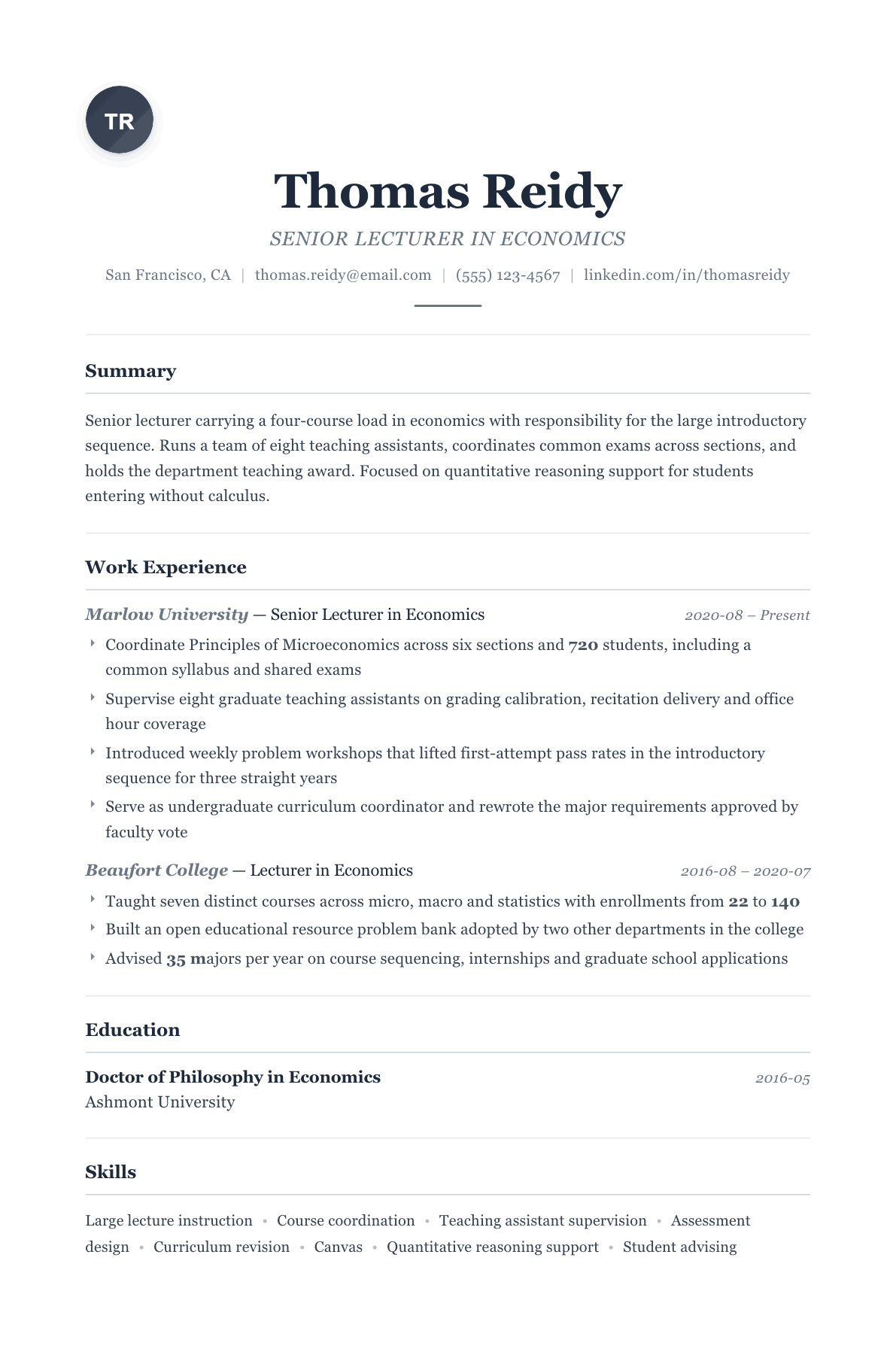
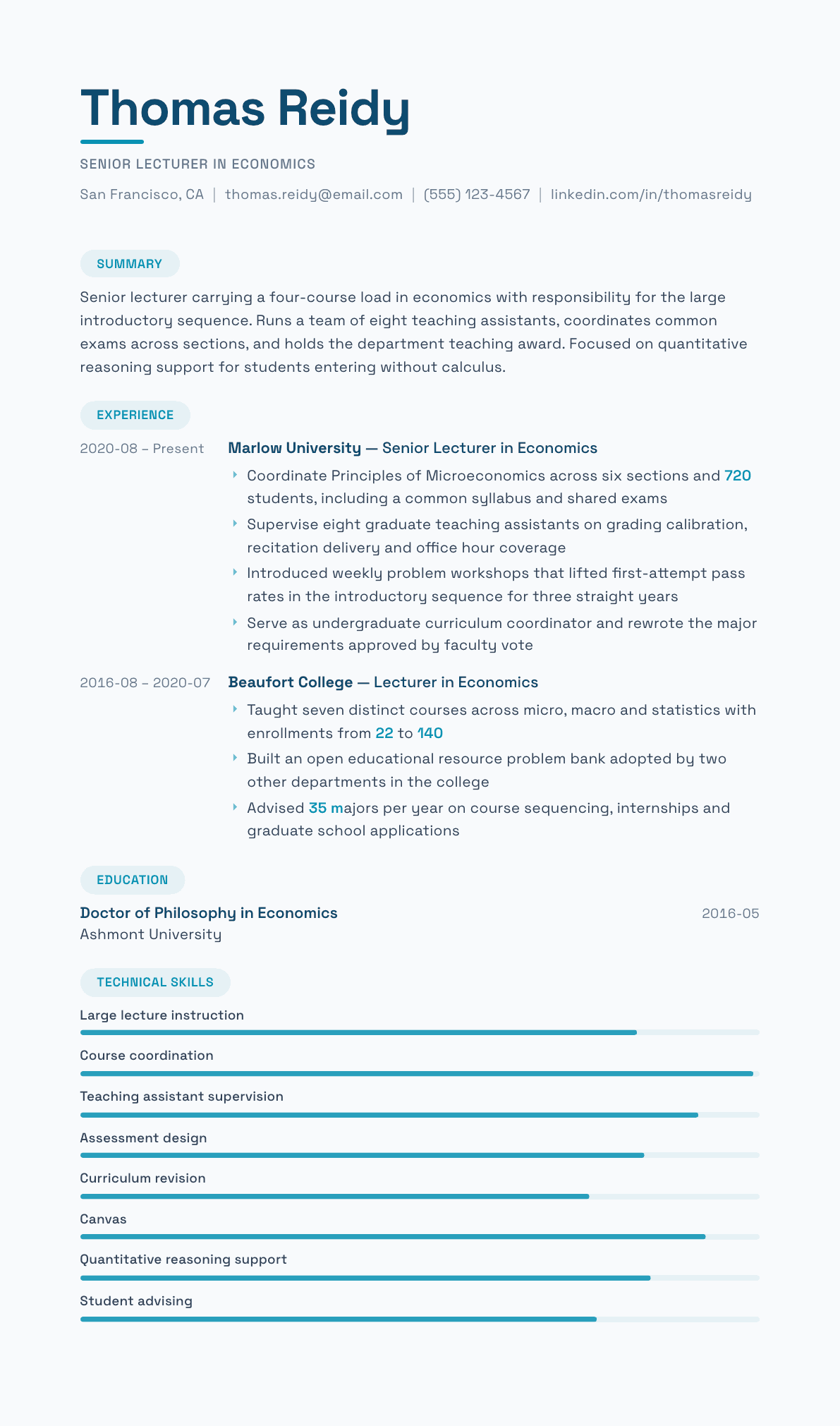
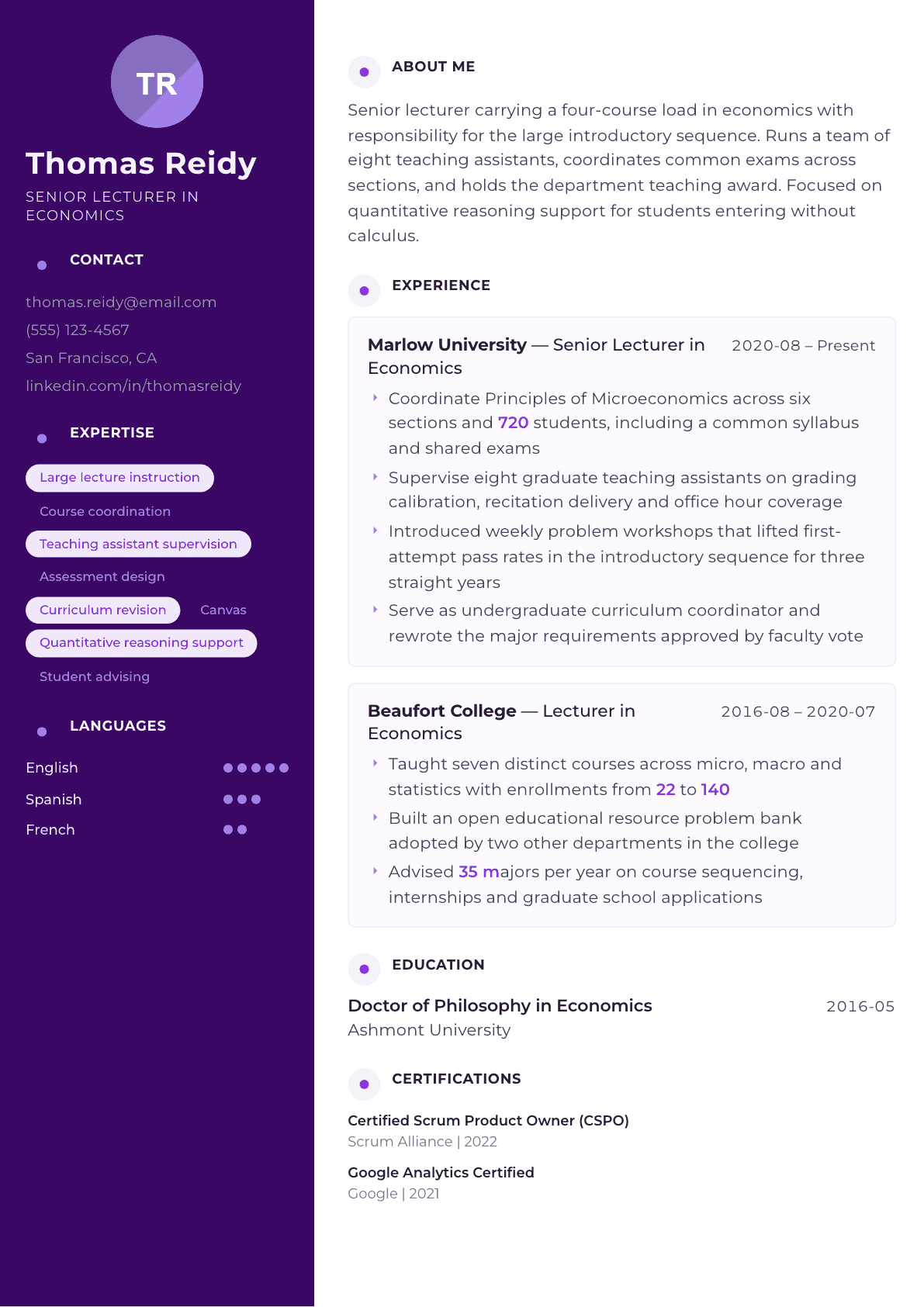
Example Lecturer summary
Senior lecturer in economics with nine years of undergraduate teaching and responsibility for the introductory sequence. Coordinates six sections and more than seven hundred students, supervises eight graduate teaching assistants, and rewrote the major requirements now in the catalog. Holder of the department teaching award and builder of an open problem bank used by other departments. Seeking a teaching professor appointment.
Skills to list on a Lecturer resume
- Undergraduate teaching
- Large lecture delivery
- Course coordination
- Syllabus and assessment design
- Teaching assistant supervision
- Curriculum development
- Learning outcomes assessment
- Canvas
- Open educational resources
- Student advising
- Grading calibration
- Active learning methods
- Course scheduling
- Peer observation and feedback
What actually gets this resume read
- Lead with a course inventory rather than a research agenda, because lecturer searches are hiring teaching capacity across a specific catalog.
- Give enrollment sizes, since running a lecture of six hundred and a seminar of eighteen are different skills to a department chair.
- Describe course coordination work explicitly if you managed sections, common exams or teaching assistants, as that is often the real job.
- Reference teaching evaluations carefully: cite an award, a peer observation or a departmental comparison rather than raw numbers.
- Include curriculum contributions such as new courses proposed, sequences redesigned or open resources you built and others adopted.
- Mention advising and student support duties, because lecturer contracts usually bundle them into the load without naming them.
How to write a lecturer resume
A lecturer search is a staffing decision before it is a scholarly one. The department has a catalog to cover, a large introductory sequence that eats teaching hours, and a chair who needs someone who can carry three or four courses a term without the quality dropping. Your file has to answer the coverage question on the first page.
That is why a lecturer resume that opens with a research agenda usually loses to one that opens with a course inventory. Research is welcome, but it is not the argument. The argument is range, reliability at scale, and evidence that students learn in your sections.
This guide sets out how a lecturer file should be ordered, how to write about enrollment and coordination work, three summaries covering a first appointment through a senior lecturer, before-and-after bullets, and the questions teaching-track faculty ask when they apply.
Format: teaching first, everything else supporting
Two pages for most lecturers, longer as a curriculum vitae if the department requests one. Put a courses taught block immediately after the summary with the catalog title, level, enrollment range and modality. A chair reading twenty files wants that grid, and few candidates supply it.
Then experience by appointment, with bullets on coordination, curriculum and student outcomes rather than a restatement of the syllabus. Reserve one short section near the end for scholarship, professional development and service.
- Header: name, degree, city and state, phone and professional email.
- Sections in this order: summary, courses taught, teaching appointments, curriculum contributions, education, service.
- Mark which courses you can teach immediately versus which you have prepared but not yet delivered.
Summary: load, range, scale, one distinguishing contribution
Name the load you carry, the range of courses across the curriculum, the largest enrollment you have handled, and one contribution that outlived the term. A rewritten sequence, an adopted open resource, a coordination structure or a teaching award all work.
If the posting is a coordinator role in disguise, say so in your own words. Departments hiring for the introductory sequence care more about whether you can run six sections consistently than whether you can teach the elective you love.
Experience: coordination is the hidden half of the job
Large-course lecturers usually run more than a classroom. Common syllabi, shared exams, grading calibration across sections, teaching assistant supervision, recitation design and section scheduling are all real management work, and they are what separate a senior lecturer file from a junior one.
Write them as such. Say how many sections you coordinated, how many students the sequence enrolled, how many teaching assistants you supervised and how you kept grading consistent. Departments have all had a coordination failure and they hire against the memory of it.
Then show learning. Pass rates in a gateway course, a workshop structure that raised first-attempt performance, an early alert process you ran, or a redesign that reduced withdrawals. Cite the comparison rather than a raw score so the number means something.
Curriculum and assessment: what you built that others use
Give curricular work its own section. New courses proposed and approved, major requirements you rewrote, sequences you realigned, open educational resources you built, and assessment instruments other instructors adopted are the entries that make a lecturer promotable rather than renewable.
Program assessment work belongs here too. If you mapped course outcomes to program outcomes, collected artifacts, scored against a rubric or wrote an assessment report for accreditation, say it plainly. Chairs are perpetually short of faculty who will do that work well.
- Name any course you created and the approval body that adopted it.
- State when another department or institution adopted a resource you built.
- Include instructional technology projects such as a homework platform migration.
Evidence and keywords
Handle teaching evaluations carefully. A teaching award, a peer observation report, a departmental comparison or an invitation to mentor other instructors carries more weight than a decimal score with no context. Give the source of any evidence you cite.
The vocabulary lecturer postings use is stable: undergraduate instruction, course coordination, student learning outcomes, assessment, active learning, curriculum development, academic advising, and the learning management system by name. Mirror the phrasing and then prove it in a bullet nearby.
Lecturer resume summary examples
First lecturer appointment
Economics doctorate with three years of graduate instruction, including instructor of record for two sections of principles and lead recitation for an intermediate course. Built an open problem bank for the introductory sequence and completed a semester-long course design institute at the teaching center.
Five years in
Lecturer in economics teaching seven distinct courses across micro, macro and statistics with enrollments from 22 to 140. Built an open educational resource problem bank adopted by two other departments and advises 35 majors a year on sequencing, internships and graduate applications.
Senior lecturer
Senior lecturer coordinating Principles of Microeconomics across six sections and more than seven hundred students, supervising eight graduate teaching assistants. Introduced weekly problem workshops that lifted first-attempt pass rates for three consecutive years and rewrote the major requirements now in the catalog.
Work experience bullets: before and after
Before: Taught large introductory economics classes.
After: Coordinated Principles of Microeconomics across six sections and roughly 720 students, running a common syllabus, shared exams and a joint grading calendar.
Section count, enrollment and the coordination mechanics show you ran a sequence rather than a classroom.
Before: Worked with teaching assistants.
After: Supervised eight graduate teaching assistants on grading calibration, recitation delivery and office hour coverage, with a norming session before each grading round.
Naming the supervision tasks and the calibration process is what a chair worried about grade consistency needs to see.
Before: Improved student performance in the course.
After: Introduced weekly problem workshops in the gateway course and lifted first-attempt pass rates above the three-year departmental baseline for three straight years.
An intervention with a named baseline is defensible where an unsourced improvement claim is not.
Before: Helped update the curriculum.
After: Served as undergraduate curriculum coordinator and rewrote the major requirements, taking the revision through committee to a full faculty vote.
Showing the proposal through governance proves the change actually happened and that you can navigate a department.
Before: Created course materials for students.
After: Built an open problem bank for the introductory sequence, later adopted by two other departments in the college, replacing a paid homework platform.
Adoption by other departments turns personal materials into a contribution with institutional reach.
Hard skills
- Undergraduate teaching
- Large lecture delivery
- Multi-section course coordination
- Syllabus and assessment design
- Teaching assistant supervision
- Grading calibration
- Curriculum development and revision
- Program learning outcomes assessment
- Canvas
- Open educational resource development
- Active learning methods
- Academic advising
- Course scheduling
- Peer observation and instructional feedback
Soft skills
- Consistency across sections
- Mentoring new instructors
- Classroom presence at scale
- Coordination with faculty colleagues
- Patience with struggling students
- Governance and committee work
Certifications worth listing
- ACUE Certificate in Effective College Instruction (Association of College and University Educators)
- Quality Matters Applying the QM Rubric (Quality Matters)
Mistakes that cost lecturer candidates the interview
- Opening the file with a research agenda when the department is hiring teaching capacity for a specific catalog.
- Listing courses without enrollments, so a chair cannot tell a seminar of eighteen from a lecture of six hundred.
- Leaving out coordination work, which is often the actual job description hidden inside a lecturer posting.
- Quoting evaluation scores with no comparison or source, which invites doubt instead of confidence.
- Ignoring advising and student support duties that lecturer contracts bundle into the load without naming them.
- Presenting curriculum contributions as intentions rather than as changes that passed through governance and took effect.
Lecturer resume questions
How is a lecturer resume different from a tenure-track curriculum vitae?
The order changes and the emphasis moves. Teaching, coordination and curriculum come first, and research sits in a compact section near the end. The evidence a lecturer file needs is coverage, scale and student outcomes rather than funding and publication counts.
Should I include teaching evaluation numbers?
Only with context. A departmental comparison, a peer observation summary or a teaching award communicates more than a decimal average. If you do include scores, state the scale, the response rate and the departmental reference point.
Does research matter for a lecturer position?
It helps but rarely decides. Scholarship of teaching and learning is often valued more than disciplinary research in these searches, because it is directly connected to the instructional work the department is hiring you to do.
How many courses should I list as ready to teach?
List everything you have taught, then add a short prepared-to-teach line for courses you could deliver next term. Be honest about the difference, since a chair may build a schedule around it before you arrive.
How do I move from lecturer to senior lecturer or teaching professor?
Build the record those promotions score: course coordination, curriculum revision through governance, mentoring of instructors, assessment leadership and any scholarship of teaching. Then reorder the file so those contributions sit above routine section delivery.