Tax Attorney Resume Examples: free ATS score and gap list
Build a Tax Attorney Resume That Demonstrates Technical Mastery
By Mustafa Tarabya, founder of CVBooster · Published · Updated
Create a tax attorney resume showcasing your tax planning, controversy, and compliance expertise with professional legal templates designed for specialized practice areas.
Sample resumes for a tax attorney
The same tax attorney content laid out in three CVBooster templates, so you can see what the finished document looks like before you write a word.
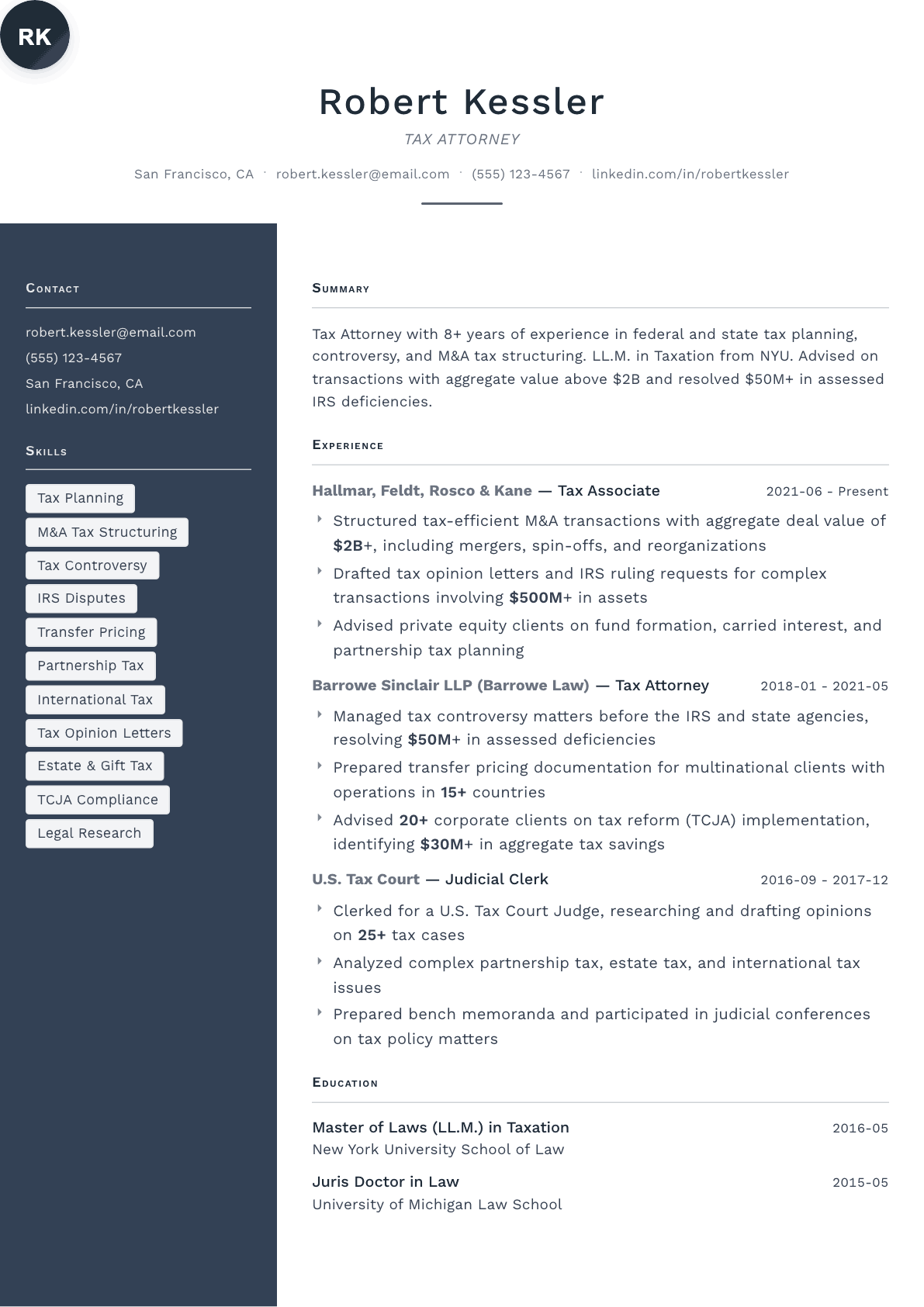
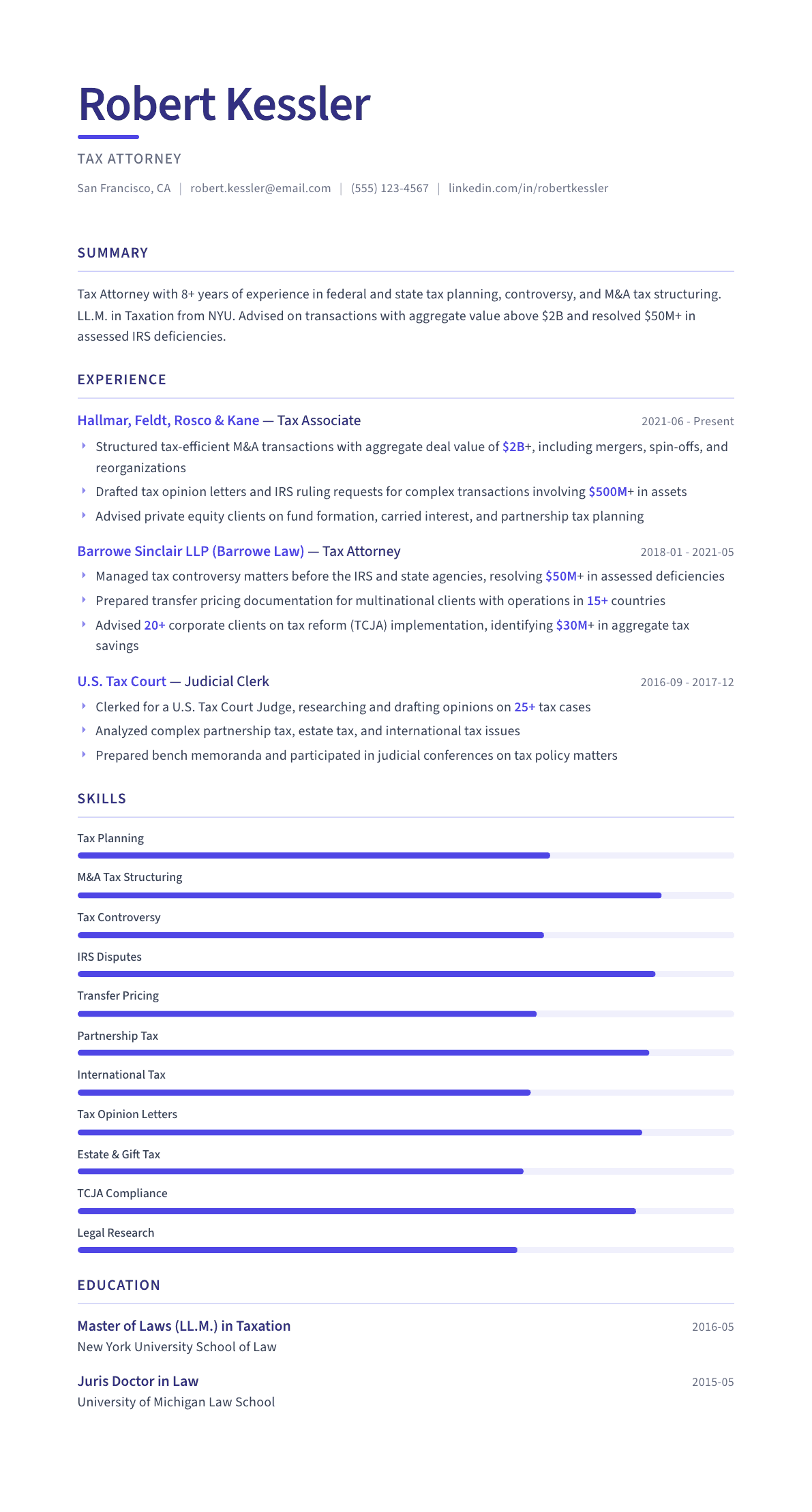
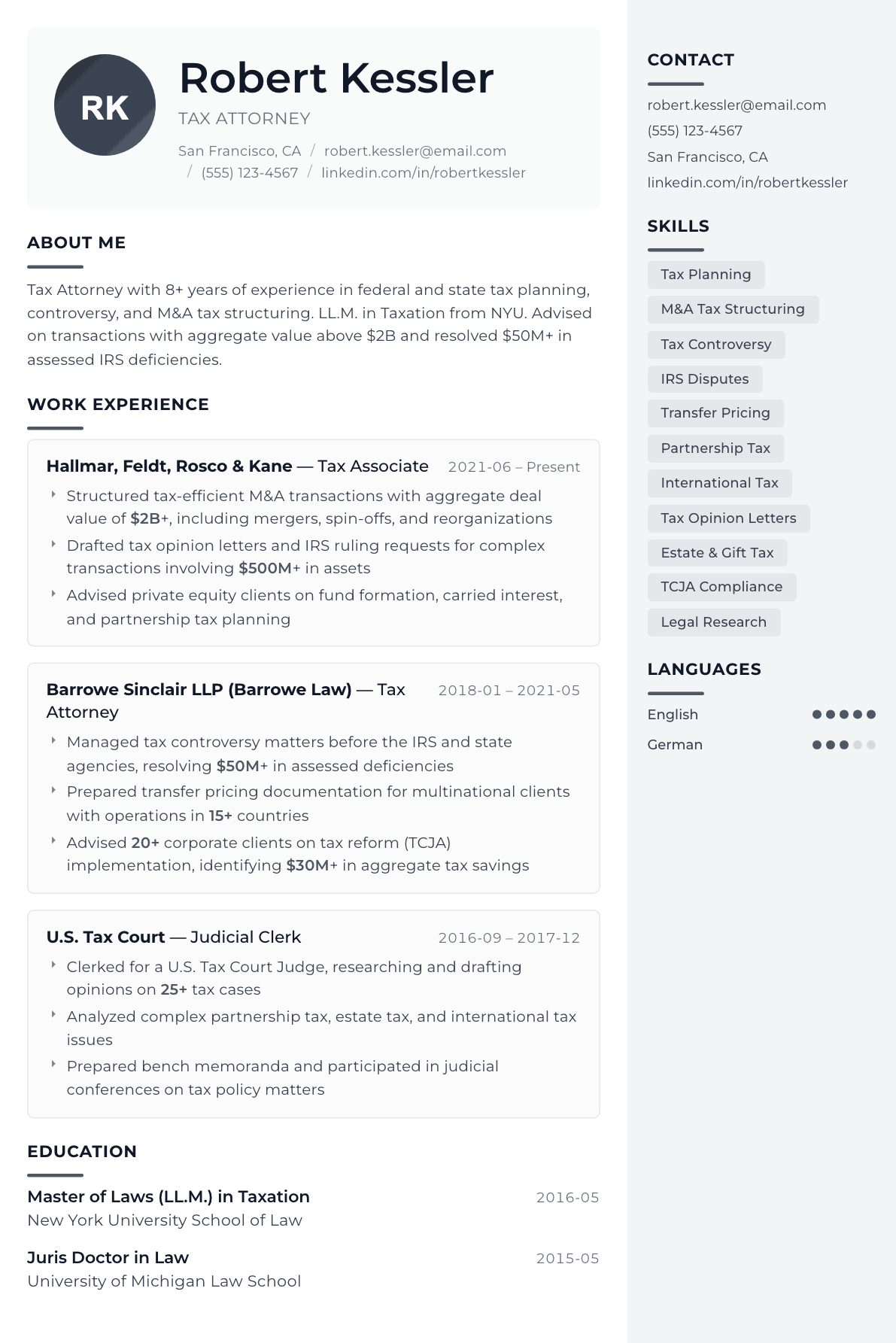
Example Tax Attorney summary
Tax Attorney with 8 years of experience in M&A tax structuring, controversy, and international tax planning. NYU LL.M. in Taxation with $2B+ in advised transaction value and $50M+ in resolved IRS disputes. Former U.S. Tax Court clerk. Seeking a senior role at a top-tier firm or in-house tax department.
Skills to list on a Tax Attorney resume
- Tax Planning
- M&A Tax Structuring
- Tax Controversy
- IRS Audit Defense
- Transfer Pricing
- Partnership Tax
- International Tax
- Estate & Gift Tax
- SALT
- Tax Opinion Letters
- TCJA / Tax Reform
- Legal Research
- Tax Court Litigation
- Fund Formation Tax
What actually gets this resume read
- Lead with your LL.M. in Taxation if you have one -- it is the gold standard credential for tax attorneys.
- Specify your practice areas: M&A tax, controversy, international, estate & gift, partnership, SALT.
- Quantify: deal values structured, tax savings identified, deficiencies resolved, or rulings obtained.
- Mention any IRS or Tax Court experience -- government service is highly valued in tax practice.
- Include CPA license status if applicable -- dual JD/CPA practitioners are in high demand.
- Show technical range: planning, compliance, controversy, and transactional tax work.
How to write a tax attorney resume
Tax is the most credential-legible practice in law. A hiring partner can tell a great deal about a candidate from three lines: the law school, whether there is a master of laws in taxation, and whether the practice is planning, controversy or both. That is why a tax attorney resume that buries the advanced degree or leaves the practice mix vague fails at the first pass, no matter how good the underlying work has been.
The second sort is by subject area, and the areas barely overlap in daily practice. Partnership taxation, corporate and mergers and acquisitions tax, international and cross-border planning, state and local tax, tax-exempt organizations, executive compensation and benefits, estate and gift, and controversy work before the Internal Revenue Service and the Tax Court are effectively different jobs sharing a title.
This guide covers the header and section order tax groups expect, how to describe transactions and controversies without exposing clients, three career-stage summaries, and the rewrites that make technical authority visible without listing code sections at random.
Format: the master of laws goes near the top
If you hold a master of laws in taxation, it belongs in the header block or immediately below the summary, not at the bottom under education. Tax groups screen for it, and postings frequently list it as preferred or required. If you also hold a certified public accountant license, that goes on the same line, because the combination routes you toward specific transactional and controversy work.
Reverse-chronological, single column, conservative typography. One page through the junior years, two once you have a body of transactions, rulings or published writing. Tax attorneys are hired partly on writing, so the document itself should read as clean and precise as a memorandum you would send a client.
- Header: name, JD, LL.M. in Taxation, CPA license if held, bar admissions, Tax Court admission if you have it.
- Section order: summary, admissions and credentials, experience, representative matters, education, publications and speaking, professional memberships.
- Students and new admittees lead with education, the tax program coursework, a tax clinic, and any accounting background or public accounting experience.
Summary: planning or controversy, and in which areas
Open by declaring the practice type. Planning means structuring transactions before they happen and writing the opinions that support them. Controversy means examinations, appeals, Tax Court petitions and collection matters. A group hiring for one rarely wants a candidate who describes both with equal weight, because the daily skills diverge quickly.
Then name two or three subject areas and the client type: private equity funds and their portfolio companies, closely held businesses, multinational corporations, tax-exempt organizations, or high net worth individuals and families. Close with the thing you are actually known for, such as partnership allocations, transfer pricing documentation, or resolving employment tax examinations.
Experience: transactions and controversies, described precisely
For planning work, describe the structures rather than the outcome alone: tax-free reorganizations, partnership formations and allocations under the applicable regulations, up-C and blocker structures, section 1031 exchanges, section 382 loss limitation analysis, choice of entity conversions, and cross-border planning including subpart F and global intangible low-taxed income analysis. Say what you personally drafted, whether that was the opinion, the structure memorandum, the tax provisions of the purchase agreement, or the partnership agreement allocation article.
For controversy, describe the posture. Examinations handled, information document requests responded to, appeals conferences attended, protests written, Tax Court petitions filed, penalty abatement obtained, voluntary disclosures completed, and collection alternatives negotiated. Say whether you were the lead contact with the examining agent, because that is a level of independence firms hire for directly.
Describe matters by type, industry and general scale without client names and without stating exact figures. The tax profession is small enough that identifiable details in a resume raise a confidentiality flag rather than an impression of scale.
Authority: opinions, rulings and writing
Any work that produced an official response is worth naming. Private letter ruling requests submitted, closing agreements obtained, technical advice requests, competent authority requests, and voluntary disclosure resolutions all show that you can carry a position through a government process rather than only inside a firm memorandum.
Publication matters more in tax than in most practices, because clients and referring accountants read the tax journals. List articles with the publishing journal, panels with the organizing body, and any adjunct teaching in a graduate tax program, which the field treats as a strong credential.
Keywords, research tools and the screening pass
Mirror the vocabulary of the postings: tax planning, tax controversy, partnership taxation, mergers and acquisitions tax, international tax, transfer pricing, state and local tax, tax-exempt organizations, executive compensation, tax opinions, examinations, appeals and Tax Court practice. Include the subject areas by name, since tax groups filter on them before reading a word of prose.
Name the research platforms and the tax research services you use, along with the modeling tools if you build quantitative structures. Accounting familiarity is worth stating plainly if you have it, since much of the daily conversation happens with the client accountants rather than with lawyers.
Tax Attorney resume summary examples
First-year tax associate
Attorney with a master of laws in taxation and a low income taxpayer clinic placement resolving 25 examination and collection matters. Drafted research memoranda on partnership allocations and cancellation of debt income, and worked two seasons in public accounting preparing partnership and corporate returns.
Six years in
Tax attorney with six years of transactional practice covering partnership formations, tax-free reorganizations and acquisitions of closely held businesses. Drafts allocation and distribution provisions, negotiates tax representations and indemnities, and supports 20 transactions a year for private equity and founder-owned clients.
Tax controversy partner
Tax controversy partner with seventeen years representing corporate and individual clients through examination, appeals and Tax Court, including transfer pricing and employment tax disputes. Obtained private letter rulings and closing agreements, teaches in a graduate tax program, and supervises four associates.
Work experience bullets: before and after
Before: Advised clients on tax issues in corporate transactions.
After: Structured acquisitions and reorganizations for closely held targets, drafting the tax provisions of purchase agreements, negotiating tax representations and indemnities and delivering the supporting structure memoranda.
Naming the deliverables shows the specific pieces of a deal you can be handed, which advised on tax issues never does.
Before: Represented clients in disputes with the IRS.
After: Served as lead contact in 15 examinations, drafting responses to information document requests, preparing protests to Appeals and filing Tax Court petitions where settlement was not reached.
The lead role and the full escalation path prove independence in controversy work rather than support on it.
Before: Worked on partnership tax matters.
After: Drafted allocation and distribution provisions for fund and joint venture agreements, modeling capital account maintenance and running waterfall scenarios with the client accountants before signing.
Drafting plus modeling with the accountants shows the technical and collaborative reality of partnership practice.
Before: Researched international tax questions for clients.
After: Analyzed cross-border structures for controlled foreign corporation and global intangible low-taxed income exposure, prepared treaty benefit analyses and coordinated transfer pricing documentation with local advisors.
The named regimes and the coordination role make international experience concrete rather than aspirational.
Before: Wrote tax memoranda and opinions.
After: Wrote 40 client memoranda and three opinions supporting reporting positions, documenting the authority hierarchy and the confidence level, and defending two of those positions later on examination.
Confidence levels and a later defense on examination show your written work held up where it counted.
Hard skills
- Partnership taxation and allocations
- Mergers and acquisitions tax structuring
- Tax-free reorganizations
- International and cross-border tax planning
- Transfer pricing documentation
- State and local tax
- Tax-exempt organization compliance
- Executive compensation and benefits taxation
- Tax opinions and reporting position analysis
- Examination and Appeals representation
- United States Tax Court practice
- Private letter ruling requests
Soft skills
- Precise written analysis
- Explaining risk to non-tax clients
- Working with accountants
- Negotiating with government agents
- Judgment on confidence levels
- Deadline management in deal timelines
Certifications worth listing
- Certified Public Accountant (CPA) (State boards of accountancy)
- Admission to the United States Tax Court (United States Tax Court)
- Board Certification in Tax Law (State bar boards of legal specialization)
Mistakes that cost tax attorney candidates the interview
- Putting the master of laws in taxation at the bottom under education, when tax groups screen for it in the first pass.
- Presenting planning and controversy work with equal weight, which reads as no real depth in either to the group hiring for one.
- Writing advised on tax matters instead of naming the structures, the agreements drafted and the government proceedings handled.
- Including matter details specific enough to identify a client, which in a small profession reads as a confidentiality risk.
- Listing code sections decoratively without any indication of what you did with them, which an experienced tax partner will probe immediately.
- Leaving out publications, panels and adjunct teaching, which are how the tax field verifies expertise to clients and referring accountants.
Tax Attorney resume questions
Do I need an LL.M. in taxation to be a tax attorney?
It is not universally required, but it is the most common credential in the field and many postings list it as preferred. Without one, lead with substantive tax experience, an accounting license, or public accounting years that show equivalent grounding.
Should I list my CPA license on a tax attorney resume?
Yes, in the header next to your bar admissions. It signals comfort with financial statements and with the accountants who drive much of the client conversation, and it opens doors in both transactional and controversy hiring.
How do I describe transactions without naming clients?
Describe them by structure, industry and general scale. A tax-free reorganization of a family-owned manufacturer, or a fund formation with a blocker structure for tax-exempt investors, is fully recognizable to a tax partner without identifying anyone.
How do I move from tax compliance into a tax attorney role?
Pull forward the analytical work rather than the return preparation. Research memoranda, positions taken and documented, examination support and the complex entity structures you have worked inside all translate, and an advanced tax degree closes the remaining gap.
Is controversy experience useful for a transactional tax role?
Very. Say what examinations taught you about how positions are tested, since planning partners value attorneys who write opinions and structure memoranda that anticipate how an agent will read them years later.