Tax Manager Resume Examples: free ATS score and gap list
Write a Tax Manager Resume That Shows Provision and Review Depth
By Mustafa Tarabya, founder of CVBooster · Published · Updated
Tax manager resume example covering provision, compliance review, staff supervision and audit defense, with keywords and a complete writing guide.
Sample resumes for a tax manager
The same tax manager content laid out in three CVBooster templates, so you can see what the finished document looks like before you write a word.
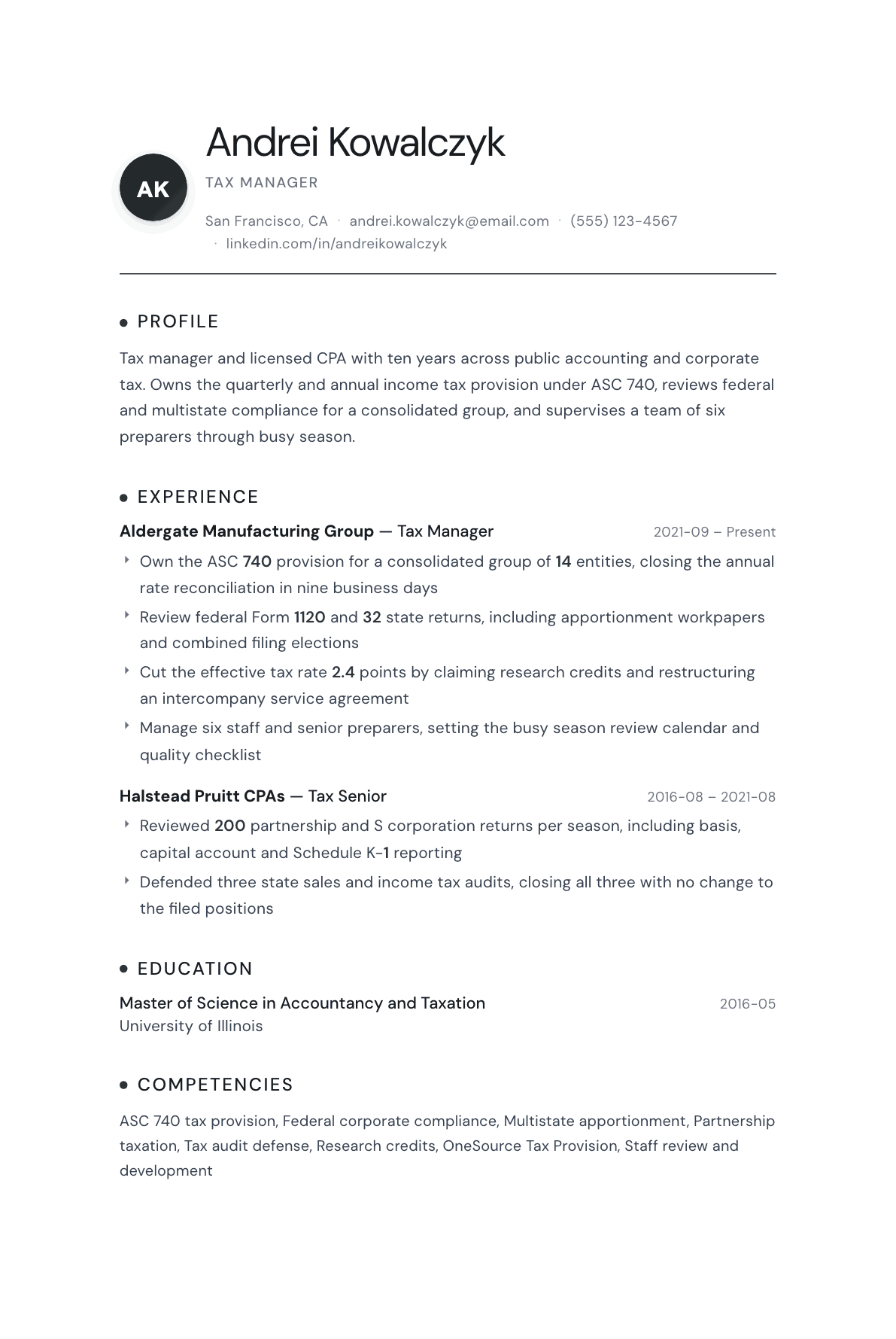
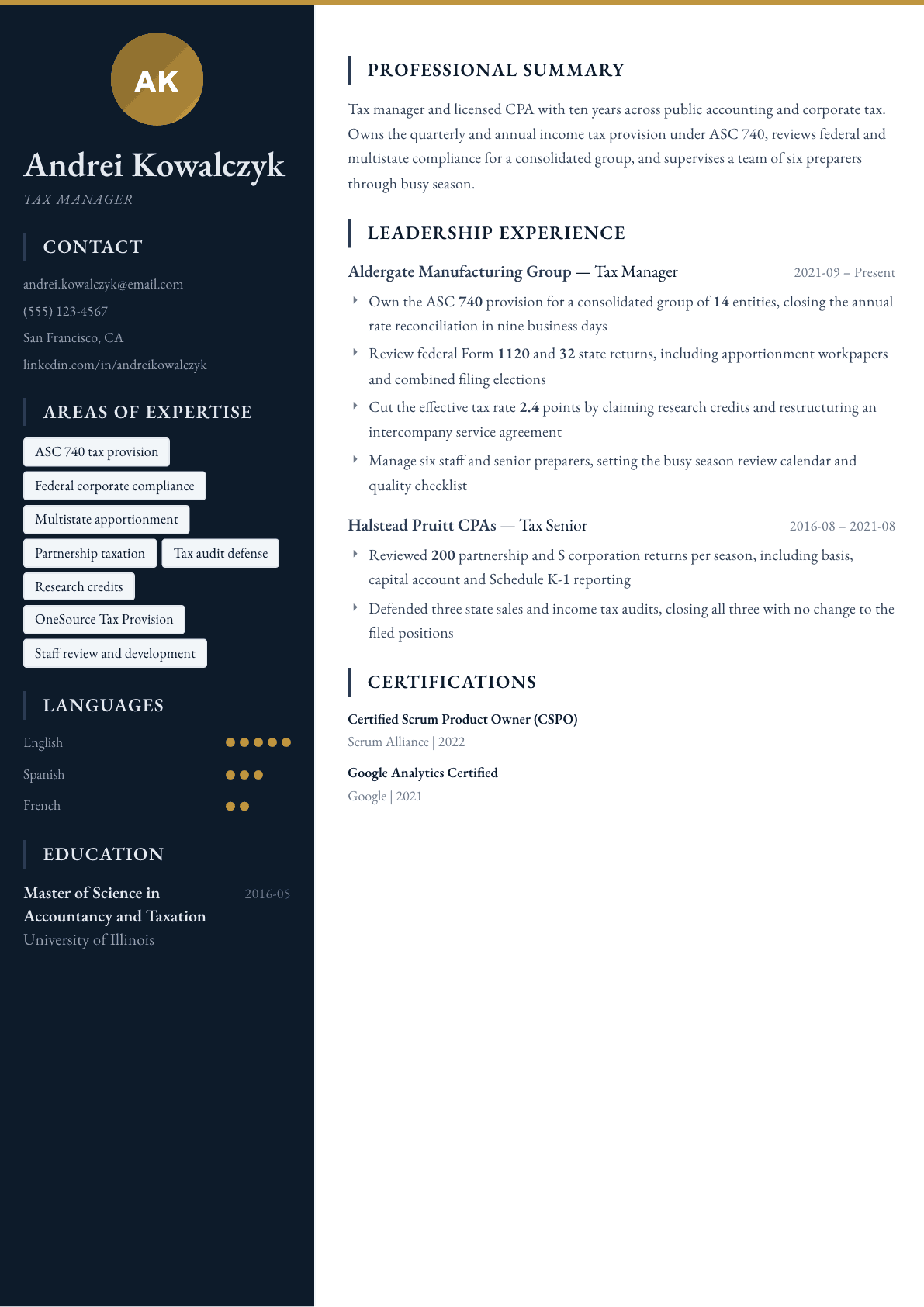
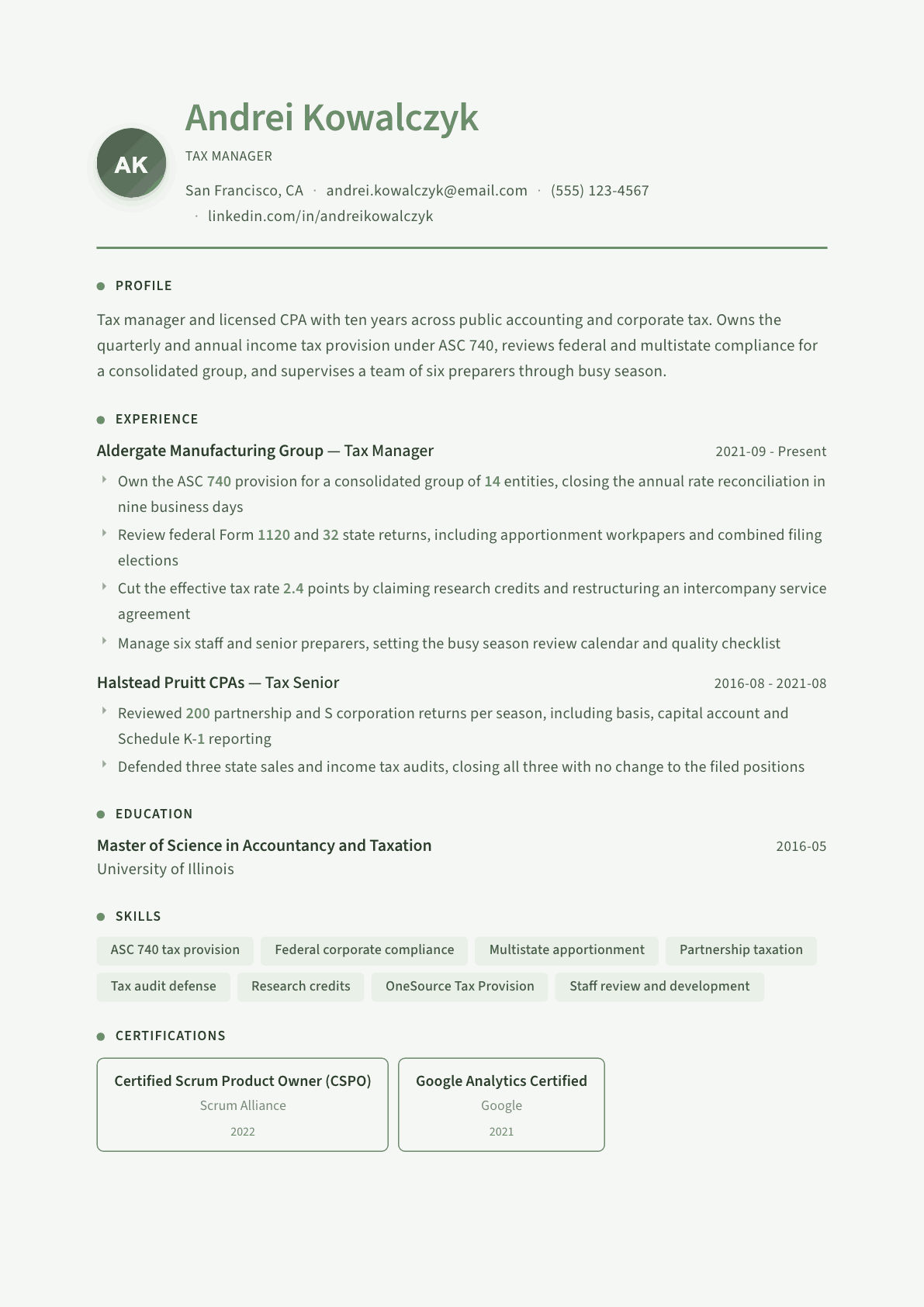
Example Tax Manager summary
Tax manager and licensed CPA with ten years spanning public accounting and corporate tax. Owns the ASC 740 provision for a consolidated group of fourteen entities and reviews federal and multistate compliance across more than thirty jurisdictions. Lowered the effective tax rate by claiming research credits and restructuring an intercompany agreement, and supervises six preparers through the busy season review calendar.
Skills to list on a Tax Manager resume
- ASC 740 income tax provision
- Effective tax rate analysis
- Federal corporate tax compliance
- Multistate apportionment and nexus
- Partnership and S corporation returns
- Uncertain tax positions
- Research and development credits
- Transfer pricing documentation
- State and federal audit defense
- Tax accounting method changes
- OneSource Tax Provision
- Corptax
- CCH Axcess
- Staff review and coaching
What actually gets this resume read
- State whether your background is public accounting, corporate tax or both, and give the entity count and structure you handled.
- Lead with provision work under ASC 740 if you have it, including the close timeline and the rate reconciliation you owned.
- Break compliance out by return type, corporate, partnership, S corporation, trust or nonprofit, and give the annual review volume.
- Show planning outcomes such as credits claimed, apportionment changes or entity restructuring, with the effect on the effective rate.
- Name the provision and compliance platforms you use, for example OneSource, Corptax, GoSystem, CCH Axcess or Alteryx workflows.
- Describe how many preparers you review and how you develop them, because a manager role is judged on review capacity as much as technical depth.
How to write a tax manager resume
A tax manager resume is read by someone deciding whether you can be trusted with a signature, a provision close and a team at the same time. The technical depth is assumed at this level. What gets tested on the page is scope: how many entities, which jurisdictions, whose returns you reviewed rather than prepared, and what happened when a taxing authority pushed back.
The corporate and public accounting versions of this role diverge sharply. A corporate tax manager lives in the provision, the effective rate and the close calendar. A public accounting tax manager lives in engagement economics, client relationships and review volume. A resume that tries to be both without saying which usually fails to convince either reader.
This guide sets out the sections a tax manager resume needs, how to describe provision and compliance ownership, three summaries across levels, before and after bullets from review files, and the questions tax professionals ask when they step up or move between corporate and public work.
Format: two pages, scope before detail
Two pages is normal at manager level and expected once you have both public and corporate history. Keep a single column and put the license line under your name, because a state board credential is verified before anything else on the page.
Give every role a scope line ahead of the bullets: entity count, structure, jurisdictions, revenue band and team size. Reviewing federal and thirty-two state returns for a consolidated group of fourteen entities is a scope statement that instantly places you against the posting.
- Header: name, city and state, phone, email, CPA license and state.
- Order: summary, technical focus areas, experience, systems, education, license and continuing education.
- Label each employer as public accounting, corporate tax or a family office.
Summary: provision, compliance scope, and team
Four lines. Say your years and the split between public and industry, then the provision responsibility, the compliance footprint and how many people you review. If you own the annual provision under the income tax accounting standard, lead with it, because that is the scarce skill in corporate tax hiring.
When you are moving from public accounting into industry, name the bridge. Reviewing corporate returns and provision workpapers for audit clients is direct preparation for owning the provision internally, and the summary is where you make that argument.
Experience: review, provision, planning, defense
Structure bullets in four groups. Review: the return types and volume you signed off on, with the errors your review process caught. Provision: the close timeline, the rate reconciliation, deferred inventory, valuation allowance analysis and uncertain positions. Planning: credits claimed, apportionment or entity changes, method changes and their effect on the effective rate or cash taxes. Defense: audits handled, information document requests answered, protests filed and how they closed.
The verbs matter at this level. Prepared belongs to a senior. Reviewed, owned, concluded, signed, negotiated and defended belong to a manager, and a hiring partner reads the verb list as a level indicator whether or not they realize it.
Give the compliance footprint precisely. Thirty-two states with combined and separate filings, three foreign disclosure forms and a partnership tier structure describes a job. Handled all tax filings does not.
Technical topics: name the ones you have concluded on
List the areas where you have written or reviewed a technical conclusion, not the ones you have read about. Revenue recognition timing differences, stock compensation, interest limitation, net operating loss carryforwards, state nexus after remote work, transfer pricing documentation and accounting method changes are the topics interviewers probe.
For each one you claim, be ready with the fact pattern. A manager who says they handled a valuation allowance release should be able to describe the evidence weighed and the conclusion reached, because that is exactly the question that follows.
Systems and screening keywords
Name the provision and compliance platforms: OneSource, Corptax, GoSystem, CCH Axcess, Longview or Alteryx workflows built around them, plus the general ledger you pull from. Then mirror the posting vocabulary once each: income tax provision, effective tax rate, deferred taxes, uncertain tax positions, apportionment, nexus, compliance review, audit defense and staff development. Each should be supported by a bullet rather than repeated.
Tax Manager resume summary examples
Tax senior stepping up
Tax senior with four busy seasons reviewing partnership and S corporation returns, preparing provision workpapers and drafting responses to state notices. Licensed CPA with a taxation masters. Seeking a manager seat owning the review calendar and a corporate compliance footprint.
Ten years, corporate tax
Tax manager and licensed CPA owning the income tax provision for a consolidated group of 14 entities and reviewing federal and 32 state returns. Closed the annual rate reconciliation in nine business days, cut the effective rate 2.4 points through research credits, and supervises six preparers.
Senior manager
Senior tax manager with sixteen years across public accounting and industry, responsible for provision, compliance and planning for a group with domestic and foreign operations. Led two state audits to no-change outcomes, implemented a provision platform, and manages a team of nine across two locations.
Work experience bullets: before and after
Before: Prepared the annual tax provision for the company.
After: Owned the annual and quarterly income tax provision for a consolidated group of 14 entities, closing the rate reconciliation in nine business days and supporting the deferred inventory rollforward for external audit.
Ownership, entity count, close timeline and the audit deliverable move the bullet from preparer to manager.
Before: Reviewed state and federal tax returns.
After: Reviewed federal Form 1120 and 32 state returns including combined filing elections and apportionment workpapers, returning 40 review notes per cycle to a team of six preparers.
The jurisdiction count and the review note volume prove review capacity rather than technical familiarity.
Before: Found tax savings for the business.
After: Reduced the effective tax rate by 2.4 points by substantiating a research credit study and restructuring an intercompany service agreement, with both positions documented for audit.
Two named mechanisms plus documentation turn a savings claim into a defensible planning outcome.
Before: Handled tax audits when they came up.
After: Defended three state sales and income tax examinations, drafting responses to 22 information document requests and closing all three with no change to the positions as filed.
The document request count and the outcome show what audit defense actually involved.
Before: Supervised and trained the tax staff.
After: Managed six staff and senior preparers, setting the busy season review calendar and a quality checklist that cut second-round review comments by a third across two seasons.
A management process with a measured effect is stronger than a statement that supervision occurred.
Hard skills
- Income tax provision under the accounting standard
- Effective tax rate reconciliation
- Deferred tax inventory and rollforward
- Uncertain tax position analysis
- Federal corporate compliance review
- Multistate apportionment and nexus
- Partnership and S corporation taxation
- Research and development credits
- Accounting method changes
- State and federal audit defense
- Transfer pricing documentation
- OneSource, Corptax and CCH Axcess
Soft skills
- Review and coaching
- Written technical conclusions
- Negotiating with examiners
- Explaining tax to non-tax leadership
- Busy season workload planning
- Client and business partner relationships
Certifications worth listing
- Certified Public Accountant (CPA) (State Board of Accountancy)
- Enrolled Agent (EA) (Internal Revenue Service)
- Certified Member of the Institute for Professionals in Taxation (CMI) (Institute for Professionals in Taxation)
Mistakes that cost tax manager candidates the interview
- Writing preparer verbs at manager level, which quietly places you a grade below the role you applied for.
- Saying handled all tax matters instead of giving the entity count, jurisdictions and return types.
- Leaving provision work off a corporate resume, since that is the scarce skill most corporate postings are built around.
- Failing to label each employer as public accounting or industry, so the reader cannot tell which environment you know.
- Claiming technical topics you have only read about, which collapses in the first probing interview question.
- Omitting team size and review volume, which is how a hiring partner sizes your management capacity.
Tax Manager resume questions
How do I move from public accounting to a corporate tax manager role?
Translate engagement work into corporate language. Provision review for audit clients becomes provision experience, compliance review becomes a footprint, and client management becomes business partnering. State the target explicitly in the summary so the reader is not left guessing.
Should the resume list every state we filed in?
Give the count and name the significant ones. Thirty-two states with the combined filing jurisdictions called out tells a reader more than a long list, and it leaves room for the apportionment and nexus work that actually differentiates you.
How much detail belongs on the provision close?
Enough to prove ownership: the entity count, the close timeline, whether you handled quarterly and annual, and which components you built rather than reviewed. Add the platform and whether external auditors tested your workpapers without adjustment.
Does a CPA license matter if I am an enrolled agent?
Both are real credentials, but many corporate and public postings state the CPA as a requirement because of signature and attest considerations. List whichever you hold with the issuing body, and note candidacy status if you are partway through.
What separates a tax manager resume from a tax senior resume?
Review, ownership and outcomes. A senior shows what they prepared and how much. A manager shows what they reviewed, what they concluded, how the effective rate or cash tax position moved, and how many people they developed while doing it.
Related resume examples
- Tax Accountant Resume example
- Controller Resume example
- Tax Preparer Resume example
- Accounting Manager Resume example
- CPA Resume example
- Tax Consultant Resume example