Teacher Resume Examples: free score, then the gap list
Teacher Resume Examples and a Teaching CV Sample
By Mustafa Tarabya, founder of CVBooster · Published · Updated
Teacher resume examples for every stage plus a teaching CV sample for UK schools: classroom results, curriculum and the format principals expect.
Sample resumes for a teacher
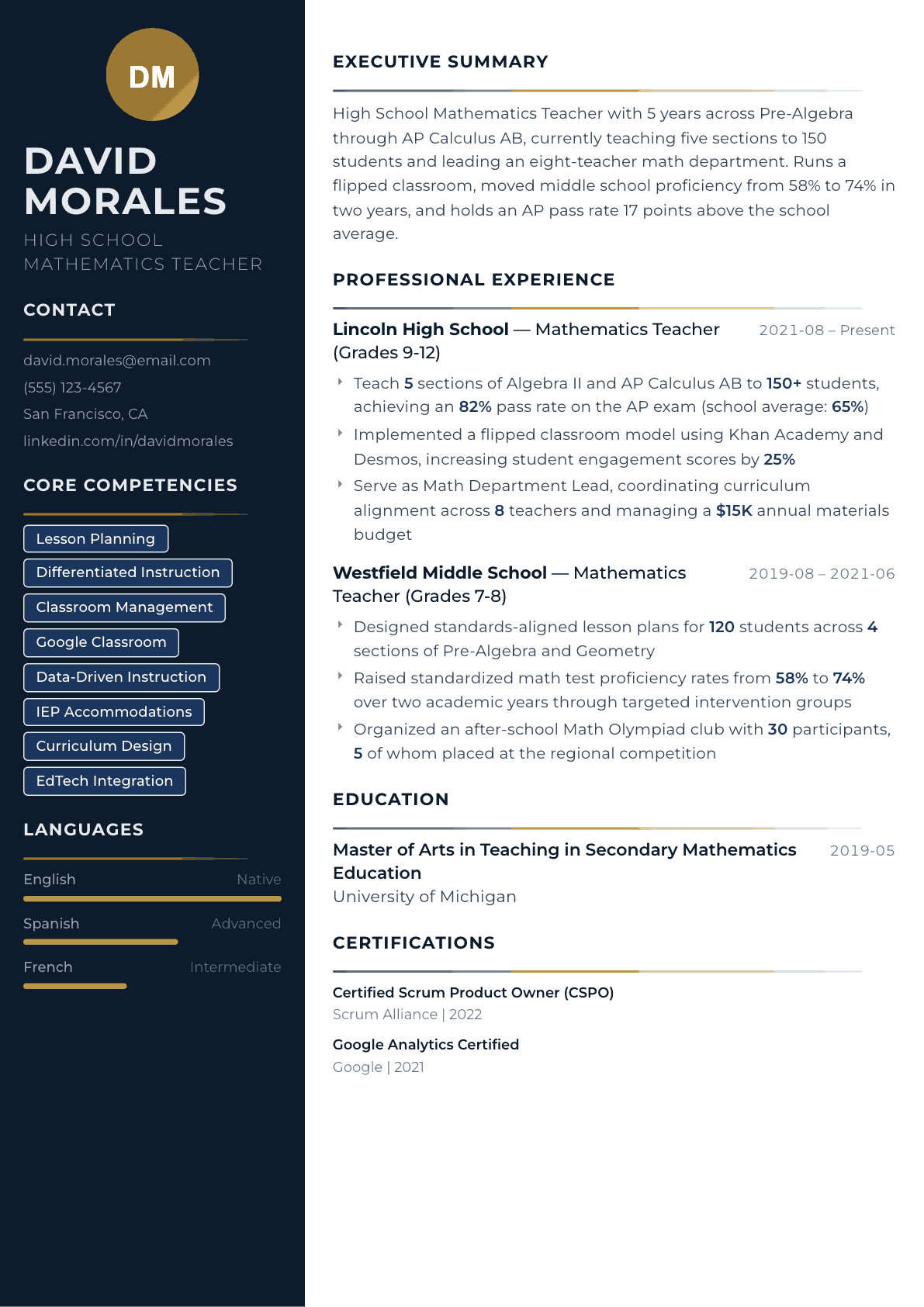
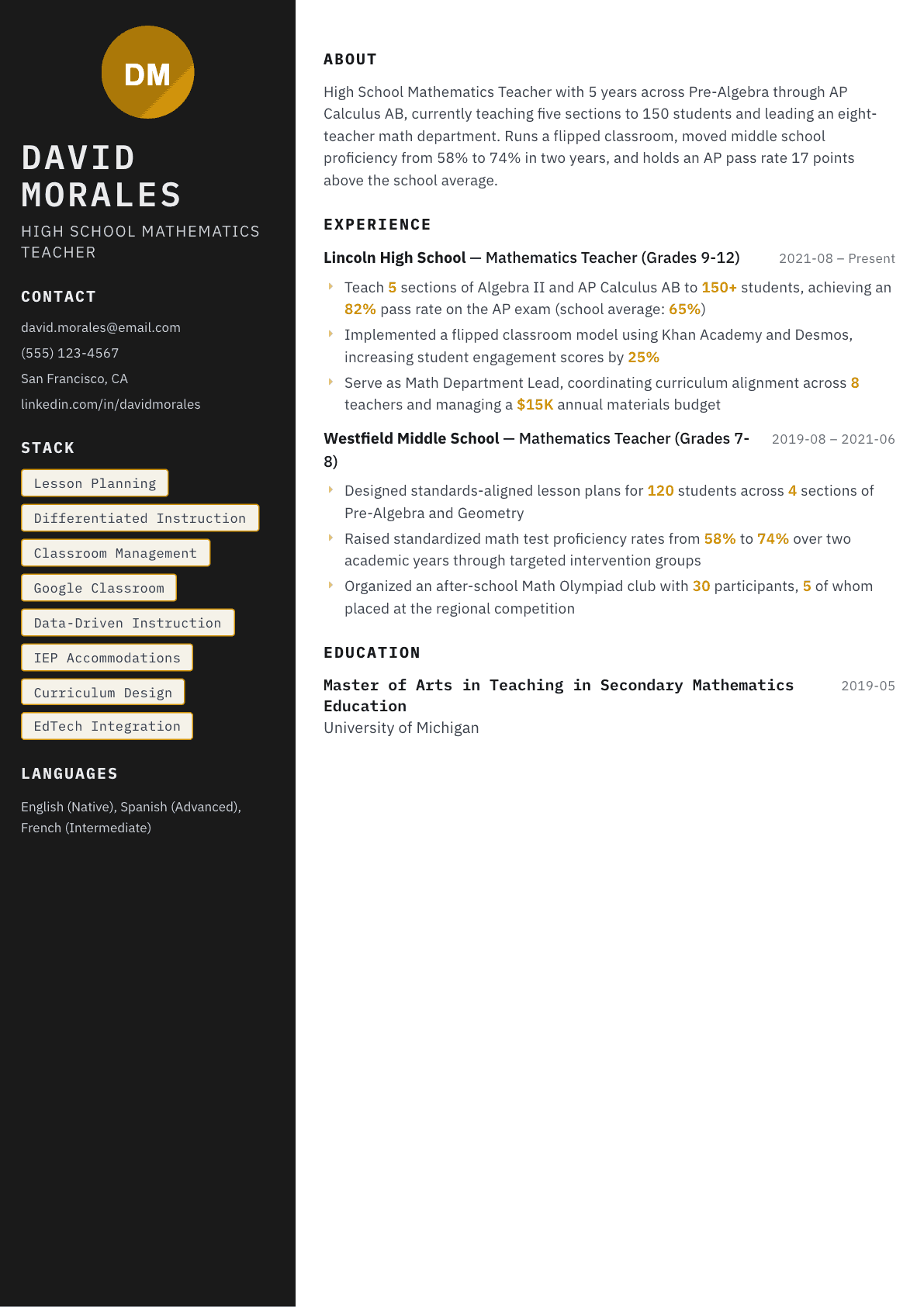
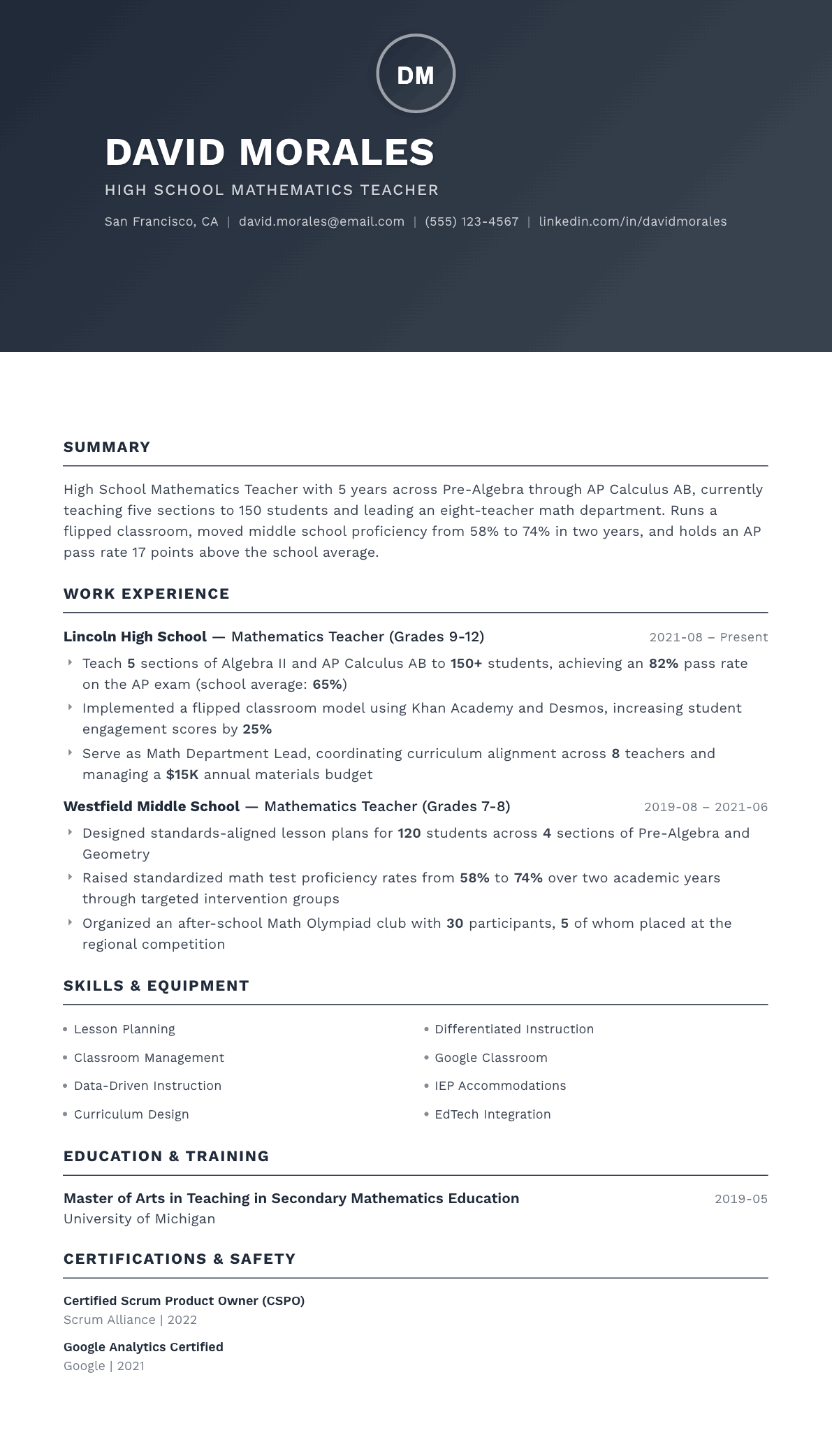
The same teacher content laid out in three CVBooster templates, so you can see what the finished document looks like before you write a word.
Example Teacher summary
Mathematics teacher, 5 years, grades 7 through 12, currently department lead over eight teachers and a $15K materials budget. AP Calculus AB pass rate of 82% against a school average of 65%, middle school proficiency raised from 58% to 74% through targeted intervention groups, and an after-school Math Olympiad club that placed five students regionally.
Skills to list on a Teacher resume
- Lesson Planning
- Differentiated Instruction
- Classroom Management
- Curriculum Design
- Google Classroom
- Canvas LMS
- Data-Driven Instruction
- IEP / 504 Accommodations
- Student Assessment
- EdTech Integration
- Parent Communication
- Standardized Test Prep
- Project-Based Learning
- Tutoring / Intervention
- Mentoring
What actually gets this resume read
- Quantify student outcomes: test score improvements, pass rates, graduation rates, or college acceptance metrics.
- List certifications and endorsements clearly (state teaching license, ESL endorsement, AP certification).
- Highlight technology integration: Google Classroom, Canvas, Nearpod, Kahoot, or other EdTech tools.
- Show extracurricular involvement like coaching, club advising, or committee work to demonstrate school commitment.
- Mention specific curricula or standards you align to (Common Core, Next Generation Science Standards, IB, AP).
- Include professional development and continuing education to show ongoing growth.
How to write a teacher resume
Teaching applications move through a district portal, not an inbox. You upload the resume into a system that already holds your license number, your transcripts and three reference forms, and the principal opens it late in the evening with fifty other files from the same posting. She is filling one vacancy with a specific subject, a specific grade and a specific schedule, and she is reading to answer one question: can this person hold that room in September.
That is why a teacher resume is judged on match before it is judged on quality. The certification area, the grade bands you have actually taught and the courses you have run have to be visible in the first few seconds. A beautifully written page that never says which grades you teach loses to a plain one that does.
Below is how principals read the file, section by section, a teaching CV sample for UK applications, with summaries for a new teacher, a mid-career subject teacher and a department chair, five bullet rewrites, and the questions teachers ask most when they finally sit down to update the page.
Format: match first, polish second
One page until you have about eight years, then two. Reverse chronological, plain single column, standard margins. Districts run large applicant tracking systems that mangle text boxes and columns, and a dropped licensure line is the most common reason a qualified teacher never gets a call.
Put your certification under your name: the state, the subject area and the grade span, plus endorsements such as English learner instruction, reading, gifted education or a second subject. If your license is pending or out of state, say which and give the reciprocity status. Principals hire people they can legally place, and ambiguity there is fatal.
- Header: name, certification area and grade span, endorsements, city, phone, email.
- Sections in order: summary, certifications, teaching experience, education, skills and technology, leadership and professional development.
- New teachers put education and student teaching first, with the cooperating school, grade and mentor teacher role.
Summary: subject, grades, and the thing you are known for
Three lines, and the first has to carry subject and grade band. Then say something a principal cannot get from your license: the courses you have built, the population you are strong with, the intervention you run, the club or team you coach. A teacher who can also cover an advanced course, a dual enrollment section or a second certification area is worth more on a master schedule, so say it here.
Avoid the opening that every teacher writes about being passionate and dedicated. The words are free and therefore carry no information. Replace them with what you can teach and what you have moved.
Experience: the courses, the load, and what changed for students
Start each position with the school, the level and the assignment: five sections of Algebra II and one of precalculus, roughly one hundred and fifty students, in a Title I high school. Load and setting are the context a principal needs before any achievement means anything, because thirty students in a self-contained elementary room and a hundred and fifty across six secondary sections are different jobs.
Then write bullets about instruction and results. Growth on a common assessment, pass rates on an advanced course exam, reclassification of English learners, reading levels moved across a year, the proportion of a class reaching proficiency. Where you cannot use a number, describe the practice precisely: how you grouped for intervention, what your formative assessment cycle looked like, how you used a data team meeting.
Add the school citizenship line. Principals are also filling coaching slots, club advisers, committee seats and duty schedules, and a candidate who ran the yearbook or coached track is solving two problems at once.
Curriculum, standards and technology, named exactly
Name the standards and curricula you have taught inside. Common Core, state science standards, an International Baccalaureate program, Advanced Placement course audits, Eureka Math, Wonders, Amplify, Illustrative Mathematics: each tells a reader what your planning has actually looked like. A teacher who arrives already fluent in the district adoption saves a semester of onboarding.
For technology, list the learning management system and the tools you use for assessment and family communication, not every app you have opened. Google Classroom or Canvas, a student information system such as PowerSchool or Infinite Campus, and whatever you use for formative checks is enough. A long list of trendy applications reads as padding.
Classroom management: show it, do not claim it
Every posting mentions classroom management and every applicant claims it, which makes the claim worthless. Show the system instead. Name the framework the school used, whether that was a positive behavior support model, restorative practices or responsive classroom, and describe what you personally ran: the routines, the tiered response, the family contact cadence, the reset space.
The strongest version attaches an outcome. A drop in removals from your room, a class that moved from constant redirection to independent work time, or a mentoring role where you helped a first-year teacher steady her period after lunch all prove the skill in a way an adjective never will.
Teaching CV sample for schools in the UK
If you are applying to schools in the UK, the document is called a CV and the order changes slightly. A teaching CV sample for England opens with your name, contact details and teaching status: Qualified Teacher Status with the year awarded, or early career teacher with the induction year you are in. In Scotland or Northern Ireland, put your registration with the teaching council in the same place. Then a short personal statement naming your subject and the key stages you teach.
Under employment, give each school, its type and age range, the key stages and subjects taught, and any responsibility such as head of year or subject lead. Safeguarding training and an enhanced DBS check sit in their own short section near the top, because a head teacher checks them before reading anything else. Many state schools still ask for their own application form, so keep the CV ready for agencies, academies and independent schools.
- Header: name, phone, email, teaching status and the year it was awarded.
- Order: personal statement, teaching experience, qualifications, safeguarding and checks, training, referees.
- Each school: name, type, age range, key stages, subjects and any responsibility held.
Teacher resume summary examples
New teacher
Certified secondary mathematics teacher, grades 7 to 12, completing a full-year student teaching placement in Algebra I and Geometry across 4 sections. Built a spiral review routine that lifted unit test averages by 11 points and served as the after-school tutoring lead 3 days a week.
Six years in
High school mathematics teacher with 6 years teaching Algebra II, precalculus and an Advanced Placement Calculus section to roughly 150 students a year. Raised the AP pass rate from 54% to 78% over 3 cohorts and mentors 2 first-year teachers as part of the district induction program.
Department chair
Mathematics department chair leading 9 teachers across a 1,400-student high school, responsible for course sequencing, common assessments and the master schedule input for the department. Rebuilt the algebra pathway and expanded advanced course enrollment by 40% in 4 years.
Work experience bullets: before and after
Before: Taught math to high school students.
After: Taught 5 sections of Algebra II and 1 of Advanced Placement Calculus AB to 152 students across 3 preps in a Title I high school.
Section count, preps, student total and school context tell a principal exactly what load you have carried.
Before: Improved student test scores.
After: Moved grade 8 proficiency on the state mathematics assessment from 58% to 74% over 2 years using weekly common assessments and a Friday intervention block.
A measured movement plus the mechanism that produced it is far more convincing than the claim on its own.
Before: Used technology in the classroom.
After: Ran a flipped model in Canvas with recorded mini-lessons and Desmos activities, freeing 2 class periods a week for small-group problem solving.
Naming the platform and what the time was spent on shows instructional purpose rather than tool adoption.
Before: Good at classroom management.
After: Cut removals from my classroom to fewer than 5 a semester by opening every period with a 4-minute entry routine and holding weekly family contacts for the 6 students on my watch list.
A concrete routine and a countable result turn a claim everyone makes into evidence.
Before: Involved in school activities.
After: Advised the robotics club and coached junior varsity track, and served 2 years on the school improvement team writing the mathematics section of the annual plan.
Naming the commitments shows a principal you fill schedule gaps she otherwise has to beg for.
Hard skills
- Lesson and unit planning
- Standards alignment
- Differentiated instruction
- Formative and common assessment design
- Data-driven small group instruction
- IEP and 504 accommodation implementation
- English learner supports
- Google Classroom and Canvas
- Student information systems
- Advanced Placement course delivery
- Reading and mathematics intervention
- Curriculum mapping
Soft skills
- Classroom routines
- Family communication
- Colleague mentoring
- Feedback delivery
- Adaptability across preps
- Calm under disruption
Certifications worth listing
- National Board Certification (National Board for Professional Teaching Standards)
- Advanced Placement Summer Institute completion (College Board)
- IB Educator Certificate in Teaching and Learning (International Baccalaureate Organization)
- Google Certified Educator Level 1 and 2 (Google for Education)
- TESOL Certificate (TESOL International Association)
Mistakes that cost teacher candidates the interview
- Never stating the grade band, which forces a principal to guess whether you can be placed in the vacancy she has.
- Opening with passion and dedication, which every file in the stack already says.
- Listing every application you have ever used instead of the learning management system and the assessment tools you actually run.
- Omitting the student load and the number of preps, the two numbers that describe the real weight of a teaching job.
- Leaving off coaching, club advising and committee work, which often decide who gets called first.
- Sending an identical file to an elementary and a secondary posting rather than reordering the bullets for each.
- Hiding a pending or out-of-state license instead of stating its status plainly.
Teacher resume questions
How long should a teacher resume be?
One page for the first several years and two once you have multiple schools, advanced courses or leadership roles. Principals read fast during hiring season, so a tight two pages with clear headings beats a dense one page in a smaller font.
Should I include student test scores?
Include them when you can state them honestly and give the comparison. Growth over a stated period or a pass rate against the school average is meaningful. A single number with no context invites suspicion, and inflated claims fall apart in the interview.
Where do student teaching and practicum hours go?
In their own block near the top for the first two years, with the school, grade, subject, length of placement and what you were given full responsibility for. Once you have a year of contracted teaching, move it down or drop it.
How do I write a resume when changing grade levels?
Name the move in the summary and hold your certification for the new band up front. Then reorder each job so the bullets closest to the target band come first, and pull in tutoring, summer school or coaching that put you in front of those students.
What does a teaching CV sample look like in the UK?
Two pages at most: name and teaching status at the top, a short personal statement with subject and key stages, then each school with its age range, subjects and responsibilities. Qualifications, safeguarding training and checks, and two referees, one of them your current head teacher, follow. Write it in plain sections an agency can scan.