High School Science Teacher Resume Examples: free score
Formulate a High School Science Teacher Resume That Gets Results
By Mustafa Tarabya, founder of CVBooster · Published · Updated
Create a high school science teacher resume highlighting lab instruction, AP course expertise, and student achievement metrics with educator-focused formatting.
Sample resumes for a high school science teacher
The same high school science teacher content laid out in three CVBooster templates, so you can see what the finished document looks like before you write a word.
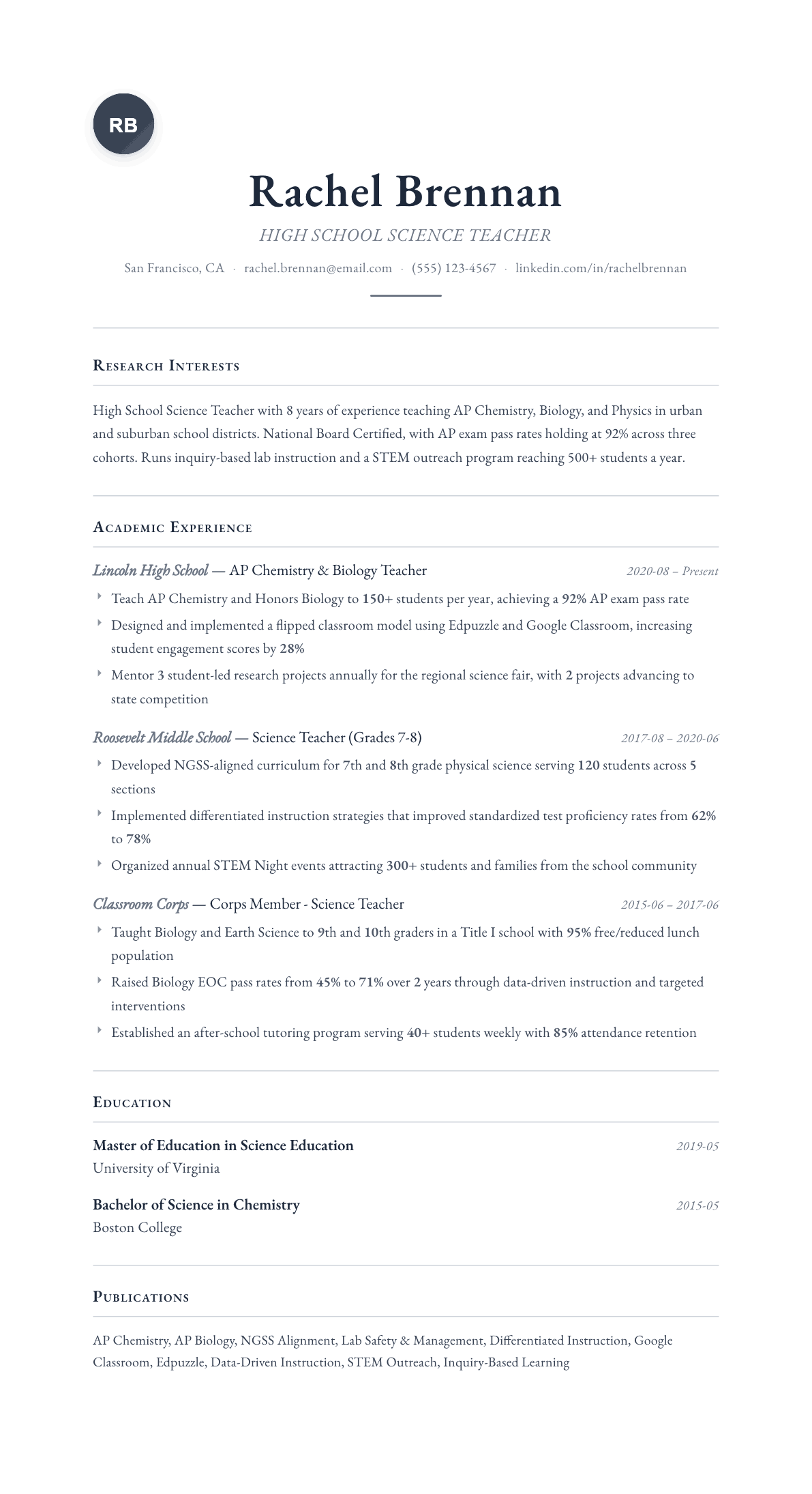
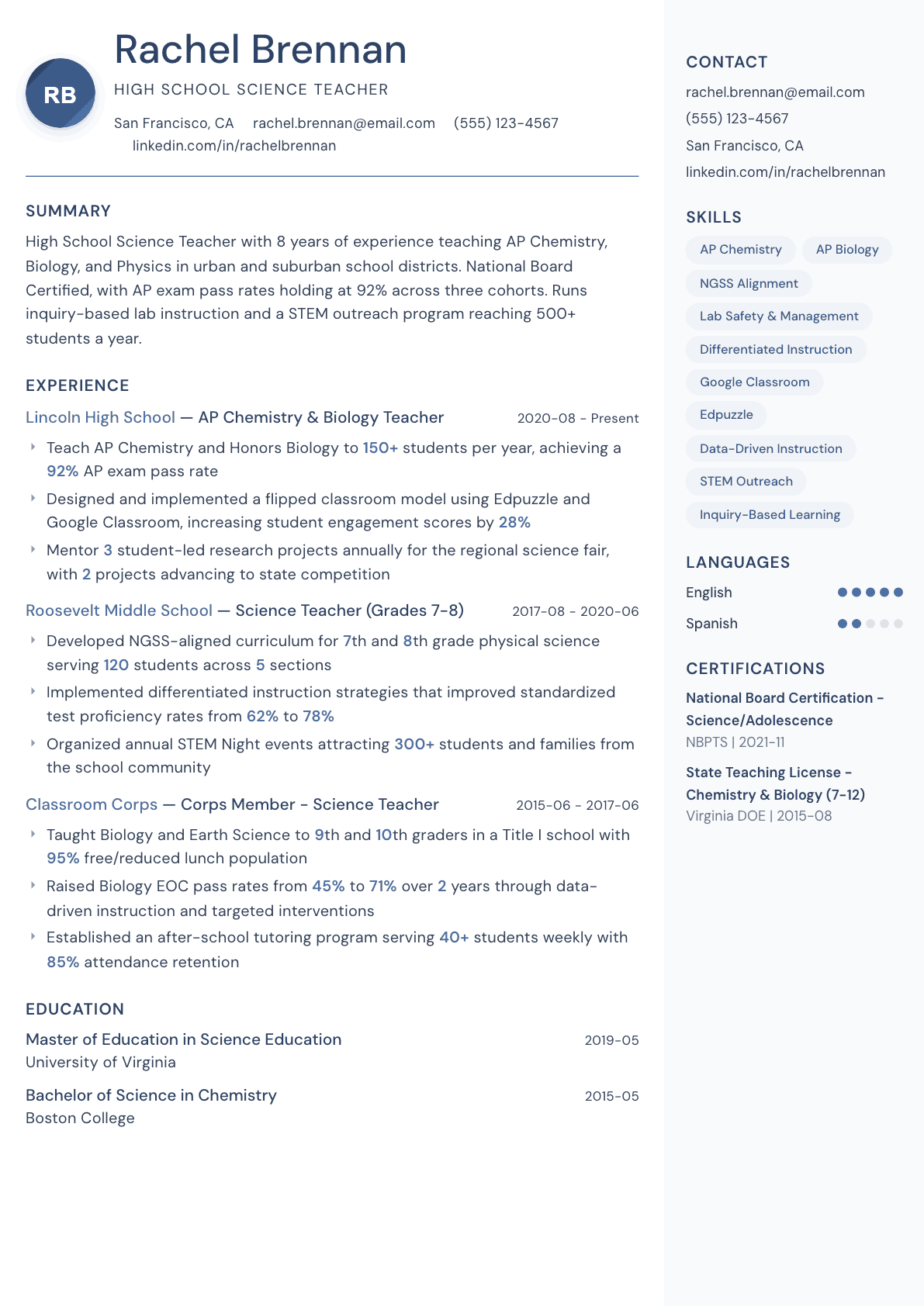
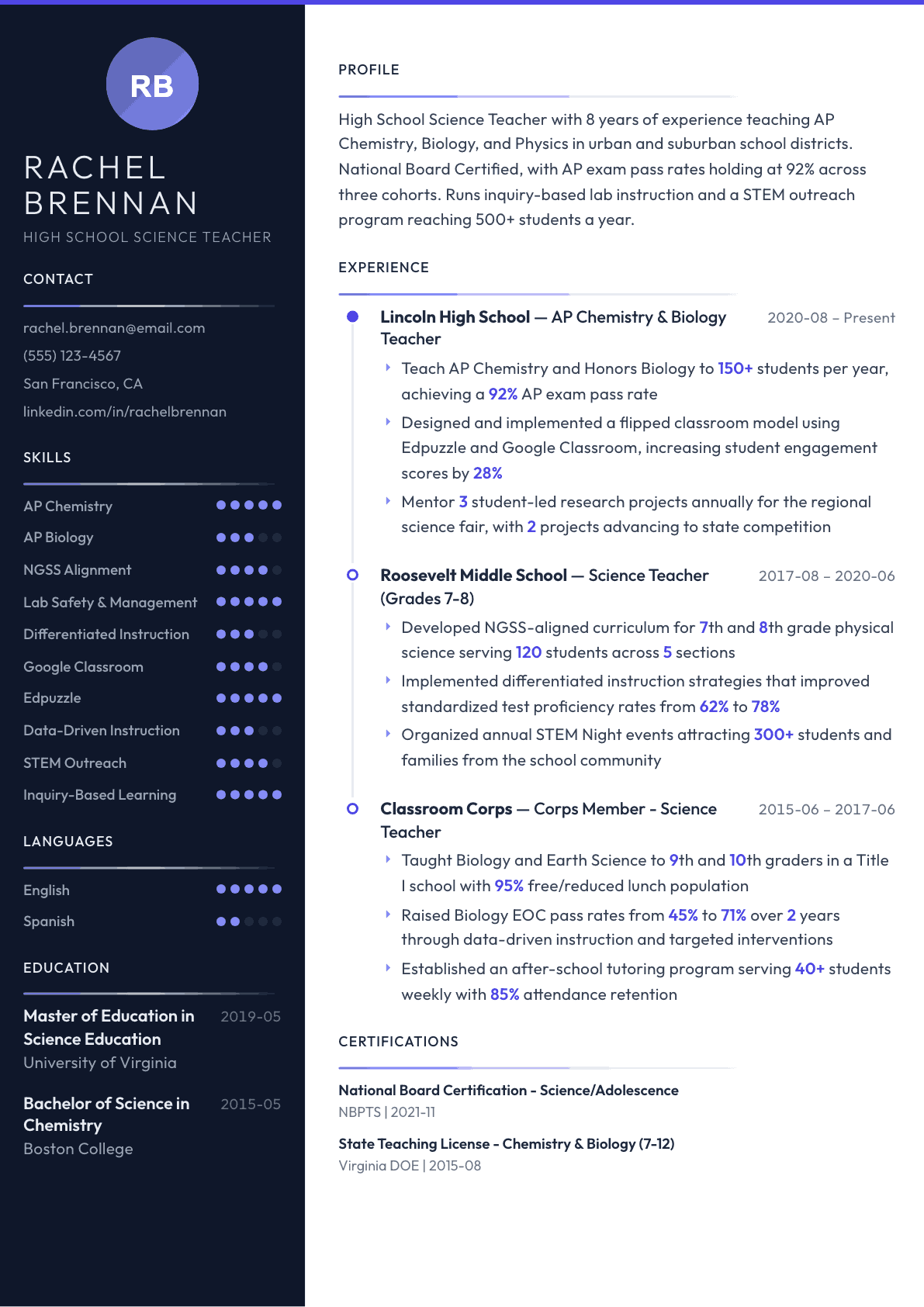
Example High School Science Teacher summary
National Board Certified science teacher with 8 years of experience teaching AP Chemistry, Biology, and Physics. Achieved 92% AP exam pass rates through inquiry-based instruction and data-driven strategies. Committed to STEM outreach and equitable science education for diverse student populations.
Skills to list on a High School Science Teacher resume
- AP Course Instruction
- NGSS-Aligned Curriculum
- Lab Safety & Management
- Differentiated Instruction
- Data-Driven Instruction
- Google Classroom
- Inquiry-Based Learning
- Classroom Management
- Student Assessment
- STEM Program Development
- IEP Accommodation
- Flipped Classroom
- Parent Communication
- Standardized Test Prep
What actually gets this resume read
- Highlight AP course teaching experience and student pass rates with specific percentages.
- Include state teaching license details with endorsement areas and grade levels.
- Quantify student outcomes: test score improvements, pass rates, college acceptance rates.
- Mention curriculum frameworks: NGSS, Common Core, state-specific standards.
- Describe technology integration: LMS platforms, virtual labs, assessment tools.
- Reference extracurricular contributions: science fairs, STEM clubs, coaching, tutoring programs.
How to write a high school science teacher resume
A high school science teacher resume passes through a district HR office before it reaches a principal. HR confirms one thing: does this candidate hold, or can this candidate hold, the state license with the right subject endorsement. Biology, chemistry, physics and earth science are separate endorsements in most states, and a resume that says only "science" forces someone to guess.
The principal and the department chair read for something else. They have a schedule with specific sections to fill, often an odd mix such as two sections of Honors Biology, one Physical Science, and an AP Chemistry group that lost its teacher. They are looking for the person who can take that load without a year of ramp-up, run a lab safely, and keep the AP scores from sliding.
This guide covers the section order a district expects, how to write course loads and lab responsibilities so a chair can picture your schedule, summaries for a first-year teacher through a department chair, and the questions science teachers ask when their resume has to compete with fifty others for one opening.
Format: two pages is normal, and the license goes above the fold
Teaching resumes run longer than corporate ones because certification, courses taught and student teaching all need room. Two pages is standard once you have a few years in the classroom. Use reverse-chronological order, plain headings, and no graphics, because most districts run applications through Frontline, Applitrack or a similar system that flattens the file before a human sees it.
Put a certification line directly under your header. State, endorsement areas, grade bands and status: "Ohio Resident Educator License, Integrated Science 7-12, Chemistry 9-12". If you are applying out of state, add a line saying reciprocity is in progress and name the state, because that single sentence stops a screener from discarding the file.
- Header: name, city and state, phone, email, and the state licenses with endorsement areas.
- Order: summary, certifications and endorsements, teaching experience, education, professional development, skills.
- A first-year applicant moves student teaching and clinical placements up, directly under education.
Summary: subjects taught, grade levels, course levels, one result
Three lines. Name the disciplines you are endorsed to teach, the grade span, whether your sections are on-level, honors, dual credit or Advanced Placement, and one outcome a chair can check. A department chair filling an AP Chemistry section scans for the word chemistry and the letters AP, and moves on if neither is there.
If you are moving between disciplines, say it plainly. A biology teacher who has been assigned two sections of physical science for three years should name both, because the resume that matches the schedule is the resume that gets the call.
Experience: the schedule, the lab, and what students did with the content
Open each teaching job with the school, the district, and a line describing the assignment: courses, number of sections, students per year, and the population. "Four sections of Honors Biology and two of AP Environmental Science, roughly 160 students, Title I comprehensive high school" is a chair reading her own master schedule.
Then bullets on what makes science teaching different from every other subject. Lab work is the core of it: the investigations you designed, the equipment you maintained, the chemical inventory and safety data sheets you were responsible for, the safety training you delivered before students touched anything. Add the standards framework you built to, since districts write postings around it, and name it as the district does: NGSS, state science standards, or a College Board course description.
Close each job with the work outside your own classroom, because that is what separates a candidate from a colleague: science fair coaching, curriculum writing over the summer, a vertical alignment team, a robotics or environmental club, and the professional learning community you contributed to.
Evidence a principal actually checks
Science hiring is unusually data-friendly, so use it. Advanced Placement pass rates, end-of-course exam proficiency, state assessment growth, and enrollment growth in an elective you built are all numbers a principal can verify and will ask about in the interview. Give the baseline as well as the result, because a rate with no starting point reads as a claim rather than a finding.
Do not stretch. If your AP group was six students, say six students. A small, honest number is more persuasive than a rounded one you cannot defend when the assistant principal opens the score report during the interview.
Skills and technology: name the instruments and the platforms
A science skills section should read like an inventory of your classroom. Probeware and data collection systems such as Vernier or PASCO, microscopy, titration and gravimetric analysis, spectrophotometry, dissection, greenhouse or aquarium care, and the simulation tools you use when the equipment budget runs out. Then the platforms: the learning management system, the grading system, the assessment tools, and anything you use to run a flipped or blended lesson.
Keep pedagogical methods here too, since postings name them: inquiry-based instruction, phenomenon-driven lessons, claim-evidence-reasoning writing, differentiation for multilingual learners, and accommodation of individualized education programs in a lab setting.
High School Science Teacher resume summary examples
First teaching position
Biology and chemistry teacher licensed 7-12, with a full-year student teaching placement covering three sections of Honors Biology and one of Physical Science. Built an NGSS-aligned genetics unit adopted by the host department and completed laboratory safety training before supervising student investigations.
Six years in
High school science teacher with six years teaching Chemistry, Honors Chemistry and AP Chemistry to about 150 students a year in a comprehensive suburban school. Raised the AP pass rate from 54% to 78% over four cohorts and maintained the chemical inventory and safety documentation for the department.
Science department chair
Science department chair leading eleven teachers across biology, chemistry, physics and environmental science in a school of 1,600. Rebuilt the four-year course sequence, added two dual-credit offerings, and ran the district vertical alignment team that moved end-of-course biology proficiency up for three consecutive years.
Work experience bullets: before and after
Before: Taught high school science classes to students of all levels.
After: Taught five sections a semester across on-level Biology, Honors Biology and AP Environmental Science, about 145 students a year, in a school where a third of students were multilingual learners.
Section counts, course levels and student population let a chair place you on a real master schedule.
Before: Conducted laboratory experiments with students.
After: Designed and ran 24 wet labs per year including titration, chromatography and calorimetry, wrote the pre-lab safety briefings, and kept the chemical inventory and safety data sheets current for the chemistry storeroom.
Naming the investigations and the safety responsibility shows you can be trusted alone with a stocked lab.
Before: Improved student test scores.
After: Moved Biology end-of-course proficiency from 61% to 79% across three years by adding weekly retrieval quizzes and a claim-evidence-reasoning writing routine tied to each unit assessment.
A baseline, a result and the method behind it turn a claim into something a principal can discuss.
Before: Sponsored the science club.
After: Founded and sponsored a science research club of 22 students, coaching eight independent projects to the regional fair and two to the state competition over two seasons.
Membership numbers and outcomes show a club you actually ran rather than a title on a stipend list.
Before: Used technology in the classroom.
After: Introduced Vernier probeware for motion and temperature investigations and paired it with short pre-lab videos so class time went to data collection and analysis rather than setup instructions.
The specific instrument and the instructional reason behind it beat the word technology.
Hard skills
- NGSS-aligned curriculum design
- Advanced Placement course instruction
- Laboratory safety and chemical inventory management
- Inquiry and phenomenon-based instruction
- Vernier and PASCO probeware
- Microscopy and dissection instruction
- Titration and quantitative analysis labs
- Claim-evidence-reasoning scientific writing
- Formative assessment and item analysis
- Learning management systems
- Differentiation for multilingual learners
- Individualized education program accommodations
- Science fair and independent research mentoring
Soft skills
- Classroom management in a lab setting
- Parent conferences
- Collaboration in a professional learning community
- Mentoring student teachers
- Calm under safety incidents
- Curricular decision making
Certifications worth listing
- National Board Certification, Adolescence and Young Adulthood Science (National Board for Professional Teaching Standards)
- AP Chemistry Summer Institute (College Board)
- AP Biology Summer Institute (College Board)
- Laboratory Safety Institute Course for Science Teachers (Laboratory Safety Institute)
- CPR, AED and First Aid (American Red Cross)
Mistakes that cost high school science teacher candidates the interview
- Writing "science" with no discipline named, so nobody can tell whether you can be assigned physics or only biology.
- Burying the license and endorsement on page two, where a district screener working through a hundred files will not look for it.
- Listing course titles with no section count or enrollment, which hides whether you carried a full teaching load.
- Omitting laboratory safety entirely, the single responsibility a principal worries about most when hiring for a chemistry room.
- Describing pedagogy in general terms when the posting names a framework the district has adopted and expects to see echoed.
- Turning the resume into a philosophy statement. Beliefs about student potential belong in the cover letter and the interview.
High School Science Teacher resume questions
Should I list every course I have taught?
List the courses, not every section of every year. Group them by discipline and level so a chair can see the range at a glance: on-level, honors, dual credit and Advanced Placement. If you taught a course once and would rather not be assigned it again, still list it, since range is what gets you scheduled.
How do I show student teaching if I have no paid classroom experience yet?
Give the placement its own entry with the school, the mentor teacher's subject, the length in weeks, the courses and the number of students you took over. Then write bullets about work you owned, such as a unit you planned end to end or an assessment you wrote and analyzed.
Do Advanced Placement scores belong on a resume?
Yes when they are strong and you can state the cohort size. Give the pass rate and the number of students, and give the starting point if you inherited the course. Leave scores off if the group was too small to be meaningful, and talk about the course design instead.
How do I apply to a district in another state?
Name your current license and endorsement exactly as issued, then add a short line saying you have applied for reciprocity in the target state or that you meet its requirements. Screeners reject out-of-state files by default unless you answer the licensing question for them on the page.
What if I have been teaching outside my endorsement area?
Say so directly in the experience entry rather than hiding it. Note the courses you taught under a supplemental or emergency assignment and any coursework you completed toward the added endorsement, because a principal would rather see the honest path than discover a mismatch during reference checks.