Math Teacher Resume Examples: free ATS score and gap list
Add Up Your Achievements with a Math Teacher Resume
By Mustafa Tarabya, founder of CVBooster · Published · Updated
Build a math teacher resume highlighting your ability to make complex concepts accessible, improve test scores, and differentiate instruction for diverse learners.
Sample resumes for a math teacher
The same math teacher content laid out in three CVBooster templates, so you can see what the finished document looks like before you write a word.
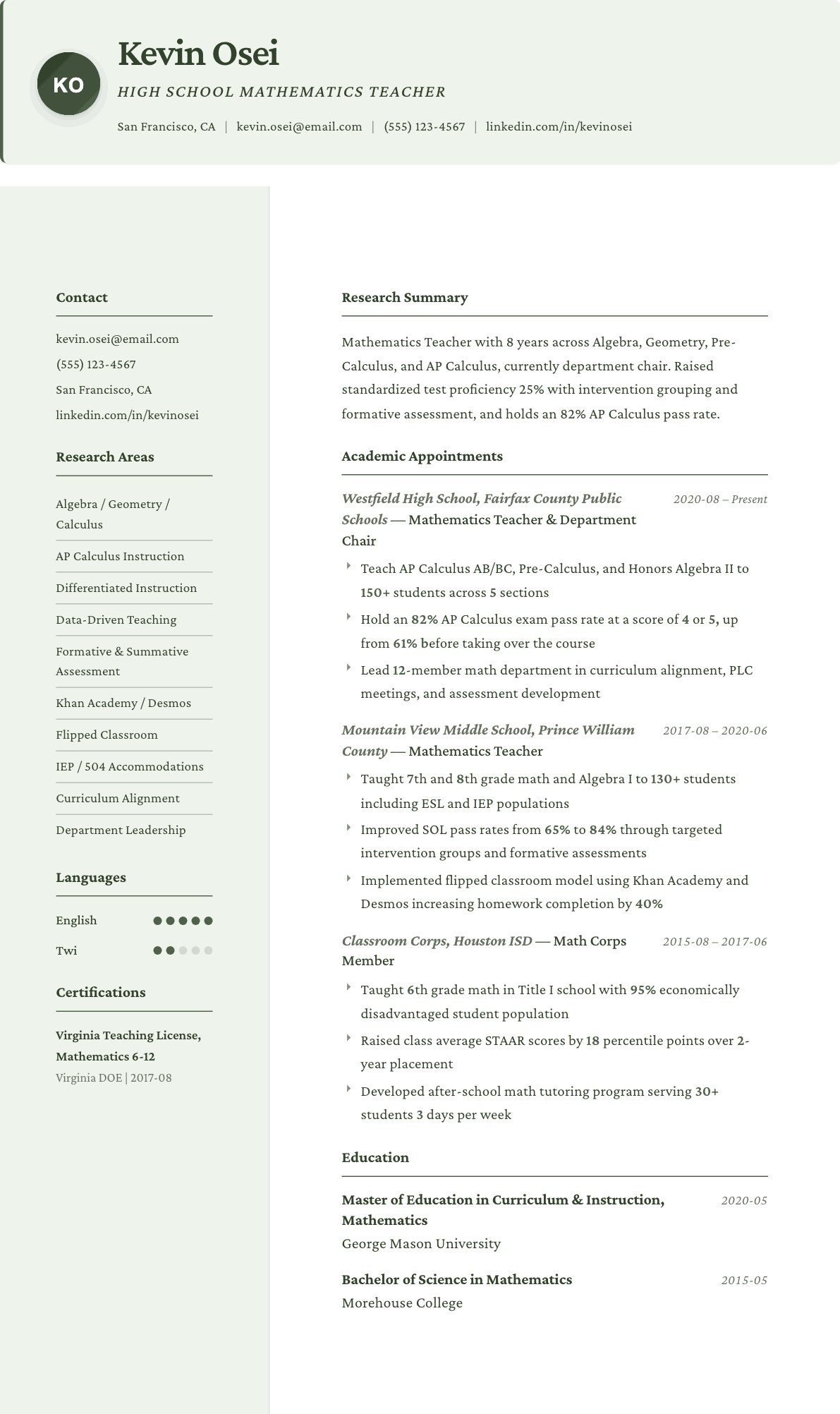
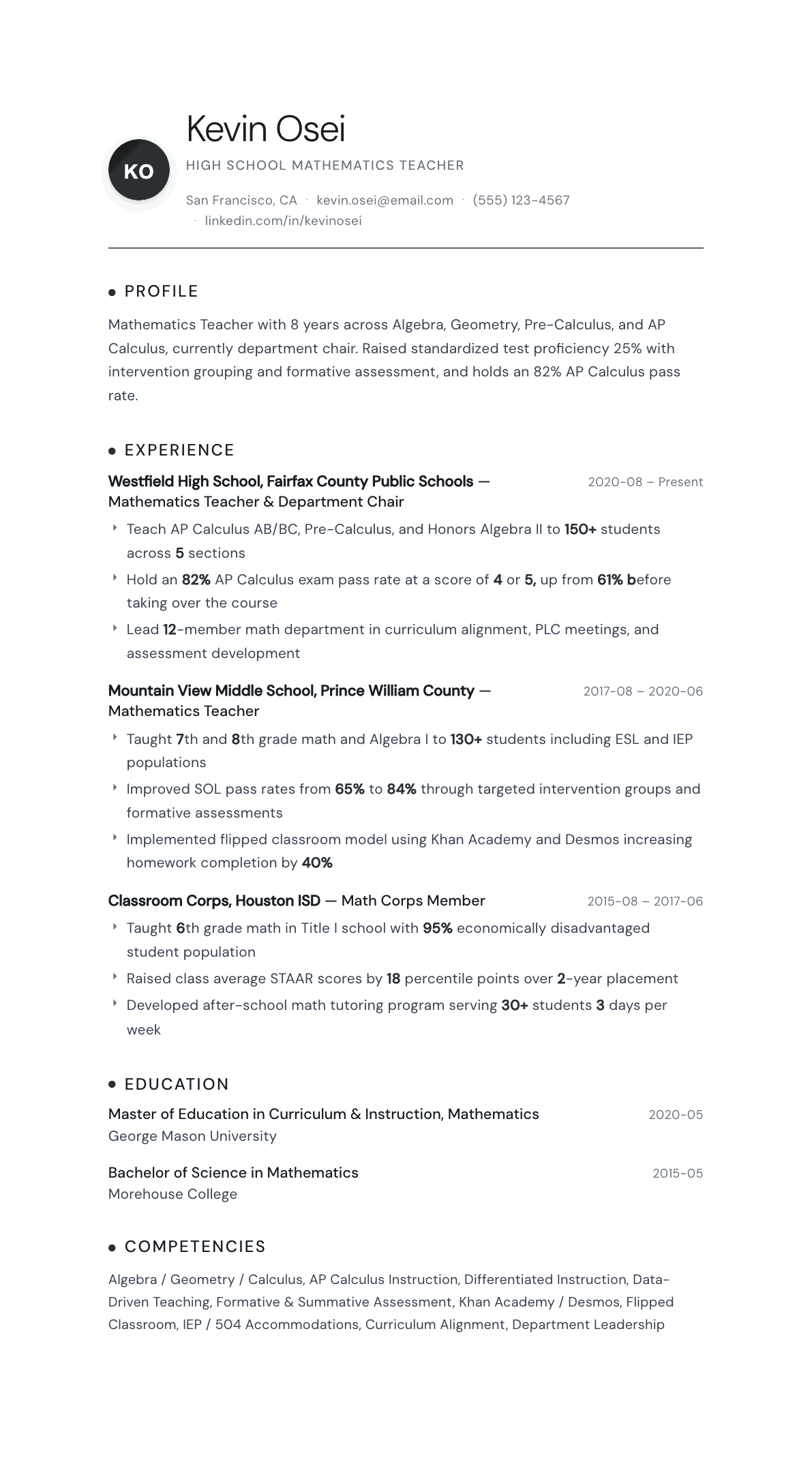
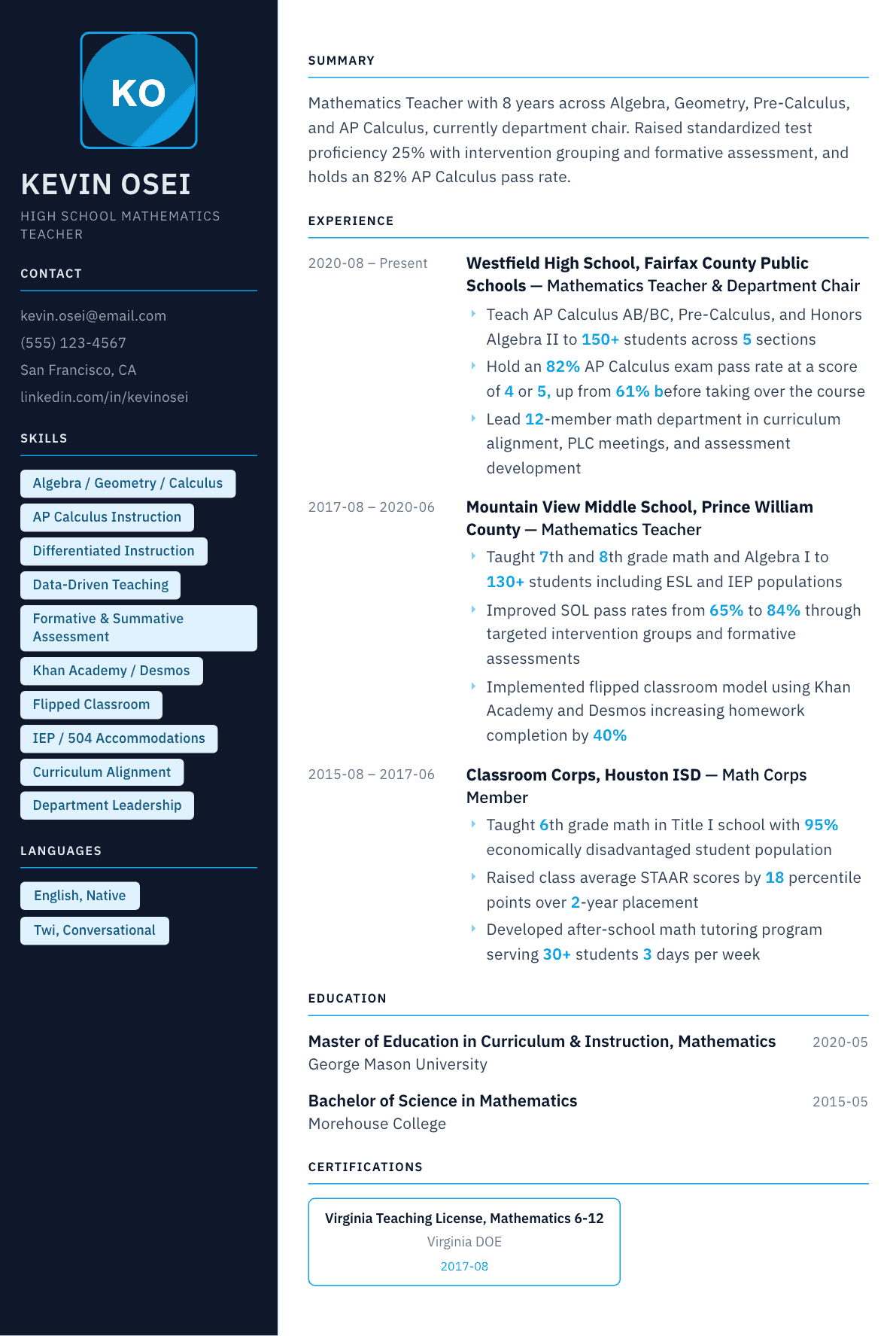
Example Math Teacher summary
Mathematics Teacher with 8 years of experience teaching Algebra through AP Calculus with 82% AP exam pass rate. Improved standardized test proficiency by 25% through data-driven instruction and differentiated learning for diverse populations.
Skills to list on a Math Teacher resume
- Algebra / Geometry / Calculus
- AP Calculus AB/BC
- Differentiated Instruction
- Data-Driven Decision Making
- Formative Assessment
- Khan Academy / Desmos / GeoGebra
- Flipped Classroom
- IEP / 504 Accommodations
- Curriculum Development
- PLC Leadership
- Classroom Management
- Standardized Test Preparation
What actually gets this resume read
- Quantify student achievement: test score improvements, AP pass rates, proficiency percentages.
- List specific courses taught including honors and AP levels to show range and rigor.
- Include educational technology: Desmos, Khan Academy, GeoGebra, Mathway, or graphing calculators.
- Highlight differentiation strategies for ESL, special education, and gifted students.
- Mention department leadership, curriculum development, or mentoring roles.
How to write a math teacher resume
Mathematics is the hardest subject for districts to staff, which changes the tone of the hiring conversation. A principal with an open Algebra I position and no qualified applicants is motivated to move fast, but she is also cautious, because the wrong hire in a foundational course damages an entire cohort's progress through the sequence. Your resume has to answer both feelings: you are licensed and available, and you have taught this specific course before.
The course sequence is the spine of a math teacher resume. Algebra I, Geometry, Algebra II, Pre-Calculus, Statistics and Calculus are not interchangeable, and neither are middle school grade bands. A department chair building next year's schedule reads your resume looking for the two or three courses she cannot cover, and everything else is background.
This guide covers the format districts expect, how to describe course loads, intervention work and data practice, a complete math teaching resume written out from header to education, three summaries from student teaching to department chair, and the questions math teachers ask when they change grade bands, states or school types. A resume for a maths teacher, a mathematics teacher or a math teacher is the same document under three names, and the same rules apply to all of them.
Format: reverse-chronological, two pages, license in the first inch
District application systems ask you to upload a resume alongside a form that already captured your license. That does not mean the license can be left off the document, because the principal reading the shortlist works from the resume, not the form. Put the state license, the endorsement and the grade band in a line under your header.
Skip columns, icons and skills bars. Math teachers sometimes reach for a data-styled layout, and it parses badly and reads as decoration to a hiring committee that wants course titles and dates.
- Header: name, city and state, phone, email, and state license with mathematics endorsement and grade band.
- Order: summary, certification, teaching experience, education, professional learning, skills and technology.
- Candidates in their first year lead with student teaching and any long-term substitute assignments in mathematics.
Summary: courses, grade band, and what happens to student results
Open with the courses you can teach tomorrow, listed by name, and the grade band. Then the piece a principal cares about most: what happened to student performance in your classes, and how. A math teacher who can describe a specific instructional move and the result it produced stands apart from a stack of resumes that describe enthusiasm for mathematics.
If you are certified in an adjacent area, say so. Dual certification in mathematics and computer science, physics or special education makes you far easier to schedule, and easier scheduling is a real hiring advantage in a small school.
Experience: the load, the levels, and the students who struggled
Start each entry with the assignment: the courses, the number of sections, the students per year, and the tracks. "Three sections of Algebra I, two of Geometry, one Algebra I support block, about 140 students" is the sentence a chair needs. Note whether you taught inclusion sections with a co-teacher, since co-teaching is a distinct skill and many postings require it.
Then write about the mathematics. How you sequence a unit, how you handle students who arrive three grade levels behind, what a typical formative check looks like in your room, and what you do the day after a poor assessment. Intervention and remediation bullets carry weight, because every math department has a group of students the standard pacing guide has already lost.
Include the department work: writing common assessments, aligning a course to state standards, running a professional learning community, choosing or piloting curriculum materials, and coaching a colleague. Math departments are small, so a candidate who contributes beyond her own sections changes the whole team.
Data: use it, but show the practice behind the number
Mathematics teachers have more usable data than anyone in the building: end-of-course exams, benchmark assessments, common unit tests, Advanced Placement scores and course pass rates. A principal will believe those numbers if you give the baseline, the cohort size and the interval, and will discount them if you do not.
More persuasive than the number is the routine that produced it. Weekly spiral review, error analysis protocols, reassessment policies, standards-based grading, a targeted small-group rotation during a support block: these are the practices an interview panel will ask you to describe, so put them in the resume where they prompt the question.
Technology and materials: name what you actually run
List the curricula and platforms by name, because districts adopt specific ones and search for them. Graphing technology such as Desmos or a handheld calculator model, an adaptive practice platform, the learning management system, the assessment tool, and the district curriculum if it is widely used. A teacher who has taught from a named curriculum arrives ready for the pacing guide.
Keep instructional methods here as well, in the district's vocabulary: number talks, three-act tasks, spaced retrieval practice, station rotation, and structured discourse routines. Those phrases appear in postings and in interview rubrics.
Math teaching resume example, written out
Here is a complete mathematics teacher resume for a high school teacher in her sixth year, written as plain text so you can see the order a principal reads. The candidate is invented; the structure is the part to copy. Header: Dana Whitfield, Columbus, Ohio, phone and email, Ohio Adolescence to Young Adult license in Integrated Mathematics, grades 7-12.
Summary: Mathematics teacher with six years in Algebra I, Geometry and Algebra II, two of them co-teaching inclusion sections of Algebra I. Runs the Algebra I support block with weekly diagnostic checks and a fixed reteach day, and writes the common unit assessments for the Algebra I team.
Experience, Lakeview High School, Mathematics Teacher, six years. The bullets below are the ones she kept after cutting everything a chair would skip.
Education: Bachelor of Science in Mathematics Education. Professional learning: AP Statistics Summer Institute, district curriculum implementation training. Technology: Desmos, the district learning management system and an adaptive practice platform named by product.
- Teach five sections a year across Algebra I, Geometry and Algebra II, about 140 students, including two co-taught inclusion sections of Algebra I.
- Run the Algebra I support block for students placed below grade level, using a diagnostic at entry and a weekly prerequisite check to move students between small groups.
- Write the shared unit assessments for the four-teacher Algebra I team and lead the review meeting where results are sorted by standard.
- Built a Geometry proof unit around structured discourse routines that the department adopted for all sections.
- Coach the after-school math team and mentor one first-year teacher each year through the district induction program.
Math Teacher resume summary examples
Student teaching complete
Mathematics teacher licensed for grades 6-12 with a full-semester placement teaching two sections of Algebra I and one of Geometry. Built a unit on linear functions around Desmos investigations and ran a twice-weekly small-group intervention for students below grade level in the same building.
Seven years in
High school math teacher with seven years in Algebra I, Geometry and Algebra II, including three years of co-taught inclusion sections. Raised Algebra I end-of-course pass rates from 68% to 85% by rebuilding the support block around targeted small-group rotations and weekly error analysis.
Department chair
Mathematics department chair leading nine teachers across a 1,400-student high school, responsible for the course sequence from Algebra I through AP Calculus BC. Rewrote the common assessment bank, opened a statistics elective that now runs three sections, and mentors two new teachers each year.
Work experience bullets: before and after
Before: Taught math to high school students.
After: Taught six sections a year across Algebra I, Geometry and an Algebra I support block, about 155 students, two of them co-taught inclusion sections with a special education partner.
Courses, sections, enrollment and the co-teaching detail let a chair see your exact place on a schedule.
Before: Helped struggling students improve in math.
After: Ran a daily 30-minute intervention block for 18 students working two or more grade levels below, using diagnostic placement and weekly progress checks on prerequisite skills.
Naming the structure, the group size and the monitoring makes the intervention something a principal can picture.
Before: Used data to inform instruction.
After: Analyzed common assessment results by standard with the department each unit, reteaching the two lowest-performing standards in a fixed review day before students could reassess.
The mechanism, the cadence and the reassessment policy show a data routine rather than a slogan.
Before: Prepared students for the AP Calculus exam.
After: Grew AP Calculus AB enrollment from one section to two and moved the qualifying score rate from 47% to 71% across four cohorts by adding a fall free-response writing routine.
Enrollment growth alongside score growth answers the objection that results improved by screening students out.
Before: Served as a member of the math department team.
After: Led the weekly professional learning community for the Algebra I team of four, building the shared unit assessments and the pacing calendar the department still uses.
Leading a team and producing something the department kept is far stronger than membership in it.
Hard skills
- Algebra I and Algebra II instruction
- Geometry instruction
- Pre-Calculus and Calculus instruction
- Advanced Placement and dual credit coursework
- Statistics instruction
- Standards alignment and pacing guides
- Common assessment design and item analysis
- Mathematics intervention and remediation
- Co-teaching in inclusion settings
- Desmos and graphing technology
- Adaptive practice platforms
- Standards-based grading
- Learning management systems
Soft skills
- Classroom management
- Explaining abstract ideas plainly
- Patience with repeated reteaching
- Parent communication about grades
- Mentoring newer teachers
- Collaborative planning
Certifications worth listing
- National Board Certification, Adolescence and Young Adulthood Mathematics (National Board for Professional Teaching Standards)
- National Board Certification, Early Adolescence Mathematics (National Board for Professional Teaching Standards)
- AP Calculus Summer Institute (College Board)
- AP Statistics Summer Institute (College Board)
Mistakes that cost math teacher candidates the interview
- Writing "taught mathematics" without naming the courses, when the course list is the only thing a chair is scanning for.
- Omitting the grade band on the endorsement, which leaves a middle school principal unsure whether you can be assigned at all.
- Reporting a pass rate with no baseline and no cohort size, which an interviewer will treat as unverifiable.
- Hiding co-teaching and intervention work, the two experiences most postings for foundational courses actually require.
- Listing a calculator model as a technology skill while leaving out the curriculum and platforms the district runs.
- Filling the resume with a philosophy of mathematics education instead of the courses, loads and results a schedule builder needs.
Math Teacher resume questions
Which courses should I list if I have taught many?
List every distinct course by name, grouped by level, even ones you taught only once. Schedule flexibility is a hiring advantage in mathematics, and a chair filling an unusual combination will call the candidate whose list already covers it.
How do I show results if my school does not have end-of-course exams?
Use what your building measures: course pass rates, benchmark assessment growth, the share of students who moved to the next course in the sequence, or reassessment data from your own common assessments. Give the baseline, the group size and the time period so the number can be checked.
Can I move from middle school math to high school math?
Usually yes, if your endorsement covers the grade band, and many mathematics licenses span grades 6-12. Lead with the Algebra I sections you taught at the middle level, because that course is the bridge and it is the one high schools most often need covered.
What should a resume for a maths teacher include?
Your license with the mathematics endorsement and grade band, the courses you have taught by name, section counts and student load, intervention and co-teaching work, and department contributions. Add substantial professional learning only, such as an AP summer institute, and name the curriculum and platforms you teach with.
What if I am teaching math on an emergency or provisional credential?
State the credential accurately and add the path you are on, including the coursework completed and the expected date of full licensure. Districts hire provisionally credentialed math teachers regularly, but they need to see the timeline before they can plan the assignment.