Trader Resume Examples: what a hiring manager reads first
Write a Trader Resume That Proves Risk and Discipline
By Mustafa Tarabya, founder of CVBooster · Published · Updated
Trader resume examples with product coverage, risk limits, execution bullets and a guide to the licenses and keywords trading desks screen for.
Sample resumes for a trader
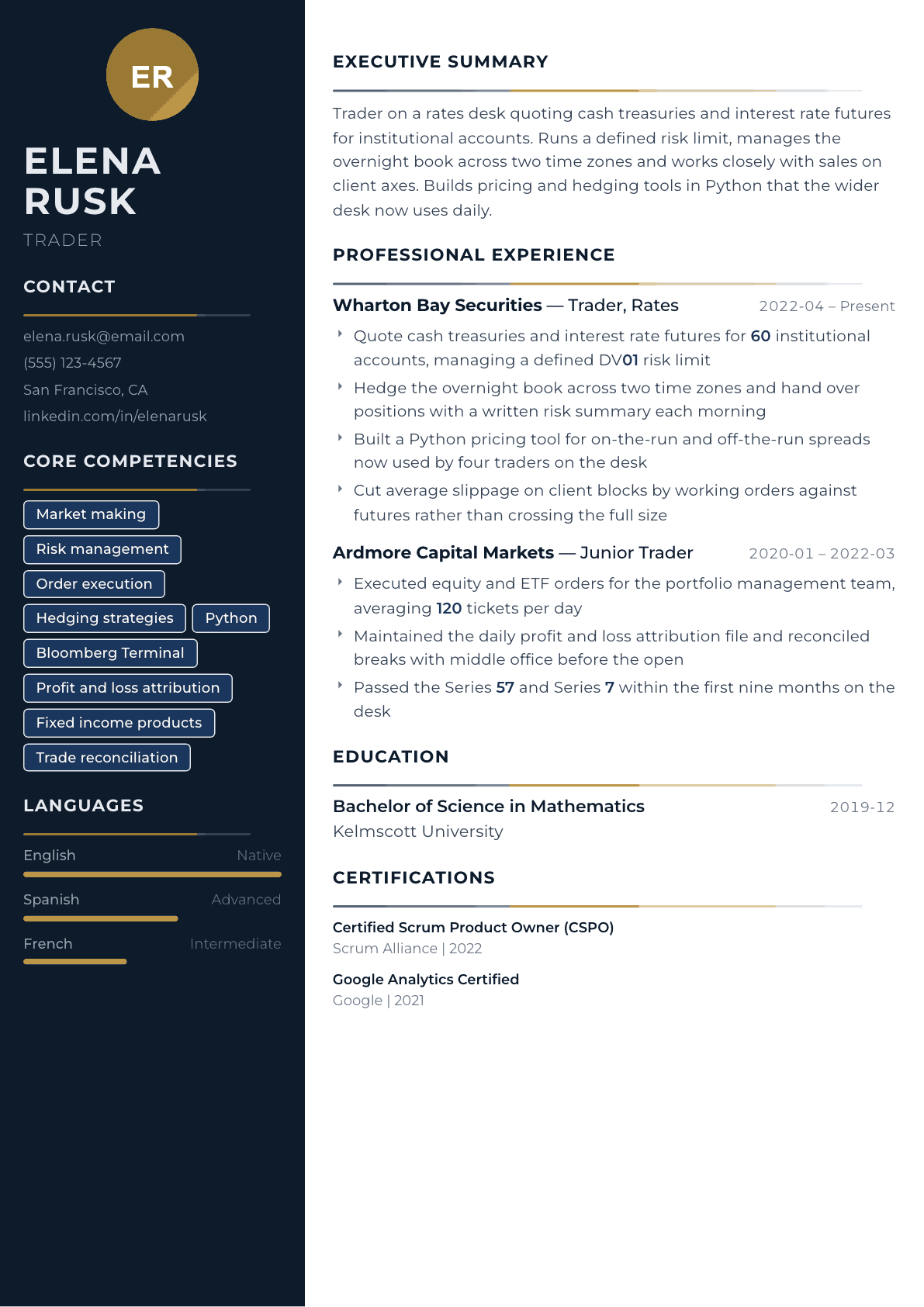
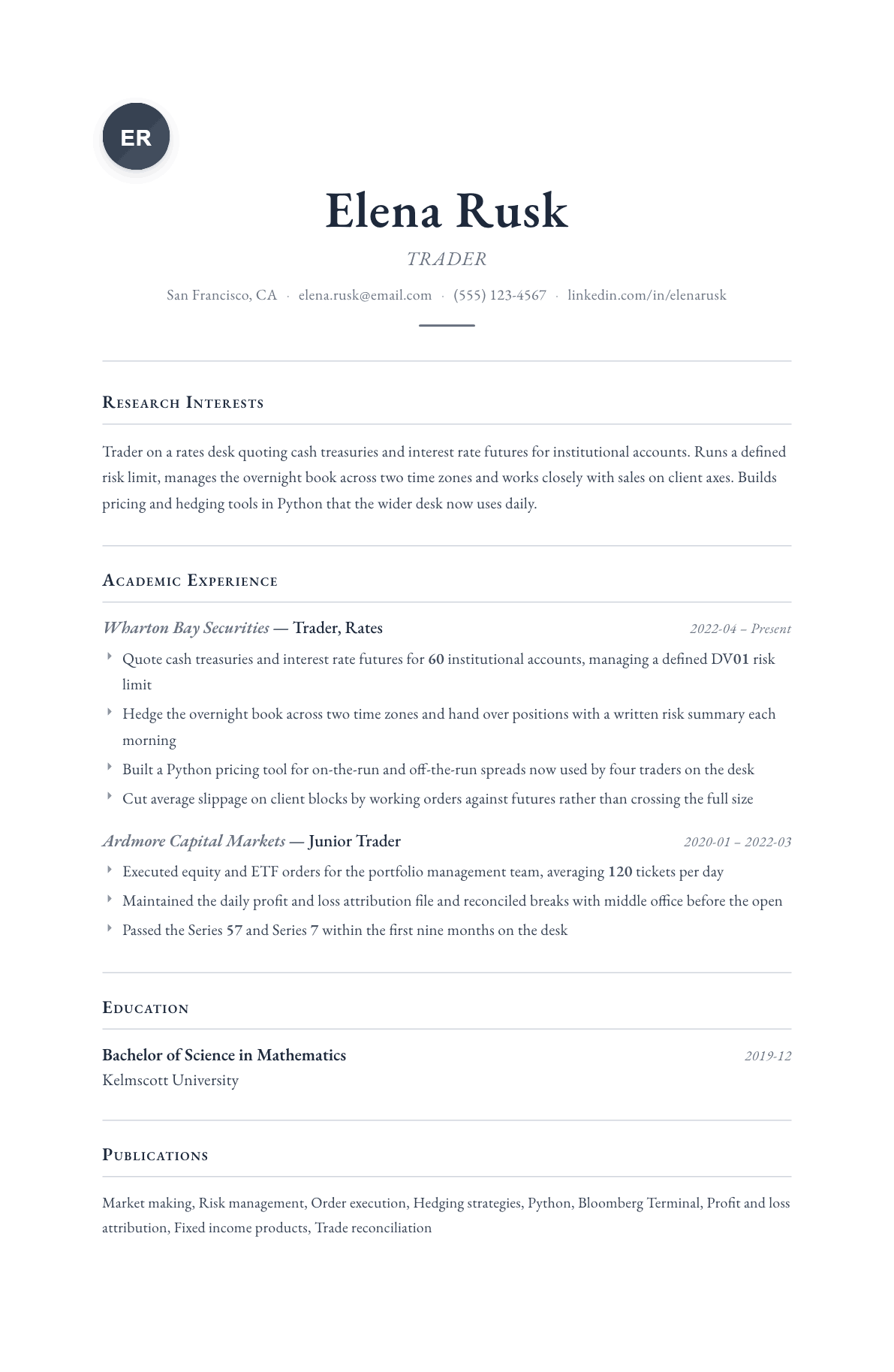
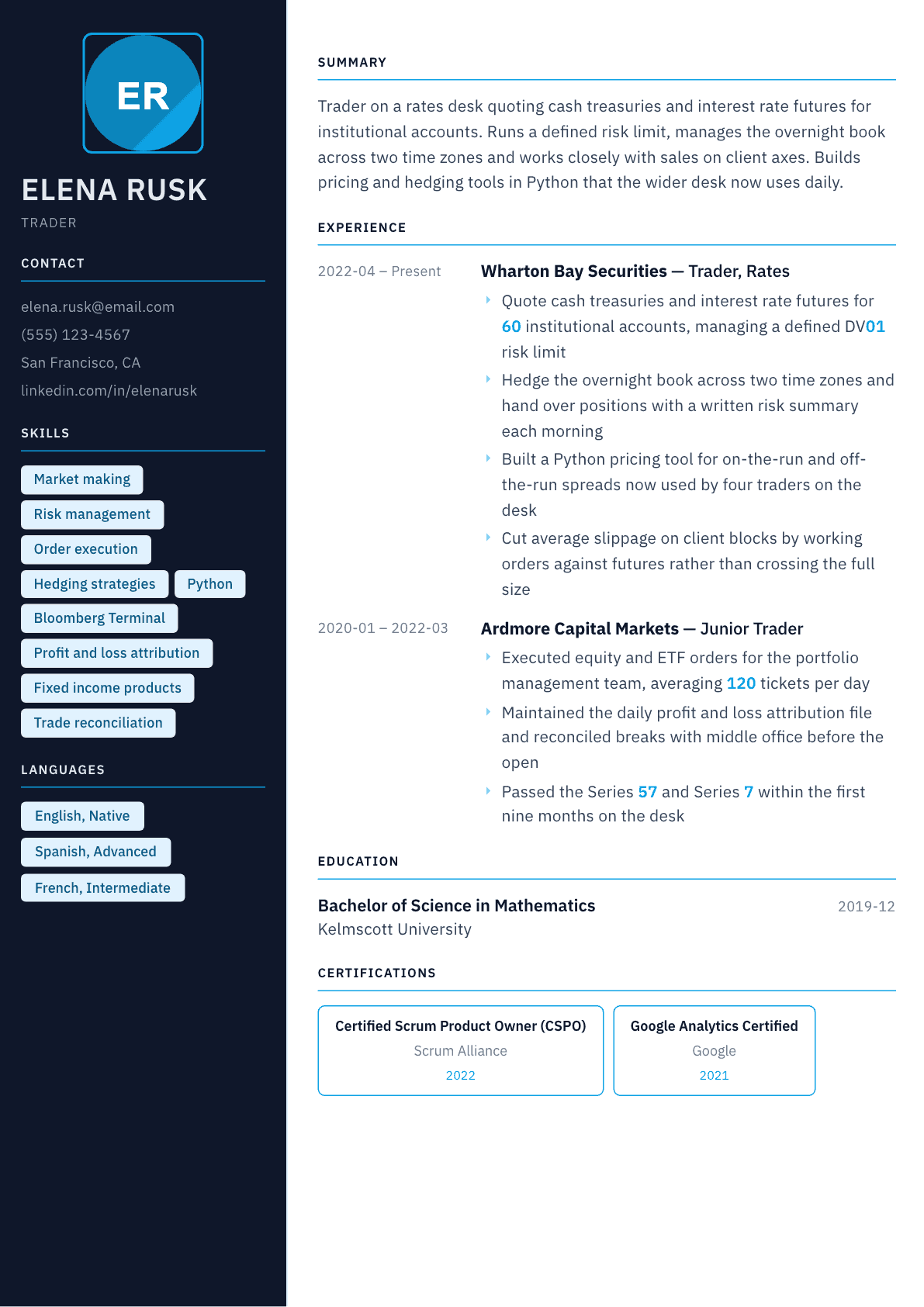
The same trader content laid out in three CVBooster templates, so you can see what the finished document looks like before you write a word.
Example Trader summary
Trader on a rates desk quoting cash treasuries and interest rate futures for roughly 60 institutional accounts under a defined DV01 limit. Manages the overnight book across two time zones and hands over with a written risk summary each morning. Built the Python spread pricing tool the desk now runs daily. Series 7 and Series 57 registered, seeking a seat with wider derivatives coverage.
Skills to list on a Trader resume
- Market making
- Order execution
- Risk management
- Hedging
- Fixed income
- Equities and ETFs
- Derivatives
- Profit and loss attribution
- Trade reconciliation
- Bloomberg Terminal
- Python
- Market microstructure
- Position management
- Regulatory compliance
What actually gets this resume read
- Name the asset class and the products, because a rates trader and an equity trader are screened by different desks.
- State the risk you were trusted with using the desk measure, whether DV01, notional, delta or a stop limit.
- Describe execution quality in the terms your desk uses, such as slippage against arrival or fill rate on blocks.
- List every current license with the number, since compliance verifies registrations before an offer goes out.
- Show the tooling you built or maintain, because desks now expect a trader who can query and script.
- Handle profit and loss carefully: give context and process rather than a bare number you cannot substantiate.
How to write a trader resume
A trader resume is read by someone who has seen candidates claim profit and loss numbers that were never theirs. The head of desk is looking for the opposite: a clear statement of the product, the risk you were trusted with, the process you followed and the mistakes you learned from. Precision reads as credibility here in a way that superlatives never will.
The word trader also covers very different jobs. Market making on a bank desk, execution for a portfolio management team, proprietary risk taking and systematic strategy work each require a different page. The screener needs to know which one you are within the first two lines.
This guide covers how to state product coverage and risk mandate, how to handle performance claims honestly, which registrations to list, and how to show the technical tooling that trading seats now assume.
Format: one page, plain, product first
Trading resumes are short and unadorned. One page, reverse chronological, no graphics. The first line under each employer should name the desk and the products, because a rates seat, a credit seat and an equity derivatives seat are screened by different people.
Put registrations and licenses in their own short block near the bottom, with the examination names spelled out. Compliance will verify these before an offer, so accuracy matters more than presentation.
- Order: summary, experience, education, technical skills, licenses and registrations.
- Under each role: the desk, the products, the client type and the risk mandate.
- State whether the seat was market making, agency execution or proprietary risk.
Summary: product, risk, client, edge
Four elements in three lines. What you trade, the size of the risk you carry stated in the desk measure, who you trade for, and one thing you do that the average trader on your desk does not. A summary reading disciplined trader with strong market knowledge tells a head of desk nothing at all.
If you are moving between asset classes, say which mechanics transfer. Someone moving from cash equities to equity derivatives should name the option knowledge and risk framework they already carry rather than hoping the reader assumes it.
Risk and performance: how to write it without overclaiming
State risk in the units your desk uses. DV01 and duration for rates, notional and gross exposure for equities, delta, vega and gamma limits for options, position limits and stop levels for a proprietary book. This is a fact your former manager can confirm, which is exactly why it is persuasive.
Performance is harder. Bank desks generally treat profit and loss as confidential, and figures without context are discounted anyway. Describe the process instead: the risk you ran, the hit rate on client flow, the improvement in execution quality, and the fact that you traded through a specific volatile period without a limit breach.
Where you do reference results, give the denominator. A return figure with no risk taken beside it is unreadable and every experienced trader knows it.
- Name your limit and say that you operated inside it, including through stress periods.
- Describe execution quality with a measure such as slippage against arrival price.
- Mention any escalation or risk incident and what you changed afterward.
Technical skills the modern desk assumes
Most desks now expect a trader who can query data and build a tool. Python or R for analysis, Excel with a real link to market data, the order management and execution systems you use, and a working knowledge of the venue and protocol landscape for your product.
Describe what you built, not just the language. A spread pricing tool used by four traders, a post-trade attribution file, or a hedge ratio calculator are all concrete artifacts. Naming Python alone puts you beside every other applicant.
Registrations, compliance and conduct
List each registration in full with its current status. On a broker dealer desk that often means the securities industry essentials examination, the general securities registration and the securities trader registration. Buy side and futures seats have their own requirements, so state exactly what you hold.
Conduct language belongs on the page too. Best execution, order marking, trade surveillance and pre-trade risk checks are terms a compliance minded head of desk is glad to see, because a trader who ignores these creates real institutional risk.
Trader resume summary examples
Junior trader
Mathematics graduate executing equity and exchange traded fund orders for a portfolio management team, averaging 120 tickets a day. Maintains the daily profit and loss attribution file and reconciles breaks with middle office before the open. Passed the general securities and securities trader examinations within nine months.
Three years on the desk
Trader on a rates desk quoting cash treasuries and interest rate futures for roughly 60 institutional accounts under a defined DV01 limit. Manages the overnight book across two time zones with a written handover each morning. Built the Python spread pricing tool the desk now runs daily.
Senior trader
Senior trader running the short end of the curve with a materially larger risk mandate and responsibility for two junior traders. Traded through several volatile periods without a limit breach and rebuilt the hedging framework around futures and swaps. Works directly with sales on client axes and large block execution.
Work experience bullets: before and after
Before: Traded fixed income products for institutional clients.
After: Quote cash treasuries and interest rate futures for 60 institutional accounts, managing a defined DV01 risk limit and a book held overnight across two time zones.
Naming the products, the client count and the risk measure gives a head of desk everything the screen needs.
Before: Managed risk on the trading book.
After: Hedge the overnight book with futures and hand over each morning with a written risk summary covering position, curve exposure and any limit proximity.
It shows the actual risk process rather than asserting that risk was managed.
Before: Improved execution for client orders.
After: Reduced average slippage on client block orders by working them against futures over the session instead of crossing the full size into a thin book.
The mechanism is named, so a trader reading it can judge whether the improvement is real.
Before: Used Python for analysis.
After: Built a Python pricing tool for on-the-run and off-the-run spreads that is now used daily by four traders on the desk to identify relative value.
A tool adopted by colleagues is far stronger evidence than listing the language on a skills line.
Before: Handled profit and loss reporting.
After: Maintain the daily profit and loss attribution file, splitting results between carry, curve and spread, and reconcile breaks with middle office before the open.
Attribution detail demonstrates that you understand where results come from, which is the analytical core of the job.
Hard skills
- Market making and quoting
- Order execution and block trading
- Risk limit management
- Hedging with futures and swaps
- Profit and loss attribution
- Fixed income and rates products
- Equity and exchange traded funds
- Options and derivatives mechanics
- Bloomberg Terminal
- Python for pricing and analysis
- Order and execution management systems
- Trade reconciliation and break resolution
- Market microstructure
Soft skills
- Composure in volatile markets
- Fast decision making with incomplete information
- Clear communication with sales and clients
- Discipline against a limit
- Honest post-trade review
- Collaboration across the desk
Certifications worth listing
- Series 7 General Securities Representative (FINRA)
- Series 57 Securities Trader Representative (FINRA)
- Securities Industry Essentials Examination (FINRA)
- Series 3 National Commodity Futures Examination (National Futures Association)
- Chartered Financial Analyst (CFA Institute)
Mistakes that cost trader candidates the interview
- Quoting a profit and loss figure with no risk taken beside it, which no experienced trader reads as meaningful.
- Writing trader without naming the asset class, so the resume cannot be routed to the right desk.
- Claiming a strategy as your own when you were executing someone else's decisions.
- Leaving out the risk mandate, which is the one fact a former manager can confirm in a reference call.
- Listing a programming language with no artifact built from it.
- Ignoring compliance vocabulary entirely, which reads as carelessness on a regulated desk.
Trader resume questions
Should I put my profit and loss on a trader resume?
Only if you are allowed to and can supply the risk context. Most bank desks treat results as confidential, and a bare number invites disbelief. Describing your limit, your process and the periods you traded through is usually more persuasive.
Which licenses does a trading role require?
It depends on the seat and the venue. Broker dealer trading commonly involves the general securities and securities trader registrations, futures work involves a separate examination, and many buy side execution seats require none. State exactly what you hold and what is in progress.
How do I move from execution to a risk taking seat?
Show that you already think in risk terms. Build attribution work, propose hedges, document a view and track it, and get a named risk allowance however small. Desks promote traders who have demonstrated judgment on real positions, not on hypotheticals.
Does a quantitative background matter for a trading job?
It helps for derivatives and systematic seats and matters less for flow and execution roles. What every desk now expects is comfort with data: pulling your own numbers, checking a hypothesis and building a small tool without waiting for technology support.
How should I explain a period of poor performance?
Directly and briefly, with what you changed. Traders respect a candidate who can describe a losing period, the risk decisions that caused it and the process adjustment that followed. Evasion on this point is far more damaging than the loss itself.
Related resume examples
- Portfolio Manager Resume example
- Financial Analyst Resume example
- Risk Analyst Resume example
- Investment Analyst Resume example
- Treasury Analyst Resume example
- Underwriter Resume example