Clerkship Cover Letter: 6 Samples for Judicial Clerkships
By Mustafa Tarabya, founder of CVBooster · Published · Updated
10 min read
A clerkship cover letter is short: three paragraphs that name the judge, the term you are applying for, why this court, and the materials enclosed, with one line of evidence that you write well. The constraint is that a judge or a current clerk reads hundreds of them in a season, so anything that reads like a firm cover letter, long and full of adjectives, works against you. What the job involves comes from the federal judiciary's OSCAR page on the duties of federal law clerks, checked in October 2026. Below are six complete judicial clerkship cover letters, from a second year law student to a lawyer with five years in practice. Written by Mustafa Tarabya, who hired for his own company, read every application himself and now writes CVBooster's guides.
You wrote a forty page note on preemption, and now the hard part is three paragraphs that a judge will read in under a minute. That is not unfair. That is the job description.
Start with the most common case, a second year student applying through OSCAR (the federal judiciary's Online System for Clerkship Application and Review) to a federal district judge.
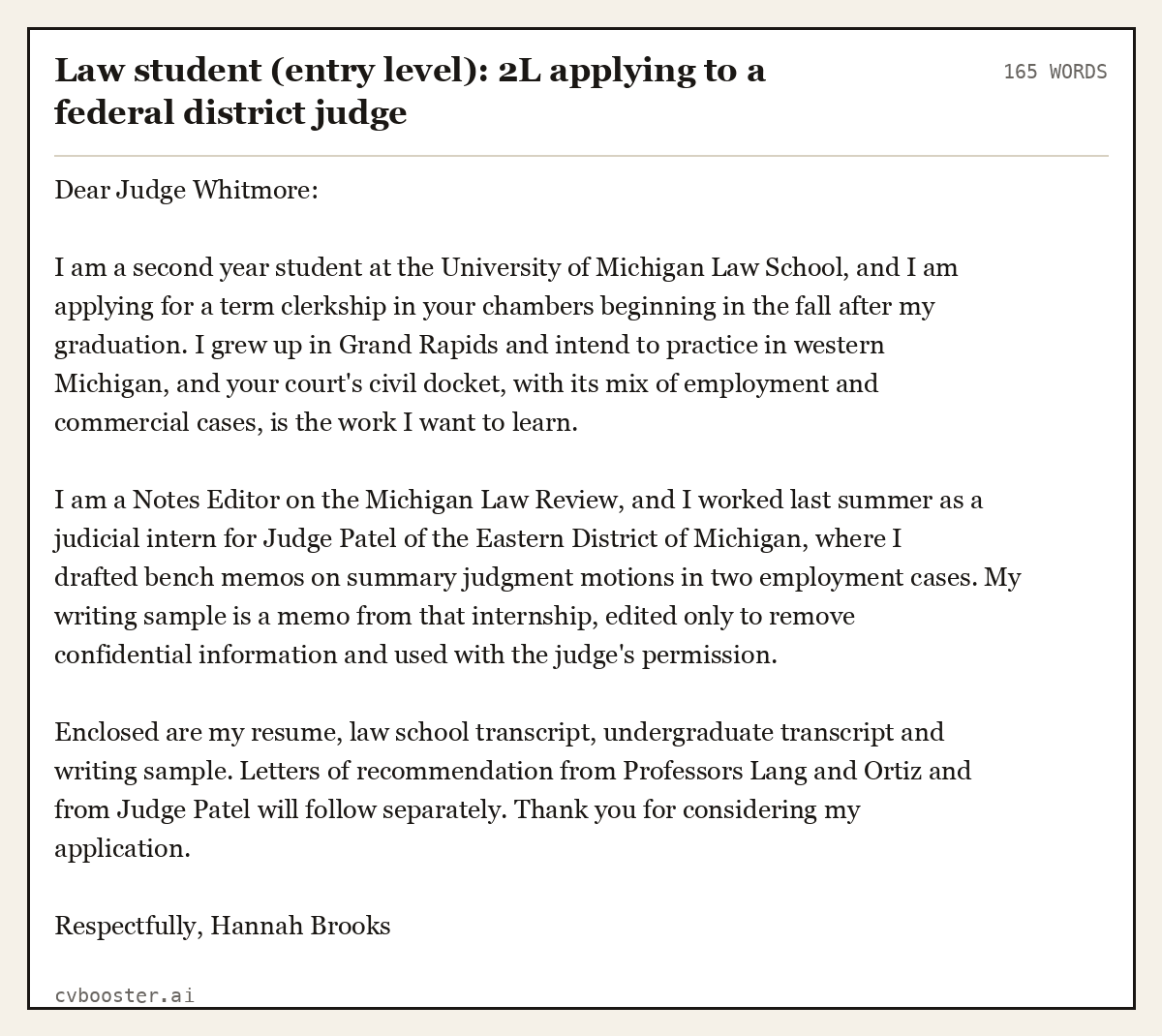
Law student (entry level): 2L applying to a federal district judge (165 words)
Dear Judge Whitmore:
I am a second year student at the University of Michigan Law School, and I am applying for a term clerkship in your chambers beginning in the fall after my graduation. I grew up in Grand Rapids and intend to practice in western Michigan, and your court's civil docket, with its mix of employment and commercial cases, is the work I want to learn.
I am a Notes Editor on the Michigan Law Review, and I worked last summer as a judicial intern for Judge Patel of the Eastern District of Michigan, where I drafted bench memos on summary judgment motions in two employment cases. My writing sample is a memo from that internship, edited only to remove confidential information and used with the judge's permission.
Enclosed are my resume, law school transcript, undergraduate transcript and writing sample. Letters of recommendation from Professors Lang and Ortiz and from Judge Patel will follow separately. Thank you for considering my application.
Respectfully, Hannah Brooks
What a judge reads a clerkship cover letter for
A clerkship is a writing job. OSCAR says so plainly: "In most chambers, law clerks concentrate on legal research and writing." It then lists the duties as "conducting legal research, preparing bench memos, drafting orders and opinions, proofreading the judge's orders and opinions, verifying citations, communicating with counsel regarding case management and procedural requirements, and assisting the judge during courtroom proceedings."
So the letter is itself a writing sample. A judge reads it for three things:
- Ties to the court. Where you grew up, studied or plan to practice. Many judges look for ties because they suggest you will settle into the term and may stay to practice in the region.
- Proof you can research and write. Journal role, moot court, a judicial internship, a published note, a legal writing fellowship.
- Clean, short prose. No errors, no inflated claims. Harvard's career office gives the general rule for any letter: "Keep letters concise and factual, no more than a single page."
What it is not read for: your passion for justice, a summary of your resume, or flattery about the judge's opinions. If you name an opinion, make it one you actually read and give one plain sentence on why.
Five more judicial clerkship cover letter samples
Every name, court and school below is invented or used only as an example. Keep the structure, change the facts.
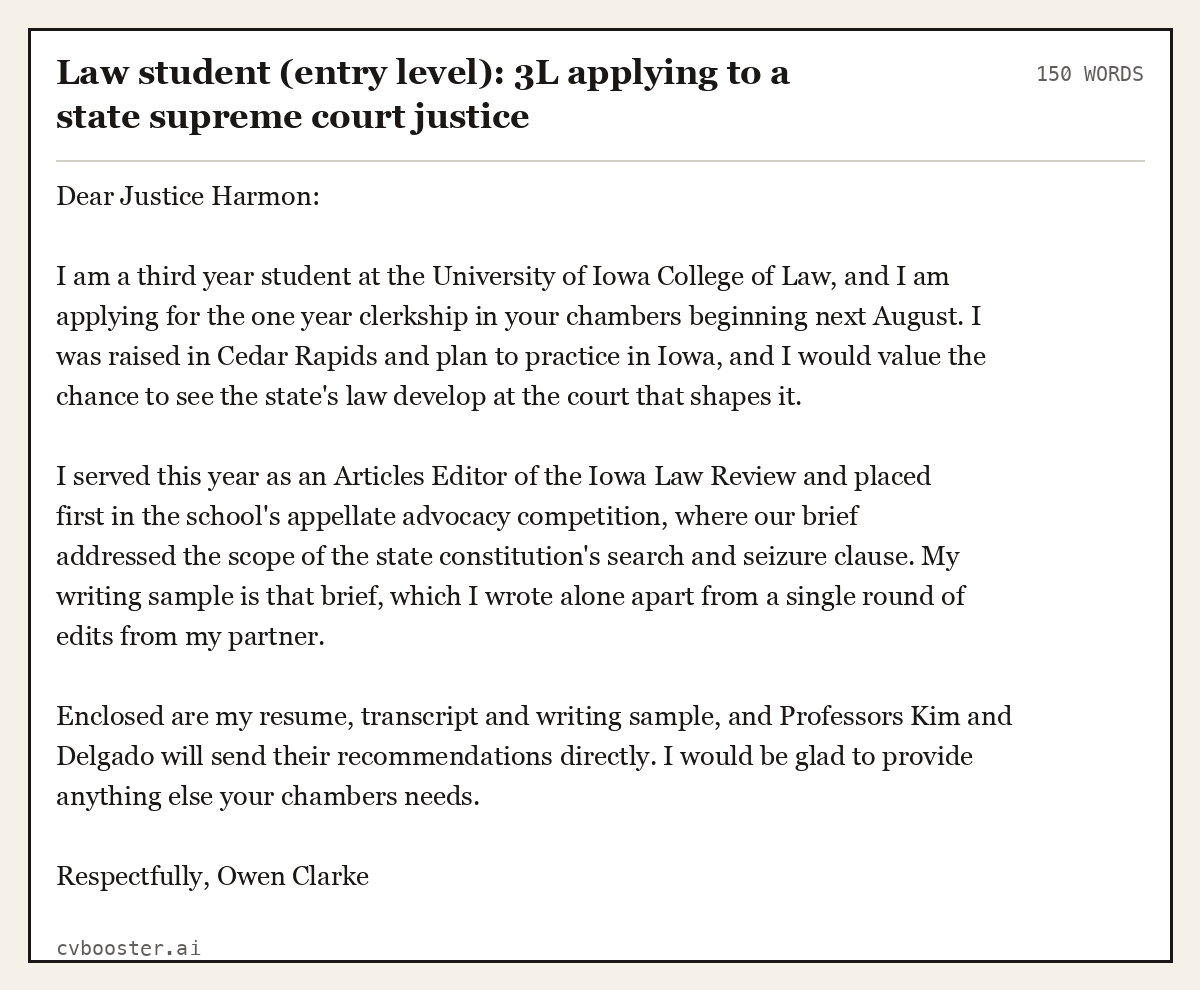
Law student (entry level): 3L applying to a state supreme court justice (150 words)
Dear Justice Harmon:
I am a third year student at the University of Iowa College of Law, and I am applying for the one year clerkship in your chambers beginning next August. I was raised in Cedar Rapids and plan to practice in Iowa, and I would value the chance to see the state's law develop at the court that shapes it.
I served this year as an Articles Editor of the Iowa Law Review and placed first in the school's appellate advocacy competition, where our brief addressed the scope of the state constitution's search and seizure clause. My writing sample is that brief, which I wrote alone apart from a single round of edits from my partner.
Enclosed are my resume, transcript and writing sample, and Professors Kim and Delgado will send their recommendations directly. I would be glad to provide anything else your chambers needs.
Respectfully, Owen Clarke
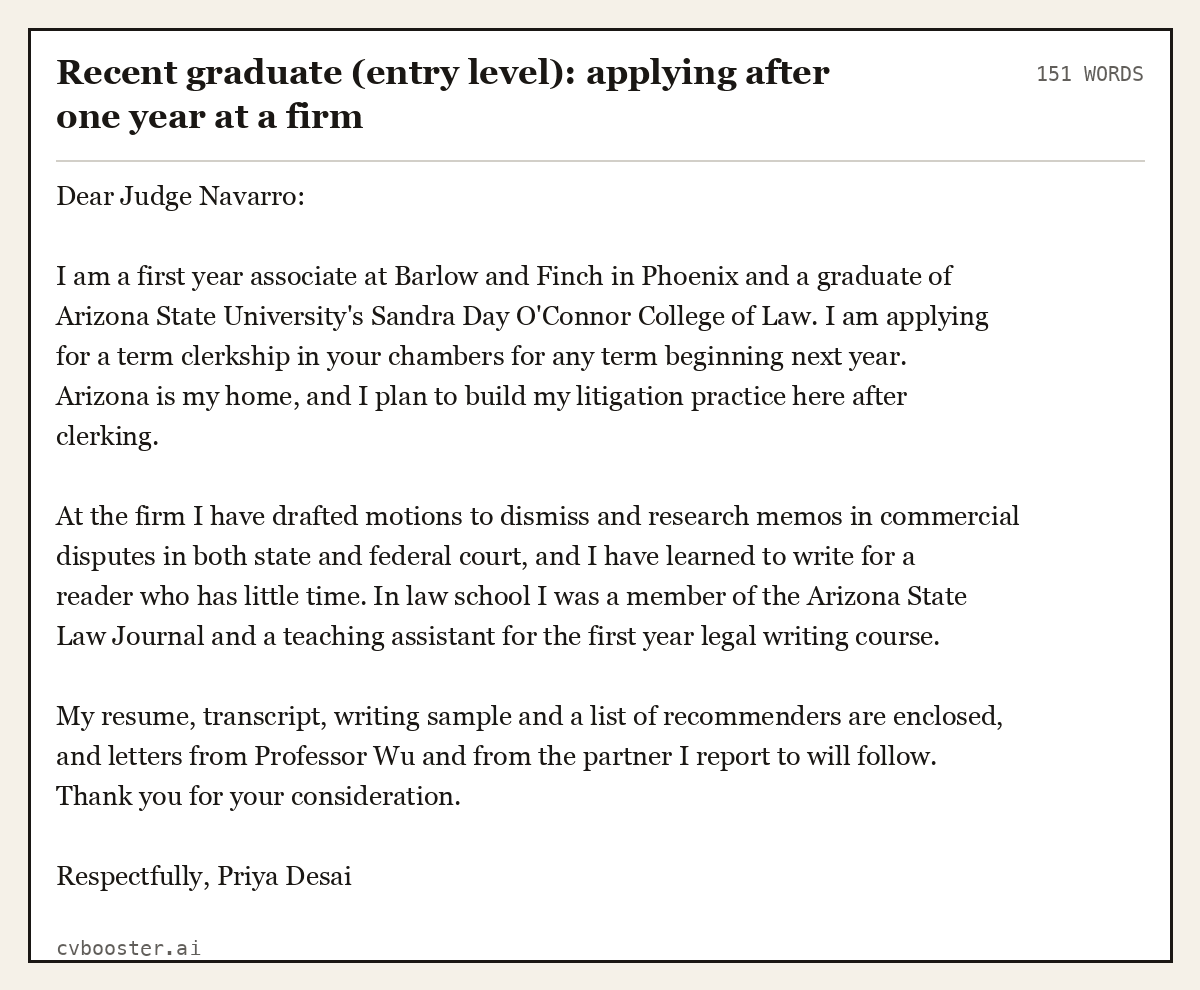
Recent graduate (entry level): applying after one year at a firm (151 words)
Dear Judge Navarro:
I am a first year associate at Barlow and Finch in Phoenix and a graduate of Arizona State University's Sandra Day O'Connor College of Law. I am applying for a term clerkship in your chambers for any term beginning next year. Arizona is my home, and I plan to build my litigation practice here after clerking.
At the firm I have drafted motions to dismiss and research memos in commercial disputes in both state and federal court, and I have learned to write for a reader who has little time. In law school I was a member of the Arizona State Law Journal and a teaching assistant for the first year legal writing course.
My resume, transcript, writing sample and a list of recommenders are enclosed, and letters from Professor Wu and from the partner I report to will follow. Thank you for your consideration.
Respectfully, Priya Desai
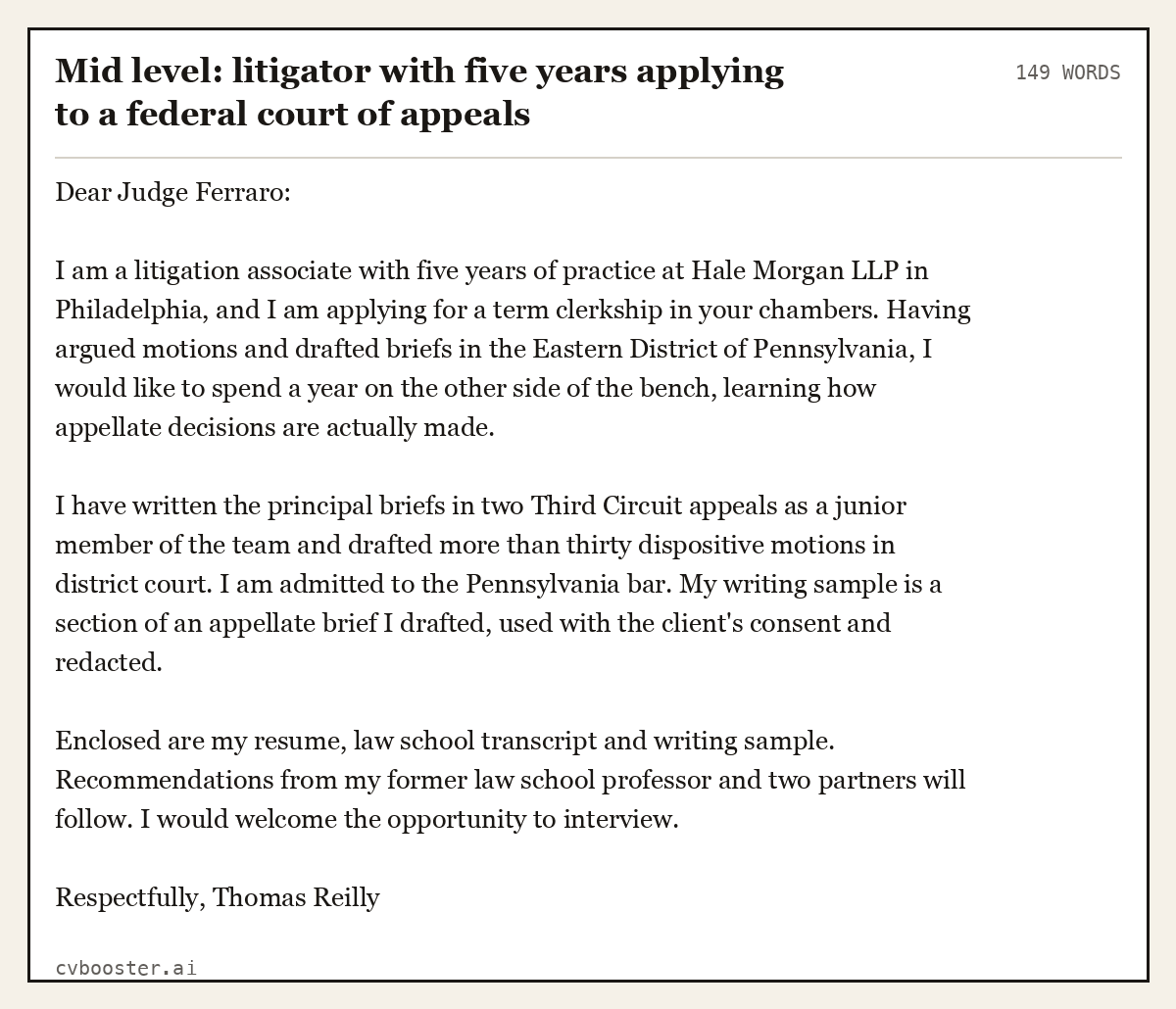
Mid level: litigator with five years applying to a federal court of appeals (149 words)
Dear Judge Ferraro:
I am a litigation associate with five years of practice at Hale Morgan LLP in Philadelphia, and I am applying for a term clerkship in your chambers. Having argued motions and drafted briefs in the Eastern District of Pennsylvania, I would like to spend a year on the other side of the bench, learning how appellate decisions are actually made.
I have written the principal briefs in two Third Circuit appeals as a junior member of the team and drafted more than thirty dispositive motions in district court. I am admitted to the Pennsylvania bar. My writing sample is a section of an appellate brief I drafted, used with the client's consent and redacted.
Enclosed are my resume, law school transcript and writing sample. Recommendations from my former law school professor and two partners will follow. I would welcome the opportunity to interview.
Respectfully, Thomas Reilly
The experienced applicant leads with the practice, the bar admission and the appellate work. OSCAR's qualifications page shows why experience matters to chambers, as pay grades rise with it: "JSP-12, step 1 – One or more years of post-graduate legal work experience and bar membership of a state, territory, or federal court of general jurisdiction."
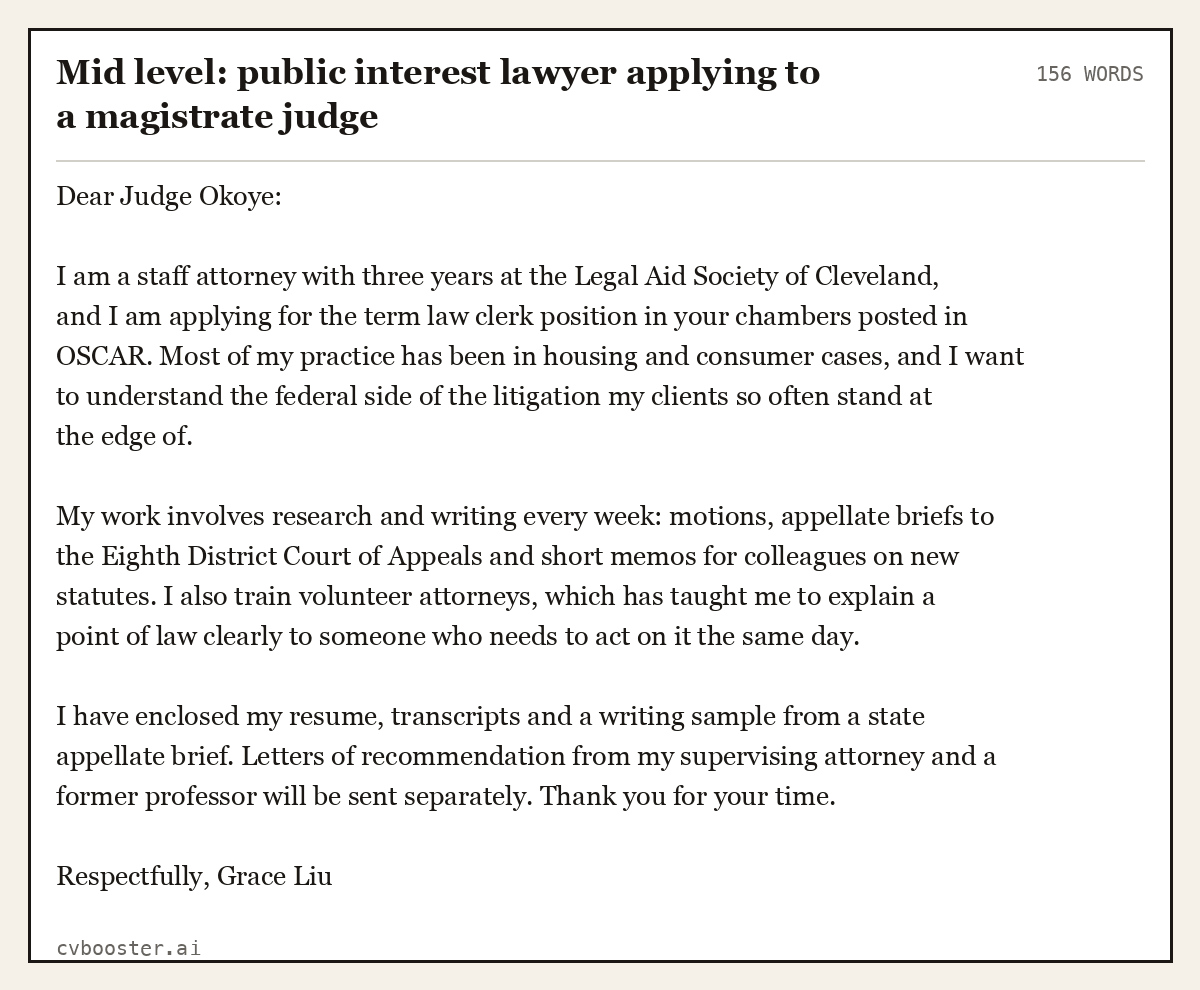
Mid level: public interest lawyer applying to a magistrate judge (156 words)
Dear Judge Okoye:
I am a staff attorney with three years at the Legal Aid Society of Cleveland, and I am applying for the term law clerk position in your chambers posted in OSCAR. Most of my practice has been in housing and consumer cases, and I want to understand the federal side of the litigation my clients so often stand at the edge of.
My work involves research and writing every week: motions, appellate briefs to the Eighth District Court of Appeals and short memos for colleagues on new statutes. I also train volunteer attorneys, which has taught me to explain a point of law clearly to someone who needs to act on it the same day.
I have enclosed my resume, transcripts and a writing sample from a state appellate brief. Letters of recommendation from my supervising attorney and a former professor will be sent separately. Thank you for your time.
Respectfully, Grace Liu
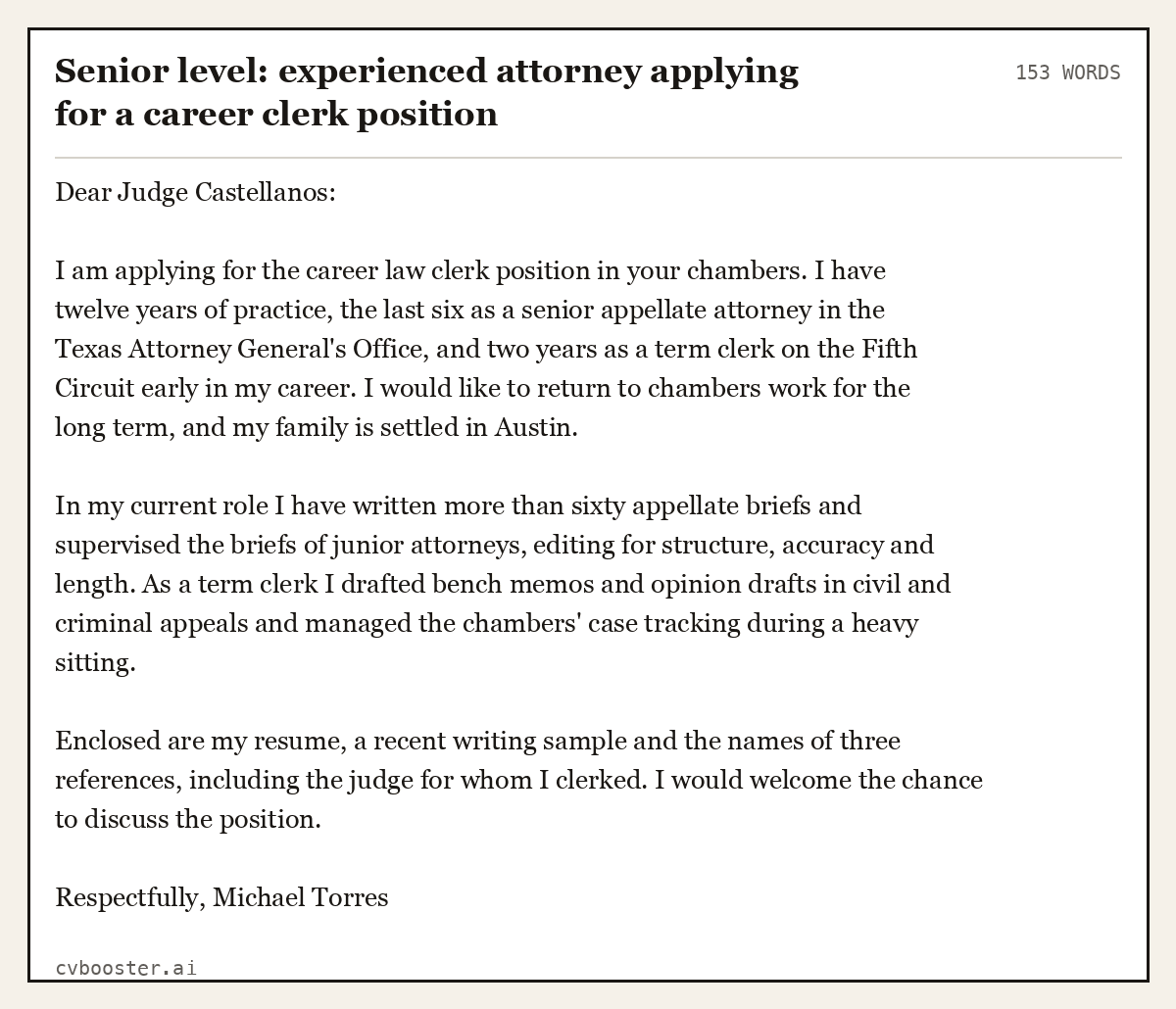
Senior level: experienced attorney applying for a career clerk position (153 words)
Dear Judge Castellanos:
I am applying for the career law clerk position in your chambers. I have twelve years of practice, the last six as a senior appellate attorney in the Texas Attorney General's Office, and two years as a term clerk on the Fifth Circuit early in my career. I would like to return to chambers work for the long term, and my family is settled in Austin.
In my current role I have written more than sixty appellate briefs and supervised the briefs of junior attorneys, editing for structure, accuracy and length. As a term clerk I drafted bench memos and opinion drafts in civil and criminal appeals and managed the chambers' case tracking during a heavy sitting.
Enclosed are my resume, a recent writing sample and the names of three references, including the judge for whom I clerked. I would welcome the chance to discuss the position.
Respectfully, Michael Torres
Clerkship cover letter format
Most judges expect a traditional business letter, even when it is uploaded through OSCAR:
- Salutation: "Dear Judge Lastname:" for federal and state trial and appellate judges, "Dear Justice Lastname:" where the court uses that title. A colon after the name is the formal choice.
- Length: three or four paragraphs on one page.
- Paragraph one: your status (year and school, or job), the term and the court, and your ties to the place.
- Paragraph two: the evidence of research and writing: journal, moot court, internship, practice.
- Paragraph three: what is enclosed, who is recommending you, and a short thanks.
- Sign off: "Respectfully," or "Sincerely," and your name.
Check the posting for the judge's own instructions, and check your school's career office guidance; Yale Law School's clerkship page is one example of the kind of support most law schools offer applicants and alumni.
Choosing the writing sample the letter mentions
The letter usually names the writing sample, so choose it before you write. Pick legal analysis you wrote yourself, ideally ten to fifteen pages: a bench memo, a brief, a seminar paper or a journal note. Say in one sentence where it came from and how much editing it received. If it came from an internship or a job, say that you have permission to use it and that confidential details were removed.
A judge would rather read a short, clean memo than a long note that a journal edited for a year. Pick the piece that shows how you reason through a problem, not the one with the most footnotes.
Mistakes that end a clerkship application
- Misspelling the judge's name or using the wrong court. Clerks catch it in a second.
- A writing sample that was heavily edited by someone else, without saying so.
- Generic praise for the judge's "distinguished career".
- Two pages. A judge reads the letter for writing quality, and length counts against you.
- Sending a firm cover letter with "your firm" left in. It happens.
Your resume matters as much as the letter. Our law CV example shows how legal experience is laid out, and the cover letter format guide has the business letter layout. If you also need references, see how to list references on a resume, and for the role itself, our judicial clerk resume page. When the clerkship ends and you apply to firms, the attorney cover letter page has three annotated letters for associate, lateral and in house roles.
Frequently asked questions
How long should a clerkship cover letter be?
One page, usually three paragraphs and under 300 words. Judges and their clerks read a large stack of applications for each opening, and the letter doubles as a writing sample. Say who you are, why this court, what proves you can research and write, and what is enclosed, then stop.
What should a judicial clerkship cover letter include?
Your year and school or current position, the term and court you are applying for, your ties to the region, one or two pieces of research and writing evidence, the enclosed materials and the names of your recommenders. Leave out anything that repeats your resume line by line.
Should a clerkship cover letter be tailored to each judge?
Tailor the first paragraph for each judge: the court, the term and your tie to the place. If you know a specific reason, such as an internship in that district or a docket you want to learn, name it in one sentence. The rest of the letter can stay the same across applications.
How do I address a judge in a cover letter?
Use "Dear Judge Lastname:" for most federal and state judges, and "Dear Justice Lastname:" for justices of courts that use that title. Address the envelope or header with "The Honorable" followed by the full name. Never use "To whom it may concern" for a clerkship.
Can lawyers with experience apply for clerkships?
Yes. Many judges hire clerks with a few years of practice, and OSCAR's qualifications page sets higher pay grades for applicants with post graduate legal work experience and bar membership. Lead with your practice area, bar admission and the briefs you have written, and explain why you want to work in chambers now.
Related articles
- Application Letter for Student: 5 Full Samples to Copy
- Application Letter Format in Word: UK Layout and 5 Letters
- Cover Letter for Artist Jobs: 6 Samples by Art Career
- Cabin Crew Cover Letter: 6 Examples for Airline Jobs
More articles
- CNA Resume No Experience: 6 Samples That Lead With Clinicals
- CNA Objectives for Resume: 6 Samples for Every Situation
- Coaching Resume Examples: 7 Coach Resume Samples by Level
Looking for a worked example for your job title? Browse the resume examples by job title.