Great Questions to Ask an Interviewee: 6 Ready Sets
By Mustafa Tarabya, founder of CVBooster · Published · Updated
9 min read
Great questions to ask an interviewee are questions about something the person actually did, tied to one requirement of the job, asked the same way to every candidate, so you can compare the answers afterward. The constraint is time: a 45 minute interview holds eight to ten real questions with follow ups, so every question has to earn its place. The US Office of Personnel Management describes the method in its guidance on structured interviews: "All candidates are asked the same predetermined questions in the same order". Below are six complete question sets, checked in October 2026, by role and level, with notes on what a strong answer sounds like, so you never walk in with a single question to ask the interviewee and a hope. Written by Mustafa Tarabya, who hired for his own company, read every application himself and now writes CVBooster's guides.
I ran the interviews at my own company, so I know the pull of opening with "tell me about yourself". Ask it, and forty minutes later you know where the candidate went to high school and nothing about whether they can do the job. That is not an interview. That is a podcast with a nervous guest.
The first set is the one most hiring managers need: a front line role with customers, where the job is half skill and half temperament.
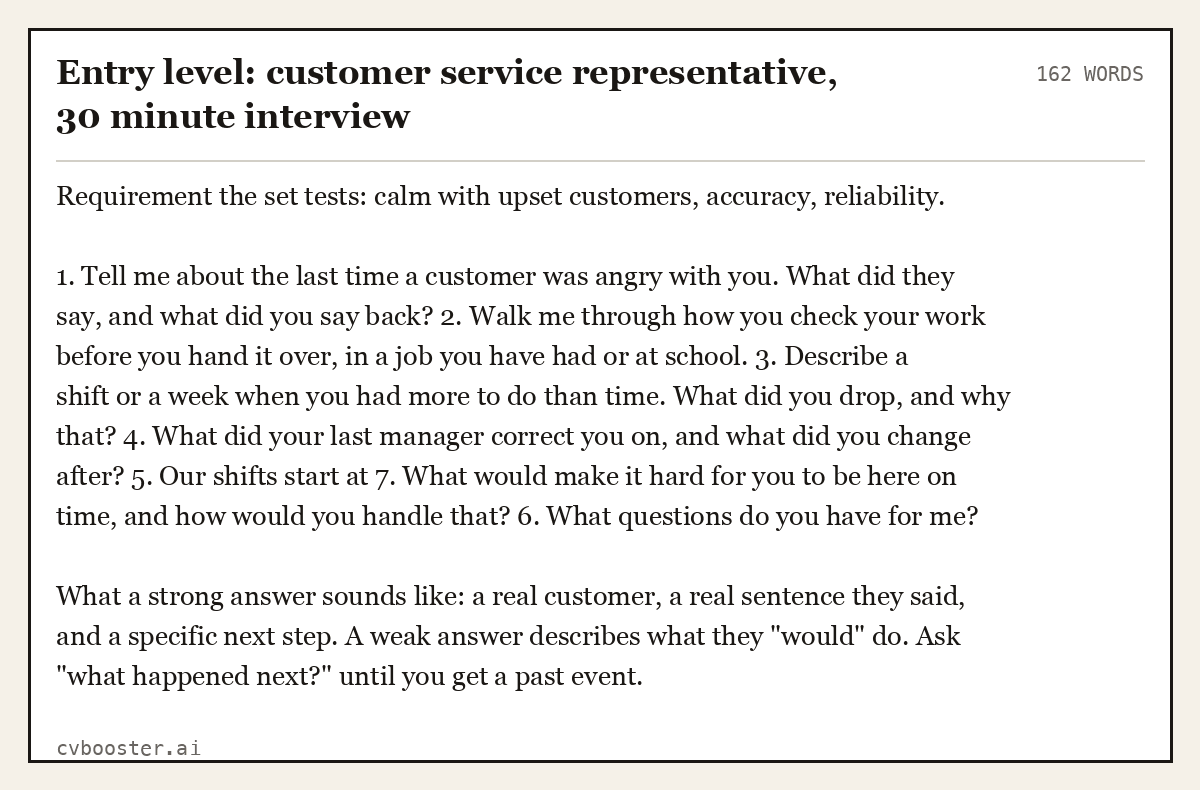
Entry level: customer service representative, 30 minute interview (162 words)
Requirement the set tests: calm with upset customers, accuracy, reliability.
1. Tell me about the last time a customer was angry with you. What did they say, and what did you say back? 2. Walk me through how you check your work before you hand it over, in a job you have had or at school. 3. Describe a shift or a week when you had more to do than time. What did you drop, and why that? 4. What did your last manager correct you on, and what did you change after? 5. Our shifts start at 7. What would make it hard for you to be here on time, and how would you handle that? 6. What questions do you have for me?
What a strong answer sounds like: a real customer, a real sentence they said, and a specific next step. A weak answer describes what they "would" do. Ask "what happened next?" until you get a past event.
How many questions to ask in an interview
The number depends on the length of the interview and how much you follow up. A workable rule: plan one main question for every four to five minutes, then keep two spare.
- 30 minute screen: five or six questions, one of them the candidate's questions for you.
- 45 minute interview: eight to ten questions.
- 60 minute final round: ten to twelve questions, with time for a short work sample or a case.
Fewer questions with real follow ups beat a long list read off a page. The follow up is where you learn something: "What did you do next?", "Who else was involved?", "How did you know it worked?" If a candidate gives a polished answer in thirty seconds, the second question is the real one.
The structured interview guidance from OPM lists two benefits that matter for small teams as much as for federal agencies: the same questions in the same order, and "All responses are evaluated using the same rating scale and standards for acceptable answers". In practice, write down before the first interview what a strong, average and weak answer looks like for each question. It is short work, and it stops you hiring the person you liked best over coffee.
Five more interview question sets, by role and level
Each set below is complete and ready to use. Change the requirement line to match your own job posting, then keep the questions that test it. The roles and details are examples; adapt them to your team.
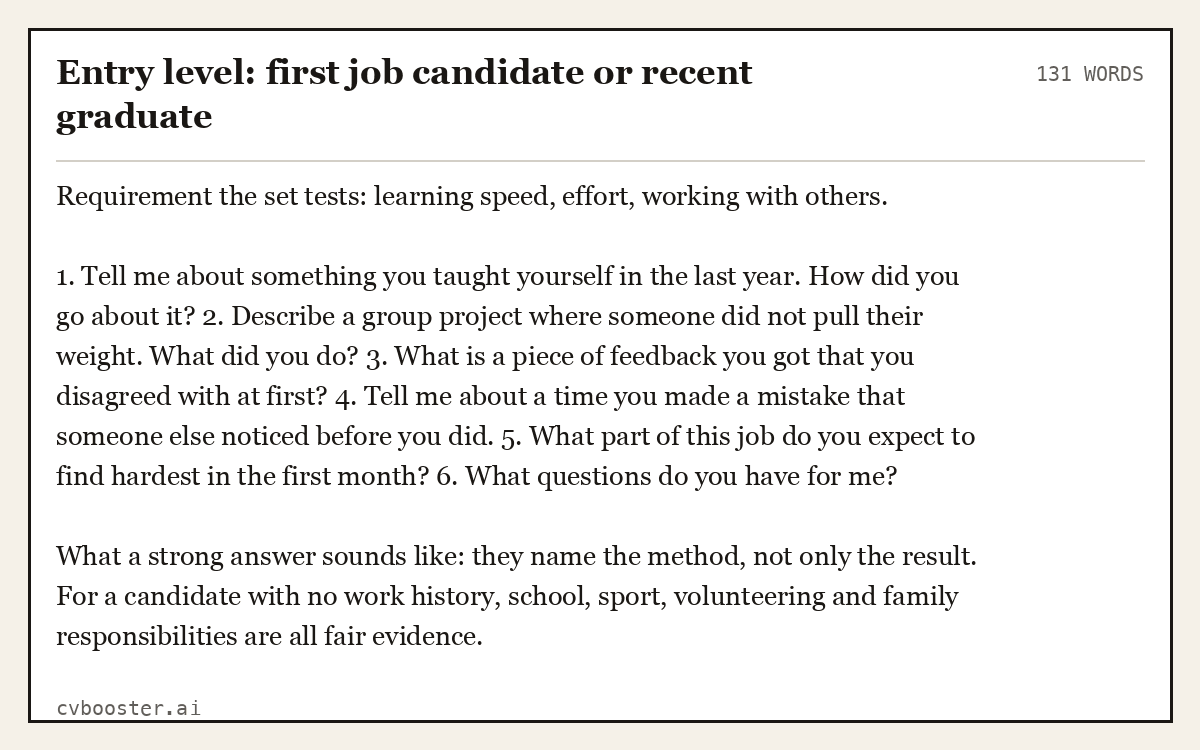
Entry level: first job candidate or recent graduate (131 words)
Requirement the set tests: learning speed, effort, working with others.
1. Tell me about something you taught yourself in the last year. How did you go about it? 2. Describe a group project where someone did not pull their weight. What did you do? 3. What is a piece of feedback you got that you disagreed with at first? 4. Tell me about a time you made a mistake that someone else noticed before you did. 5. What part of this job do you expect to find hardest in the first month? 6. What questions do you have for me?
What a strong answer sounds like: they name the method, not only the result. For a candidate with no work history, school, sport, volunteering and family responsibilities are all fair evidence.
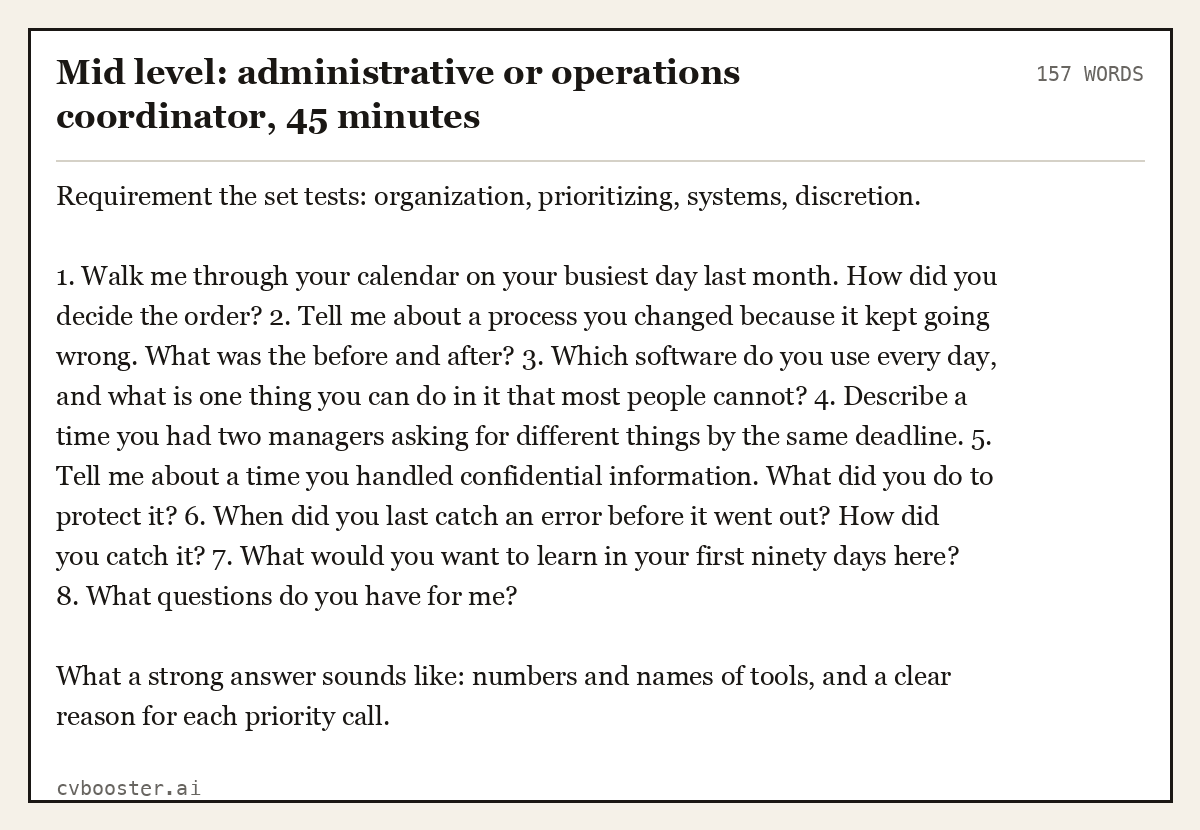
Mid level: administrative or operations coordinator, 45 minutes (157 words)
Requirement the set tests: organization, prioritizing, systems, discretion.
1. Walk me through your calendar on your busiest day last month. How did you decide the order? 2. Tell me about a process you changed because it kept going wrong. What was the before and after? 3. Which software do you use every day, and what is one thing you can do in it that most people cannot? 4. Describe a time you had two managers asking for different things by the same deadline. 5. Tell me about a time you handled confidential information. What did you do to protect it? 6. When did you last catch an error before it went out? How did you catch it? 7. What would you want to learn in your first ninety days here? 8. What questions do you have for me?
What a strong answer sounds like: numbers and names of tools, and a clear reason for each priority call.
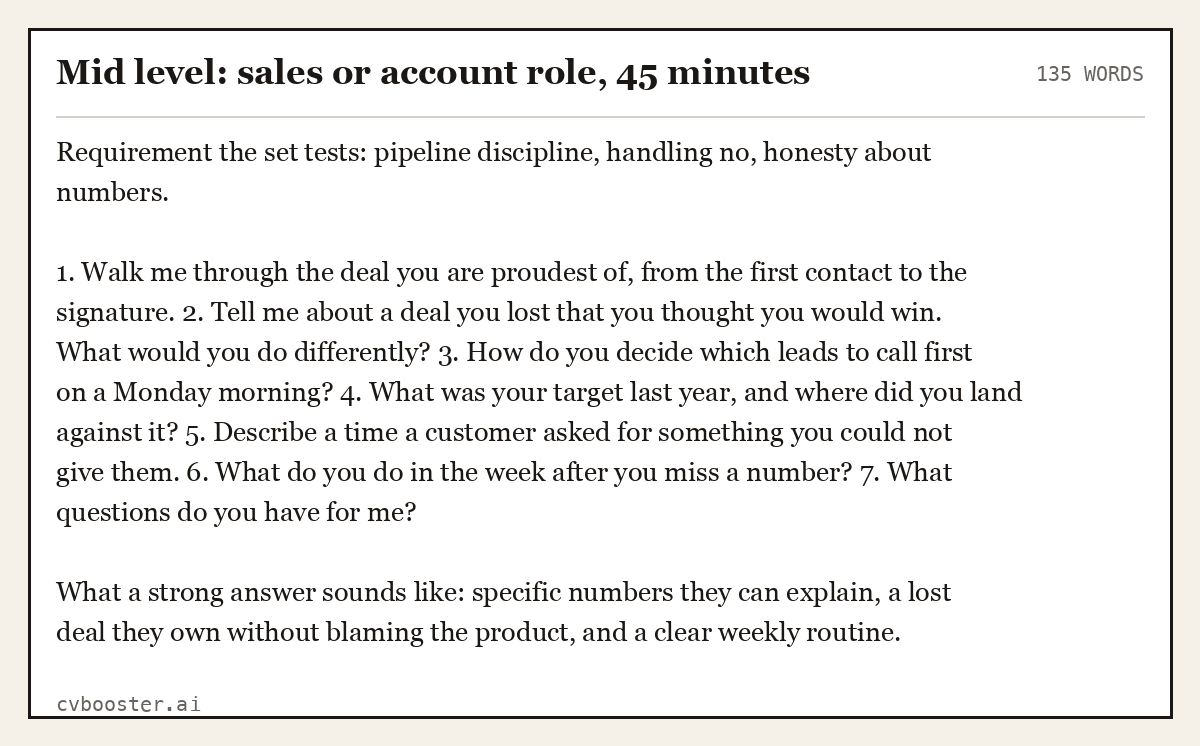
Mid level: sales or account role, 45 minutes (135 words)
Requirement the set tests: pipeline discipline, handling no, honesty about numbers.
1. Walk me through the deal you are proudest of, from the first contact to the signature. 2. Tell me about a deal you lost that you thought you would win. What would you do differently? 3. How do you decide which leads to call first on a Monday morning? 4. What was your target last year, and where did you land against it? 5. Describe a time a customer asked for something you could not give them. 6. What do you do in the week after you miss a number? 7. What questions do you have for me?
What a strong answer sounds like: specific numbers they can explain, a lost deal they own without blaming the product, and a clear weekly routine.
Senior level: team lead or people manager, 60 minutes (171 words)
Requirement the set tests: hiring, feedback, decisions, results through other people.
1. Tell me about the best hire you ever made. What did you see in the interview that others missed? 2. Tell me about a hire that did not work out. When did you know, and what did you do? 3. Describe the hardest feedback conversation you have had with someone on your team. 4. Walk me through a decision you made with incomplete information. How did it turn out? 5. How do you know, week to week, whether your team is on track? 6. Tell me about a time you disagreed with your own manager and lost the argument. 7. What would your current team say you should do more of? 8. What would you change first here, and what would you leave alone? 9. What questions do you have for me?
What a strong answer sounds like: names their own part in what went wrong, and shows a method for checking progress that does not depend on mood.
Career changer: candidate moving in from another field (128 words)
Requirement the set tests: transferable skills, motivation, realism about the gap.
1. What made you decide to move into this field, and what did you do about it before applying? 2. Which part of your last job is closest to this one? Give me an example. 3. What do you expect to be new for you here, and how are you preparing for it? 4. Tell me about the last time you started something from zero. How long until you felt competent? 5. What would make you leave this job in the first year? 6. What questions do you have for me?
What a strong answer sounds like: concrete steps already taken, such as a course, a project or volunteering, and an honest view of the learning curve.
Questions you should not ask an interviewee
A good question is about the job. A risky one is about the person's private life. The US Equal Employment Opportunity Commission states the principle plainly: "the information obtained and requested through the pre-employment process should be limited to those essential for determining if a person is qualified for the job". It also notes that "Employers are explicitly prohibited from making pre-offer inquiries about disability."
What you can ask is whether the person can do the work. The EEOC's guidance on pre-employment questions says an employer "may ask whether applicants can perform any or all job functions". So swap the personal question for the job question:
- Instead of "Do you have kids?", ask "This role needs two late shifts a week. Can you work them?"
- Instead of "How old are you?", ask about the experience the job actually needs.
- Instead of "Where are you from originally?", ask "Are you authorized to work in the US?" if the posting requires it, and ask it of every candidate.
- Instead of "Do you have any health problems?", ask "Can you lift boxes of up to the weight the job lists, with or without an accommodation?"
Small talk is where most of these slip out, so keep the friendly part about the commute, the weather or the role itself.
How to score the answers so the interview is fair
Write a one line standard for each question before the first interview, then rate every answer on the same scale, such as one to four. Take notes on what the candidate said, not on your impression of them. Compare candidates question by question, not overall, and the strongest answer to each requirement becomes clear.
If you are hiring for a role you have not written down properly yet, start with the job description template, because the requirements in it are what your questions test. Candidates prepare with the STAR interview questions guide, so expect answers in situation, task, action and result order, and ask for the result if it is missing. If you are on the other side of the table this week, the questions to ask in an interview guide covers what the candidate should ask you.
Frequently asked questions
What are some good questions to ask an interviewee?
Questions about something the person has actually done, tied to one requirement of the job. "Tell me about the last time a customer was angry with you" beats "How do you handle difficult customers?" because it asks for a real event. Ask the same set in the same order to every candidate.
How many questions should you ask in an interview?
Plan about one main question for every four to five minutes and keep two spare. That means five or six for a 30 minute screen, eight to ten for 45 minutes, and ten to twelve for an hour. Fewer questions with real follow ups tell you more than a long list.
What is the best question to ask an interviewee?
There is no single best one, but "Tell me about a time this went wrong, and what you did next" comes close for most roles. It shows ownership, judgment and honesty in one answer. Point it at the hardest part of your job, such as a missed deadline or an angry client.
What questions should an interviewer avoid?
Avoid anything about age, family plans, religion, national origin, health or disability before an offer. Ask instead whether the candidate can do the specific job functions, such as working the listed shifts or travelling for the role, and ask every candidate the same thing.
Should you let the interviewee ask questions?
Yes, always leave at least five minutes at the end. The questions a candidate asks show what they have researched and what they care about, such as the team, training or how success is measured. A candidate with no questions at all is worth a gentle follow up.
Related articles
- Creative Interview Questions With 6 Sample Answers
- ED Nurse Interview Questions With 9 Full Sample Answers
- Female Job Interview Attire: Six UK Outfits by Job Type
- Interview Questions for an LPN: 9 Full Sample Answers
More articles
- Questions to Ask in an Interview: Final Round, HR and Sales
- Real Cost of Resume Builders: the four-weekly billing trick
- Receptionist Job Descriptions for a Resume: 9 Examples
Looking for a worked example for your job title? Browse the resume examples by job title.