Fire Department Interview Questions and Answers: 5 Samples
By Mustafa Tarabya, founder of CVBooster · Published · Updated
11 min read
Fire department interview questions and answers come down to one thing: the oral board wants proof that you will be safe, honest and easy to live with on a 24-hour shift, and it wants that proof in short stories, not adjectives. The one constraint is time. Most boards give you a few minutes per question and score you against the same sheet as every other candidate. The Bureau of Labor Statistics describes the process, quoted below. Five full sample answers follow, from first-time candidate to lieutenant. Written by Mustafa Tarabya, who hired for his own company, read every application himself and now writes CVBooster's guides.
Every candidate at the oral board says they want to help people. The panel has heard it eleven times before lunch, from eleven people in the same pressed shirt, and the twelfth one is you.
How the fire department interview works
The Bureau of Labor Statistics firefighter profile puts the interview in its place in the process: "Prospective firefighters must pass written and physical tests, complete interviews, and train at a fire academy." So by the time you sit in front of the board, the department already knows you can pass a written test and carry a hose up the stairs. The interview is where it decides whether you belong in the station.
Most departments run an oral board: three to five people, often a captain, a battalion chief, a human resources representative and sometimes a firefighter from the union or a member of the public. Each asks a set question, each scores your answer, and the scores are added up to rank you on the hiring list. A chief's interview may follow for the top of the list. Ask the recruiter or the testing notice which format your department uses, because the preparation is the same but the length of your answers is not.
Here is the first question nearly every board asks, answered by a candidate with no fire service experience yet.
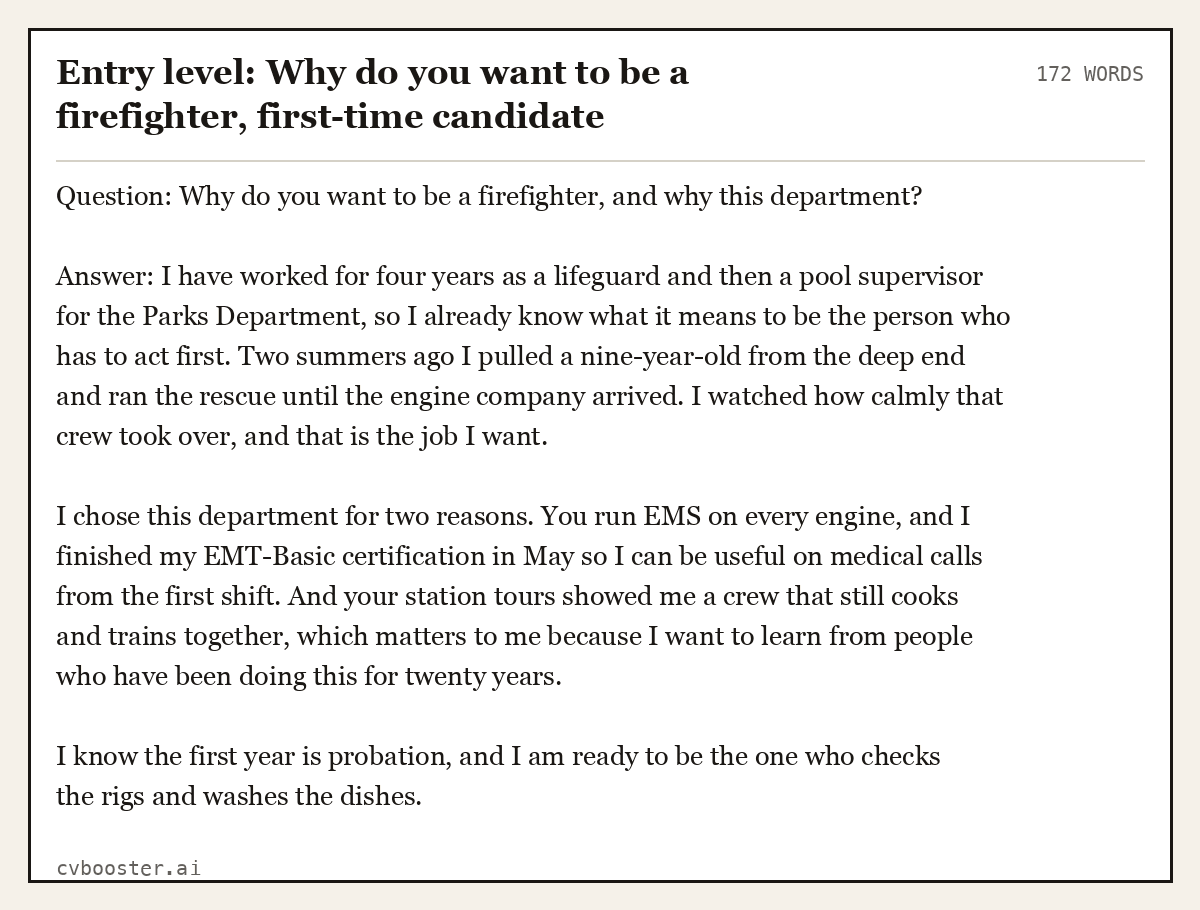
Entry level: Why do you want to be a firefighter, first-time candidate (172 words)
Question: Why do you want to be a firefighter, and why this department?
Answer: I have worked for four years as a lifeguard and then a pool supervisor for the Parks Department, so I already know what it means to be the person who has to act first. Two summers ago I pulled a nine-year-old from the deep end and ran the rescue until the engine company arrived. I watched how calmly that crew took over, and that is the job I want.
I chose this department for two reasons. You run EMS on every engine, and I finished my EMT-Basic certification in May so I can be useful on medical calls from the first shift. And your station tours showed me a crew that still cooks and trains together, which matters to me because I want to learn from people who have been doing this for twenty years.
I know the first year is probation, and I am ready to be the one who checks the rigs and washes the dishes.
What the oral board scores
The panel does not score whether your story is impressive. It scores whether it shows the traits on its sheet. The O*NET summary for firefighters describes the work: "Control and extinguish fires or respond to emergency situations where life, property, or the environment is at risk." Every answer should connect back to that job, not to a general idea of service.
The traits most rating sheets look for:
- Integrity. You do the right thing when nobody is watching, and you report it when someone else does not.
- Teamwork and station life. You can live with the same crew for a full shift, take orders and take a joke.
- Safety and judgment. You know when to stop, ask and follow the chain of command.
- Customer service. Most calls are medical or public service calls, and the public is the customer; our good customer service examples for interview show how to tell those stories.
- Knowledge of the department. You know the call volume, the stations, the apparatus and the community.
- Composure. You stay calm under pressure, including in the interview room.
Structure every answer the same way. MIT's career office describes STAR and its weighting; one line reads "Action (60%), describe the actions that you personally took to complete the task or reach the end goal." For a board, keep it to about two minutes: a short situation, your own actions in detail, and the result.
Fire service interview questions and answers on integrity
Integrity questions decide more fire department interviews than any other kind, because a firefighter is trusted inside people's homes. The classic is the one about a crew member taking something from a call. There is only one right answer, and the board wants to hear you reach it without hesitating.
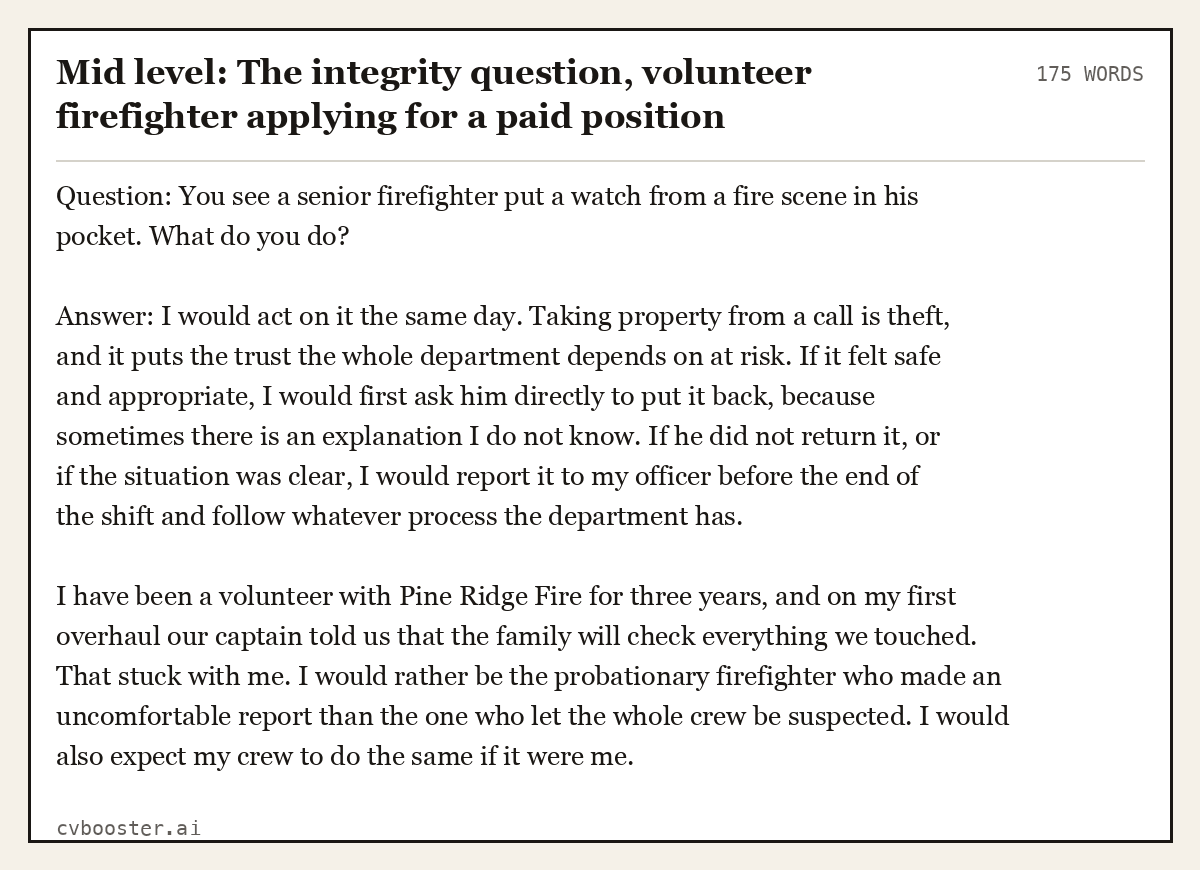
Mid level: The integrity question, volunteer firefighter applying for a paid position (175 words)
Question: You see a senior firefighter put a watch from a fire scene in his pocket. What do you do?
Answer: I would act on it the same day. Taking property from a call is theft, and it puts the trust the whole department depends on at risk. If it felt safe and appropriate, I would first ask him directly to put it back, because sometimes there is an explanation I do not know. If he did not return it, or if the situation was clear, I would report it to my officer before the end of the shift and follow whatever process the department has.
I have been a volunteer with Pine Ridge Fire for three years, and on my first overhaul our captain told us that the family will check everything we touched. That stuck with me. I would rather be the probationary firefighter who made an uncomfortable report than the one who let the whole crew be suspected. I would also expect my crew to do the same if it were me.
Notice what the answer does not do. It does not threaten to go straight to the news, it does not cover for the senior firefighter, and it does not lecture. It follows the chain of command and says why it matters.
Firefighter interview questions about teamwork and conflict
The board needs to know you can live at the station. Questions about conflict, criticism and working with people you do not like are really questions about a 24-hour shift. Give a real example where you were partly at fault, because a story where everyone else was wrong tells the panel you will be hard to work with.
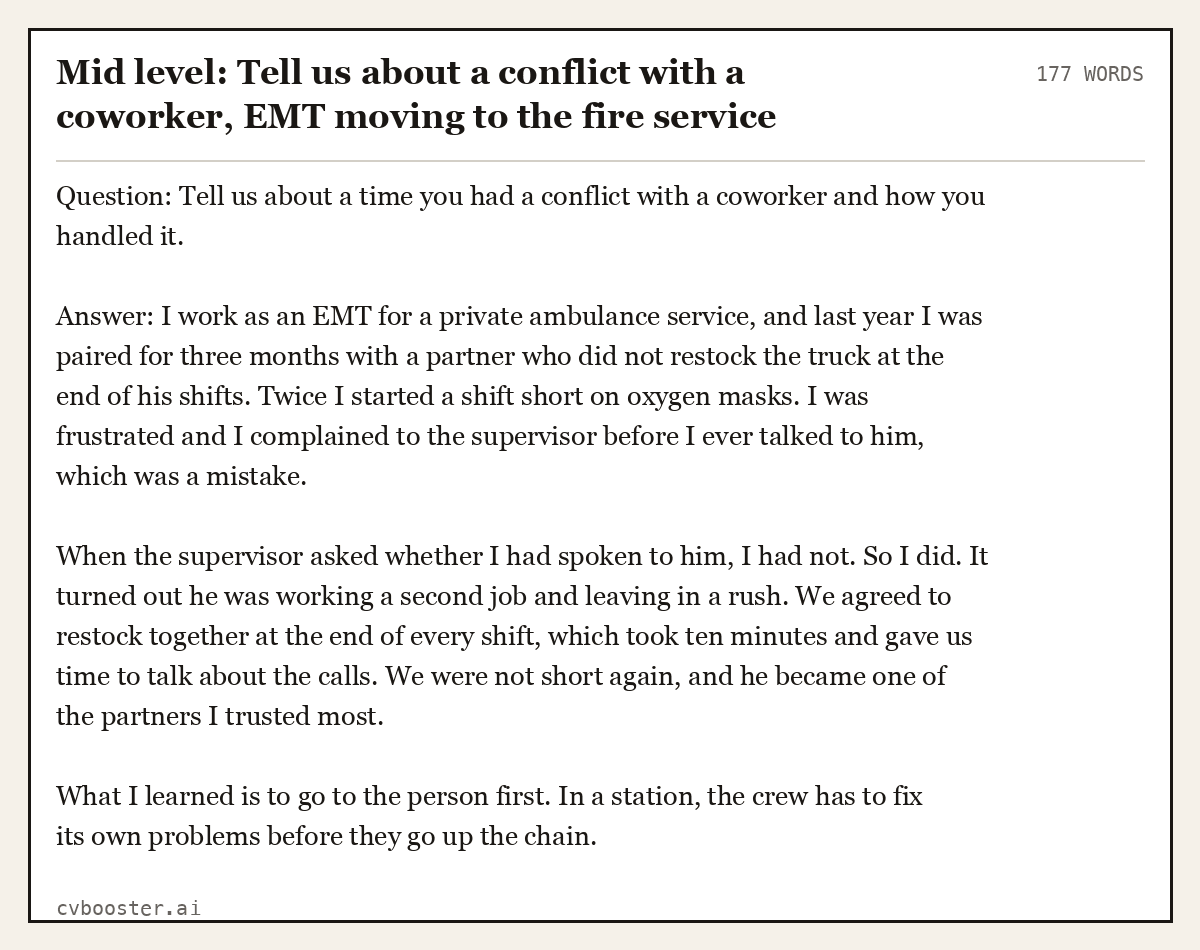
Mid level: Tell us about a conflict with a coworker, EMT moving to the fire service (177 words)
Question: Tell us about a time you had a conflict with a coworker and how you handled it.
Answer: I work as an EMT for a private ambulance service, and last year I was paired for three months with a partner who did not restock the truck at the end of his shifts. Twice I started a shift short on oxygen masks. I was frustrated and I complained to the supervisor before I ever talked to him, which was a mistake.
When the supervisor asked whether I had spoken to him, I had not. So I did. It turned out he was working a second job and leaving in a rush. We agreed to restock together at the end of every shift, which took ten minutes and gave us time to talk about the calls. We were not short again, and he became one of the partners I trusted most.
What I learned is to go to the person first. In a station, the crew has to fix its own problems before they go up the chain.
Fireman interview questions and answers on safety and judgment
Boards still get asked "fireman interview questions" by people searching, and the questions are the same: scenarios that test whether you follow orders, protect your crew and know your limits. The answer that loses points is the hero answer, the one where you charge back into the building alone.
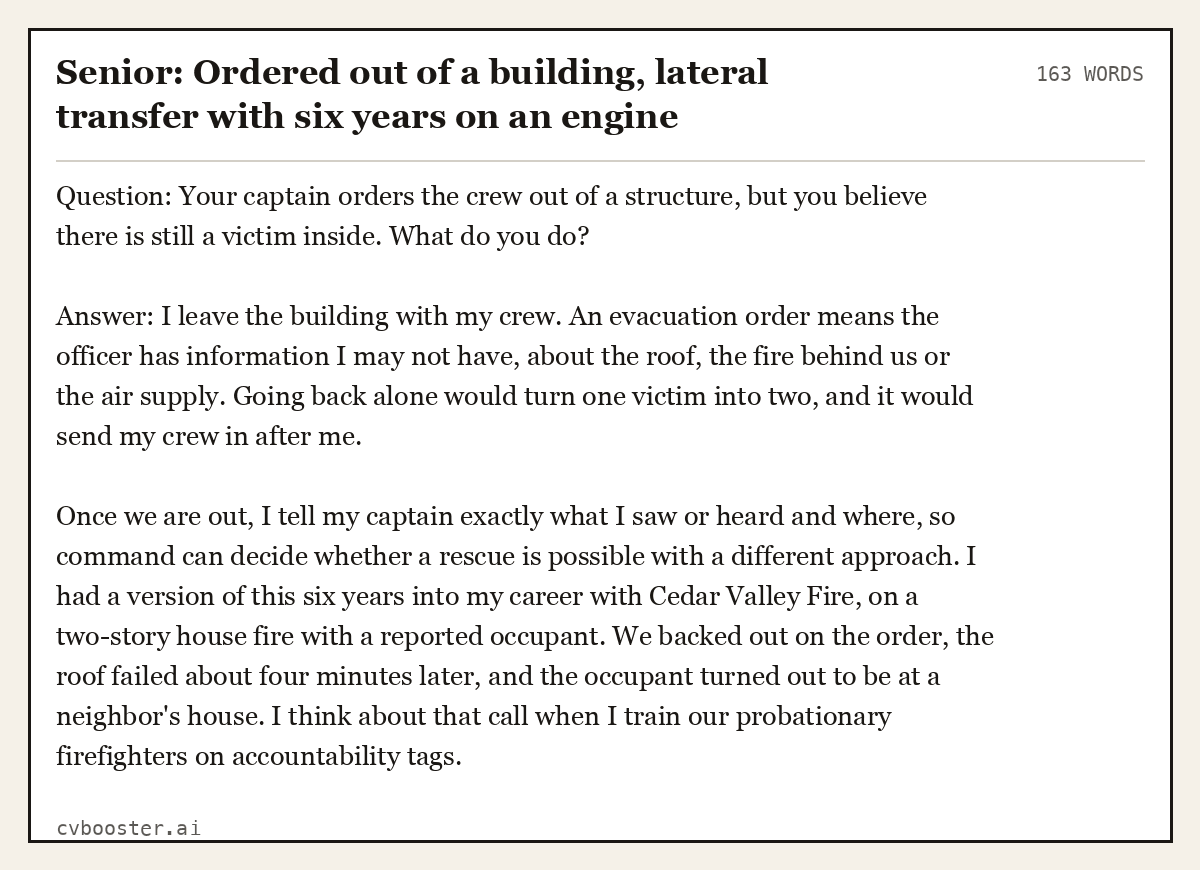
Senior: Ordered out of a building, lateral transfer with six years on an engine (163 words)
Question: Your captain orders the crew out of a structure, but you believe there is still a victim inside. What do you do?
Answer: I leave the building with my crew. An evacuation order means the officer has information I may not have, about the roof, the fire behind us or the air supply. Going back alone would turn one victim into two, and it would send my crew in after me.
Once we are out, I tell my captain exactly what I saw or heard and where, so command can decide whether a rescue is possible with a different approach. I had a version of this six years into my career with Cedar Valley Fire, on a two-story house fire with a reported occupant. We backed out on the order, the roof failed about four minutes later, and the occupant turned out to be at a neighbor's house. I think about that call when I train our probationary firefighters on accountability tags.
Promotional fire department interview questions
Promotional boards for engineer, lieutenant and captain ask different questions: how you would supervise former peers, run training, handle discipline and support the department's goals. The same STAR structure works, but the actions must be a supervisor's actions.
Senior: How would you handle a firefighter who is late, promotional board for lieutenant (172 words)
Question: As a new lieutenant, one of your firefighters, a friend you came on with, keeps arriving late for shift change. How do you handle it?
Answer: I talk to him privately on the first late shift, not the third. I would tell him what I saw, ask if something is going on at home, and be clear that I expect him on time from now on. Friendship makes that conversation harder, which is why it has to happen early.
If it continues, I document it and follow the department's progressive discipline policy, the same way I would for anyone on the crew. The rest of the shift is watching to see whether I treat my friends differently, and the day I do, I lose them.
As acting officer on B shift this year, I had a similar situation with apparatus checks being skipped. I set a start time, checked the logs myself for two weeks and praised the crew when the checks were done. It has not been a problem since.
More fire department oral board questions to prepare
Prepare a short story for each of these. Most boards draw from the same pool.
| Question | What the board is checking |
|---|---|
| Tell us about yourself. | A two-minute summary tied to the job, not your life story |
| What do you know about our department? | Call volume, stations, apparatus, community, current projects |
| What does a firefighter do on a typical shift? | That you know most calls are medical and public service |
| Tell us about a mistake you made. | Ownership, what you changed afterwards |
| How do you handle stress? | Real habits, such as training, fitness, talking to your crew |
| What would you do if a citizen complained about a crew member? | Customer service and chain of command |
| Why should we hire you over the other candidates? | Specific skills and certifications, said without boasting |
| Do you have any questions for us? | Interest in the station, the training and the probation year |
For the last question, see our list of questions to ask in an interview. For a board with several raters, our guide to panel interview questions covers how to address everyone at the table, and the general common interview questions and answers help with "tell us about yourself".
How to prepare in the week before the board
- Learn the department. Read the annual report, visit a station on a quiet afternoon, and ask the crew what the job is really like there.
- Write eight stories. MIT's advice is to "Prepare 3-5 stories by creating a bulleted outline or jotting down notes using CAPD’s STAR method worksheet". For a fire board, eight gives you room: integrity, teamwork, conflict, mistake, stress, customer service, leadership and why this job.
- Practice out loud with a timer. Two minutes per answer. Ask a firefighter or a friend to play the board.
- Prepare your opening and closing statements. Many departments allow both.
- Dress the part. A dark suit or the department's guidance, polished shoes, and arrive early.
Our general guide on how to prepare for an interview has a full checklist for the day itself.
Before you apply, make sure your resume tells the same story as your answers: certifications, EMS experience and community service in the first half of page one.
Frequently asked questions
What questions are asked in a fire department interview?
Most oral boards ask why you want to be a firefighter, what you know about the department, and situational questions on integrity, teamwork, conflict, stress and customer service. Expect at least one scenario where a crew member does something wrong. Promotional boards add questions on supervision, training and discipline.
How do you answer the firefighter integrity question?
State clearly that taking property, lying or covering for unsafe behavior is wrong, and that you would act the same day. Follow the chain of command: speak to the person if it is safe and appropriate, then report to your officer. Avoid both covering it up and dramatic answers such as calling the media.
How long should answers be at a firefighter oral board?
About one and a half to two minutes for most questions. That is long enough for a short situation, the actions you personally took and the result, and short enough that the board can score you before the next question. Practice with a timer, because nerves make most candidates talk faster or much longer.
What should I wear to a fire department interview?
A dark, well-fitted suit, a plain shirt and tie or equivalent business attire, and polished shoes, unless the testing notice says otherwise. Keep it simple and tidy. The board is looking for someone who takes the process seriously and pays attention to detail, which starts with how you show up.
Should I bring a resume to a firefighter interview?
Yes, bring several copies even if you submitted one online, plus copies of your certifications such as EMT, CPR and any fire science courses. Some boards hand your resume to raters as a reference. Make sure every certification date on it is current and matches what you say in your answers.
Related articles
- Accountancy CV Example: 6 UK Accounts CVs by Career Level
- Accounting Interview Questions and Answers: 7 Full Examples
- Activity Resume Example: 6 Samples for College Applications
- Administration CV Example: 6 Admin CVs from Entry to Senior
More articles
- How to Write a Resume for Your First Job (No Experience Needed)
- Flight Attendant Cover Letter: 6 Samples by Experience
- Football CV: How to Write One, With 6 Player Examples
Looking for a worked example for your job title? Browse the resume examples by job title.