Interview Panel Questions: 6 Full Answers, Seat by Seat
By Mustafa Tarabya, founder of CVBooster · Published · Updated
11 min read
Interview panel questions are the same competency questions one interviewer would ask, split between several people who each own a part of the job: the hiring manager asks about the work, someone from HR asks how you behave, a peer asks how you actually do the task, and sometimes a person from another team asks how you would work with them. The catch is that each of them scores you separately. The US Office of Personnel Management describes it plainly in its guide to structured interviews: "Structured interviews are usually scored by a panel in which each member rates applicant responses individually and then participates in a group discussion to resolve significant scoring discrepancies." Below are the questions each seat tends to ask, six complete answers from entry level to senior, and how to handle the room. Written by Mustafa Tarabya, who hired for his own company, read every application himself and now writes CVBooster's guides.
Five people, one table, one glass of water, and somebody writing every time you pause. It feels like a tribunal. It is a scoring sheet with five pens, and once you know what each pen scores, it gets less strange.
Panel interview questions from the hiring manager
The hiring manager owns the job, so the questions are about the work:
- Walk us through the experience that is most relevant to this role.
- Why do you want this job, and why now?
- What would you need from us in your first month?
- Which part of this job would you find hardest?
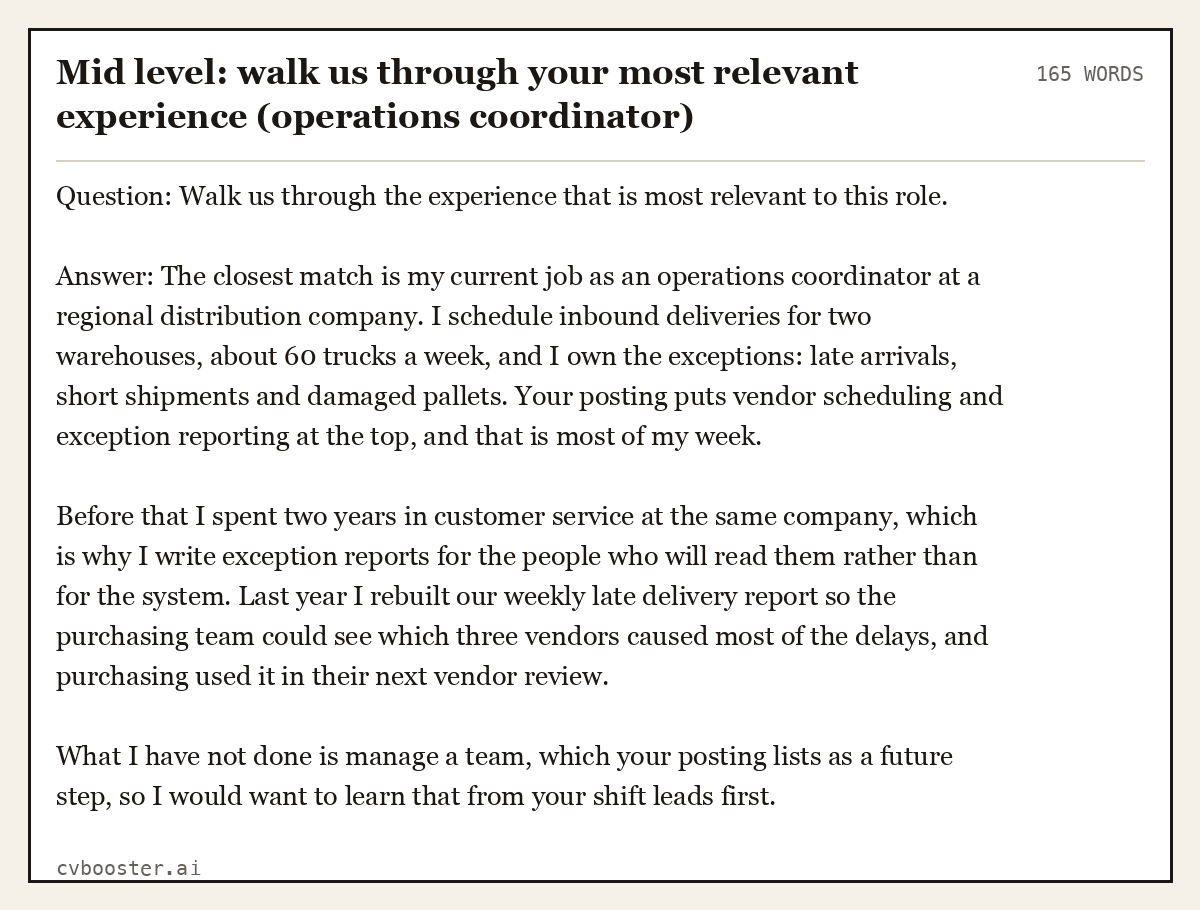
Mid level: walk us through your most relevant experience (operations coordinator) (165 words)
Question: Walk us through the experience that is most relevant to this role.
Answer: The closest match is my current job as an operations coordinator at a regional distribution company. I schedule inbound deliveries for two warehouses, about 60 trucks a week, and I own the exceptions: late arrivals, short shipments and damaged pallets. Your posting puts vendor scheduling and exception reporting at the top, and that is most of my week.
Before that I spent two years in customer service at the same company, which is why I write exception reports for the people who will read them rather than for the system. Last year I rebuilt our weekly late delivery report so the purchasing team could see which three vendors caused most of the delays, and purchasing used it in their next vendor review.
What I have not done is manage a team, which your posting lists as a future step, so I would want to learn that from your shift leads first.
How a panel interview works
A structured panel agrees the questions in advance and gives each member a few of them. The person who asks a question usually scores the answer most carefully, but everybody writes something down. After you leave, they compare scores and argue about the gaps, which is why one strong answer to one person does not carry you; each seat needs its own evidence.
Expect two kinds of question. OPM separates them clearly: "Situational interview questions ask applicants to describe what they would do or how they would behave in a situation similar to those encountered on the job." Behavioral questions ask what you did before. Harvard's career office explains the logic behind the second kind in its interviewing guide: "The principle behind this type of interview is that past behavior is a good predictor of future behavior."
Panel interview questions from HR
The HR member is usually scoring behavior and fit against the same list for every candidate. Expect behavioral questions that start with "tell us about a time": a conflict, a mistake, a deadline, a change you did not like. Answer with a situation, what you did and what happened, which is the framework Harvard teaches, and keep each answer under two minutes. Our STAR interview questions guide has more worked answers in the same shape.
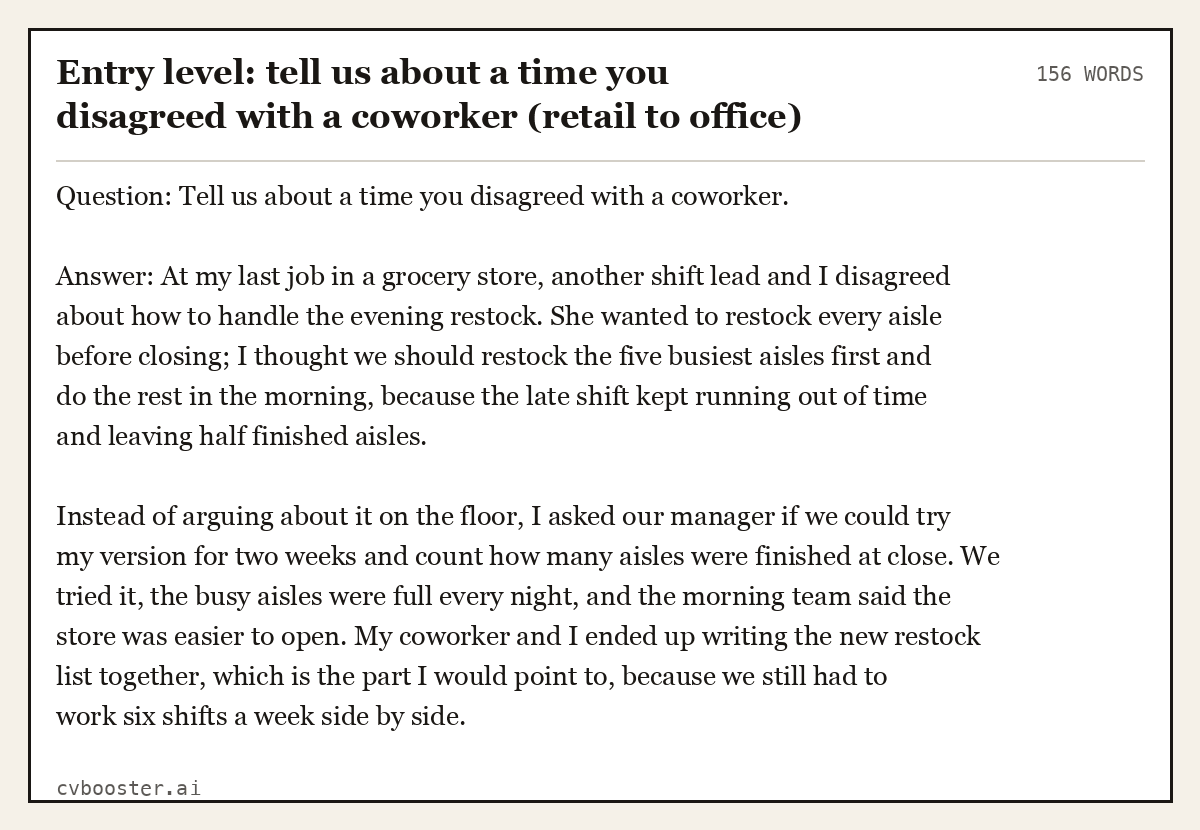
Entry level: tell us about a time you disagreed with a coworker (retail to office) (156 words)
Question: Tell us about a time you disagreed with a coworker.
Answer: At my last job in a grocery store, another shift lead and I disagreed about how to handle the evening restock. She wanted to restock every aisle before closing; I thought we should restock the five busiest aisles first and do the rest in the morning, because the late shift kept running out of time and leaving half finished aisles.
Instead of arguing about it on the floor, I asked our manager if we could try my version for two weeks and count how many aisles were finished at close. We tried it, the busy aisles were full every night, and the morning team said the store was easier to open. My coworker and I ended up writing the new restock list together, which is the part I would point to, because we still had to work six shifts a week side by side.
Panel interview questions from a peer or technical member
The peer is the person you would sit next to. They want to know whether you can do the work without being walked through it, so their questions are practical and often situational: here is a problem we had last month, what would you do? Answer with steps, name the tools you would use, and say what you would check before acting. If you do not know their system, say which system you know and how you would learn theirs. Our page on situational interview questions covers this format in more depth.
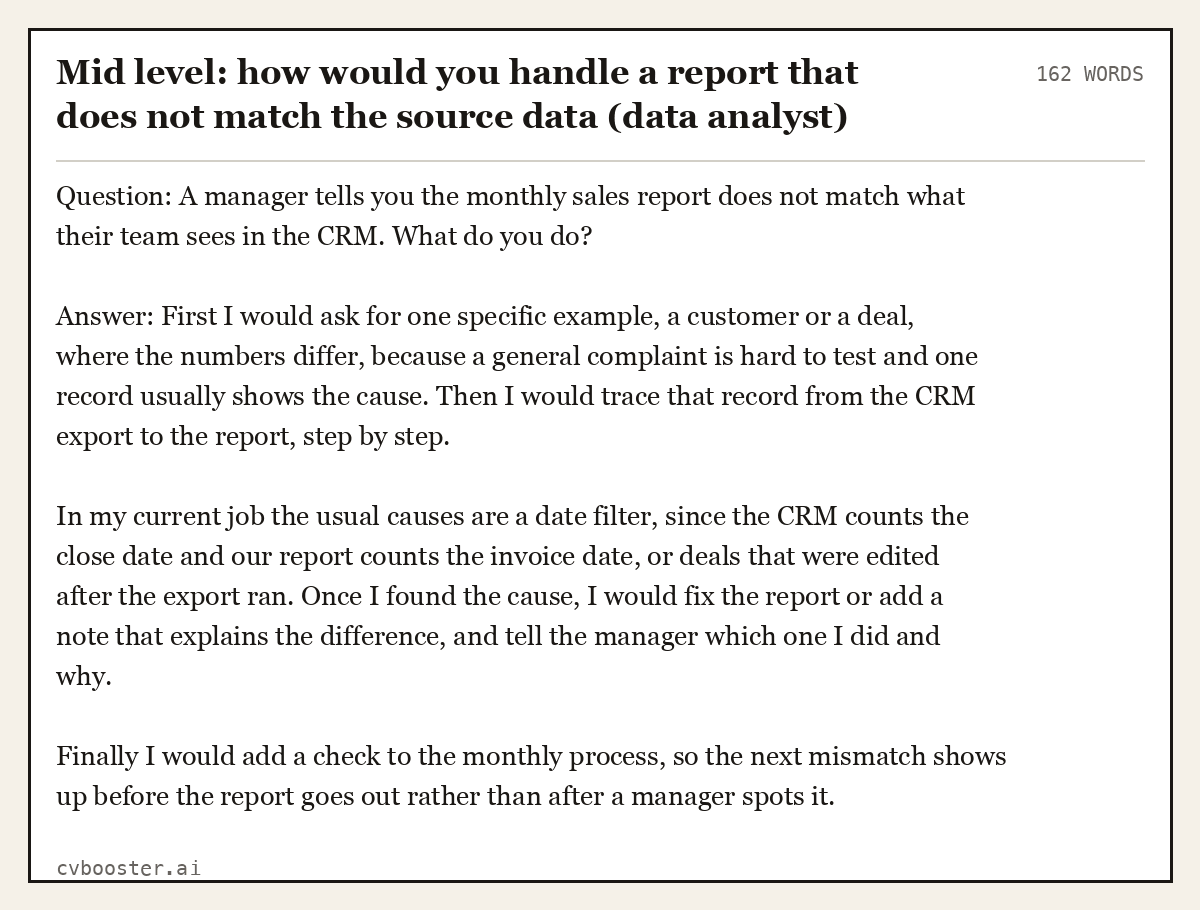
Mid level: how would you handle a report that does not match the source data (data analyst) (162 words)
Question: A manager tells you the monthly sales report does not match what their team sees in the CRM. What do you do?
Answer: First I would ask for one specific example, a customer or a deal, where the numbers differ, because a general complaint is hard to test and one record usually shows the cause. Then I would trace that record from the CRM export to the report, step by step.
In my current job the usual causes are a date filter, since the CRM counts the close date and our report counts the invoice date, or deals that were edited after the export ran. Once I found the cause, I would fix the report or add a note that explains the difference, and tell the manager which one I did and why.
Finally I would add a check to the monthly process, so the next mismatch shows up before the report goes out rather than after a manager spots it.
Questions from a stakeholder outside the team
Some panels include a person from a team you would work with but not for: sales sitting in on a marketing hire, a nurse manager sitting in on a scheduler hire. Their question is nearly always a version of "how would you work with us?" Answer by naming what their team needs from your role, how often you would talk, and what you would do when your priorities clash with theirs.
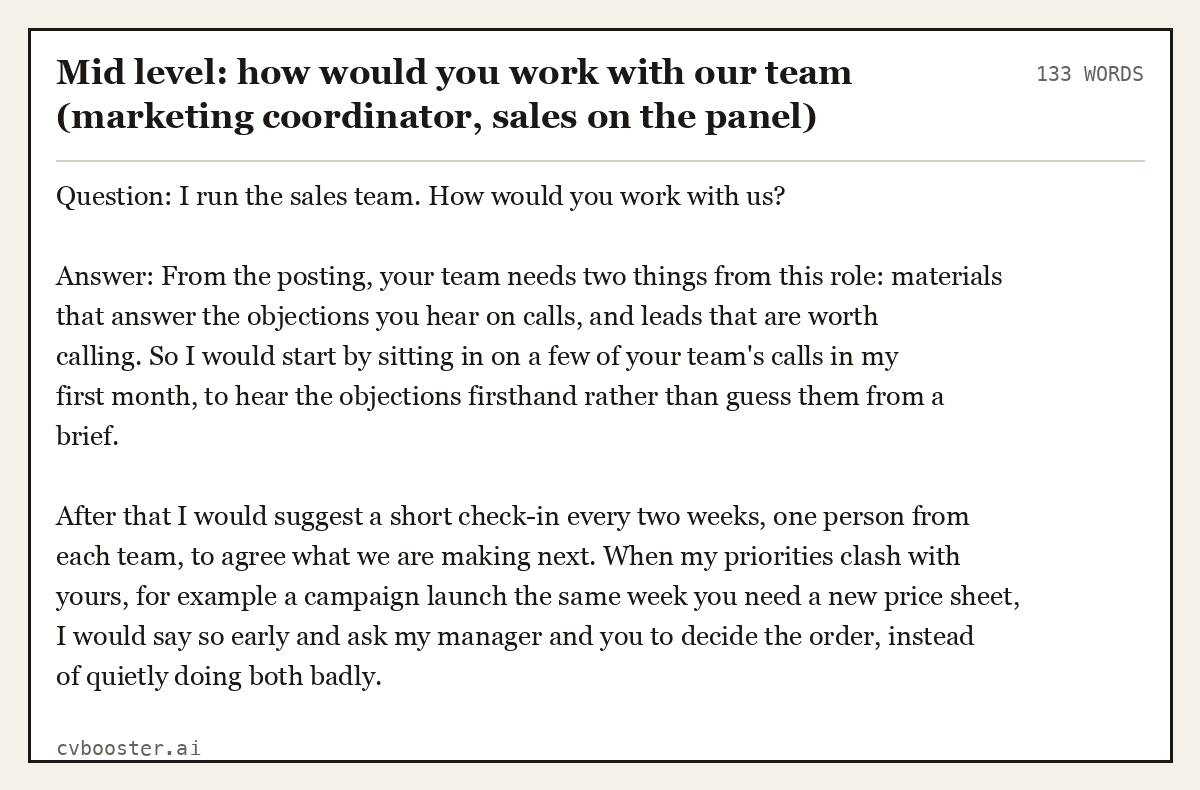
Mid level: how would you work with our team (marketing coordinator, sales on the panel) (133 words)
Question: I run the sales team. How would you work with us?
Answer: From the posting, your team needs two things from this role: materials that answer the objections you hear on calls, and leads that are worth calling. So I would start by sitting in on a few of your team's calls in my first month, to hear the objections firsthand rather than guess them from a brief.
After that I would suggest a short check-in every two weeks, one person from each team, to agree what we are making next. When my priorities clash with yours, for example a campaign launch the same week you need a new price sheet, I would say so early and ask my manager and you to decide the order, instead of quietly doing both badly.
Panel questions at entry level
Graduates and first job candidates get the same panel format with simpler questions, and "tell us about yourself" almost always comes first. Keep it to about a minute: what you studied or did, one piece of evidence, why this job. Address the person who asked, then look around the table as you finish.
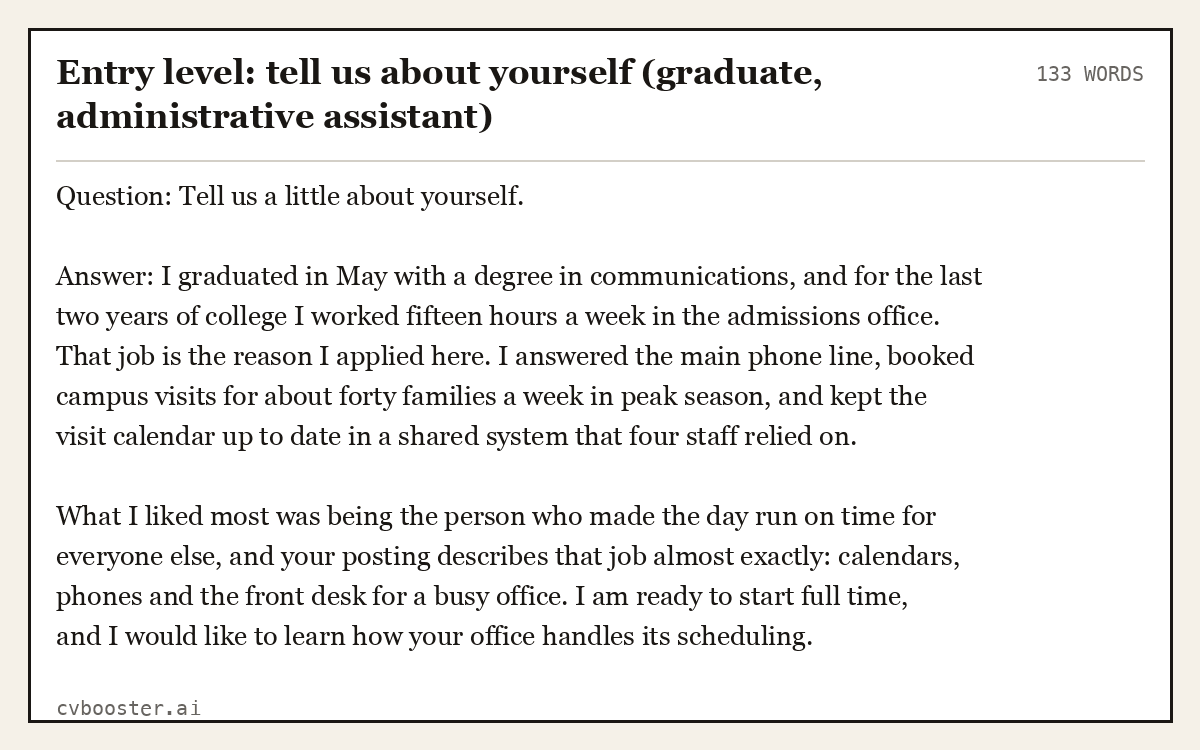
Entry level: tell us about yourself (graduate, administrative assistant) (133 words)
Question: Tell us a little about yourself.
Answer: I graduated in May with a degree in communications, and for the last two years of college I worked fifteen hours a week in the admissions office. That job is the reason I applied here. I answered the main phone line, booked campus visits for about forty families a week in peak season, and kept the visit calendar up to date in a shared system that four staff relied on.
What I liked most was being the person who made the day run on time for everyone else, and your posting describes that job almost exactly: calendars, phones and the front desk for a busy office. I am ready to start full time, and I would like to learn how your office handles its scheduling.
Panel questions for senior roles
Senior panels are bigger and often include someone from leadership. The questions move from "what did you do" to "what would you change and how would you decide": your first ninety days, a decision you got wrong, how you would handle a team that is not performing. Give a plan with a sequence, not a list of values.
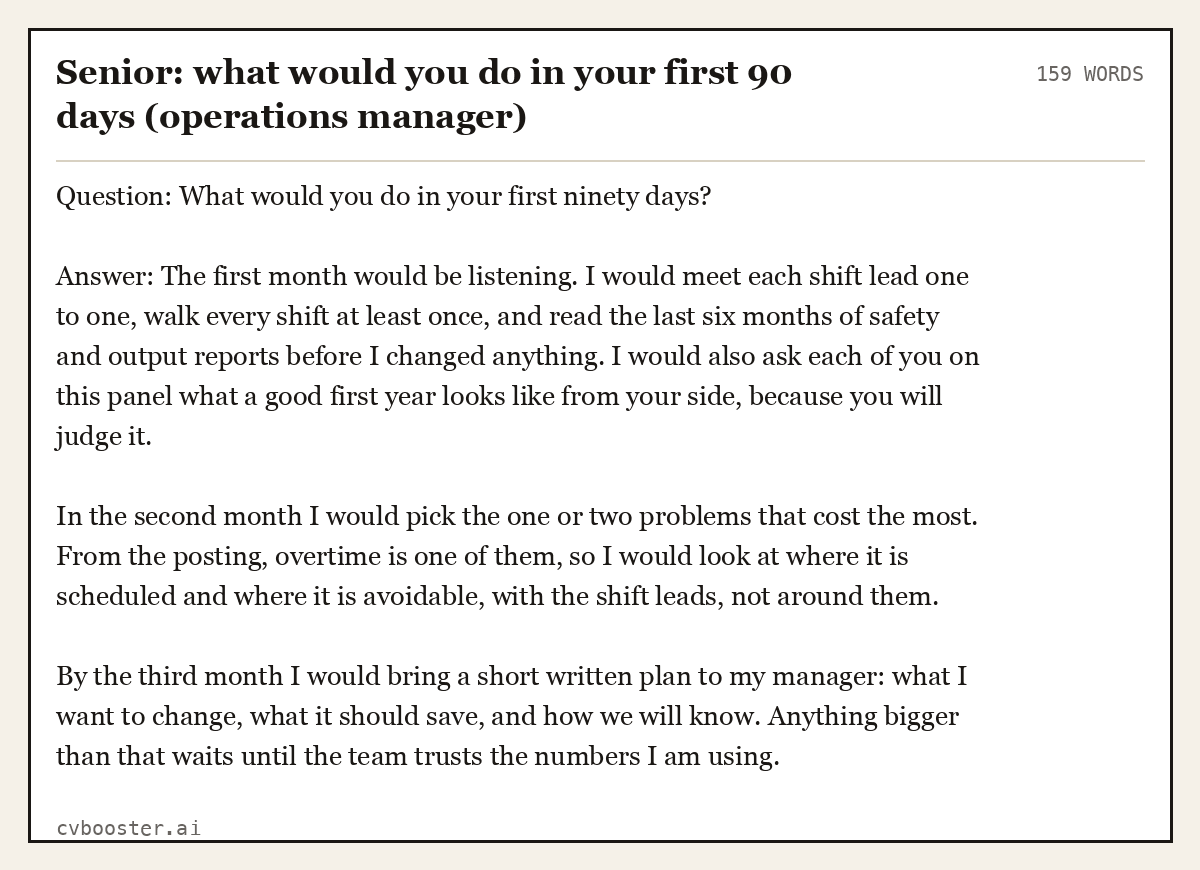
Senior: what would you do in your first 90 days (operations manager) (159 words)
Question: What would you do in your first ninety days?
Answer: The first month would be listening. I would meet each shift lead one to one, walk every shift at least once, and read the last six months of safety and output reports before I changed anything. I would also ask each of you on this panel what a good first year looks like from your side, because you will judge it.
In the second month I would pick the one or two problems that cost the most. From the posting, overtime is one of them, so I would look at where it is scheduled and where it is avoidable, with the shift leads, not around them.
By the third month I would bring a short written plan to my manager: what I want to change, what it should save, and how we will know. Anything bigger than that waits until the team trusts the numbers I am using.
How to answer a panel
- Learn the names. Write them down when you are introduced and use them once or twice. It also helps you send the right thank-you notes later.
- Answer the asker, then the room. Start your answer looking at the person who asked, and look around the table as you finish.
- Do not play favorites. The quiet member writing notes may be the one whose score decides it.
- Match the answer to the seat. Give the peer detail, the manager results and HR behavior.
- Ask for a repeat if two people speak at once. Asking which question to answer first is normal on a panel.
For the full week of preparation, see how to prepare for an interview, and for the questions that come up in almost every format, our common interview questions and answers.
Questions to ask an interview panel
Ask one question aimed at a seat other than the hiring manager, because it shows you noticed who was in the room:
- For the hiring manager: What would a strong first three months look like in this role?
- For the peer: What does a normal week look like for the team, and where does the work pile up?
- For the stakeholder: What does your team most need from this role that it is not getting now?
- For HR: What are the next steps, and when should I expect to hear from you?
More options are in our questions to ask in an interview list.
After the panel
Send a short thank-you to each member, or one email to the hiring manager that names everyone if you only have one address. CareerOneStop's interview tips say it simply: "Don't forget to send a thank-you email or letter after the interview." Harvard's guide puts a time on it: "Send a thank-you email after the interview within 24-48 hours." In each note, mention one thing that person asked about, so it reads as written for them.
Frequently asked questions
What questions are asked in a panel interview?
The same kinds of questions as a one to one interview, split by seat. The hiring manager asks about relevant experience and why you want the job, HR asks behavioral questions about conflict, mistakes and deadlines, a peer asks practical or situational questions about the work, and a stakeholder asks how you would work with their team.
How do you answer panel interview questions?
Answer the person who asked, then include the rest of the room as you finish. Use a situation, what you did and the result for behavioral questions, and clear steps for situational ones. Keep most answers under two minutes, match the detail to the seat, and use the panel members' names once or twice.
How many people are on an interview panel?
There is no fixed number. A panel usually includes the hiring manager, someone from HR and one or two people from the team or a partner team, and senior roles can add a leader from outside the department. Ask the recruiter beforehand who will be on the panel and what each person does.
How should I prepare for a panel interview?
Find out who is on the panel and what each person does, then prepare one or two stories for each seat: results for the hiring manager, behavior examples for HR, practical detail for the peer. Practice answering out loud while looking at different people, and prepare one question for a panel member other than the hiring manager.
Should I send a thank-you note to every panel member?
Yes, if you have their email addresses. Send a short note to each within a day or two and mention one thing that person asked about. If you only have the hiring manager's or recruiter's address, send one email that thanks the panel by name and ask them to pass it on.
Related articles
- Accountancy CV Example: 6 UK Accounts CVs by Career Level
- Accounting Interview Questions and Answers: 7 Full Examples
- Activity Resume Example: 6 Samples for College Applications
- Administration CV Example: 6 Admin CVs from Entry to Senior
More articles
- PE Teaching Interview Questions and 6 Full Sample Answers
- Personal Skills for Resume: 14 Traits and How to Prove Them
- CV Personal Statement Examples: 12 Written for Real Jobs
Looking for a worked example for your job title? Browse the resume examples by job title.