Heading for CV: What Goes at the Top, Plus Section Headings
By Mustafa Tarabya, founder of CVBooster · Published · Updated
6 min read
The heading for a CV is your full name in large type, with your town, mobile number, email address and, if you have one, a LinkedIn link on the line underneath. That is all. The one rule people break is writing "Curriculum Vitae" across the top, and Prospects is blunt about it: "Avoid titling the document 'curriculum vitae' or 'CV'. It's a waste of space. Instead, let your name serve as the title." Below are six complete examples: four CV headings for different stages and two sets of section headings for the body of the CV. Written by Mustafa Tarabya, who hired for his own company, read every application himself and now writes CVBooster's guides.
A CV with CURRICULUM VITAE in large bold capitals across the top tells the reader two things before the first sentence: that it is a CV, which the file name already said, and that the applicant's name is somewhere further down in smaller letters.
What goes in a CV heading
A CV heading has one job: tell the reader who you are and how to reach you, in two lines they can read in a second. The National Careers Service lists the contact details to include: "You should include your name, phone number, email address and a link to your work network profile, if you have one, such as LinkedIn."
Your town is enough for the address. A full street address adds nothing at the application stage, and a town tells the employer whether you can commute. Leave out your date of birth, marital status, nationality and a photo. The University of Kent careers service keeps it to "Details that the employer can use to contact you: your name, phone number and email address."
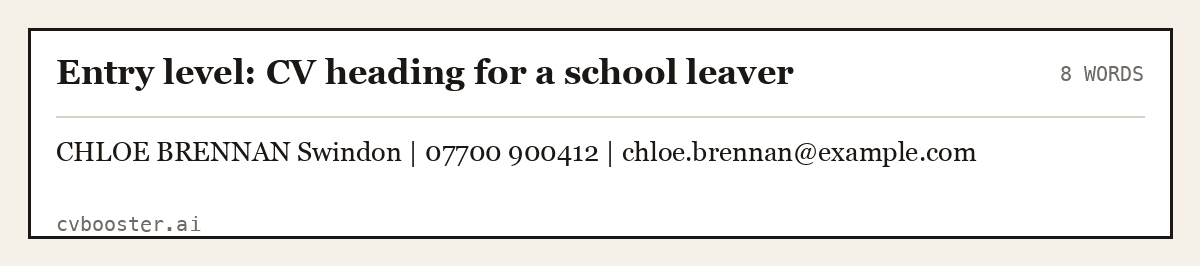
Entry level: CV heading for a school leaver (8 words)
CHLOE BRENNAN Swindon | 07700 900412 | chloe.brennan@example.com
The name is the largest text on the page. The second line uses a plain separator and an email address made from the name, not a nickname.
CV heading examples by career stage
The heading grows by one item at most as your career grows. A graduate adds a LinkedIn or portfolio link; an experienced applicant can add a short professional title under the name if it matches the job advert.
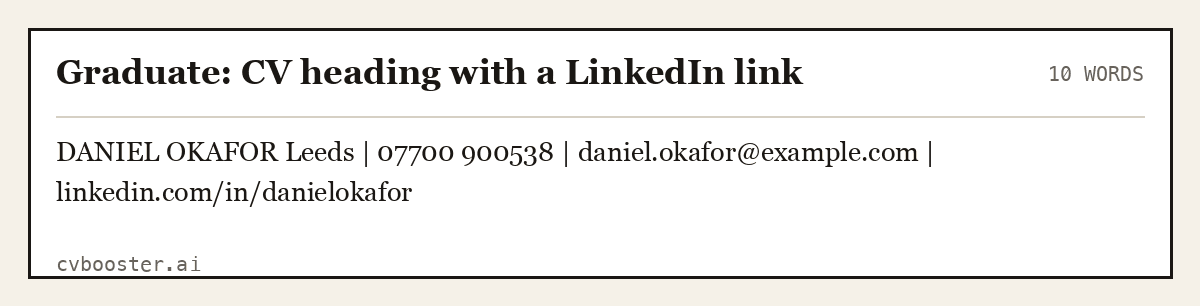
Graduate: CV heading with a LinkedIn link (10 words)
DANIEL OKAFOR Leeds | 07700 900538 | daniel.okafor@example.com | linkedin.com/in/danielokafor
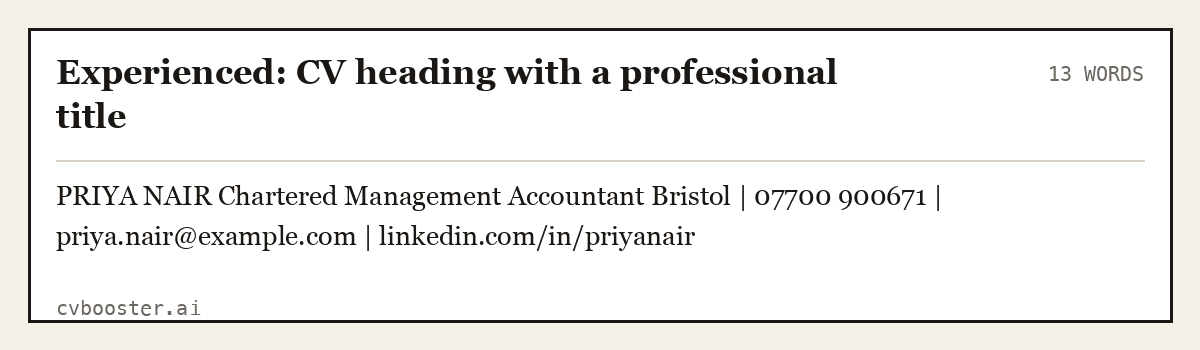
Experienced: CV heading with a professional title (13 words)
PRIYA NAIR Chartered Management Accountant Bristol | 07700 900671 | priya.nair@example.com | linkedin.com/in/priyanair
The title line is optional. Use it only when it is the same job you are applying for, or very close to it. A heading that says "Chartered Management Accountant" on an application for a finance business partner role is fine; on an application for a teaching job it works against you.
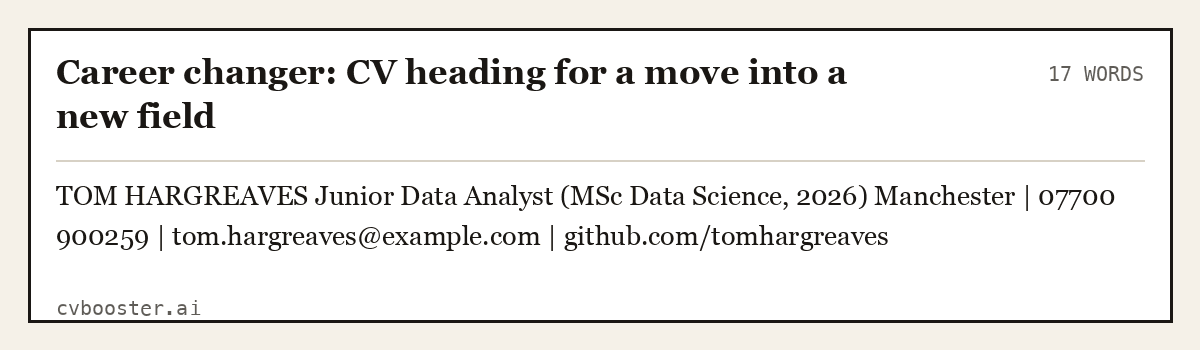
Career changer: CV heading for a move into a new field (17 words)
TOM HARGREAVES Junior Data Analyst (MSc Data Science, 2026) Manchester | 07700 900259 | tom.hargreaves@example.com | github.com/tomhargreaves
A career changer can use the title line to name the job they want, with the qualification that supports it in brackets. The profile underneath then explains the change in three lines.
Section headings for a UK CV
The other meaning of "heading for CV" is the headings that divide the page. Prospects advises: "Section headings are a good way to break up your CV. Ensure they stand out by making them larger (font size 14 or 16) and bold." Keep the wording plain, because employers and applicant tracking systems both look for familiar labels.
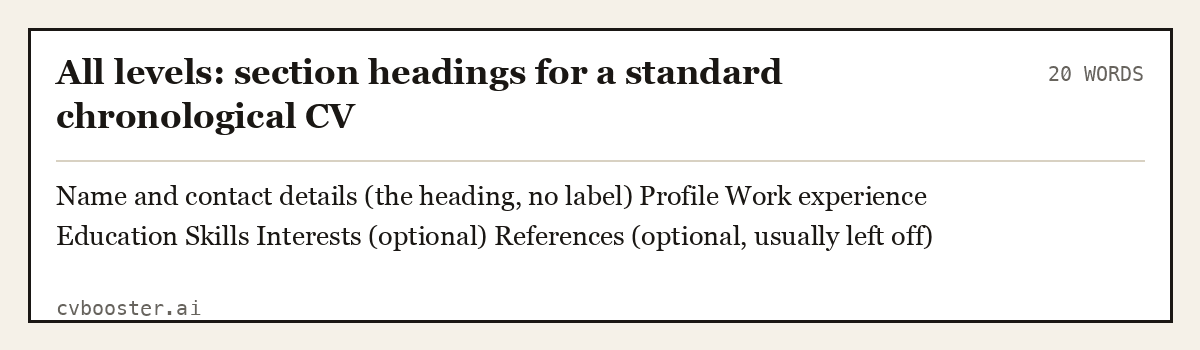
All levels: section headings for a standard chronological CV (20 words)
Name and contact details (the heading, no label) Profile Work experience Education Skills Interests (optional) References (optional, usually left off)
If your work experience is the strongest thing you have, it goes straight after the profile. If you are still at school or university, education goes first. The National Careers Service says the profile "should go just under your name and contact details", so nothing sits between the heading and the profile.
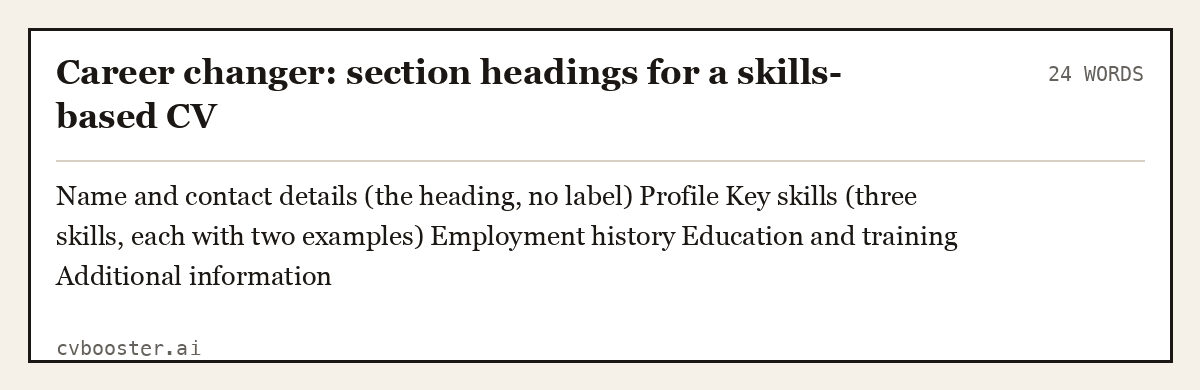
Career changer: section headings for a skills-based CV (24 words)
Name and contact details (the heading, no label) Profile Key skills (three skills, each with two examples) Employment history Education and training Additional information
For the full layout behind the second set, see our skills-based CV template.
What not to put at the top of a CV
- The words Curriculum Vitae or CV. Your name is the title.
- Date of birth, age, marital status or nationality. UK employers do not need them to shortlist you; our guide on what not to include on a UK CV explains why.
- A photo. Prospects says you don't need one "unless you're applying for an acting or modelling job".
- Two phone numbers and three email addresses. One of each, the ones you check.
- Your full street address. Town or city is enough.
- Contact details inside Word's header area. Some applicant tracking systems skip a document's header and footer, so type your name and contact details in the main body of the page.
The last point is one of the few things a CV shares with an American resume; the US version of this page, on the resume header, covers it in more detail. For the whole page around the heading, our one page CV guide shows a finished example.
Save the file with your name too. Prospects suggests a file title that "identifies you, such as 'Joe-Smith-CV'". CVBooster lets you fill in every CV section by hand and check its ATS score on the free plan once you have an account; AI writing help, templates and the finished CV are part of Pro.
Frequently asked questions
What should be the heading of a CV?
Your full name, in the largest text on the page, with your town, mobile number, email address and an optional LinkedIn link on the line below. Do not write Curriculum Vitae or CV as the heading. The reader already knows what the document is, and the space at the top is better used for your name.
Should I write Curriculum Vitae at the top of my CV?
No. Prospects calls it a waste of space and recommends letting your name serve as the title. Writing Curriculum Vitae at the top was common in older templates, and it still appears in some, but UK employers do not expect it and it pushes your name and contact details down the page.
What are the main section headings in a CV?
Profile, work experience, education and skills, with interests and references as optional extras. Put work experience before education once you have relevant jobs, and education first if you are a student or recent graduate. Use plain, familiar labels so recruiters and applicant tracking systems find each section quickly.
Should I put my address on my CV heading?
Your town or city is enough. It tells the employer whether the commute works without giving a full street address to everyone you send the CV to. Add a postcode area only if the advert asks where you live or the job depends on travel distance, such as community or field roles.
Can I put a job title under my name on a CV?
Yes, if it matches or closely matches the job you are applying for, such as Chartered Management Accountant on an application for a finance role. Career changers can use the line for the target job with the supporting qualification in brackets. If the title would confuse the reader about what you want, leave it out.
Related articles
- Accounting Executive Resume: 5 Examples by Career Level
- Administration Resume Examples: 8 Samples, Entry to Manager
- Aged Care Resume: 6 Australian Examples and a Template
- Another Word for Resume: CV, Bio and 10 More Options
More articles
- Healthcare Cover Letter Examples: 7 Letters by Role
- High Paying Low Stress Jobs in the UK: 10 With CV Lines
- Highest Paying Jobs in Fashion: 8 Salaries and CV Lines
Looking for a worked example for your job title? Browse the resume examples by job title.