How to Spell Resume: Resume, Résumé or Resumé, and When
By Mustafa Tarabya, founder of CVBooster · Published · Updated
6 min read
Resume for a job can be spelled three ways, resume, résumé or resumé, and all three are correct, but the plain spelling "resume" is the safest choice for applications in the United States and Canada. The one rule that matters more than the accents is consistency: pick one form and use it everywhere in the same application. Dictionary.com says the accent marks "are not required and it is better to avoid using them". Six correctly written examples follow. Written by Mustafa Tarabya, who hired for his own company, read every application himself and now writes CVBooster's guides.
You have spent ten minutes deciding whether a document about your entire career needs two tiny marks over the e. The person reading it will spend about as long on the whole page. Use the plain spelling and spend the ten minutes on your first bullet.
How to spell resume in a real application
Here is one application with the plain spelling used the same way in every place the word appears.
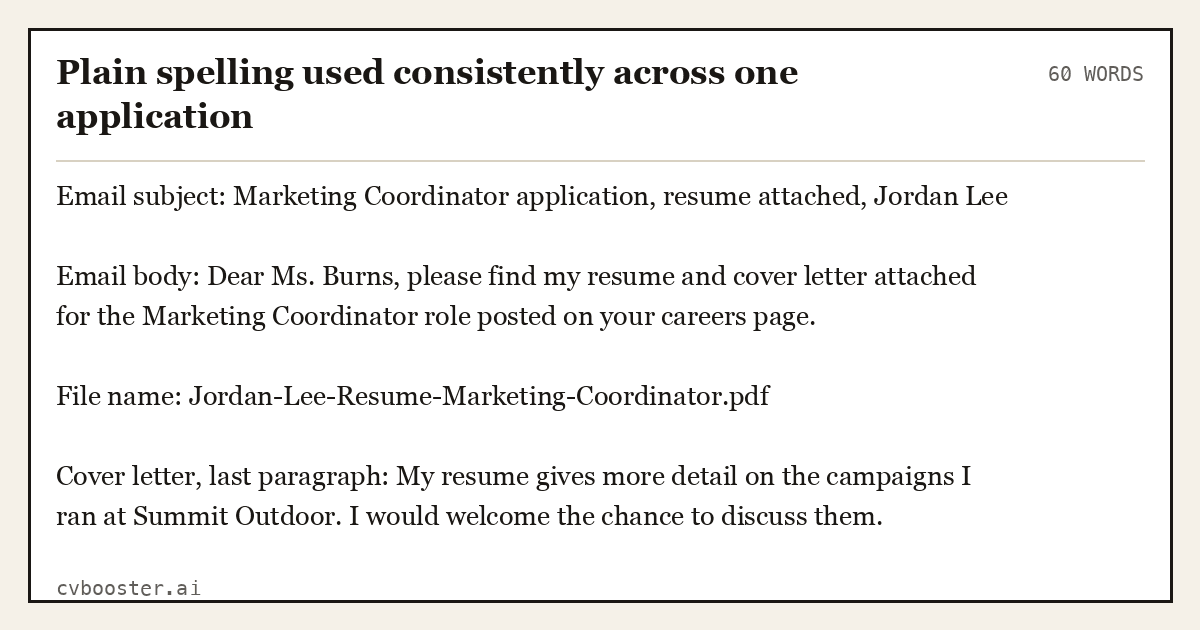
Plain spelling used consistently across one application (60 words)
Email subject: Marketing Coordinator application, resume attached, Jordan Lee
Email body: Dear Ms. Burns, please find my resume and cover letter attached for the Marketing Coordinator role posted on your careers page.
File name: Jordan-Lee-Resume-Marketing-Coordinator.pdf
Cover letter, last paragraph: My resume gives more detail on the campaigns I ran at Summit Outdoor. I would welcome the chance to discuss them.
The word appears four times, spelled the same way four times. That is the whole standard an employer will notice.
The three spellings, and what each dictionary says
Résumé, with two accents. The French original. The Oxford Advanced American Dictionary lists the noun under résumé and gives resumé and resume as accepted alternatives, defining it as "a written record of your education and the jobs you have done, that you send when you are applying for a job".
Resume, no accents. The most common spelling on American job sites and in job adverts. Dictionary.com gives the noun meaning as "a brief written account of personal, educational, and professional qualifications and experience, as that prepared by an applicant for a job."
Resumé, one accent on the last e. Accepted by the dictionaries above, but the least common of the three.
Résume, an accent on the first e only. Not a correct spelling. If you use accents, you need the final one.
Why the plain spelling is usually the better choice
- It is what American employers write. Most US job postings use "resume", so matching their spelling is the safe default.
- It survives every system. Accented letters can turn into odd symbols in older applicant tracking systems, plain text emails or file names on another computer.
- It is consistent by default. No accents means no risk of mixing résumé and resume in the same letter.
The one case for the accents is context. If your sentence could read as the verb, "resume" meaning to continue, the accents remove the doubt. Dictionary.com explains the difference in pronunciation: the verb sounds like "ri-zoom", the noun like "rez-oo-mey". Cambridge Dictionary shows how common the verb is, with examples such as "The talks are due to resume today."
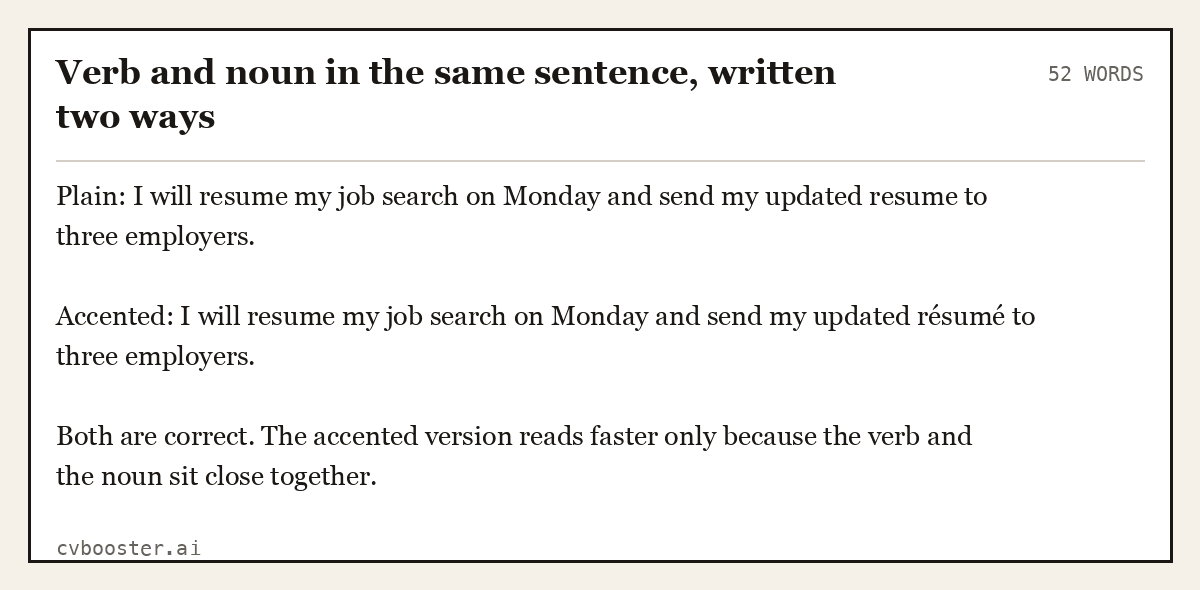
Verb and noun in the same sentence, written two ways (52 words)
Plain: I will resume my job search on Monday and send my updated resume to three employers.
Accented: I will resume my job search on Monday and send my updated résumé to three employers.
Both are correct. The accented version reads faster only because the verb and the noun sit close together.
How to spell resume in a header and file name
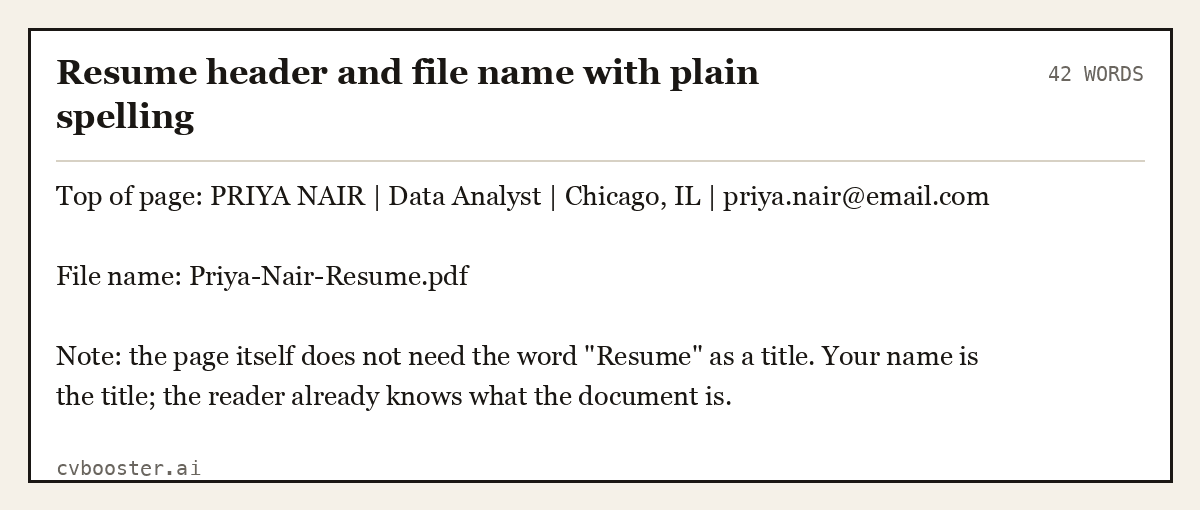
Resume header and file name with plain spelling (42 words)
Top of page: PRIYA NAIR | Data Analyst | Chicago, IL | priya.nair@email.com
File name: Priya-Nair-Resume.pdf
Note: the page itself does not need the word "Resume" as a title. Your name is the title; the reader already knows what the document is.
You do not need to write the word on the resume at all. Our guide to the resume header shows what belongs at the top instead.
Resume spelling in a cover letter
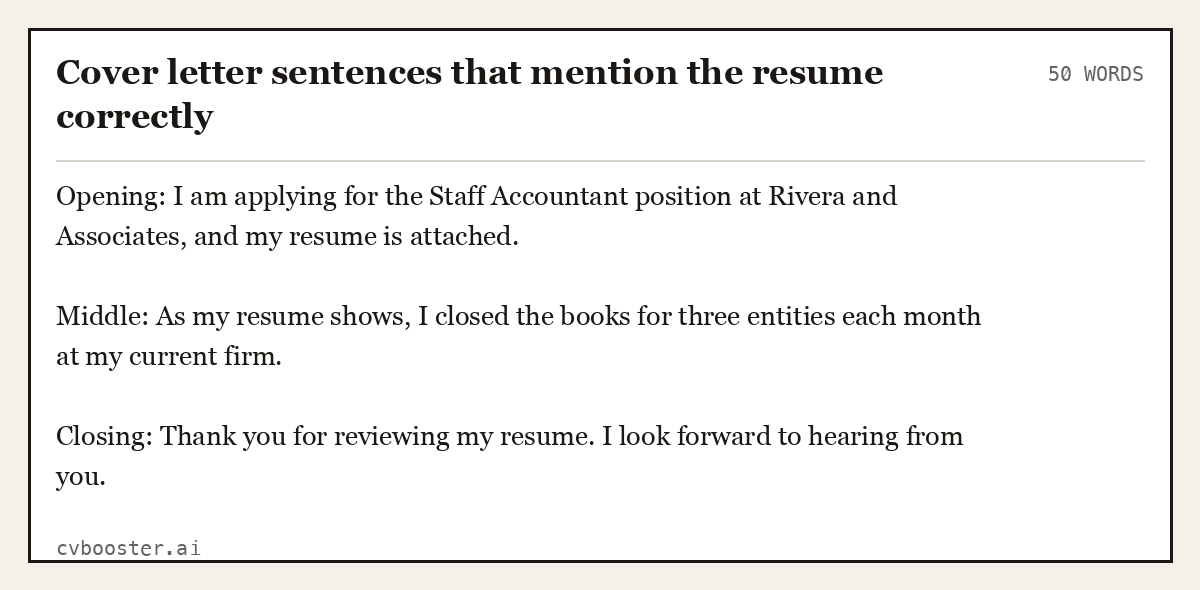
Cover letter sentences that mention the resume correctly (50 words)
Opening: I am applying for the Staff Accountant position at Rivera and Associates, and my resume is attached.
Middle: As my resume shows, I closed the books for three entities each month at my current firm.
Closing: Thank you for reviewing my resume. I look forward to hearing from you.
Resume, CV and other words for the same thing
In the US and Canada a "resume" is the one or two page summary you send for most jobs, and a "CV" is the longer academic document. In the UK, Ireland, Australia and much of the world, "CV" covers both. Our page on CV vs resume explains which one to send, and another word for resume lists the other names you will see in adverts.
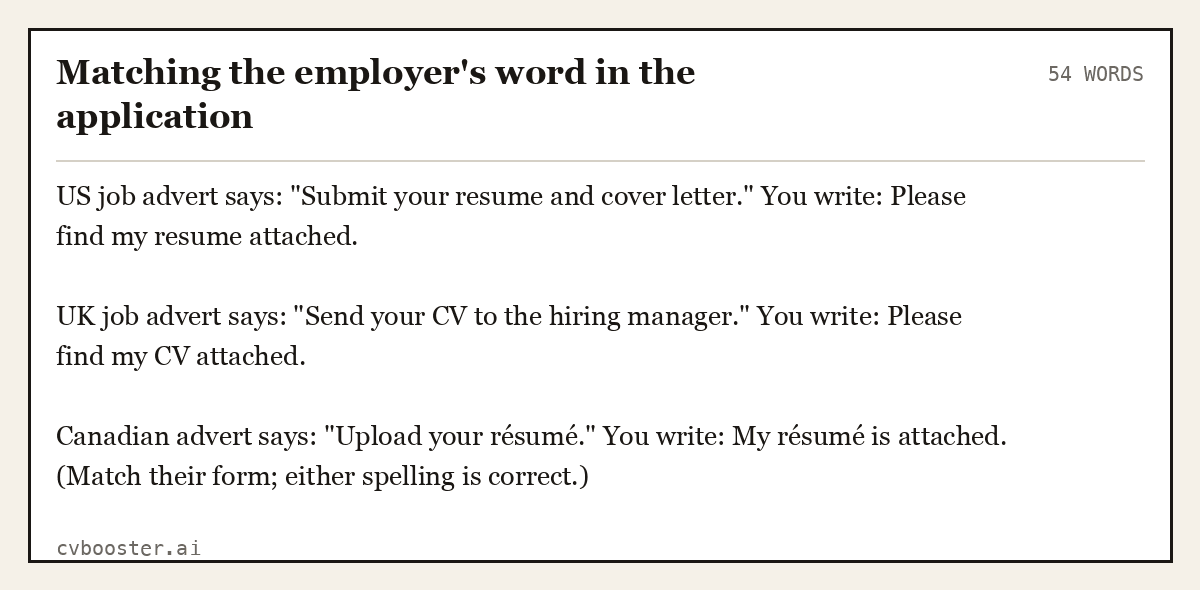
Matching the employer's word in the application (54 words)
US job advert says: "Submit your resume and cover letter." You write: Please find my resume attached.
UK job advert says: "Send your CV to the hiring manager." You write: Please find my CV attached.
Canadian advert says: "Upload your résumé." You write: My résumé is attached. (Match their form; either spelling is correct.)
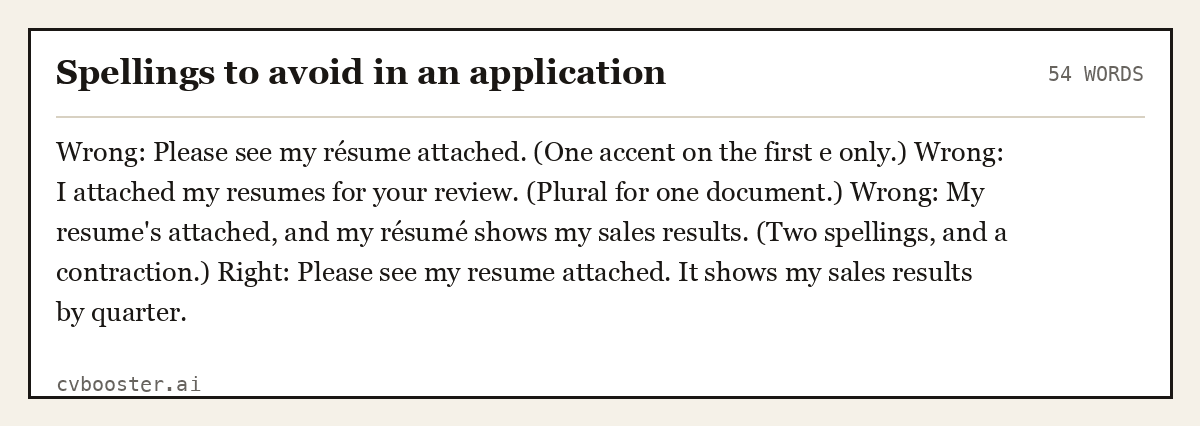
Spellings to avoid in an application (54 words)
Wrong: Please see my résume attached. (One accent on the first e only.) Wrong: I attached my resumes for your review. (Plural for one document.) Wrong: My resume's attached, and my résumé shows my sales results. (Two spellings, and a contraction.) Right: Please see my resume attached. It shows my sales results by quarter.
The spelling mistakes that matter more
Nobody rejects an applicant for "resume" without accents. Recruiters do notice a misspelled company name, a wrong job title, or "manger" where "manager" should be. Spellcheck misses all three, because they are real words or proper names. Our guide to resume proofreading lists the errors to hunt for.
CVBooster checks your resume against the job posting, including the job title and the words the advert uses: filling any of the 99 templates is free after you sign in, with the ATS score and gap list; the PDF and Word download is Pro.
For how to write the numbers in your bullets, see the abbreviation for million on a resume.
Frequently asked questions
How do you spell resume for a job?
Write "resume", "résumé" or "resumé". All three are correct for the job document. In the United States and Canada "resume" without accents is the most common and the safest, because it matches most job adverts and never breaks in software. Whichever you choose, use it the same way everywhere.
Is it résumé or resume?
Both are correct. Résumé keeps the French accents and is common in formal writing and in Canada. Resume is the everyday American spelling and the one most employers use in job postings. Dictionary.com says the accent marks are not required and that it is better to avoid them.
Do you need accents on resume?
No. The accents are optional. Use them only if you prefer the formal look or the employer's advert uses them, and then use both accents, not just one. If you are unsure, leave them out, because plain letters never turn into odd symbols in email or tracking software.
How do you pronounce resume?
The job document is pronounced "REZ-oo-may". The verb meaning to continue, as in "the meeting will resume at two", is pronounced "ri-ZOOM". They are spelled the same in plain English, which is the main reason some writers add accents to the noun.
Related articles
- Resume Spelling: The Errors Spellcheck Misses
- Abbreviation for Million: M, MM or Mil, and Which to Use
- Artist CV: Section Order, Format and 6 Complete Examples
- Biodata Format for Job: 6 Filled Samples and What to Include
More articles
- How to Write a Cover Letter: Structure, Examples, Mistakes
- How to Write a CV for a 15 Year Old: 6 Full UK CVs
- How to Write a Personal Statement for a Job Application
Looking for a worked example for your job title? Browse the resume examples by job title.