Another Word for Resume: CV, Bio and 10 More Options
By Mustafa Tarabya, founder of CVBooster · Published · Updated
8 min read
The most common other word for resume is CV, short for curriculum vitae, which is what the UK, Ireland, Australia and most of the world call the same document; in the US, CV usually means a longer academic record. The catch is that the words are not perfect swaps, and using the wrong one can make an employer ask for a document you did not send. The Cambridge Dictionary defines a résumé in American English as "a written statement of your educational and work experience." Below are twelve alternatives with when each fits, six short examples of the documents behind them, and synonyms for resume the verb. Written by Mustafa Tarabya, who hired for his own company, read every application himself and now writes CVBooster's guides.
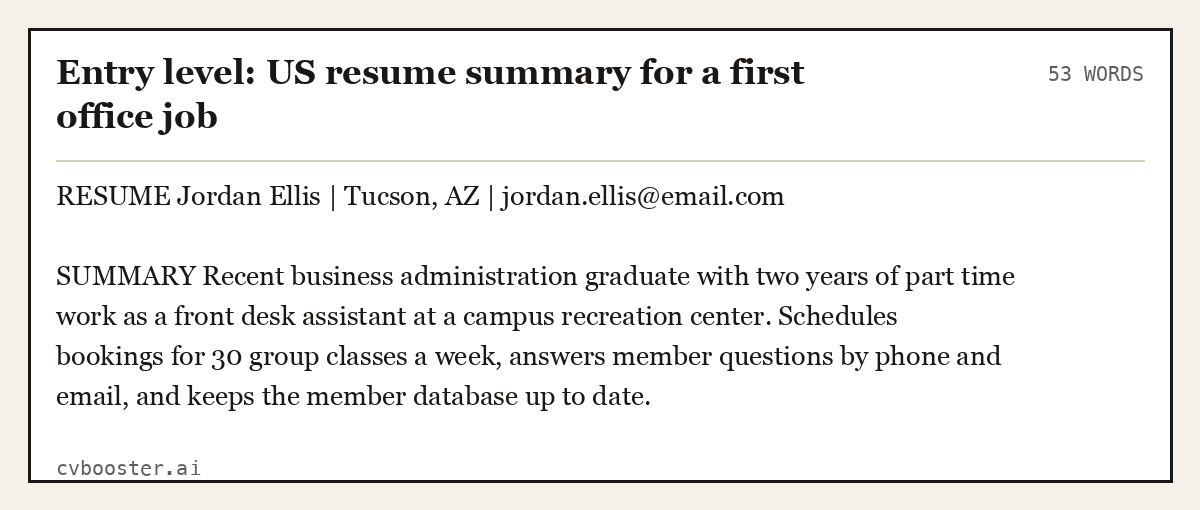
Entry level: US resume summary for a first office job (53 words)
RESUME Jordan Ellis | Tucson, AZ | jordan.ellis@email.com
SUMMARY Recent business administration graduate with two years of part time work as a front desk assistant at a campus recreation center. Schedules bookings for 30 group classes a week, answers member questions by phone and email, and keeps the member database up to date.
Twelve other words for resume, and when each one fits
These are the words people use in place of resume, roughly from the closest match to the loosest.
| Word | Where it is used | When it fits |
|---|---|---|
| CV | UK, Ireland, Europe, Australia, Asia, Africa | The standard word for a job application document outside North America |
| Curriculum vitae | Formal and academic use everywhere | Academic, medical and research jobs, or formal application forms |
| Résumé | US and Canada, formal spelling | The same document; the accents are optional in everyday writing |
| Professional profile | Job sites, recruiter databases | A summary of your career, often online rather than a file |
| Bio or professional bio | Conferences, websites, proposals | A short third person paragraph about you, not a job application |
| Career summary | Recruiter requests | One page or one paragraph overview of your work history |
| Work history | Application forms | A list of jobs with dates, often entered into a form |
| Employment record | Government and formal forms | A record of past employers, sometimes with salary and reasons for leaving |
| Credentials | Licensed fields | Your qualifications and licenses, usually part of a resume |
| Qualifications summary | Resume sections | The top block of a resume, not the whole document |
| Portfolio | Design, writing, media, architecture | Samples of your work, sent alongside a resume, not instead of it |
| Biodata | Parts of South Asia | A personal details document; less common in modern hiring |
If a posting asks for one of these, use the employer's word in your file name and your email. "Please find my CV attached" reads naturally to a London recruiter and slightly odd to a recruiter in Ohio, who would expect resume.
CV and resume: the closest synonym, with one catch
In most of the English speaking world, a CV and a resume are the same thing. Cambridge defines a CV as "a short written description of your education, qualifications, previous jobs, and sometimes also your personal interests, that you send to an employer when you are trying to get a job". Its entry for résumé uses exactly the same definition for US English, marked "(UK CV)".
The catch is American English. The same Cambridge entry for CV gives a second, US meaning: "a written description of the previous work of someone who is looking for a job at a college or university". A US university, hospital or research lab asking for a CV wants the long academic version with publications, grants, teaching and presentations, and it can run to many pages. A US company asking for a resume wants one or two pages. Our guide to CV vs resume covers the differences in detail, and the European CV vs American resume guide covers photos, personal details and length by country.
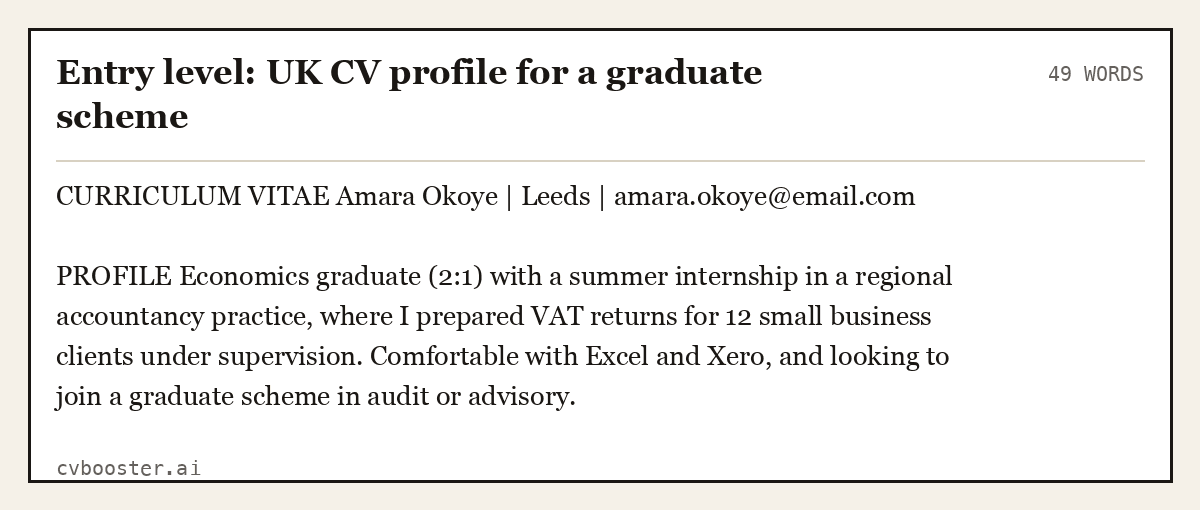
Entry level: UK CV profile for a graduate scheme (49 words)
CURRICULUM VITAE Amara Okoye | Leeds | amara.okoye@email.com
PROFILE Economics graduate (2:1) with a summer internship in a regional accountancy practice, where I prepared VAT returns for 12 small business clients under supervision. Comfortable with Excel and Xero, and looking to join a graduate scheme in audit or advisory.
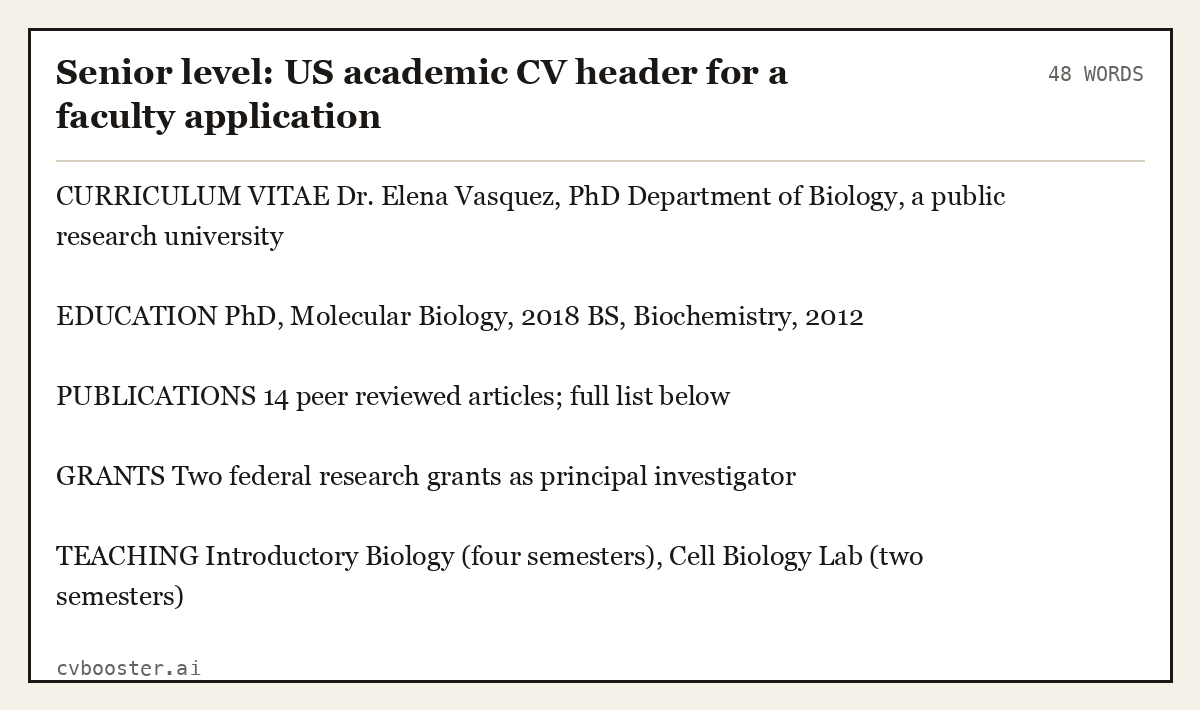
Senior level: US academic CV header for a faculty application (48 words)
CURRICULUM VITAE Dr. Elena Vasquez, PhD Department of Biology, a public research university
EDUCATION PhD, Molecular Biology, 2018 BS, Biochemistry, 2012
PUBLICATIONS 14 peer reviewed articles; full list below
GRANTS Two federal research grants as principal investigator
TEACHING Introductory Biology (four semesters), Cell Biology Lab (two semesters)
Bio, profile and summary: words for parts of a resume
Several words people use for a resume actually describe a smaller document or a section of one. Using them correctly matters, because an employer who asks for a bio does not want your full work history.
- Bio: a short paragraph in the third person, used on a company website, a conference program or a proposal. It describes who you are and what you are known for. It is not used to apply for jobs.
- Profile or summary: the opening section of a resume, three or four lines that state your role, experience and strengths. Our resume summary examples show how to write one for most jobs.
- Qualifications summary or highlights: a bullet list at the top of a resume, common for career changers. CareerOneStop notes that a "Professional Summary or Highlights of Qualifications section may be used to highlight relevant experience".
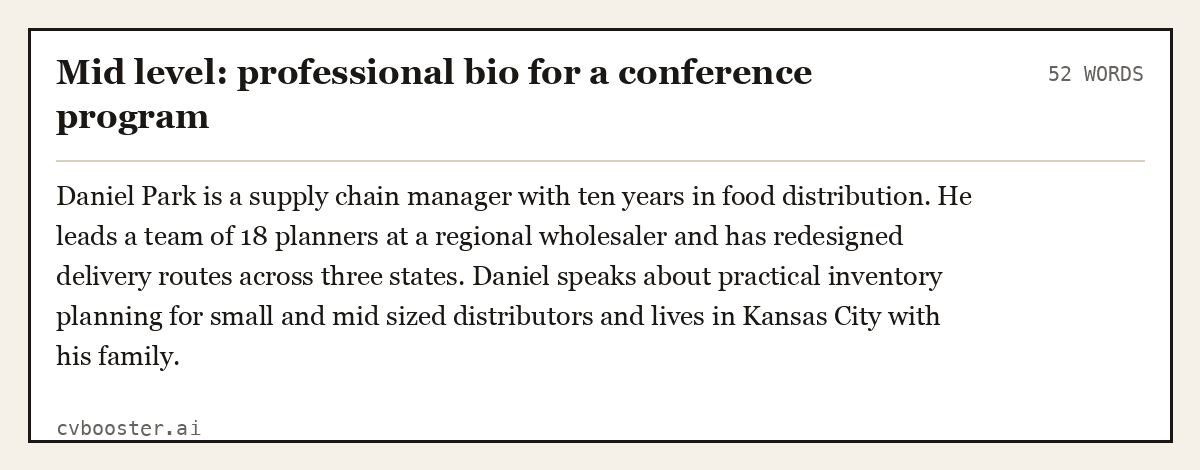
Mid level: professional bio for a conference program (52 words)
Daniel Park is a supply chain manager with ten years in food distribution. He leads a team of 18 planners at a regional wholesaler and has redesigned delivery routes across three states. Daniel speaks about practical inventory planning for small and mid sized distributors and lives in Kansas City with his family.
Notice the differences from a resume: third person, no dates, no bullet points, and a personal line at the end. A bio introduces you; a resume proves your experience.
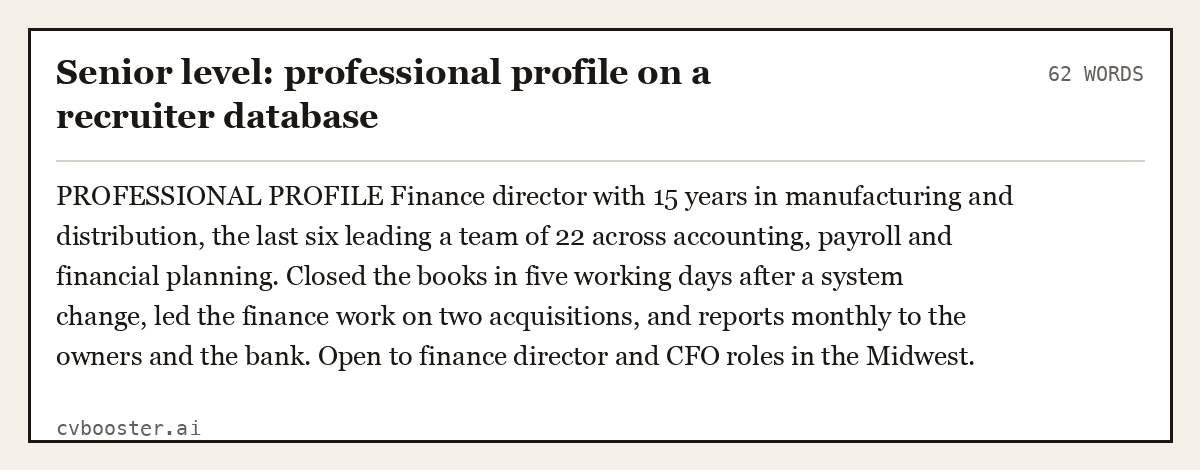
A professional profile sits between the two. It is the summary you write on a job site or a recruiter database, in the first person or with no pronoun at all, and it should read like the top of your resume.
Senior level: professional profile on a recruiter database (62 words)
PROFESSIONAL PROFILE Finance director with 15 years in manufacturing and distribution, the last six leading a team of 22 across accounting, payroll and financial planning. Closed the books in five working days after a system change, led the finance work on two acquisitions, and reports monthly to the owners and the bank. Open to finance director and CFO roles in the Midwest.
Employment record and work history on application forms
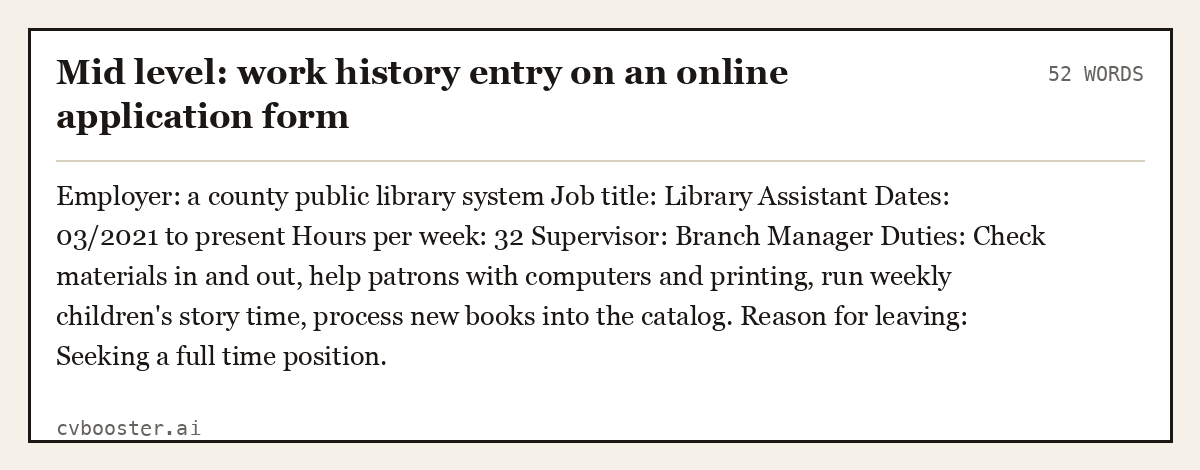
Government jobs, schools, hospitals and large employers often ask for a work history or an employment record inside an online form. That is not another word for resume in the sense of a document you upload. It is a structured list, and the form may ask for exact start and end dates, supervisor names, hours per week and reasons for leaving.
Keep your resume and the form consistent. CareerOneStop's resume guide advises: "Use the exact terms in your resume." The same principle applies to forms: copy job titles and dates exactly from your resume so the two never disagree.
Mid level: work history entry on an online application form (52 words)
Employer: a county public library system Job title: Library Assistant Dates: 03/2021 to present Hours per week: 32 Supervisor: Branch Manager Duties: Check materials in and out, help patrons with computers and printing, run weekly children's story time, process new books into the catalog. Reason for leaving: Seeking a full time position.
Another word for resume as a verb
Resume is also a verb with a completely different meaning and pronunciation. Cambridge's American dictionary defines it as "to start something again after a pause or period of time". If that is the word you need, these synonyms work:
- continue, carry on, proceed
- restart, start again, pick up again
- reopen, renew, take up again
- return to, get back to
Example: "The meeting will resume after lunch" can become "The meeting will continue after lunch." If you are looking for other words to use inside your resume, such as replacements for managed, helped or responsible for, that is a different list. Our guide to resume action verbs covers them by skill.
Which word should you use?
Match the word to the country and the employer. Use resume for US and Canadian companies, CV for jobs almost everywhere else and for US academic and research roles, and bio only when someone asks for a short introduction. When in doubt, mirror the posting: if it says "send your CV", name your file CV and call it a CV in your email, even if it is the same two pages you would call a resume in Chicago. The document is what gets you the interview; the word on top only has to match what the reader asked for.
Frequently asked questions
What is another word for resume?
The most common other word for resume is CV, short for curriculum vitae, used in the UK, Ireland, Europe, Australia and most other countries. Other words include résumé, professional profile, career summary and work history. A bio is related but different: a short third person introduction rather than a job application document.
Is a CV the same as a resume?
Outside North America, yes: a CV is the standard name for the one or two page document you send with a job application. In the US and Canada, a CV usually means a longer academic record with publications, research and teaching, used for university, medical and research positions, while a resume stays short.
What is a professional resume called?
It is still called a resume in the US and Canada and a CV in most other countries. Some people say professional profile, career summary or executive resume for senior roles. Recruiters care more about the content and format than the name, but using the word the employer used in the posting is safest.
What is a short resume called?
A short version of a resume can be called a one page resume, a career summary, a profile or, in some fields, a bio. A bio is written in the third person and used for websites and events. For job applications, a one page resume or a short CV is what employers expect.
What is another word for resume as a verb?
As a verb, resume means to start something again after a pause. Synonyms include continue, carry on, proceed, restart, pick up again, return to and take up again. For example, "Classes resume on Monday" can be written as "Classes start again on Monday" with the same meaning.
Related articles
- Accounting Executive Resume: 5 Examples by Career Level
- Administration Resume Examples: 8 Samples, Entry to Manager
- Apple Pages Resume Template: 6 Examples Built for ATS
- Bank Teller Job Description for a Resume: 7 Examples
More articles
- Application Letter Format in Word: UK Layout and 5 Letters
- Apprenticeship Cover Letter: 6 UK Examples for Every Level
Looking for a worked example for your job title? Browse the resume examples by job title.