Resume Spelling: The Errors Spellcheck Misses
By Mustafa Tarabya, founder of CVBooster · Published · Updated
11 min read
Your spellchecker will pass every error that happens to be a real word, and most resume errors are real words. "Form" for "from". "Manger" for "manager". A previous employer's name left in the summary. Nothing is underlined, so nothing gets fixed.
The second problem is that you cannot see your own document any more. You have read it so many times that you are reading the version in your head rather than the one on the page. Both problems have practical fixes, and neither of them is reading it again.
What errors does spellcheck miss?
Everything that is correctly spelled and wrong. These are the categories worth hunting deliberately, because no tool will raise its hand.
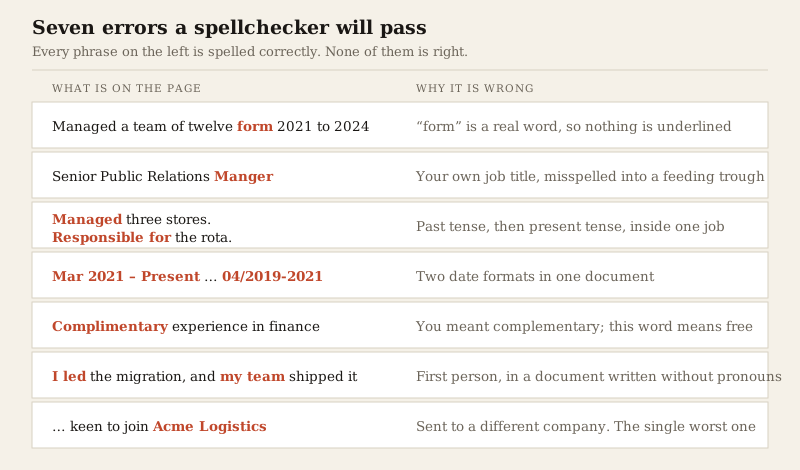
- Real-word typos: form and from, manger and manager, pubic and public, casual and causal, trial and trail, defiantly and definitely.
- Confusable pairs: complementary and complimentary, principal and principle, discreet and discrete, affect and effect, its and it's, their and there.
- Your own job titles and employer names. These are the words a spellchecker has no opinion about and the ones a reader notices instantly.
- Product and system names with internal capitals: PostgreSQL, JavaScript, GitHub, SharePoint, MySQL. Getting these wrong signals you have not used them.
- Numbers. A team of 12 in one line and a team of 21 in another, a job that ends before it starts, a percentage that does not match the one in your cover letter.
- Leftovers from the last application: the previous company's name, a job title you are no longer applying for, a sentence you meant to rewrite.
Tip: Search the document for the name of every company you have applied to recently. It takes ten seconds and it catches the one error that ends an application on the spot.
How do you keep tense consistent?
One rule covers it. Past roles are written in the past tense throughout. Your current role is written in the present tense for things you still do, and the past tense for finished projects inside it. Our resume tense guide shows six complete examples, including freelance work and ongoing projects.
So a former job reads "Managed a team of twelve" and "Rebuilt the inbound schedule". Your current job reads "Manage a team of twelve" alongside "Rebuilt the inbound schedule in 2024", because the managing continues and the rebuilding finished.
The failure is almost always mid-job drift: the first two bullets are in the past, then a bullet beginning "Responsible for" appears and the tense quietly changes. Read each job's bullets as a block and check that the verbs agree with each other before you check anything else.
Tip: "Responsible for" is the phrase that causes most of the drift, and it is weak on its own terms. Replace it with the verb that describes what you actually did, and the tense problem disappears with it.
Should a resume use "I"?
The convention is to drop the pronoun and start bullets with a verb: "Led the migration", not "I led the migration". It is terser and it puts the verb where the eye lands.
What matters more than which convention you pick is that you pick one. A document that drops pronouns for eleven bullets and then says "I was responsible for" in the twelfth reads as two people wrote it. The same applies to a summary written in the third person — "Sarah is a logistics coordinator who" — sitting above bullets written in the first.
Pick verb-first for the bullets and first person without pronouns for the summary, and apply it to every line.
How should dates be formatted?
Identically, everywhere, including in education and certifications. Pick one of these and use nothing else:
- Mar 2021 – Present, with three-letter months and an en dash.
- March 2021 – Present, with months written out.
- 03/2021 – Present, numeric, only if you are consistent about it.
- 2021 – 2024, years only, which is acceptable if you use it for every single entry.
The mixed document is the problem. One role dated to the month and another dated to the year invites the reader to wonder what the vaguer one is hiding, even when the answer is nothing. Use the same separator throughout — a hyphen or an en dash, not both — and the same word for the present: "Present" or "Current", chosen once.
Numeric dates carry an extra trap when you apply across borders. 04/06/2024 is April in the United States and June almost everywhere else. Three-letter months remove the ambiguity for the cost of one character.
US or UK spelling?
Match the employer's country. Organised, programme, centre, analyse and licence for a UK employer; organized, program, center, analyze and license for a US one. Set your word processor's language to match before you start, or it will helpfully underline the correct version all afternoon.
Then check for the half-converted document, which is the common failure when you reuse a resume across markets. "Organised the centre's programme analysis" has three British spellings and one American one, and the mixture is more visible than either standard would have been.
Proper nouns keep their own spelling regardless. If you worked for the Ohio Department of Labor, it is Labor, even in a British application.
How do you proofread something you have read forty times?
You change the conditions until it stops looking familiar. Each of these breaks the pattern in a different way, and they work best used in combination.
- Read it aloud, slowly, at full volume. Your mouth stops at things your eye skips, especially missing words and clauses that never finish.
- Read it backwards, last bullet to first. This removes the narrative that lets your brain autocomplete the next line.
- Change the font and the size, then read it again. A document in a different typeface is a document you have not seen before.
- Print it. Errors that are invisible on a screen are visible on paper, and you also get a free check on where the page break falls.
- Have your computer read it to you. Every operating system has a built-in speech function, and hearing your own bullets in a flat synthetic voice exposes both typos and padding.
- Sleep on it. A gap of a day does more than another hour tonight will.
- Give it to one other person and ask them to look for errors, not to give feedback on the content. Those are different jobs and people default to the second.
Why you cannot see your own errors
There is nothing mysterious about it. You wrote the sentence, so you already know what it says. Reading it again is not checking, it is confirming, and confirmation is fast and shallow. You are matching the shape of the line against the version stored in your head, and when the shapes match you move on.
That is why every technique that works is a technique for making the document unfamiliar. Reading aloud forces you through every word at speaking speed. Reading backwards removes the narrative that lets you predict the next line. Changing the font changes the shape of every line, so the shapes no longer match the stored version. A day away lets the stored version fade.
It also explains why the errors that survive longest are in the places you look at most: your own name in the file name, your job titles, the summary you rewrote nine times. Familiarity is the problem, so the most familiar text is the least checked.
A worked proofread
Here is one invented experience entry, written the way people actually write them. Everything in it is an example. There are eight errors and a spellchecker flags none of them.
Before: "Senior Public Relations Manger — Northgate Retail Group, Leeds, 03/2019-Present. I was responsible for the press office and manage a team of 8. Organised the annual conference for 400 attendees form 2019 to 2023. Led a rebrand that generated significant press coverage and complimentary skills across the marketing team. Responsible for crisis comms. Reduced agency spend by 30% while increasing coverage by 30%. Keen to bring this experience to Acme Retail."
The eight, in order. "Manger" is a real word and it is her own job title. "03/2019-Present" is a numeric format that will not match the rest of the document. "I was responsible for" introduces a pronoun into a verb-first document, and pairs a past tense with "manage" in the present, inside one sentence. "form" should be "from". "significant press coverage" is a claim with nothing behind it. "complimentary" should be "complementary", and the sentence does not survive the substitution anyway. "Responsible for crisis comms" is a fragment with no verb and an abbreviation. The two identical thirty per cent figures are suspicious as a pair, and unless she can source both, neither should be there. And the last sentence names a different company from the one receiving the file.
After: "Senior Public Relations Manager — Northgate Retail Group, Leeds. Mar 2019 – Present. Run the press office and manage a team of eight. Organised the annual conference for 400 attendees from 2019 to 2023. Led the 2022 rebrand, coordinating messaging across marketing, retail and customer service. Own crisis communications, including the media response to the 2021 distribution failure. Renegotiated the agency retainer at the 2023 renewal."
The job title is correct. Dates match one format. The tense is present for continuing responsibilities and past for finished work, with no pronouns. The vague claims are gone and specifics have taken their place, and the two unverifiable percentages have been replaced with something checkable. The other company's name is out.
Tip: If you cannot source a number, delete it rather than softening it. A specific unverifiable figure is worse than the concrete detail you could have written instead, and it is the thing an interviewer will pick to ask about.
Proofreading a resume you tailor every time
If you tailor for each application, you are not proofreading one document. You are proofreading a base document once and then checking a small set of changes twenty times, and confusing those two jobs is where the embarrassing errors come from.
Split the work. Proofread the base version properly, using everything above, and then leave it alone. Anything you change afterwards changes in the copy, not in the base.
For each application, run a short delta check on only the parts that moved.
- The company name, everywhere it appears, including the summary, the title line and the file name.
- The job title you are targeting, in the header and in the summary.
- Any bullet you reordered — check that the tense still agrees with its neighbours after the move.
- Any keyword you swapped in from the ad, checked for the industry's own capitalisation.
- The file name itself, which is the field people forget and the one the recruiter sees first in their inbox.
- The covering email, which is the least proofread text in the entire application.
Tip: Keep the base document in one place and never send it. Every application is an export from it. The moment you start editing whichever copy is nearest, you have several slightly different resumes and no idea which one is correct.
The mechanical pass
Separately from reading, run a pass that is purely visual and ignores meaning entirely. Look only at shapes and alignment.
- Every bullet uses the same character and the same indent.
- Every job title is styled the same way, and so is every employer, every location and every date range.
- Punctuation at the end of bullets is consistent: full stops on all of them or none of them.
- Only one space after a full stop, throughout.
- No stray double spaces mid-line, no empty bullets, no orphaned punctuation left from an edit.
- Capitalisation of section headings matches: all of them in title case, or all of them in sentence case.
- Hyperlinks are not blue and underlined in a document that is otherwise black text.
Tip: Turn on your word processor's paragraph marks for one minute. Every stray tab, double space and empty paragraph becomes visible at once, and most of them are left over from an edit you made months ago.
The last five minutes before you send it
- The company name in the document is the company you are sending it to.
- Your own name, job titles and employers are spelled correctly.
- Every tense inside a single job agrees with itself.
- Every date in the document uses one format.
- The spelling standard matches the employer's country, all the way through.
- Your email address is correct — read it character by character, out loud.
- The file is named with your name and the role, and it opens correctly on a device that is not yours. If you wrote it on a phone, the guide on how to do a resume on your phone covers the export step where layouts usually break.
Proofreading is unglamorous and it is the cheapest improvement available to any application. Once the text is clean, the remaining question is whether the document is built in a shape that survives being read by software, which is what ATS resumes in 2026 covers.
Related articles
- Bad Resume Examples: 10 Mistakes and the Fixed Version
- Accounting Executive Resume: 5 Examples by Career Level
- Administration Resume Examples: 8 Samples, Entry to Manager
- Aged Care Resume: 6 Australian Examples and a Template
More articles
- Resume Review: The Order to Check Things In
- How to List Skills on a Resume (With 50+ Examples)
- Resume Skills Section: Layout and Placement
Looking for a worked example for your job title? Browse the resume examples by job title.