Job Offer Letter: What to Check Before Signing
By Mustafa Tarabya, founder of CVBooster · Published · Updated
13 min read
A job offer letter is the employer's written statement of what they are offering you: the role, the money, the start date, and the conditions the offer depends on. It arrives after the decision and before the paperwork, and it is the last moment at which anything is easy to change.
One thing before anything else. This article is written for candidates and it is not legal advice. What an offer letter must contain, whether it is itself a contract, and which of its clauses are enforceable all depend on where you are working — sometimes on which country, sometimes on which state or province. Where a specific rule is quoted below, its source is named. Everything else is described as common practice, because that is what it is.
What does a job offer letter contain?
In most markets a full offer letter covers the following. If yours is missing several of them, that is information about the employer as much as about the offer.
- The job title, and who you report to. Both, not just the first.
- Employment type and hours: permanent or fixed-term, full or part-time, weekly hours, and where the work happens.
- The start date, as an actual date.
- Base pay as a number, with the period it covers and how often it is paid.
- Variable pay: bonus, commission or profit share, with how it is calculated and whether it is discretionary.
- Benefits: pension or retirement contributions, health cover, holiday entitlement, sick pay, anything else of value.
- Probation, if there is one, with its length and what changes at the end of it.
- Notice periods, in both directions.
- Conditions the offer depends on — references, right-to-work or visa checks, background or credit checks, medical or qualification checks.
- A date by which they would like an answer, and what you should sign or return.
In the United Kingdom, the law puts a floor under most of that list, though it does so through a different document. Section 1 of the Employment Rights Act 1996 requires an employer to give a worker a written statement of particulars of employment "not later than the beginning of the employment", and requires that statement to cover, among other things, the scale or rate of remuneration and how it is calculated, the intervals at which it is paid, terms about working hours, holidays and holiday pay, sickness and sick pay, pensions, and the length of notice. That is a statutory requirement on the employer, not a favour. Other countries have their own equivalents, and some have none.
Is an offer letter the same as an employment contract?
Not necessarily, and the honest answer is that it depends on where you are and on what the letter itself says. In some places the offer letter is the contract. In others it is a summary that a separate contract will supersede. In the United States it is common for an offer letter to state explicitly that it is not a contract and that employment is at will.
At-will employment is worth understanding precisely rather than vaguely, because it is the assumption most American offer letters are built on and it is not universal even within the United States. California's Labor Code section 2922 states: "An employment, having no specified term, may be terminated at the will of either party on notice to the other." Montana is the well-known exception. Under Montana Code Annotated section 39-2-904, a discharge is wrongful if, among other grounds, "the discharge was not for good cause and the employee had completed the employer's probationary period of employment" — with the same section providing that during a probationary period employment may be terminated at will by either party.
Two neighbouring states, two different defaults. That is the entire reason this page will not tell you what your notice rights are. Read your own letter, and if something significant turns on the answer, ask someone qualified in your jurisdiction.
There is one more clause in that family worth knowing about. Many American offer letters state a job title alongside a classification as exempt or non-exempt from overtime. A title on its own does not settle that question. The federal regulation is unusually blunt: 29 CFR 541.2, headed "Job titles insufficient", says "A job title alone is insufficient to establish the exempt status of an employee. The exempt or nonexempt status of any particular employee must be determined on the basis of whether the employee's salary and duties meet the requirements of the regulations in this part." If you are being offered a manager title with a schedule that looks like overtime, that is a question worth asking out loud before you sign.
What is missing when an offer letter is vague?
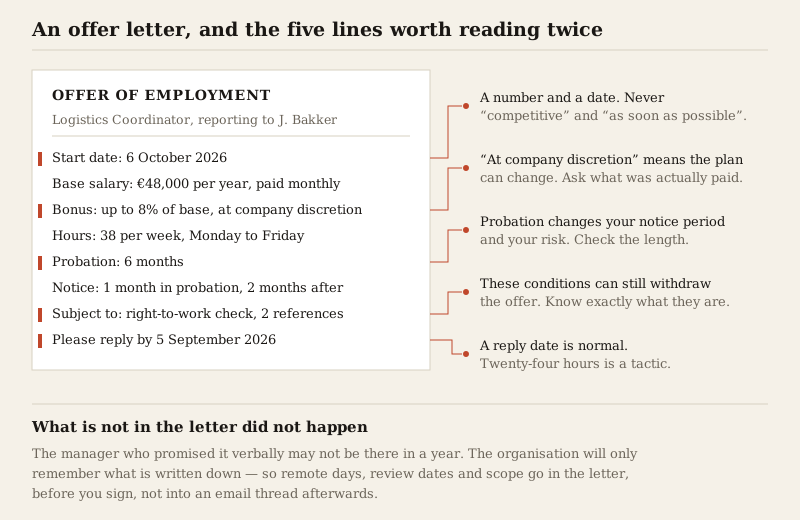
A vague offer is not usually a trap. Most often it is a template that has not been updated, or a small employer who has never had to write one carefully. But vagueness has a cost regardless of intent, and the cost falls on you, because the person who promised you something in an interview may not be at the company in a year and the organisation will only remember what is written down.
- Pay expressed as a range, a target, or "competitive". A range is a stage in a negotiation, not an offer. Ask for the number.
- Pay expressed only as on-target earnings. OTE is base plus what happens if everything goes well. The number that pays your rent is the base, so ask for both, and ask what the median person on the team actually earned last year.
- A bonus that is "discretionary" with nothing else said. Discretionary is a legitimate and normal arrangement, but it means the amount and the existence are both decisions somebody else makes. Ask what was paid in each of the last two years.
- Equity with no share count, no strike price, no total shares outstanding, and no vesting schedule. A percentage without a denominator is not information.
- A start date given as "to be confirmed". Your resignation timing depends on it. If you are leaving your current job to retire rather than to move, the retirement resignation letter samples show how much notice to plan for.
- Remote or hybrid arrangements agreed verbally and absent from the letter. This is the single most common gap since working patterns became negotiable, and the one that most often changes after a manager does.
- A title in the letter that is not the title you interviewed for.
- No probation clause in a market where probation is standard, or a probation clause with no stated length.
- No mention at all of the conditions the offer depends on, in a role that obviously requires a check.
Tip: There is a polite, low-friction sentence that fixes almost all of this: "Before I sign, could you confirm a couple of things in writing so we have them in one place?" Nobody reasonable objects, and an employer who does object has told you something useful.
What is negotiable after the offer arrives?
More than people expect, but not everything, and the mechanism explains which is which. An employer approves headcount in advance with a band attached, and how far a hiring manager can move inside that band without going back for another approval is the real constraint you are negotiating against. Things that cost nothing outside the band move easily. Things that break precedent for a whole team move hardly at all.
- Base salary. Usually the first thing people ask about and often the hardest, because it is the thing the band was drawn around. Still worth asking once, with a reason.
- Start date. Almost always movable, costs nothing, and is the easiest thing to get.
- A signing bonus. Often easier than base, because it is a one-off that does not raise the floor of the salary band permanently.
- Title. Sometimes free, sometimes impossible, depending entirely on whether the company uses levelled titles tied to pay.
- Holiday allowance and remote days. Frequently policy-wide, and therefore harder than they look — but worth asking, because if the answer is no it is a fast no.
- The date of your first review. An underrated ask. Six months instead of twelve moves a pay conversation forward by half a year and costs the employer nothing today.
- Relocation support, a training budget, professional membership fees, equipment. Small line items that are often approved by a different budget entirely.
- Removing or narrowing a restrictive clause. Rarely offered, sometimes granted, and always worth raising before signing rather than after.
One negotiation, written out. Everything in it is an example.
"Dear Joost, thank you — I am glad to have the offer and I want to accept. Before I do, could we look at two things? On base salary, the offer is €48,000. Based on what the role covers — running the customs declarations in-house rather than through a broker — I was hoping for €52,000, and I would be comfortable at €51,000. If the band does not allow that, I understand, and a review at six months rather than twelve would go a long way instead. Second, we discussed two days a week from home and I could not see it in the letter. Could that be added, so it survives a change of manager? Everything else looks right to me and I am ready to sign as soon as those are settled. Best regards, Sarah"
Four things make that work. It says yes first, so the employer is not negotiating against the risk of losing you. It gives a reason tied to the job rather than to her rent. It names a fallback that costs them nothing, which gives a manager who cannot move on base a way to say yes to something. And it puts the remote-days request in writing for the reason that actually matters, which is continuity rather than trust. How to negotiate salary goes into the money side in more depth.
What should you check before signing?
Read it twice: once for what it gives you, once for what it lets them do. The second read is the one people skip.
- Contingencies. Which checks the offer depends on, and what happens if one comes back with something on it. If you have anything in your history that a background check will surface, it is better handled now than after you have resigned.
- Restrictive covenants. Non-compete, non-solicitation and non-dealing clauses. How enforceable these are varies enormously between countries and between US states, and the answer changes, so treat the clause as real until you have checked your own jurisdiction rather than assuming it is unenforceable boilerplate.
- Intellectual property assignment. Standard in most employment, but read what it covers — some clauses reach anything you create during the employment, including on your own time, and some jurisdictions limit that.
- Repayment or clawback clauses. Relocation costs, signing bonuses, training and certification fees are commonly repayable if you leave within a stated period. Find out the period and the amount.
- Notice, in both directions. In particular, whether it changes at the end of probation.
- Whether the letter says it supersedes prior discussions. If it does, anything promised verbally and not written down has just stopped existing.
- The expiry date on the offer itself.
- Whether the pay figure is gross or net, and which currency, if you are moving country.
And one non-legal check that matters as much: does the letter describe the job you interviewed for? A title, a reporting line or a scope that has quietly shifted between the final interview and the letter is worth a phone call before it is worth a signature.
How should you reply to an offer?
Acknowledge the same day, decide later. Those are two separate messages and people collapse them into one under pressure.
The acknowledgement: "Thank you — this is good news and I am glad to have it. Could I take until Friday to read it properly? I have one or two questions I will send in one go rather than in pieces." A few days is normal in almost every market. If the answer is that you must decide within twenty-four hours, that is a piece of information about how the company operates, and it is worth weighing alongside the salary.
The acceptance, once everything is settled: "Dear Joost, thank you for the revised letter. I am pleased to accept the role of Logistics Coordinator at a base salary of €51,000, starting on 6 October 2026, with two days a week from home as set out in the letter. I have signed and attached it. I will confirm my resignation this week and let you know immediately if my notice period changes anything. I am looking forward to starting. Best regards, Sarah Okonkwo"
Restating the terms in your own acceptance is not pedantry. It creates a written record that both sides have agreed the same thing, and it catches the occasional honest error before it becomes an argument in month three.
The decline, which deserves as much care: "Dear Joost, thank you for the offer, and for how straightforward the whole process was. After thinking it through I am going to decline — I have accepted another role that is closer to the customs side of the work. I am sorry to say no after the time your team gave me, and I would be glad to stay in touch. Best regards, Sarah Okonkwo"
Short, decided, and without a fabricated reason. Industries are small, and the person you decline this year is sometimes the person hiring for the job you want in four.
One last thing about pressure
The period between an offer and a signature is the only moment in the whole process where you hold more of the position than the employer does. They have run a search, spent weeks of interview time and chosen. Every question you ask is cheaper for them to answer than starting again.
That does not mean pushing hard. It means asking clearly, in writing, once, and then deciding. And it means not resigning from your current job until you hold a signed letter with every contingency cleared, because a withdrawn offer after a resignation is the one genuinely bad outcome available in this whole sequence.
If you are still earlier in the process than this, how to prepare for an interview and questions to ask in an interview cover the stage where most of these terms are actually decided — because what you learn in the final interview is what tells you whether the letter, when it arrives, says what it should.
Related articles
- Letter of Introduction for a Job: When to Send One
- Skills to Put on a Job Application Form
- Top 10 Job Search Strategies: the ones that get replies
- Professional Resume Writing Services: Worth Paying?
More articles
- Job Resume Title: How to Write It, With 12 Examples
- Jobscan Alternatives for UK and Public Sector Applications
Looking for a worked example for your job title? Browse the resume examples by job title.